
The Protein Threshold That Determines Whether TRT Builds Muscle or Just Maintains It
Published on:
Updated on:
People are asking...
Would a person that has low test and takes trt build more or less muscle than an average person that doesn’t take anything?...
They would generally build the same amount of muscle, assuming that "average person" was not also a low Testosterone individual. This is because the primary goal of TRT is to get you back to where you... See Full Answer
Fitness question: Many men think about starting TRT with their natural T levels in the 200-400 range. How much improvement in the gym would such patie...
In general, men who have levels in those ranges & who are experiencing low Testosterone symptoms will already have difficulty putting on muscle mass, maintaining it, and keeping fat off due to those f... See Full Answer
I’m on top of macros and lifting heavy. History of losing body fat and keeping it off. Disciplined. Etc. I have rocked pretty large deficits for mo...
Yes. While on TRT, you are more likely to preserve muscle while in a caloric deficit. In fact, it is still potentially possible to gain some muscle in a slight caloric deficit if your testosterone rem... See Full Answer
Have a question? Ask us.
At AlphaMD, we're here to help. Feel free to ask us any question you would like about TRT, medical weightloss, ED, or other topics related to men's health. Or take a moment to browse through our past questions.
Most men on testosterone replacement therapy expect the muscle gains to follow almost automatically. The reality is more nuanced, and the difference between building new tissue and simply maintaining what you already have often comes down to one variable: how much usable protein you are consistently eating.
Why Testosterone Alone Is Not a Muscle-Building Plan
Testosterone plays a genuine and well-documented role in muscle protein synthesis, the biological process through which your body repairs and adds to muscle fibers. When levels are restored to a healthy physiological range through TRT, many men do notice improvements in body composition, strength, and recovery capacity. That is real, and it matters.
But hormonal optimization is better understood as removing a ceiling, not as a construction crew. It creates more favorable conditions for muscle adaptation. It does not bypass the fundamental requirement that your muscles need both a mechanical stimulus - resistance training - and an adequate supply of amino acids to actually build new tissue. Without those two inputs, restored testosterone levels will more likely help you maintain the muscle you have rather than accumulate more of it.
This distinction between maintenance and hypertrophy is critical, and it is where the concept of a protein threshold becomes practically important.
What the Protein Threshold Actually Means
The protein threshold is not a single magic number that applies to every man on the planet. It refers to the minimum daily protein intake, and the quality of that protein, needed for muscle protein synthesis to consistently outpace muscle protein breakdown, particularly when combined with regular resistance training.
Below this threshold, your body may be in a state of net protein breakdown even if you are training hard. You are essentially spending more than you are depositing. Above it, especially with progressive training and adequate total calories, the balance tips toward growth and repair.
Where that threshold sits for you personally depends on several intersecting variables, and understanding them is more useful than chasing a single number.
The Variables That Move the Target
Body size is an obvious starting point. Larger men with more lean mass require more total protein to support that tissue, both at rest and under the added demands of training. But body size is only part of the picture.
Training status matters significantly. Beginners tend to respond strongly to even modest protein intakes because the body is highly sensitive to new training stimuli. More experienced lifters, who have already captured a lot of their genetic potential, typically need more precise and consistent protein intake to continue making progress. The gains get harder to come by and the inputs need to be tighter.
Age shifts the equation in a meaningful way. Older men, particularly those in their forties, fifties, and beyond, experience a phenomenon sometimes called anabolic resistance, where the muscle protein synthesis response to both protein intake and exercise becomes blunted. This means that the same protein intake that was sufficient at thirty may fall short at fifty. TRT may partially address the hormonal side of anabolic resistance, but protein intake still needs to rise to meet the changed physiology.
Total calorie intake sets the broader context. A man eating at a significant caloric deficit is fighting an uphill battle even with excellent protein intake and TRT, because the body under energy stress will prioritize survival functions over muscle building. Caloric maintenance or a modest surplus creates the metabolic environment where protein can do its job most effectively for hypertrophy. For recomposition - building muscle while losing fat simultaneously - the margin is tighter, and protein quality and distribution become even more important.
How protein is distributed across the day also influences outcomes. Spreading intake across several meals, rather than concentrating it in one large meal, appears to support more sustained muscle protein synthesis throughout the day. Each protein-containing meal acts as a stimulus. One enormous serving does not simply stack on top of another the way calories might.
Protein Quality and the Leucine Factor
Not all protein sources are created equal for muscle-building purposes, and this is one of the most persistent misconceptions in the nutrition space. The amino acid leucine functions as a key trigger for muscle protein synthesis. Foods that are leucine-rich and contain the full spectrum of essential amino acids tend to produce a stronger anabolic signal per gram than lower-quality sources.
Animal proteins - eggs, dairy, poultry, beef, fish - are generally high in leucine and complete in their amino acid profiles. Many plant proteins are lower in leucine and may be incomplete, meaning they lack sufficient quantities of one or more essential amino acids. This does not make plant protein useless, but it does mean that men relying primarily on plant sources may need to be more deliberate about variety and total intake to hit the same functional threshold.
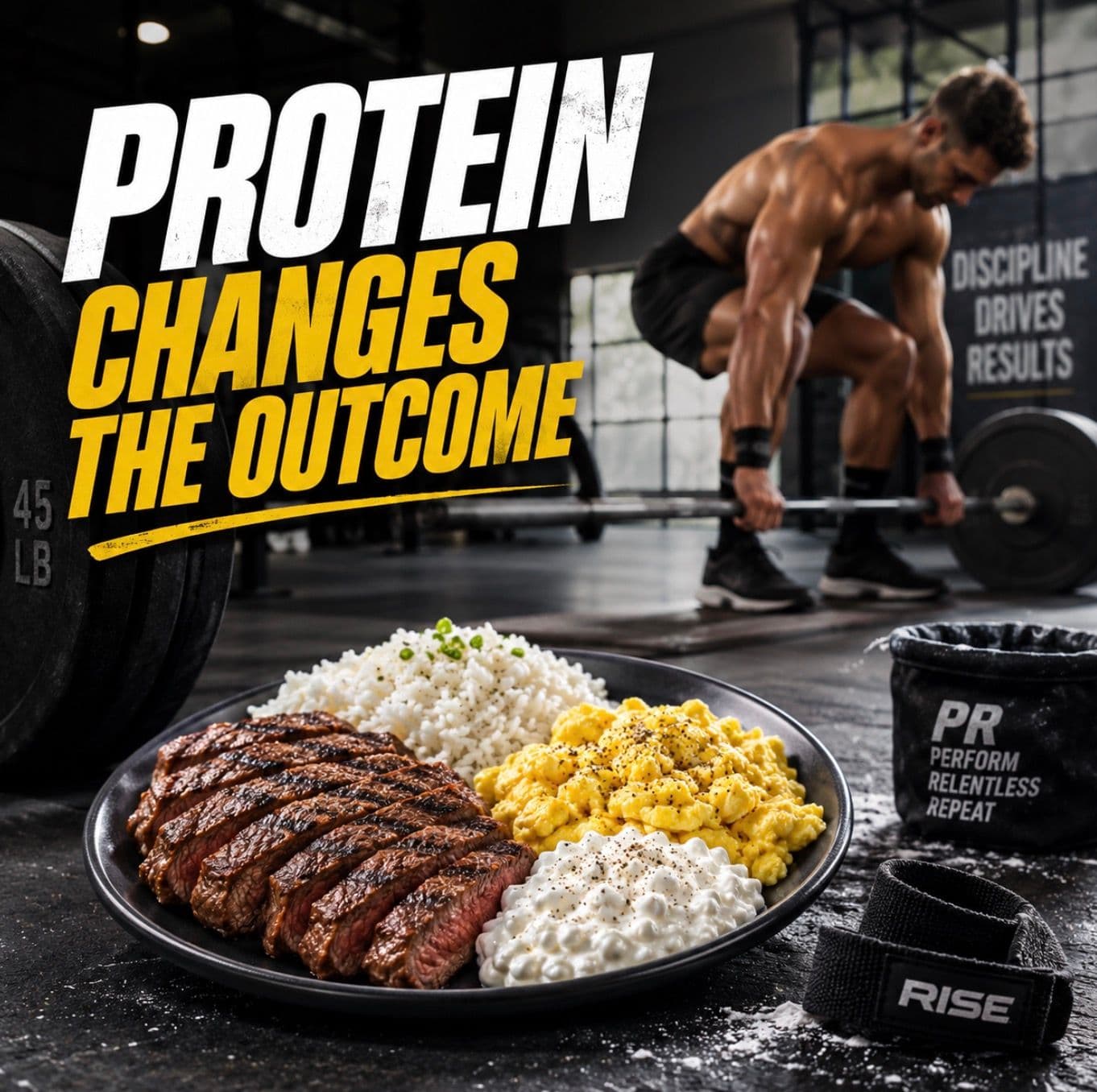
The practical implication: a meal built around eggs, Greek yogurt, cottage cheese, or a lean meat is a more efficient protein stimulus than the same caloric value from rice or bread, even if both are labeled as containing protein.
How TRT Changes Nutrient Partitioning, But Not the Rules
One of the more interesting effects of testosterone at healthy physiological levels is improved nutrient partitioning, meaning that a greater proportion of the calories and protein you consume gets directed toward muscle repair and growth rather than fat storage. This is part of why men with optimized hormone levels often notice favorable shifts in body composition even without dramatic changes to diet or training.
But nutrient partitioning is a multiplier, not a replacement. If you are partitioning a protein intake that is already below your threshold, you are efficiently directing an insufficient resource. TRT amplifies what you give it. If what you are giving it is inadequate, the amplification of an inadequate input is still inadequate.
Recovery and sleep are tightly connected here as well. Testosterone supports overnight recovery and the anabolic processes that happen during deep sleep. But those processes still require circulating amino acids. A man sleeping well on TRT but consistently under-eating protein is still leaving adaptation on the table.
Recognizing When Your Intake Is Likely Below the Threshold
There are practical signals that suggest protein intake may not be meeting the demands of your training and hormonal status. Strength progress that stalls or moves inconsistently despite regular training is one of the clearer indicators. Feeling unrecovered between sessions, particularly muscle soreness that persists longer than expected, can also reflect inadequate protein repair. Losing weight unintentionally while training, especially when you are not trying to cut, is a signal worth paying attention to.
Satiety is an indirect but useful marker. Protein is the most satiating macronutrient, and men who are eating meaningful amounts of it across the day tend to feel fuller and more stable between meals. Persistent hunger and energy fluctuations may suggest overall intake is too low, including protein.
These are not diagnostic criteria. They are prompts for honest self-assessment and, where relevant, conversation with a clinician.
Practical Food-First Strategies
Building toward an adequate protein intake does not require obsessive tracking to be effective. Anchoring each main meal around a high-quality protein source, rather than treating protein as an afterthought, is a practical starting point. Think of a palm-sized serving of meat, fish, eggs, or dairy as the structural center of breakfast, lunch, and dinner, with additional protein from snacks if needed.
Breakfast in particular tends to be where men undereat protein. A meal of eggs, Greek yogurt, or cottage cheese sets up the day's amino acid availability very differently than toast or cereal alone. Lunch and dinner built around complete proteins, with carbohydrates and fats filling the remaining caloric space, creates a distribution pattern that supports sustained muscle protein synthesis across the day.
For men who train in the evening, a protein-containing meal or snack post-workout supports overnight recovery. For morning trainers, making sure the pre- and post-workout window includes quality protein sources is similarly useful.
Maintenance, Recomposition, and Growth Are Not the Same Goal
This point deserves explicit attention because conflating these three states leads to confusion about what is actually achievable and at what protein intake.
Maintaining existing muscle mass requires a lower protein threshold than building new tissue. A man on TRT who eats a moderately protein-adequate diet and trains sporadically may hold onto his current muscle well and look reasonably lean. But he is not building. He is preserving.
Active hypertrophy - measurable increases in muscle cross-sectional area - requires consistent training that progressively challenges the muscle, a sustained protein intake above the maintenance threshold, and enough total energy to support the building process. TRT supports each of these inputs, but does not substitute for them.
Recomposition, which sits between the two, is possible but slower. It requires careful management of both protein and total calories, and tends to work best for men who are relatively new to training, returning after a break, or in a specific metabolic context where fat loss and muscle retention can happen simultaneously.
Working With a Clinician Who Understands the Whole Picture
TRT is not a decision to make casually or manage without proper oversight. Regular lab monitoring, individualized dosing, and ongoing evaluation of how your body is responding are not optional extras. They are the difference between therapy that supports your health long-term and an approach that creates new problems while solving old ones.
Providers on the AlphaMD platform approach hormone optimization with this kind of individualized framework, recognizing that TRT outcomes are shaped by the full picture of a man's lifestyle, including nutrition, training, sleep, and recovery, not just the hormonal intervention itself. That integrated perspective is what separates genuine optimization from simply prescribing without context.
What TRT can genuinely do is meaningful: improve energy, support recovery, enhance the body's ability to respond to training, and create conditions where consistent effort produces consistent results. What it cannot do is manufacture muscle from insufficient raw materials.
If you are on TRT and not seeing the physical changes you expected, the first honest question to ask is not whether your protocol needs adjustment. It is whether your protein intake and training are actually giving the hormonal environment something to work with. The threshold exists. Meeting it consistently is what turns hormonal support into visible, measurable progress.
Have a question? Ask us.
At AlphaMD, we're here to help. Feel free to ask us any question you would like about TRT, medical weightloss, ED, or other topics related to men's health. Or take a moment to browse through our past questions.
People are asking...
Would a person that has low test and takes trt build more or less muscle than an average person that doesn’t take anything?...
They would generally build the same amount of muscle, assuming that "average person" was not also a low Testosterone individual. This is because the primary goal of TRT is to get you back to where you... See Full Answer
Fitness question: Many men think about starting TRT with their natural T levels in the 200-400 range. How much improvement in the gym would such patie...
In general, men who have levels in those ranges & who are experiencing low Testosterone symptoms will already have difficulty putting on muscle mass, maintaining it, and keeping fat off due to those f... See Full Answer
I’m on top of macros and lifting heavy. History of losing body fat and keeping it off. Disciplined. Etc. I have rocked pretty large deficits for mo...
Yes. While on TRT, you are more likely to preserve muscle while in a caloric deficit. In fact, it is still potentially possible to gain some muscle in a slight caloric deficit if your testosterone rem... See Full Answer
Get $30 off your first month’s order
Enter your email address now to receive $30 off your first month’s cost, other discounts, and additional information about TRT.
Legal Disclaimer
This website is a repository of publicly available information and is not intended to form a physician-patient relationship with any individual. The content of this website is for informational purposes only. The information presented on this website is not intended to take the place of your personal physician's advice and is not intended to diagnose, treat, cure, or prevent any disease. Discuss this information with your own physician or healthcare provider to determine what is right for you. All information is intended for your general knowledge only and is not a substitute for medical advice or treatment for specific medical conditions. The information contained herein is presented in summary form only and intended to provide broad consumer understanding and knowledge. The information should not be considered complete and should not be used in place of a visit, phone or telemedicine call, consultation or advice of your physician or other healthcare provider. Only a qualified physician in your state can determine if you qualify for and should undertake treatment.