
Sermorelin + TRT: The Combination Protocol Rationale That Most Providers Don't Explain Clearly
Published on:
Updated on:
People are asking...
Is there any reason to use Testosterone Cypionate and Enclomiphene concurrently?...
There are two negative feedback loops on LH release, estrogen and testosterone. So having normal or high levels of estrogen will shut down GnRH (gonadotropin releasing hormone) from the hypothalamus a... See Full Answer
Do you have a protocol for someone wanting to come off after a couple years?...
There is no "one answer fits all" to this question, as so much about starting TRT as well as coming off of a medication, has to do with the individual's goals of care. Analyzing each patient's regime... See Full Answer
Yeah i feel like that would work much better 140-160 split up twice weekly something like that. Do you guys only prescribe testosterone or can you als...
Providers on the AlphaMD platform also prescribe some peptides like GLP-1s & Sermorelin when appropriate. Many patients add on a few ancillary medications once their TRT is dialed in.... See Full Answer
Have a question? Ask us.
At AlphaMD, we're here to help. Feel free to ask us any question you would like about TRT, medical weightloss, ED, or other topics related to men's health. Or take a moment to browse through our past questions.
Most men on testosterone replacement therapy are only getting half the story. The other half, the part about why growth hormone signaling deteriorates alongside testosterone and what that means for your recovery, sleep, and body composition, rarely gets explained in a way that makes sense.
This article is about that gap. It covers why some forward-thinking clinicians combine TRT with sermorelin, what the physiological rationale actually is, what the misconceptions are that lead men astray, and how to think about this kind of protocol without falling for hype.
What TRT and Sermorelin Actually Are
Testosterone replacement therapy is straightforward in concept: when the body no longer produces enough testosterone on its own to maintain healthy function, exogenous testosterone is introduced to restore physiological levels. The causes of low testosterone vary, from aging and metabolic changes to stress, poor sleep, and other hormonal disruptions, but the downstream effects tend to look similar: fatigue, reduced muscle mass and strength, increased body fat, low libido, mood disturbances, and poor recovery from exercise.
Sermorelin is a different animal entirely. It is a growth hormone-releasing hormone analog, which means it works by stimulating the pituitary gland to produce and secrete your own growth hormone. It does not introduce synthetic growth hormone into the body. That distinction matters enormously, and we will return to it.
Growth hormone is released in pulses throughout the day, with the largest pulse occurring during deep, slow-wave sleep. As men age, growth hormone output naturally declines, a process called somatopause. This decline runs parallel to the decline in testosterone, which is why men in their 40s, 50s, and beyond often experience compounding symptoms that testosterone alone does not fully address.
Why the Combination Exists: Complementary Physiology, Not Stacking
The rationale for combining TRT with sermorelin is not about chasing bigger numbers or layering compounds for their own sake. It is about recognizing that testosterone and growth hormone operate on overlapping but distinct physiological pathways, and that deficiency in both creates a compounding effect that deficiency in just one does not fully explain.
Testosterone is primarily anabolic in the context of muscle protein synthesis, bone density, red blood cell production, and libido. It also plays a role in mood, cognitive function, and metabolic efficiency. But testosterone does not drive sleep architecture the way growth hormone does. It does not have the same direct influence on cellular repair, connective tissue recovery, or fat mobilization from visceral stores that growth hormone signaling mediates.
When both systems are underperforming, men often plateau on TRT alone. They feel better than before, but not as good as they expected. They are still waking up unrested. Their waistline is not moving despite consistent training. Their joints feel older than their age. These are not testosterone problems. They are growth hormone signaling problems, and sermorelin addresses that pathway specifically.
A thoughtful clinician looking at this combination is not trying to maximize any single hormone. They are trying to restore a system where two interdependent axes are both underperforming.
The Misconceptions That Get in the Way
The biggest misconception men have about sermorelin is that it is the same as human growth hormone injections. It is not. HGH therapy introduces synthetic growth hormone directly into circulation, bypassing the body's own regulatory feedback entirely. Sermorelin works upstream, prompting the pituitary to release growth hormone through normal physiological mechanisms. The pituitary retains its ability to self-regulate, which means the risk profile and the way the body responds are meaningfully different.
A second common misconception is that both therapies will produce dramatic, rapid changes. Testosterone replacement can improve energy and libido within weeks for some men, but body composition changes, sleep normalization, and performance improvements unfold over months. Sermorelin works even more gradually, because it is restoring a signaling process rather than flooding a receptor. Men who expect to feel transformed in two weeks will be disappointed and may abandon a protocol before it has had adequate time to work.
A third misunderstanding, sometimes held by providers as much as patients, is that optimizing testosterone is sufficient for addressing sleep quality, recovery capacity, and body composition in men who have both low testosterone and declining growth hormone. Testosterone optimization improves many things. It does not comprehensively restore deep sleep. It does not fully address the cellular repair processes that growth hormone mediates. Assuming it does leads to undermanaged patients and frustrated outcomes.
What Systems Are Actually Being Targeted
Looking at the combination from a systems perspective makes the rationale clearer.
Sleep architecture is perhaps the most underappreciated target. Deep sleep is when the pituitary releases its largest growth hormone pulse, and growth hormone is what drives much of the overnight cellular repair and metabolic reset the body depends on. Men with low growth hormone output often have fragmented sleep, reduced time in slow-wave stages, and poor overnight recovery even when total sleep hours look adequate. Sermorelin, by augmenting that nightly growth hormone pulse, may improve sleep quality at a mechanistic level, not just as a secondary benefit.
Recovery and training adaptation are linked directly to this. The connective tissue, muscle protein synthesis, and metabolic clearing that happen after resistance training are growth hormone-dependent processes. Men who train consistently but recover poorly are often fighting a growth hormone deficit as much as a testosterone deficit. When both are addressed, training adaptation tends to normalize in a way that one intervention alone cannot achieve.
Body composition is another convergence point. Testosterone supports lean mass retention and can oppose fat accumulation. Growth hormone signaling is specifically tied to visceral fat mobilization, insulin sensitivity, and lipid metabolism. The stubborn midsection that many men on TRT still struggle with often reflects inadequate growth hormone signaling rather than inadequate testosterone.
Mental clarity, motivation, and sustained energy throughout the day are influenced by both axes. Some men describe a qualitative difference in cognitive sharpness and emotional steadiness when both systems are functioning well that they did not achieve with TRT alone.
Who Might Be a Good Candidate, and Who Might Not
In general terms, the combination is worth discussing with a qualified provider if a man has confirmed or suspected low testosterone alongside symptoms consistent with declining growth hormone output: poor sleep quality despite adequate duration, slow recovery from training, persistent body composition struggles despite reasonable effort, low energy that does not fully resolve on TRT, and deteriorating cognitive stamina.
Age matters contextually. Younger men with primary hypogonadism may have very different profiles than men in their 50s experiencing age-related somatopause alongside testosterone decline. The clinical picture has to be individualized.
The combination is not appropriate for everyone. Men with active or history of hormone-sensitive cancers are not candidates. Those with untreated sleep apnea should address that condition before pursuing any growth hormone-adjacent therapy, as sleep apnea and growth hormone signaling interact in clinically relevant ways. Men with certain metabolic conditions, pituitary abnormalities, or a history of intracranial hypertension require careful evaluation. This is not a protocol to self-prescribe or source informally.
How a Thoughtful Clinical Approach Looks
A responsible clinic does not start two interventions simultaneously and call it a day. The evaluation should begin with a comprehensive baseline: a detailed symptom history, quality of life assessment, and relevant lab work that captures not just hormone levels but metabolic markers, thyroid function, and other relevant panels.
Ideally, TRT is established and stable before sermorelin is introduced, so that any symptom changes can be attributed appropriately. Adjusting one variable at a time is not bureaucratic caution, it is good science applied to an individual patient.
Follow-up should be regular and structured. Lab monitoring matters, but experienced providers know that labs without symptom context are incomplete. How is the patient sleeping? How is training recovery? Has the waistline changed? Is energy stable throughout the day? These functional markers often tell you more than any single panel, and a good provider is tracking both.
Side effect monitoring is important for both therapies. TRT carries known considerations around hematocrit, cardiovascular health, testicular atrophy, and fertility, among others. Sermorelin is generally considered well-tolerated, but some men experience injection site reactions, water retention in early use, carpal tunnel-like symptoms, or changes in fasting glucose. These are manageable with proper monitoring and dosing adjustments, but they require an informed provider who is paying attention.
Because sermorelin is typically compounded rather than commercially manufactured, sourcing matters significantly. Compounding pharmacies vary widely in quality, testing practices, and sterility standards. Obtaining compounded peptides through unvetted online channels or grey-market sources introduces serious risks that negate any potential benefit. A reputable clinic will work only with accredited compounding pharmacies and will not cut corners on this.
What Success Actually Looks Like
Success on this protocol is not a testosterone number. It is not a growth hormone peak on a lab panel. Those markers inform clinical decisions, but the lived experience of the patient is the real measure.
Success looks like waking up rested and cognitively sharp. It looks like training sessions that feel productive, followed by recovery that is genuinely restorative rather than grinding. It is a waistline that is slowly trending in the right direction over months, not stalled despite real effort. It is sustained energy through the afternoon without the kind of crash that used to define the day. It is mood stability, libido that reflects genuine vitality, and joints that are not chronically inflamed.
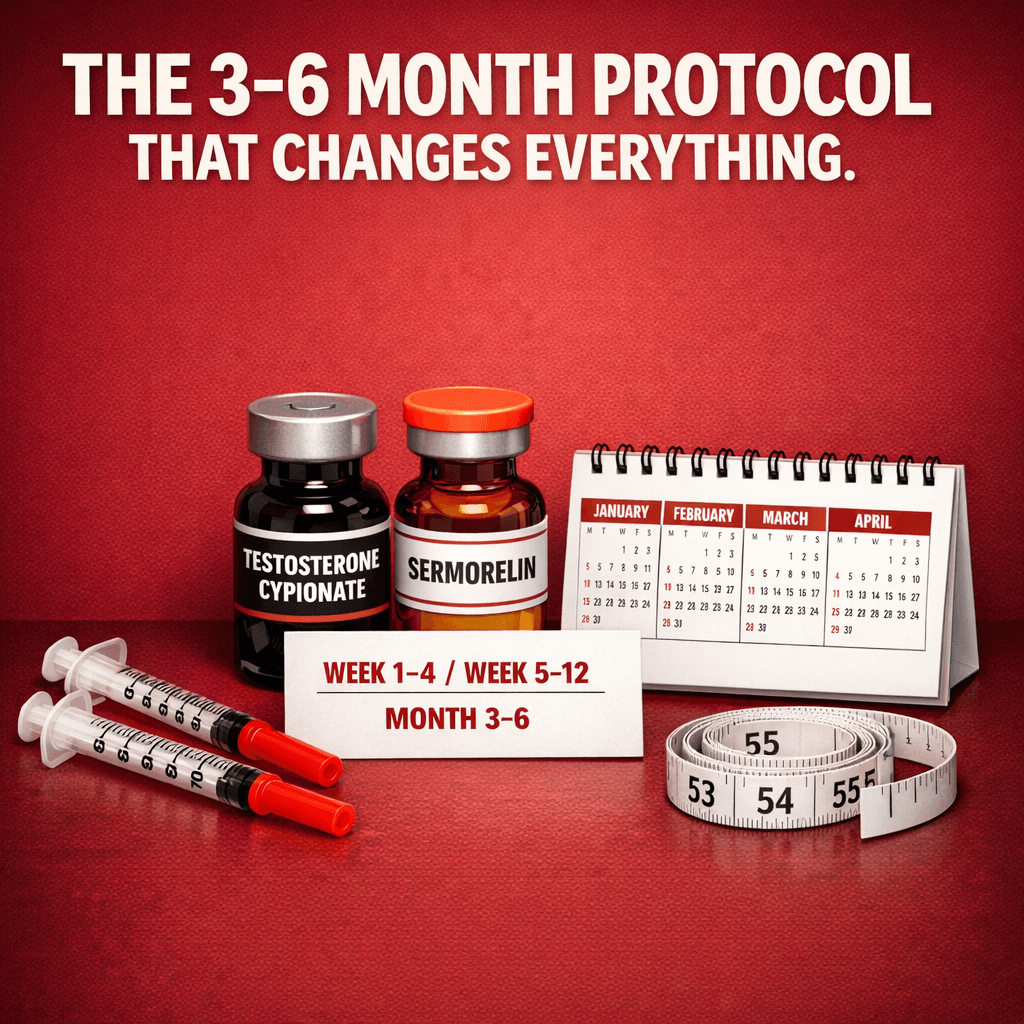
This takes time. Most men see meaningful shifts over three to six months, with continued gradual improvements beyond that. Patience and consistent monitoring are not optional, they are the mechanism.
Lifestyle Is Not Optional
No hormone protocol outperforms a fundamentally broken lifestyle. Sleep deprivation blunts growth hormone release directly, which partially defeats the purpose of sermorelin. Excess alcohol disrupts pituitary signaling, degrades sleep architecture, and opposes testosterone. Chronic stress elevates cortisol in ways that antagonize both testosterone and growth hormone signaling.
Resistance training amplifies the benefits of both therapies by providing the physiological stimulus that these hormones are meant to support. Nutrition, particularly adequate protein and appropriate caloric balance, is the substrate the system needs to do its work.
This is not about being perfect. It is about recognizing that these interventions are tools that work within a biological system, not replacements for the inputs that system requires.
The Protocol Deserves a Clear Explanation
The reason most providers do not explain this combination clearly is partly time, partly complexity, and partly an industry habit of treating hormone therapy as a product rather than a physiological intervention. Men deserve better than a rushed intake and a prescription.
The combination of TRT and sermorelin, when indicated, is not a shortcut or a biohacking trend. It is an attempt to restore two interconnected signaling systems that decline together and create compounding dysfunction when both are ignored. The rationale is physiological, the monitoring requirements are real, and the results, when achieved through careful individualized care, are meaningful and sustainable.
Clinics like AlphaMD approach this kind of protocol with the level of evaluation, education, and ongoing monitoring it actually requires, treating the patient as a whole system rather than a hormone level to be corrected. That distinction, between informed individualized care and transactional prescribing, is ultimately what determines whether a protocol like this delivers on its promise.
Have a question? Ask us.
At AlphaMD, we're here to help. Feel free to ask us any question you would like about TRT, medical weightloss, ED, or other topics related to men's health. Or take a moment to browse through our past questions.
People are asking...
Is there any reason to use Testosterone Cypionate and Enclomiphene concurrently?...
There are two negative feedback loops on LH release, estrogen and testosterone. So having normal or high levels of estrogen will shut down GnRH (gonadotropin releasing hormone) from the hypothalamus a... See Full Answer
Do you have a protocol for someone wanting to come off after a couple years?...
There is no "one answer fits all" to this question, as so much about starting TRT as well as coming off of a medication, has to do with the individual's goals of care. Analyzing each patient's regime... See Full Answer
Yeah i feel like that would work much better 140-160 split up twice weekly something like that. Do you guys only prescribe testosterone or can you als...
Providers on the AlphaMD platform also prescribe some peptides like GLP-1s & Sermorelin when appropriate. Many patients add on a few ancillary medications once their TRT is dialed in.... See Full Answer
Get $30 off your first month’s order
Enter your email address now to receive $30 off your first month’s cost, other discounts, and additional information about TRT.
Legal Disclaimer
This website is a repository of publicly available information and is not intended to form a physician-patient relationship with any individual. The content of this website is for informational purposes only. The information presented on this website is not intended to take the place of your personal physician's advice and is not intended to diagnose, treat, cure, or prevent any disease. Discuss this information with your own physician or healthcare provider to determine what is right for you. All information is intended for your general knowledge only and is not a substitute for medical advice or treatment for specific medical conditions. The information contained herein is presented in summary form only and intended to provide broad consumer understanding and knowledge. The information should not be considered complete and should not be used in place of a visit, phone or telemedicine call, consultation or advice of your physician or other healthcare provider. Only a qualified physician in your state can determine if you qualify for and should undertake treatment.