
Sermorelin Injections: What You Need to Know Before You Start
Published on:
Updated on:
People are asking...
Do you offer peptides and if so can you talk a little bit about which ones you offer and the possible benefits?...
Yes — providers on the AlphaMD platform can prescribe certain peptides, though the selection is more tightly focused than a full on peptide provider. This is because prescribing is limited to peptides... See Full Answer
What are the best peptides to pair with TRT for getting lean?...
In terms of current official pharmacy offerings, providers often recommend Sermorelin as a good boost. Anecdotally, Ipamorelin / CJC with or without dac is often described as a solid peptide for fitne... See Full Answer
I still want to have kids and want to avoid anything that could possibly shut me down all together. Which treatment is best for me ?...
It depends on when you want to have children. If your intent is to conceive in the next 12 months, you should choose hCG alone or a SERM like enclomiphene. These will maintain or even likely increase ... See Full Answer
Have a question? Ask us.
At AlphaMD, we're here to help. Feel free to ask us any question you would like about TRT, medical weightloss, ED, or other topics related to men's health. Or take a moment to browse through our past questions.
Most men don't realize that the gradual erosion of sleep quality, recovery, and body composition that comes with aging isn't simply "getting older" - it's largely the story of a declining growth hormone axis. Understanding what can be done about it, safely and legally, starts with understanding how Sermorelin actually works.
The Mechanism That Makes Sermorelin Different From Growth Hormone
Sermorelin is a synthetic peptide - specifically, a 29-amino acid analogue of the naturally occurring growth hormone-releasing hormone (GHRH) that your hypothalamus already produces. It is the shortest synthetic GHRH fragment that still retains full biological activity. When administered, it binds to GHRH receptors in the anterior pituitary gland, prompting your body to produce and release its own endogenous growth hormone in the same pulsatile, episodic rhythm that healthy physiology requires.
This is fundamentally different from injecting recombinant human growth hormone (rhGH) directly into your bloodstream. With rhGH, you're bypassing the body's own regulatory systems and flooding the body with a constant, non-physiological "square wave" of growth hormone. Sermorelin, by contrast, works within your existing feedback architecture. The body's own inhibitory hormone, somatostatin, still governs the response - making it extremely difficult to overstimulate endogenous growth hormone production to a dangerous level.
There is also a longer-term structural benefit worth understanding. According to research published in Clinical Interventions in Aging, sermorelin stimulates pituitary gene transcription of human growth hormone mRNA, which means it may actually preserve and even restore pituitary reserve over time - a quality sometimes described as "pituitary recrudescence." Direct rhGH therapy, by contrast, can suppress and erode pituitary function.
From a regulatory standpoint, this distinction matters enormously. Federal law specifically prohibits the off-label prescribing of synthetic recombinant HGH in adults for anti-aging or performance purposes. Sermorelin is a GHRH analogue, not synthetic HGH, and off-label prescribing of compounded sermorelin is not prohibited by federal law. It requires a valid physician prescription and must be obtained through a licensed compounding pharmacy.
Who Is a Reasonable Candidate and Who Should Be Cautious
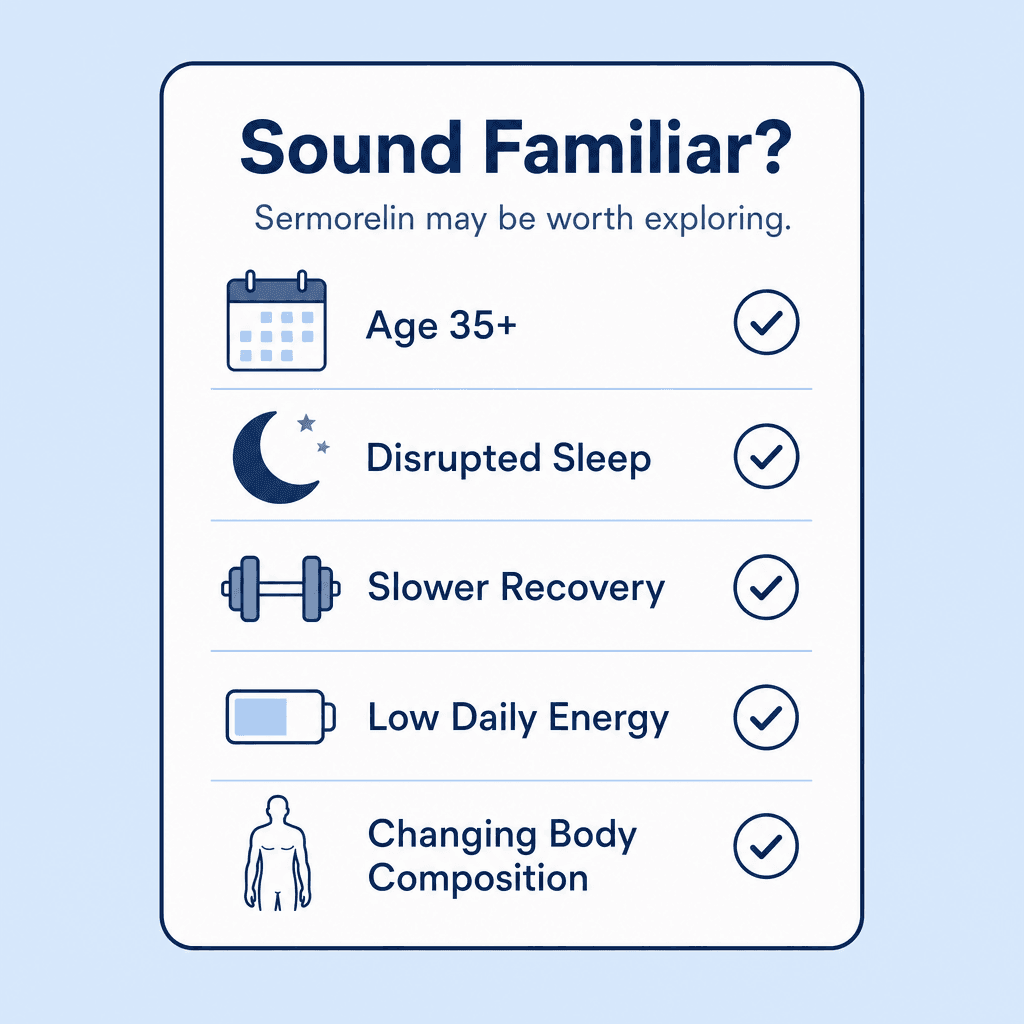
The men who tend to benefit most from a clinician-guided conversation about sermorelin are typically those in their late 30s and beyond who are experiencing the gradual but unmistakable effects of age-related growth hormone decline: disrupted sleep architecture, slower recovery after exercise, creeping changes in body composition despite disciplined habits, and a general blunting of energy and drive.
It is also particularly relevant for men already on testosterone replacement therapy. Research from Baylor College of Medicine, published in Translational Andrology and Urology, found that in hypogonadal men already on testosterone therapy, combined use of growth hormone secretagogues including sermorelin led to significant increases in IGF-1 at multiple follow-up timepoints. The same research noted that sermorelin may also stimulate acute rises in LH and FSH alongside growth hormone, suggesting a potential complementary role in supporting endogenous testosterone production.
That said, not everyone is an equally good candidate. Men with active malignancies or a history of cancer should approach any therapy that influences growth factor pathways with extreme caution, and this should be a direct conversation with a physician. An underactive thyroid (hypothyroidism) is another important consideration - this condition can blunt sermorelin's effectiveness, and it should be identified and addressed before starting therapy. A thorough intake process with a qualified clinician, including a review of medical history and relevant laboratory work, is not optional - it is foundational.
What Actually Happens When You Start - and When
Expectations matter here, and overpromising is a disservice to patients. Sermorelin is not a rapid transformation agent. Men who approach it expecting week-one results are likely to be disappointed. The response is gradual, cumulative, and genuinely variable between individuals.
In a 5-month placebo-controlled clinical trial, sermorelin produced meaningful increases in lean body mass in men, alongside improvements in IGF-1, insulin sensitivity, and self-reported wellbeing and libido. Sleep quality - particularly deeper, more restorative sleep stages - is frequently among the first improvements men report, and this matters because growth hormone is largely secreted during slow-wave sleep. Better sleep means more natural growth hormone release, which compounds the effects of the therapy itself.
Body composition changes, when they occur, tend to emerge gradually over several months. Recovery from training may feel more consistent. Energy and mood can improve. But these outcomes vary. Some men respond more clearly than others, and individual factors - baseline hormone status, lifestyle, sleep habits, thyroid function, and whether other therapies are being used concurrently - all shape the experience.
Monitoring is part of the process, not a formality. Regular follow-up with a clinician allows for objective assessment of how the therapy is working and whether any adjustments to the overall protocol are warranted.
The Basics of Sermorelin Injections: What to Expect Practically
Sermorelin is administered as a subcutaneous injection, meaning it goes into the fatty tissue just beneath the skin rather than into muscle. The injection sites are typically rotated among the abdomen, hip, thigh, and upper arm - keeping a log of dates and locations is a practical habit that reduces tissue irritation and helps maintain consistent absorption.
Proper storage is non-negotiable. Sermorelin must be kept refrigerated and must never be frozen. Freezing degrades the peptide, rendering it ineffective. Your compounding pharmacy and prescribing clinician will walk you through preparation and handling, but this is worth emphasizing because peptides are not as shelf-stable as some other medications.
Self-administration is something most patients learn quickly, but it requires a proper introduction - technique, hygiene, site rotation, and what to watch for. A responsible clinic provides this education before you ever pick up a syringe, not as an afterthought.
Side Effects: What Is Common and What Warrants a Call to Your Clinician
Sermorelin has a well-characterized and generally favorable safety profile in clinical literature. The most common side effects are localized - pain, redness, or swelling at the injection site. These tend to be mild and transient, and rotating injection sites helps minimize them.
Less common but documented side effects include facial flushing, headache, dizziness, itching, trouble swallowing, and drowsiness. These are generally not serious but should be reported to your clinician if they are persistent or troubling.
What sermorelin does not carry are the more serious risks associated with direct recombinant HGH therapy - including joint stiffness, edema, carpal tunnel syndrome, and concerns about waking latent malignancies through sustained supraphysiological growth factor exposure. The somatostatin feedback mechanism that governs sermorelin's effects is a meaningful safety feature, not a marketing talking point.
If you experience anything unusual - significant swelling, signs of an allergic reaction, or symptoms that feel out of proportion - contact your prescribing physician promptly. Do not make adjustments to your protocol on your own.
Sermorelin in the Context of Broader Men's Health Therapy
For many men, sermorelin does not exist in isolation. It is frequently part of a broader protocol that may include testosterone therapy, and understanding how these therapies interact is important.
Testosterone and growth hormone are complementary axes. Low testosterone and age-related growth hormone decline often occur together, and addressing only one while ignoring the other may produce incomplete results. This is why many men's health clinicians evaluate both axes together and consider how therapies can be thoughtfully combined.
Human chorionic gonadotropin, or HCG, is another therapy that sometimes enters these conversations - particularly for men on TRT who want to maintain testicular function or fertility potential. A comprehensive men's health evaluation will consider all relevant factors rather than treating each in a silo.
It is also worth noting that growth hormone dynamics are relevant beyond men's health. Women experience age-related declines in growth hormone as well, and the conversation around Female TRT and hormonal optimization in women often touches on similar themes of body composition, energy, and vitality - even if the specific protocols differ considerably from those used for men.
What a Responsible Telehealth Clinic Actually Does
The growth in telehealth for men's hormonal health has created genuine access to care that did not previously exist for millions of men. It has also created a spectrum of quality - and knowing what separates a responsible provider from a careless one matters before you hand over your health.
A responsible telehealth clinic begins with a thorough intake process. This means a detailed medical history, not just a symptom checklist. It means ordering and reviewing relevant laboratory work before making any prescribing decisions. It means screening for contraindications - active cancer history, untreated hypothyroidism, and other factors that would make sermorelin inappropriate or premature.
It also means educating you before you start. You should understand what the therapy is, why it has been recommended for you specifically, what to realistically expect, how to administer it properly, and what side effects to watch for. A prescription without education is not good care.
Ongoing follow-up is non-negotiable. Lab monitoring over time allows the clinician to evaluate response objectively. Protocols should be adjusted based on how you're actually responding - not locked in permanently based on an initial intake.
And safe prescribing means not overpromising. Clinicians who lead with guarantees of dramatic transformation are not approaching this with the medical seriousness it deserves.
Cost and What Drives It
Sermorelin therapy involves several cost components, and these vary meaningfully based on a number of factors. The compounding pharmacy used, the specific formulation, the inclusion of other peptides or adjunct therapies, geographic location, and the structure of the clinic (whether it charges consultation fees separately or bundles everything) all influence what you will pay.
General expectation-setting: sermorelin is typically more accessible in cost than direct recombinant HGH therapy, which is one reason it is an attractive option for men seeking age management support. However, it is not a trivial expense, and you should factor in ongoing lab monitoring and follow-up visits as part of the total picture.
Be cautious of providers offering unusually low prices with minimal oversight - that is a signal, not a deal. The value of a therapy like this is inseparable from the quality of the clinical supervision surrounding it.
What This All Means for You
Sermorelin sits at an interesting intersection: a well-researched peptide with a favorable safety profile, a mechanism that works with the body rather than around it, and a growing body of clinical evidence supporting its role in adult age management and as an adjunct to testosterone-based protocols. It is not a magic solution, and it requires patience, proper administration, and consistent clinical oversight to use responsibly.
If you are considering it, the starting point is a clinician-guided conversation - not a forum, not a friend's experience, and not a checkout cart. On the AlphaMD platform, individualized care is the model: a licensed provider conducts a thorough intake, reviews appropriate laboratory work, sets honest expectations, and monitors your response over time, keeping your protocol calibrated to how you are actually responding. That kind of partnership is what separates meaningful hormonal optimization from guesswork.
Have a question? Ask us.
At AlphaMD, we're here to help. Feel free to ask us any question you would like about TRT, medical weightloss, ED, or other topics related to men's health. Or take a moment to browse through our past questions.
People are asking...
Do you offer peptides and if so can you talk a little bit about which ones you offer and the possible benefits?...
Yes — providers on the AlphaMD platform can prescribe certain peptides, though the selection is more tightly focused than a full on peptide provider. This is because prescribing is limited to peptides... See Full Answer
What are the best peptides to pair with TRT for getting lean?...
In terms of current official pharmacy offerings, providers often recommend Sermorelin as a good boost. Anecdotally, Ipamorelin / CJC with or without dac is often described as a solid peptide for fitne... See Full Answer
I still want to have kids and want to avoid anything that could possibly shut me down all together. Which treatment is best for me ?...
It depends on when you want to have children. If your intent is to conceive in the next 12 months, you should choose hCG alone or a SERM like enclomiphene. These will maintain or even likely increase ... See Full Answer
Get $30 off your first month’s order
Enter your email address now to receive $30 off your first month’s cost, other discounts, and additional information about TRT.
Legal Disclaimer
This website is a repository of publicly available information and is not intended to form a physician-patient relationship with any individual. The content of this website is for informational purposes only. The information presented on this website is not intended to take the place of your personal physician's advice and is not intended to diagnose, treat, cure, or prevent any disease. Discuss this information with your own physician or healthcare provider to determine what is right for you. All information is intended for your general knowledge only and is not a substitute for medical advice or treatment for specific medical conditions. The information contained herein is presented in summary form only and intended to provide broad consumer understanding and knowledge. The information should not be considered complete and should not be used in place of a visit, phone or telemedicine call, consultation or advice of your physician or other healthcare provider. Only a qualified physician in your state can determine if you qualify for and should undertake treatment.