
Sermorelin Reviews: What You Need to Know Before You Start
Published on:
Updated on:
People are asking...
Do you offer peptides and if so can you talk a little bit about which ones you offer and the possible benefits?...
Yes — providers on the AlphaMD platform can prescribe certain peptides, though the selection is more tightly focused than a full on peptide provider. This is because prescribing is limited to peptides... See Full Answer
How about stacking TRT with peptide therapy. Are Sermorelin, Tesamorelin, or CJC w/ Ipamorelin actually safe to use with TRT? What are the real benef...
These are perfectly reasonable options. Currently, licensed providers can prescribe Sermorelin, though not long ago it was permissible to work with the other peptides you mentioned as well. Many men h... See Full Answer
What are the best peptides to pair with TRT for getting lean?...
In terms of current official pharmacy offerings, providers often recommend Sermorelin as a good boost. Anecdotally, Ipamorelin / CJC with or without dac is often described as a solid peptide for fitne... See Full Answer
Have a question? Ask us.
At AlphaMD, we're here to help. Feel free to ask us any question you would like about TRT, medical weightloss, ED, or other topics related to men's health. Or take a moment to browse through our past questions.
Most men searching for sermorelin reviews are not looking for a sales pitch. They want to know whether the experiences other people report are real, whether the science holds up, and whether the process is worth their time.
Those are exactly the right questions to ask, and this article is designed to help you answer them.
What Sermorelin Actually Is and Why It Matters
Sermorelin is a synthetic analog of growth hormone-releasing hormone (GHRH), specifically the first 29 amino acids of the naturally occurring molecule. Its job is to stimulate the pituitary gland to produce and release the body's own human growth hormone (hGH). This is a fundamentally different mechanism from directly injecting recombinant human growth hormone (rhGH), and that distinction carries real clinical significance.
When you take exogenous rhGH, you are bypassing the body's natural regulatory system entirely. Sermorelin, by contrast, works upstream, binding to GHRH receptors in the pituitary and triggering endogenous GH release in a pulsatile, feedback-regulated pattern that mirrors what a healthy body does on its own. The body's built-in braking system, a hormone called somatostatin, remains active throughout. That feedback loop makes it physiologically difficult to produce a dangerous overdose of growth hormone through sermorelin use, which is one reason researchers and clinicians have examined it as a potentially safer alternative to direct rhGH therapy for aging adults.
The FDA approved sermorelin acetate under the brand name Geref in 1997, originally for children with growth hormone deficiency. Its commercial manufacturing was later discontinued, and current access is primarily through compounding pharmacies operating under state and federal pharmacy regulations. Off-label prescribing in adults is not explicitly prohibited under federal law, which peer-reviewed literature cites as a meaningful regulatory distinction from rhGH, where adult use is tightly restricted.
Why Men Consider It in the First Place
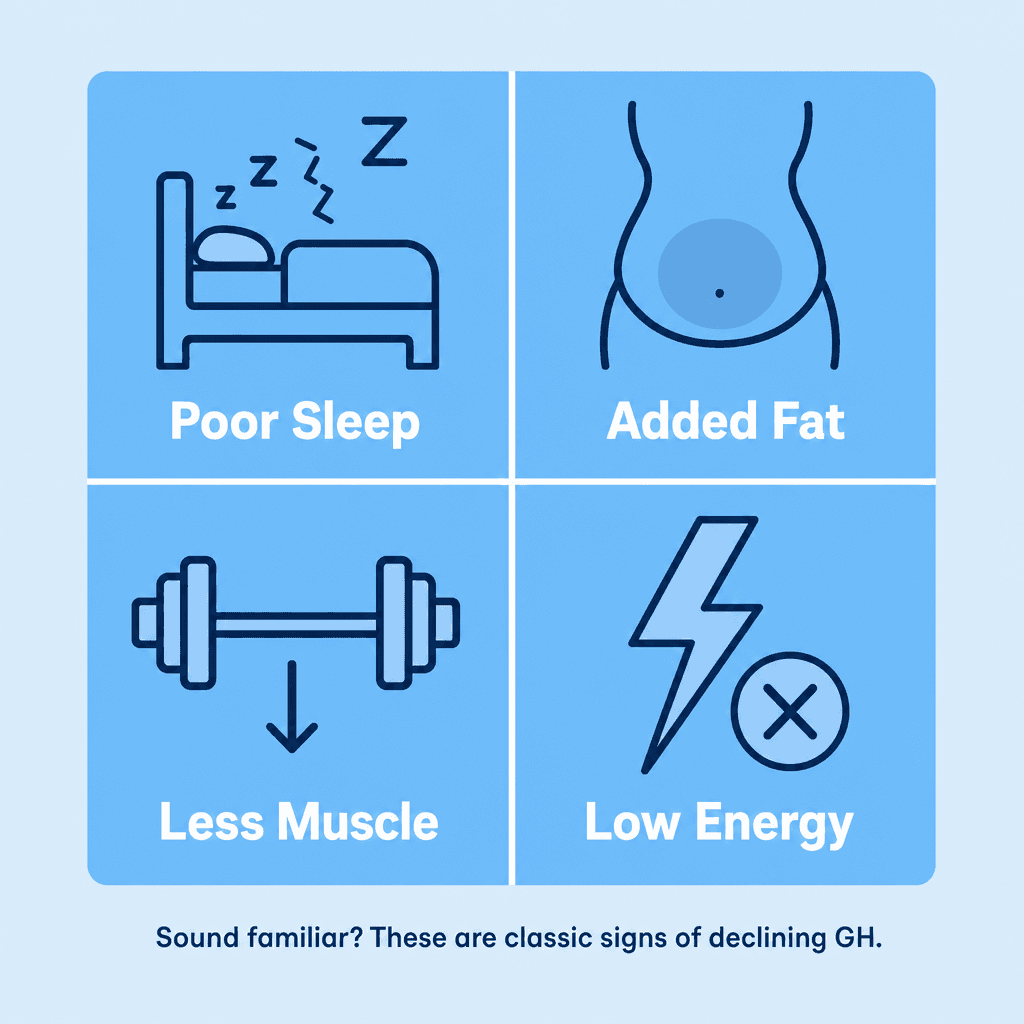
Growth hormone production declines steadily after early adulthood. By middle age, many men experience symptoms that may be associated with this decline: persistent fatigue, increased body fat (particularly around the abdomen), reduced muscle mass, slower recovery from exercise, disrupted sleep, and a general sense that the body is not performing the way it used to.
Not all of these symptoms are caused by low GH. Thyroid issues, low testosterone, sleep apnea, nutritional deficiencies, and a dozen other factors can produce similar complaints. That is why a responsible evaluation does not start with a prescription. It starts with a thorough medical history, appropriate laboratory testing, and a conversation about what is actually driving the symptoms. Growth hormone deficiency is typically assessed using GH stimulation testing and IGF-1 blood measurement, since IGF-1 serves as a more stable surrogate marker for overall GH activity throughout the day. You can read more about how growth hormone tests work through the NIH's MedlinePlus resource.
For men who do have documented GH insufficiency or who are working with a clinician to address age-related hormonal decline, sermorelin is one option that generates a significant amount of real-world discussion online.
Decoding What People Actually Report in Reviews
Online reviews of sermorelin tend to cluster around a few recurring themes. Sleep is mentioned frequently, and this aligns with what the clinical literature suggests: GH secretagogues as a class have demonstrated improvements in sleep architecture, particularly in deep and REM sleep stages. Better sleep alone can produce downstream effects on energy, mood, and body composition, so separating the benefits of improved sleep from direct hormonal effects is genuinely difficult.
Body composition changes are the other most common theme. People report gradual reductions in body fat and modest gains in lean muscle, though the timelines vary considerably. These are not overnight transformations. The research on GH secretagogues supports improvements in lean body mass and reductions in fat mass, as well as increases in exercise tolerance and muscle strength, but results depend heavily on individual baseline hormone levels, age, diet, exercise habits, and compliance with the treatment protocol.
Energy and overall sense of well-being are mentioned frequently in reviews as well, though these are among the harder outcomes to attribute cleanly to any single intervention. Recovery from exercise, joint comfort, and skin quality also appear in patient accounts, though individual variation here is substantial.
A 2006 editorial published in Clinical Interventions in Aging by Walker examined sermorelin specifically and highlighted its ability to stimulate pituitary gene transcription of hGH messenger RNA, a mechanism that may help preserve pituitary reserve and slow the decline of the growth hormone neuroendocrine axis, which is the first hormonal axis to deteriorate with aging. A 2017 review from Baylor College of Medicine published in Sexual Medicine Reviews by Sigalos and Pastuszak examined the broader GH secretagogue class and documented bone turnover benefits as well, including increases in markers like serum osteocalcin and bone-specific alkaline phosphatase.
What reviews often underrepresent is how much individual factors matter. A man in his early 40s with borderline IGF-1 levels who also exercises consistently will likely have a very different experience than someone in their 60s who is sedentary and has significant metabolic issues. Tempering expectations based on individual circumstances is not pessimism. It is accuracy.
What the Risk Profile Looks Like
Sermorelin is generally considered well-tolerated, but "generally well-tolerated" does not mean risk-free. The most common side effects are injection-site reactions, including pain, redness, and swelling at the site of the subcutaneous injection. Rotating injection sites across the abdomen, hip, thigh, and upper arm is recommended to manage this.
Less common side effects include dizziness, flushing, headache, sleepiness, and difficulty swallowing. These are reported in a minority of users but are worth knowing about before you start. An underactive thyroid (hypothyroidism) can meaningfully interfere with sermorelin's effects, so thyroid function is an important part of any baseline workup.
The more significant safety consideration involves blood sugar. GH secretagogues as a class are associated with increased insulin insensitivity and elevated blood glucose. This makes regular monitoring of fasting glucose and HbA1c essential during therapy, particularly for anyone with prediabetes, diabetes, or metabolic syndrome. This is not a theoretical concern; it is a documented finding in the clinical literature and one of the reasons unsupervised use is a poor idea.
Long-term safety data for sermorelin specifically remain limited. The broader GH secretagogue literature calls for larger controlled trials to fully characterize cancer risk, cardiovascular effects, and mortality before comprehensive risk profiles can be established. Elevated IGF-1, which is a downstream marker of GH activity, has been associated in some research with increased cancer risk, though the clinical relevance at physiological GH levels is still debated. Anyone with a history of malignancy should discuss this explicitly with their physician before considering any GH-stimulating therapy. The Cleveland Clinic has a useful overview of conditions associated with excess growth hormone, such as acromegaly, which helps illustrate why keeping GH within physiological ranges matters.
What a Responsible Evaluation Process Looks Like
The difference between a responsible provider and a careless one shows up clearly in the intake process. A thorough evaluation should include a detailed medical history covering past and current diagnoses, medications, family history of hormone-sensitive cancers, and a review of symptoms. Laboratory testing at baseline should cover IGF-1, thyroid function, fasting glucose and HbA1c, and a general metabolic panel at minimum. Some providers will also assess other hormonal markers, since men with GH insufficiency frequently have overlapping concerns in other areas.
Follow-up matters as much as the initial evaluation. Monitoring IGF-1 levels during therapy allows the clinician to assess whether the pituitary is responding appropriately and to make adjustments. Blood glucose monitoring should continue throughout. A provider who hands you a prescription without any of this infrastructure in place is a red flag, not a convenience.
Red flags in online clinics are not subtle once you know what to look for. Avoid any provider who does not require lab work before prescribing, who offers dosing without an individualized assessment, who cannot explain how they will monitor your progress, or who makes sweeping promises about outcomes. Sermorelin is a prescription medication that requires medical oversight, not a supplement you manage on your own.
Questions Worth Asking Before You Start
Before committing to a sermorelin protocol, these are the questions worth raising directly with any prospective provider. First, what does the evidence actually show for my specific symptom profile, and how confident are you that GH insufficiency is playing a role? Second, what lab work will you run at baseline, and what will ongoing monitoring look like? Third, how will you know whether the treatment is working, and at what point would you recommend stopping or adjusting? Fourth, where will the sermorelin be compounded, and how do you verify that the compounding pharmacy is properly licensed? Fifth, how does this fit alongside any other treatments or interventions I am already using?
Good providers welcome these questions. Evasive or dismissive responses to straightforward clinical questions are informative in their own right.
Where Sermorelin Fits in a Broader Conversation About Men's Health
Sermorelin rarely exists in isolation when men are evaluating hormone optimization. Many men exploring GH insufficiency also have questions about testosterone replacement therapy, since low testosterone and low GH often coexist and share overlapping symptoms. Some providers address both in the same protocol, with appropriate monitoring for each. Human chorionic gonadotropin is another agent that sometimes appears in men's health discussions, particularly around maintaining testicular function alongside hormonal therapies.
The point is not that sermorelin is automatically part of a broader protocol, but that any honest evaluation of what a man's body needs should look at the full picture rather than treating each symptom in isolation. A competent provider will help you understand how different options relate to each other and whether combinations are appropriate for your specific situation.
Making an Informed Decision Instead of a Reactive One
The volume of sermorelin reviews online reflects genuine curiosity from men who are paying attention to their health and looking for options that go beyond generic lifestyle advice. That curiosity is worth respecting, and so is the complexity of what they are evaluating.
Sermorelin has a scientifically grounded mechanism, a meaningful regulatory distinction from direct rhGH therapy, and a growing body of clinical literature supporting its use in adults with GH insufficiency. It also has real risks, meaningful individual variability in outcomes, and a strong requirement for medical supervision. None of that makes it the right or wrong choice for any individual without a proper evaluation.
If you are considering it, the most productive first step is not reading another review. It is connecting with a provider who will take your full clinical picture seriously. At AlphaMD, that kind of individualized, evidence-informed evaluation is exactly how conversations about sermorelin and broader hormone optimization get started.
Have a question? Ask us.
At AlphaMD, we're here to help. Feel free to ask us any question you would like about TRT, medical weightloss, ED, or other topics related to men's health. Or take a moment to browse through our past questions.
People are asking...
Do you offer peptides and if so can you talk a little bit about which ones you offer and the possible benefits?...
Yes — providers on the AlphaMD platform can prescribe certain peptides, though the selection is more tightly focused than a full on peptide provider. This is because prescribing is limited to peptides... See Full Answer
How about stacking TRT with peptide therapy. Are Sermorelin, Tesamorelin, or CJC w/ Ipamorelin actually safe to use with TRT? What are the real benef...
These are perfectly reasonable options. Currently, licensed providers can prescribe Sermorelin, though not long ago it was permissible to work with the other peptides you mentioned as well. Many men h... See Full Answer
What are the best peptides to pair with TRT for getting lean?...
In terms of current official pharmacy offerings, providers often recommend Sermorelin as a good boost. Anecdotally, Ipamorelin / CJC with or without dac is often described as a solid peptide for fitne... See Full Answer
Get $30 off your first month’s order
Enter your email address now to receive $30 off your first month’s cost, other discounts, and additional information about TRT.
Legal Disclaimer
This website is a repository of publicly available information and is not intended to form a physician-patient relationship with any individual. The content of this website is for informational purposes only. The information presented on this website is not intended to take the place of your personal physician's advice and is not intended to diagnose, treat, cure, or prevent any disease. Discuss this information with your own physician or healthcare provider to determine what is right for you. All information is intended for your general knowledge only and is not a substitute for medical advice or treatment for specific medical conditions. The information contained herein is presented in summary form only and intended to provide broad consumer understanding and knowledge. The information should not be considered complete and should not be used in place of a visit, phone or telemedicine call, consultation or advice of your physician or other healthcare provider. Only a qualified physician in your state can determine if you qualify for and should undertake treatment.