
PSA on TRT: What the Number Actually Predicts (And the Velocity Metric That Matters Far More Than the Absolute Value)
Published on:
Updated on:
People are asking...
It makes no rational sense to me that total testosterone “far more important”…. even for starting dose. When subjects can have the same total testoste...
Maybe think of it a different way. Your FT level varies a lot based on your SHBG and your albumin levels. And since no one knows to what degree your body will respond to TRT, initial dosing, for the T... See Full Answer
What is the goal level of free/testosterone to achieve on trt? What’s the aim range?...
It may not be the answer you're looking for, but it is very much it depends. Men are so wildly different in both their bodies and how they respond to treatment that it would not be right to aim for th... See Full Answer
How do you look at "dialing in" doses and other aspects of a protocol for somebody who is generally responding to TRT well? The only clear restriction...
In medical school, they often say "Treat the patient, not the numbers." For the providers you'll see through AlphaMD, in no other field of medicine is this more true than in treating hypogonadism. The... See Full Answer
Have a question? Ask us.
At AlphaMD, we're here to help. Feel free to ask us any question you would like about TRT, medical weightloss, ED, or other topics related to men's health. Or take a moment to browse through our past questions.
Your doctor mentions your PSA came back elevated, and before you can ask a single question, your brain jumps straight to the worst-case scenario. That reaction is completely human, and it is also, in most cases on testosterone replacement therapy, premature.
Prostate-Specific Antigen gets a lot of airtime in conversations about TRT, and most of that conversation centers on a single number pulled from a single blood draw. That framing misses the point almost entirely. Understanding what PSA actually measures, what makes it move, and why the pattern of change over time carries far more clinical weight than any isolated result can genuinely change how you approach monitoring and how calmly you walk out of your follow-up appointments.
The Prostate Is Doing Chemistry, Not Sending Distress Signals
PSA is a protein produced by cells in the prostate gland. Its biological job is to liquefy semen after ejaculation, which is a perfectly ordinary function. Some of that protein leaks into the bloodstream in small amounts, and that is what labs measure. The critical point is that PSA does not originate only in cancer cells. It comes from all prostate tissue, healthy or otherwise.
This is where a lot of confusion begins. PSA is often described as a cancer marker, and while elevated levels can sometimes warrant further investigation for prostate cancer, calling it a cancer test is genuinely misleading. A high PSA reading is better understood as a signal of prostate activity, which can reflect enlargement, irritation, inflammation, infection, or simply a larger-than-average gland doing more work than average. The prostate is a busy, sensitive structure, and PSA is its footprint in the bloodstream, nothing more and nothing less.
Why TRT Changes the Conversation, But Not as Dramatically as People Fear
Testosterone plays a role in prostate tissue maintenance, so it is not surprising that starting TRT can influence PSA. When a man begins therapy and testosterone levels normalize after a period of deficiency, the prostate responds. Prostate cells become more metabolically active, and PSA often reflects that with a modest early shift upward. This is generally expected, typically modest in magnitude, and, when it stabilizes, is not considered alarming by experienced clinicians.
The distinction worth holding onto is the difference between an expected early adjustment and an unexpected, persistent rise over months or years. The former is the prostate recalibrating to a healthier hormonal environment. The latter, particularly when it accelerates or occurs without an obvious explanation, is what draws clinical attention and warrants a closer look.
It is also worth knowing that testosterone therapy does not appear to cause prostate cancer in men with no pre-existing disease, based on current evidence. The older hypothesis that testosterone "feeds" existing cancer in healthy men has been significantly revised over time. That does not mean monitoring stops. It means monitoring becomes smarter and more contextual.
The Long List of Things That Move PSA Before Cancer Even Enters the Picture
Before anyone interprets a PSA result, it is worth asking a straightforward question: what else was going on in the days before that blood draw?
Ejaculation within a day or two of testing can temporarily elevate PSA. A long bike ride or significant perineal pressure can do the same. Urinary tract infections, prostatitis (inflammation of the prostate), and even vigorous digital rectal exams or urologic procedures can push the number noticeably higher for a period of time. Benign prostatic hyperplasia, the non-cancerous enlargement that affects a large portion of men as they age, raises PSA simply because there is more prostate tissue producing more of the protein.
Urinary symptoms are another common culprit. Frequency, urgency, or incomplete bladder emptying can signal prostatic inflammation or enlargement, conditions that independently shift PSA without any malignancy present.
None of this means a high result should be ignored. It means context is not optional. A PSA result is a data point, and data points require interpretation.
One Number Is a Photograph. A Trend Is the Full Film.
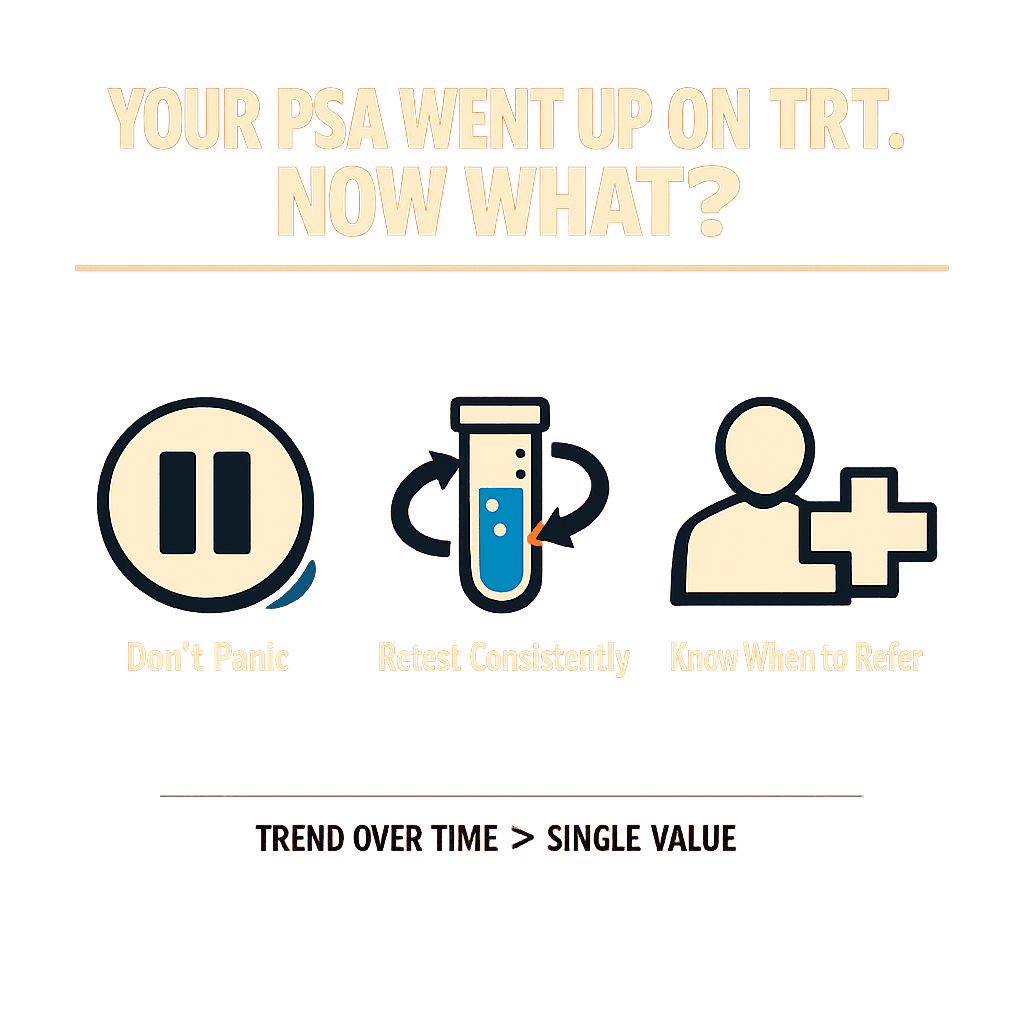
This is the core of what most men never hear in a short appointment: PSA velocity, which is the rate of change in PSA over time, is frequently more informative than the absolute value on any given day.
Consider two men who both show the same PSA level on a lab report. One man has held steady at that level across several years of monitoring. The other arrived at that same number after a rapid climb over several months. Clinically, these two situations are not equivalent, even though the number printed on the page is identical. The pattern is what separates a finding worth watching from one worth acting on urgently.
Clinicians think about PSA in several pattern categories. A stable result that remains consistent over time, even if it sits higher than what a population average might suggest, is generally reassuring in the absence of other concerning signs. A gradual drift upward over years, particularly in an older man with a known history of benign enlargement, often reflects that condition progressing rather than anything malignant. A sudden jump between two close readings, or a persistent and accelerating upward trend, is what elevates clinical concern and prompts further evaluation.
Age matters, too. The same absolute PSA level carries different weight in a younger man than in an older one. Prostate size affects interpretation as well, since a larger gland naturally produces more PSA regardless of cellular health. Establishing a personal baseline early, ideally before or shortly after starting TRT, gives future readings something meaningful to be compared against. Without that baseline, every number floats in isolation.
Free PSA, Density, and the Art of Repeat Testing
When a PSA result raises a question, a single additional tool is often brought in before anything more invasive is considered: a repeat test under consistent conditions. Lab variability, biological fluctuation, and the lifestyle factors mentioned earlier mean that one unexpected reading is often followed by a confirmatory draw, taken at the same lab, ideally under similar conditions, a few weeks later.
Beyond the standard PSA measurement, clinicians may also look at percent free PSA, which compares the amount of PSA circulating freely in the blood to the total amount. A lower percentage of free PSA has historically been associated with a higher likelihood of malignancy, while a higher percentage tends to point toward benign causes. This ratio adds another layer of context without requiring any invasive procedure.
PSA density, which accounts for the volume of the prostate relative to the PSA level, is another way of refining interpretation. A man with a large prostate and a moderately elevated PSA may have a lower PSA density than a man with a small prostate and the same reading, which shifts how that result is weighted clinically.
Digital rectal examination remains part of a thorough prostate health evaluation, not because it is comfortable, but because it gives a clinician direct physical information about the gland's texture, symmetry, and firmness that no blood test can provide. Symptom review, covering urinary habits, pelvic discomfort, sexual function changes, and any pain, rounds out the picture in ways that numbers alone cannot.
Practical Watchfulness Without Unnecessary Alarm
For men on TRT, the practical takeaway is not to obsess over individual results, but to stay consistent with monitoring and to report symptoms that arise between lab draws.
Urinary changes are worth flagging: a new difficulty starting urination, a sense that the bladder is never fully empty, increased frequency at night, or any pain in the pelvis or lower back. These are not necessarily signs of cancer, but they are signs the prostate deserves attention, and they can independently affect PSA results in ways that make interpretation more complex.
If a result comes back higher than expected, the first step is usually not a biopsy. It is a conversation. A good clinician will review the trend, consider the timeline, ask about recent activities, look at symptom history, and decide whether the right move is a repeat test in a few weeks, an adjustment in monitoring frequency, a referral to urology, or continued observation. Shared decision-making, where the patient understands what is being watched and why, produces better outcomes than a numbers-driven reaction in either direction.
A urology referral is appropriate when velocity concerns are present, when a single result is significantly outside the expected range for age and prostate size, when symptoms are new or worsening, or when a clinician simply wants an additional expert perspective. A referral is not a diagnosis. It is a tool for getting more information.
Trending Well: Why Pattern Recognition Is the Real Science Here
A single PSA value, stripped of its history, its context, and the clinical picture surrounding it, tells an incomplete story. The number matters, but what the number is doing over time matters more. Velocity, trajectory, and rate of change are the metrics that give PSA its real predictive power in the context of ongoing TRT monitoring.
That kind of monitoring, the kind that tracks patterns rather than reacting to snapshots, is what responsible TRT management looks like in practice. With AlphaMD, that approach is built into the experience: the provider overseeing your care reviews trends across lab draws, factors in symptoms and history, and connects you with urologic care when the data calls for a closer look. The goal is never to generate anxiety over a number. It is to give that number the context it needs to mean something useful.
Have a question? Ask us.
At AlphaMD, we're here to help. Feel free to ask us any question you would like about TRT, medical weightloss, ED, or other topics related to men's health. Or take a moment to browse through our past questions.
People are asking...
It makes no rational sense to me that total testosterone “far more important”…. even for starting dose. When subjects can have the same total testoste...
Maybe think of it a different way. Your FT level varies a lot based on your SHBG and your albumin levels. And since no one knows to what degree your body will respond to TRT, initial dosing, for the T... See Full Answer
What is the goal level of free/testosterone to achieve on trt? What’s the aim range?...
It may not be the answer you're looking for, but it is very much it depends. Men are so wildly different in both their bodies and how they respond to treatment that it would not be right to aim for th... See Full Answer
How do you look at "dialing in" doses and other aspects of a protocol for somebody who is generally responding to TRT well? The only clear restriction...
In medical school, they often say "Treat the patient, not the numbers." For the providers you'll see through AlphaMD, in no other field of medicine is this more true than in treating hypogonadism. The... See Full Answer
Get $30 off your first month’s order
Enter your email address now to receive $30 off your first month’s cost, other discounts, and additional information about TRT.
Legal Disclaimer
This website is a repository of publicly available information and is not intended to form a physician-patient relationship with any individual. The content of this website is for informational purposes only. The information presented on this website is not intended to take the place of your personal physician's advice and is not intended to diagnose, treat, cure, or prevent any disease. Discuss this information with your own physician or healthcare provider to determine what is right for you. All information is intended for your general knowledge only and is not a substitute for medical advice or treatment for specific medical conditions. The information contained herein is presented in summary form only and intended to provide broad consumer understanding and knowledge. The information should not be considered complete and should not be used in place of a visit, phone or telemedicine call, consultation or advice of your physician or other healthcare provider. Only a qualified physician in your state can determine if you qualify for and should undertake treatment.