
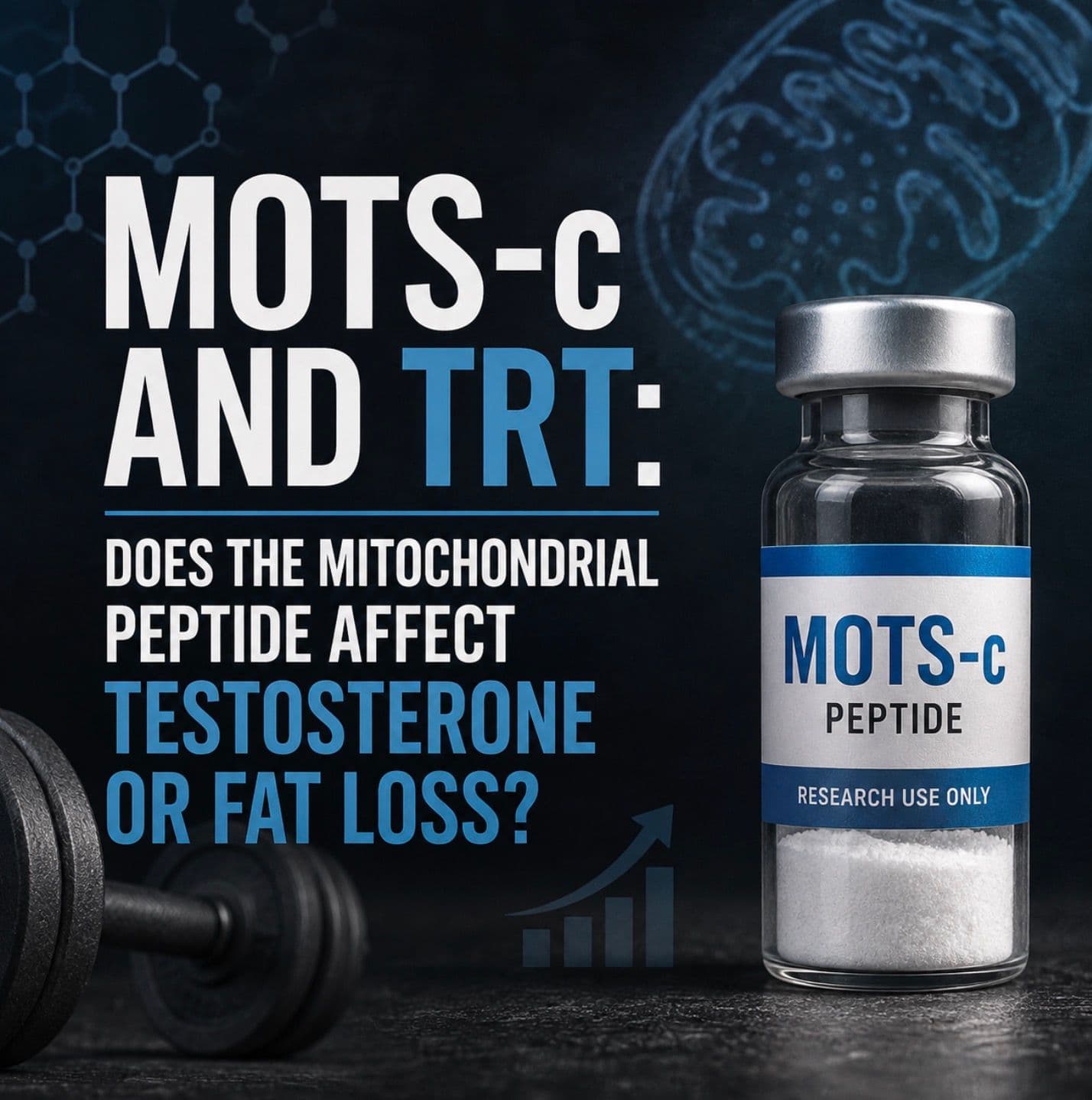
MOTS-c and TRT: Does the Mitochondrial Peptide Affect Testosterone or Fat Loss?
Published on:
Updated on:
People are asking...
What you are doing is awesome guys! I would highly appreciate your input on my case. I have been working out in the gym/calisthenics/swimming/jogging...
To answer your questions in order: Varicocele is one of the only truly reversible causes of hypogonadism. It is a fairly minor procedure, so if you can get it taken care of now, there is a possibility... See Full Answer
Fitness question: Many men think about starting TRT with their natural T levels in the 200-400 range. How much improvement in the gym would such patie...
In general, men who have levels in those ranges & who are experiencing low Testosterone symptoms will already have difficulty putting on muscle mass, maintaining it, and keeping fat off due to those f... See Full Answer
Does TRT benefit erection quality?...
Yes, generally the three main reasons people start TRT are: Energy/motivation, fat loss issues/muscle loss, and libido/erectile function.... See Full Answer
Have a question? Ask us.
At AlphaMD, we're here to help. Feel free to ask us any question you would like about TRT, medical weightloss, ED, or other topics related to men's health. Or take a moment to browse through our past questions.
Men on testosterone replacement therapy are, on average, an unusually health-optimized audience: they already track labs, already think about hormones as a system, and are already primed to ask what else might sharpen energy, body composition, or recovery. MOTS-c, a mitochondrial peptide marketed for metabolism and fat loss, has landed squarely in that audience's field of view. The question this article answers directly is whether that interest is backed by any real evidence specific to men on TRT, and the honest answer is that it is not.
MOTS-c and testosterone act through different biological systems: MOTS-c is proposed to influence cellular energy production and insulin sensitivity, while testosterone production depends on a hormonal signaling chain from the brain to the testes. No published human study has tested synthetic MOTS-c in men on TRT, measured its effect on testosterone, estrogen, fertility, PSA, or hematocrit in that population, or evaluated how it might interact with exogenous testosterone, hCG, or weight-loss medications. What follows works through each specific question a TRT patient is likely to ask, using the actual research that exists rather than the extrapolation that usually fills the gap.
Why Men on TRT May Become Interested in MOTS-c
TRT reliably raises testosterone into a target range, but it does not automatically fix every symptom that brought a man in for treatment. Energy, body composition, and metabolic health are influenced by many systems beyond serum testosterone, and MOTS-c's marketing speaks directly to the gap that remains after labs look "optimized" but a patient still feels off: it is pitched as a way to fix metabolism and mitochondrial function at a cellular level, layered on top of hormone optimization. That framing is appealing precisely because it sounds like it is addressing something TRT does not, but appeal is not evidence, and MOTS-c's own human research record, covered in AlphaMD's MOTS-c human studies review, shows that almost none of it has tested the peptide in people at all, let alone in men already on testosterone therapy.
Does MOTS-c Raise Testosterone?
The honest answer is that no human study has tested this. The closest available evidence is a rodent study in which researchers infused MOTS-c directly into the brain's lateral ventricles, not under the skin the way peptides are typically self-administered, in obese and non-obese male rats over 14 days. That study found that central MOTS-c infusion increased hypothalamic GnRH expression along with serum LH, FSH, and testosterone in both groups of rats, with a larger effect in the non-obese animals. Review the central MOTS-c infusion and reproductive hormone study.
That finding is worth taking seriously as a research signal and also worth being precise about. The route of administration in that study, direct infusion into the brain's ventricular system, is nothing like a subcutaneous injection, which is how MOTS-c is actually sold and used. No study has tested whether subcutaneous MOTS-c, the form available online, reaches the brain in a way that would reproduce this effect, and no study has repeated this experiment in a second species, in humans, or in any animal already receiving exogenous testosterone. A single rodent study using a delivery method nobody actually uses is not evidence that injectable MOTS-c raises testosterone in a man on TRT.
The human data point in the opposite direction from what marketing implies, and in a different population entirely. In women with polycystic ovary syndrome, a condition marked by excess androgens, both circulating and skeletal-muscle MOTS-c are significantly lower than in matched healthy women, and serum MOTS-c is inversely correlated with total testosterone. Review the MOTS-c and PCOS hyperandrogenism study. That is a correlation in women with excess androgens, not a treatment effect in hypogonadal men, but it is worth noting because it is the closest thing to human MOTS-c-and-testosterone data that currently exists, and it does not point toward "more MOTS-c raises testosterone" in any straightforward way.
Does It Affect Estrogen, Fertility, PSA, or Hematocrit?
Estrogen: Human research shows that circulating MOTS-c is regulated in part by estradiol: postmenopausal women have lower MOTS-c than premenopausal women of similar age and body composition, and mitochondrial biogenesis itself is influenced by estrogen-receptor signaling. That describes estrogen's effect on MOTS-c, not the reverse, and it comes entirely from female physiology. No study has measured what MOTS-c does to estradiol or the testosterone-to-estrogen ratio in men, a ratio that TRT patients already track closely because of its effect on mood, water retention, and libido.
Fertility: Mitochondria are essential to sperm function, which makes fertility a biologically plausible area for MOTS-c research, and a recent, not-yet-peer-reviewed preprint reported that men with poor semen parameters (oligoasthenozoospermia) had lower serum MOTS-c than men with normal semen quality, alongside mouse experiments suggesting MOTS-c protects sperm-producing cells from a specific form of oxidative cell death. Review the MOTS-c and spermatogenesis preprint. As a preprint, this has not yet passed peer review, and its human component is an association, not a treatment trial. It also does not address the specific fertility question a TRT patient actually faces, which is that exogenous testosterone itself suppresses the brain signals (LH and FSH) that drive natural sperm production. No study has tested whether MOTS-c does anything to counteract that specific, well-documented effect of TRT.
PSA and prostate: A case-control study of men undergoing prostate biopsy found that higher circulating MOTS-c was associated with lower odds of a prostate cancer diagnosis in European American men, with no significant association in African American men, after adjusting for PSA and other factors. Review the MOTS-c and prostate cancer risk study. This is a biomarker-association study in men already being biopsied for suspected prostate cancer, not a study of MOTS-c's effect on PSA in a routine TRT monitoring context, and it did not administer MOTS-c to anyone. It cannot tell a TRT patient whether taking MOTS-c would raise, lower, or have no effect on their PSA, which is a standard, separate lab that should continue to be monitored on its own established schedule regardless.
Hematocrit: No published research links MOTS-c to hematocrit or red blood cell production in any species. That is a genuine evidence gap, not a reassurance, since hematocrit is one of the few TRT-specific risks with a well-established mechanism and monitoring protocol of its own. For the reasons hematocrit rises on TRT and how it is managed, independent of anything related to MOTS-c, see AlphaMD's Hematocrit 101 guide for TRT patients.
Energy Metabolism Versus Hormone Production
It helps to separate what MOTS-c's actual, published mechanism is from what testosterone production actually requires, because marketing tends to blur the two into a single "optimize your hormones and metabolism" pitch.
MOTS-c's best-established mechanism involves activating AMPK, a cellular energy sensor, which in turn affects glucose uptake, fat oxidation, and mitochondrial stress responses, primarily in skeletal muscle. Testosterone production is a separate, hormonally driven process: the pituitary releases luteinizing hormone, which binds receptors on testicular Leydig cells and triggers a step-by-step conversion of cholesterol into testosterone, a process that itself depends on healthy mitochondria within those Leydig cells but is regulated by the brain's hormonal signals, not by a circulating metabolic peptide. A molecule that plausibly influences how efficiently a muscle cell burns fuel is not, by that fact alone, a molecule that influences how much testosterone the testes make. Those would need to be established as two separate findings, and only the first has any real human research behind it.
Body-Composition Claims
MOTS-c's fat-loss and body-composition reputation comes from mouse research, not human trials. In diet-induced-obese mice, MOTS-c treatment prevented weight gain and reduced liver fat accumulation by increasing fat oxidation rather than reducing food intake, and in aged mice it improved treadmill running capacity and body composition. None of that research involved men on TRT, men taking exogenous testosterone at all, or any combination of MOTS-c with a hormone therapy. As detailed in AlphaMD's broader MOTS-c human studies review, the only completed human trial of a MOTS-c-related molecule (a modified analog, not MOTS-c itself) found that an imaged measure of body fat did not differ from placebo, and the first trial of the actual peptide in people has not yet reported results. A TRT patient hoping MOTS-c will resolve a body-composition plateau is relying on mouse data that has not yet been shown to translate into any human, let alone one already on hormone therapy.
Unknown Interactions With Testosterone, hCG, and Weight-Loss Medications
No study has combined MOTS-c with exogenous testosterone, human chorionic gonadotropin (hCG, commonly used on TRT to help preserve testicular size and fertility), or a GLP-1 or GIP receptor agonist such as semaglutide or tirzepatide, and measured what happens. That absence matters most in contrast to what has been studied: GLP-1 receptor agonists and TRT have a real, published evidence base showing they can be combined safely, with GLP-1-driven weight loss independently raising endogenous testosterone through reduced aromatization of testosterone to estrogen in fat tissue. MOTS-c has no comparable body of combination research. Because MOTS-c's proposed mechanism overlaps with AMPK activation, the same broad pathway used by metformin and, to a lesser extent, implicated in some GLP-1 effects, an unstudied interaction with glucose-lowering medications is a theoretical possibility that has simply never been tested, not a risk that has been ruled out.
Why Fatigue on TRT Should Not Automatically Be Treated as a Mitochondrial Problem
Persistent fatigue despite a testosterone level that looks adequate on paper is common, and it has several well-documented causes that have nothing to do with mitochondrial peptides:
- Elevated hematocrit: Thicker blood from TRT-driven erythrocytosis can itself cause fatigue, headaches, and reduced exercise tolerance, and is checked with a simple blood draw rather than addressed with an unapproved peptide. See AlphaMD's guide to hematocrit and TRT.
- Estradiol out of range: Both excessively high and excessively low estradiol on TRT are linked to fatigue, mood changes, and low libido. See AlphaMD's overview of estrogen, DHT, and the other hormones that affect how TRT feels.
- Obstructive sleep apnea: TRT can worsen or unmask sleep apnea in some men, and sleep apnea independently causes daytime fatigue and can itself suppress testosterone, creating a cycle that no peptide addresses.
- Thyroid dysfunction: Low thyroid function produces fatigue, weight gain, and cold intolerance that closely mimic undertreated hypogonadism, and is not corrected by testosterone or by MOTS-c.
- Dosing and protocol issues: Injection frequency, dose, and timing all affect how stable testosterone levels feel day to day; trough-level fatigue from an every-two-week protocol looks identical to "TRT isn't working" fatigue but has a straightforward fix that does not involve a peptide. See AlphaMD's guide to sleep, stress, and testosterone.
Reaching for a peptide with essentially no human safety or efficacy data before ruling out any of the above skips the evaluation most likely to actually explain the fatigue.
The Importance of Checking Sleep, Thyroid, Glucose Control, and Dosing First
Before considering an unapproved peptide, a structured check-in covers most of the ground that actually explains persistent symptoms on TRT: a current hematocrit and complete blood count, an estradiol and free testosterone level drawn at the right point in the injection cycle, a thyroid panel (TSH, free T4, and free T3), a fasting glucose or HbA1c, a sleep-quality assessment or screening for sleep apnea, and a review of injection frequency and dose. AlphaMD's guide to how often TRT labs should be checked outlines this schedule in more detail. Most of the specific complaints that draw men toward MOTS-c, low energy, stubborn body fat, feeling like TRT "stopped working," have a higher chance of being explained and fixed by this kind of systematic review than by an injectable peptide with no completed human efficacy trial.
The Bottom Line
MOTS-c and testosterone operate through different biological systems, and no reliable human evidence currently establishes that combining MOTS-c with TRT is either beneficial or safe. A single rodent study using a brain-infusion route nobody actually uses found that MOTS-c raised reproductive hormones; the closest human data, from women with excess androgens, points in the opposite direction; and there is no published research at all on MOTS-c's effect on estrogen, fertility, hematocrit, or PSA in men, or on how it interacts with exogenous testosterone, hCG, or weight-loss medications. Fatigue and body-composition frustration on TRT usually have identifiable, well-studied causes, hematocrit, estradiol, thyroid function, sleep apnea, and dosing among them, that a standard lab review can uncover. Until actual human trials test MOTS-c in men on testosterone therapy, treating it as a proven or even reasonably studied add-on to TRT is not supported by the evidence that exists today.
For a full audit of what has and has not been tested in people, see AlphaMD's MOTS-c human studies review, and for the broader benefits, risks, and FDA status of the peptide, see AlphaMD's MOTS-c benefits, risks, and side effects overview.
Medical disclaimer: This article is for informational purposes only and does not constitute medical advice. MOTS-c is not currently an FDA-approved drug. Speak with a licensed medical provider before combining any medication, peptide, supplement, or injectable product with testosterone replacement therapy.
Have a question? Ask us.
At AlphaMD, we're here to help. Feel free to ask us any question you would like about TRT, medical weightloss, ED, or other topics related to men's health. Or take a moment to browse through our past questions.
People are asking...
What you are doing is awesome guys! I would highly appreciate your input on my case. I have been working out in the gym/calisthenics/swimming/jogging...
To answer your questions in order: Varicocele is one of the only truly reversible causes of hypogonadism. It is a fairly minor procedure, so if you can get it taken care of now, there is a possibility... See Full Answer
Fitness question: Many men think about starting TRT with their natural T levels in the 200-400 range. How much improvement in the gym would such patie...
In general, men who have levels in those ranges & who are experiencing low Testosterone symptoms will already have difficulty putting on muscle mass, maintaining it, and keeping fat off due to those f... See Full Answer
Does TRT benefit erection quality?...
Yes, generally the three main reasons people start TRT are: Energy/motivation, fat loss issues/muscle loss, and libido/erectile function.... See Full Answer
Get $30 off your first month’s order
Enter your email address now to receive $30 off your first month’s cost, other discounts, and additional information about TRT.
Legal Disclaimer
This website is a repository of publicly available information and is not intended to form a physician-patient relationship with any individual. The content of this website is for informational purposes only. The information presented on this website is not intended to take the place of your personal physician's advice and is not intended to diagnose, treat, cure, or prevent any disease. Discuss this information with your own physician or healthcare provider to determine what is right for you. All information is intended for your general knowledge only and is not a substitute for medical advice or treatment for specific medical conditions. The information contained herein is presented in summary form only and intended to provide broad consumer understanding and knowledge. The information should not be considered complete and should not be used in place of a visit, phone or telemedicine call, consultation or advice of your physician or other healthcare provider. Only a qualified physician in your state can determine if you qualify for and should undertake treatment.