
You're Dehydrated and Calling It Fatigue: How Hydration Status Directly Affects Hematocrit and TRT Symptoms
Published on:
Updated on:
People are asking...
If guys in places like Colorado have higher hematocrit levels from being at higher altitudes, why do guys on TRT have to donate blood when their hemat...
Mostly because of what it does to you & how each person is different. Their bodies may be doing that based on the strain of their environment & then utilizing the changes to better function. Someone n... See Full Answer
TLDR: high output / high stress life. Physically and mentally. Last 2 years feeling sluggish, burned out, and find doing challenging things extremely...
Providers very often hear "I have been feeling like shit for 6 months for 2 years, I have symptoms of low T" from people trying to figure out if TRT is right for them. It sounds like you're doing it r... See Full Answer
Have been zeroing on some health issues and I recently got a Testosterone test of 301 ng/dl. As a very healthy male ( train 6x a week, track every cal...
Based on your symptoms, a licensed provider would likely consider you a candidate for TRT. A provider would want to talk with you to dive a bit deeper into them, but at a glance, yes.Men who are very ... See Full Answer
Have a question? Ask us.
At AlphaMD, we're here to help. Feel free to ask us any question you would like about TRT, medical weightloss, ED, or other topics related to men's health. Or take a moment to browse through our past questions.
Most men on testosterone replacement therapy who feel exhausted, foggy, or off never think to question how much water they drank that day. It sounds almost too simple, but dehydration is one of the most overlooked variables in how a man feels on TRT, and it can quietly distort the very lab results used to monitor his health.
When Your Body Is Running Dry and Blaming It on Your Hormones
Fatigue is the most common complaint men bring to their doctors, and it is also one of the most common reasons men seek TRT in the first place. But fatigue is not a single thing. It comes from sleep, stress, nutrition, hormonal balance, cardiovascular health, and yes, hydration. The problem is that the symptoms of dehydration and the symptoms of suboptimal testosterone overlap in frustrating ways.
Brain fog, sluggishness, reduced motivation, difficulty concentrating, headaches, muscle cramps, dizziness, an elevated resting heart rate, and even constipation can all trace back to inadequate fluid intake. These are also textbook complaints from men who feel like their TRT is not working, or who feel like something is wrong with their blood work. Before assuming the therapy needs adjustment, it is worth asking a more basic question: are you actually hydrated?
The body depends on adequate fluid balance to move nutrients, regulate temperature, support cognition, and maintain cardiovascular efficiency. When fluid levels drop even modestly, the body begins compensating in ways that feel lousy. Blood pressure regulation becomes less reliable, the heart works harder to pump thicker blood, muscles tire faster, and the brain does not receive the consistent oxygen delivery it needs to stay sharp.
The Plasma Volume Problem Nobody Talks About
Here is where hydration stops being just a wellness talking point and starts being a real clinical variable. Blood is not just red blood cells. It is red blood cells suspended in plasma, which is largely water. When you are dehydrated, plasma volume drops. The red blood cells do not disappear, but they are now packed into a smaller volume of fluid.
This is called hemoconcentration. The proportion of red blood cells relative to total blood volume - measured as hematocrit - goes up, not because your body made more red blood cells, but because the liquid they float in shrank. It is the same number of apples in a smaller bag. The ratio looks different, but nothing about the apples actually changed.
This matters enormously for men on TRT. Testosterone is known to stimulate erythropoiesis, the process by which the body produces red blood cells. Because of this, hematocrit is a standard part of TRT monitoring. Elevated hematocrit can increase blood viscosity - the thickness or resistance of blood flow - which can have cardiovascular implications worth discussing with your provider.
But if a man shows up to his blood draw dehydrated, his hematocrit reading will be falsely elevated. His provider sees a number that looks high. The patient worries. Decisions may be influenced by data that does not accurately represent his true physiology. The fix in that case is not a medication change. It is a glass of water, and a repeat test drawn when he is properly hydrated.
Why Blood Viscosity Is Worth Understanding
Blood viscosity refers to how thick or resistant blood is as it moves through vessels. Thicker blood requires the heart to work harder. It moves more slowly through small vessels and capillaries. For men on TRT who are already experiencing increases in red blood cell production, adding dehydration on top creates a compounding effect.
Symptoms of elevated blood viscosity can include headaches, particularly ones that worsen with exertion, a feeling of pressure or heaviness, reduced exercise tolerance, flushing, and fatigue that does not improve with rest. These are also symptoms that get attributed to TRT when the root cause may be as correctable as drinking more water throughout the day.
This does not mean hydration solves everything. It means that before layering on more clinical complexity, the basics deserve honest attention.
The Hidden Dehydrators That Catch Men Off Guard
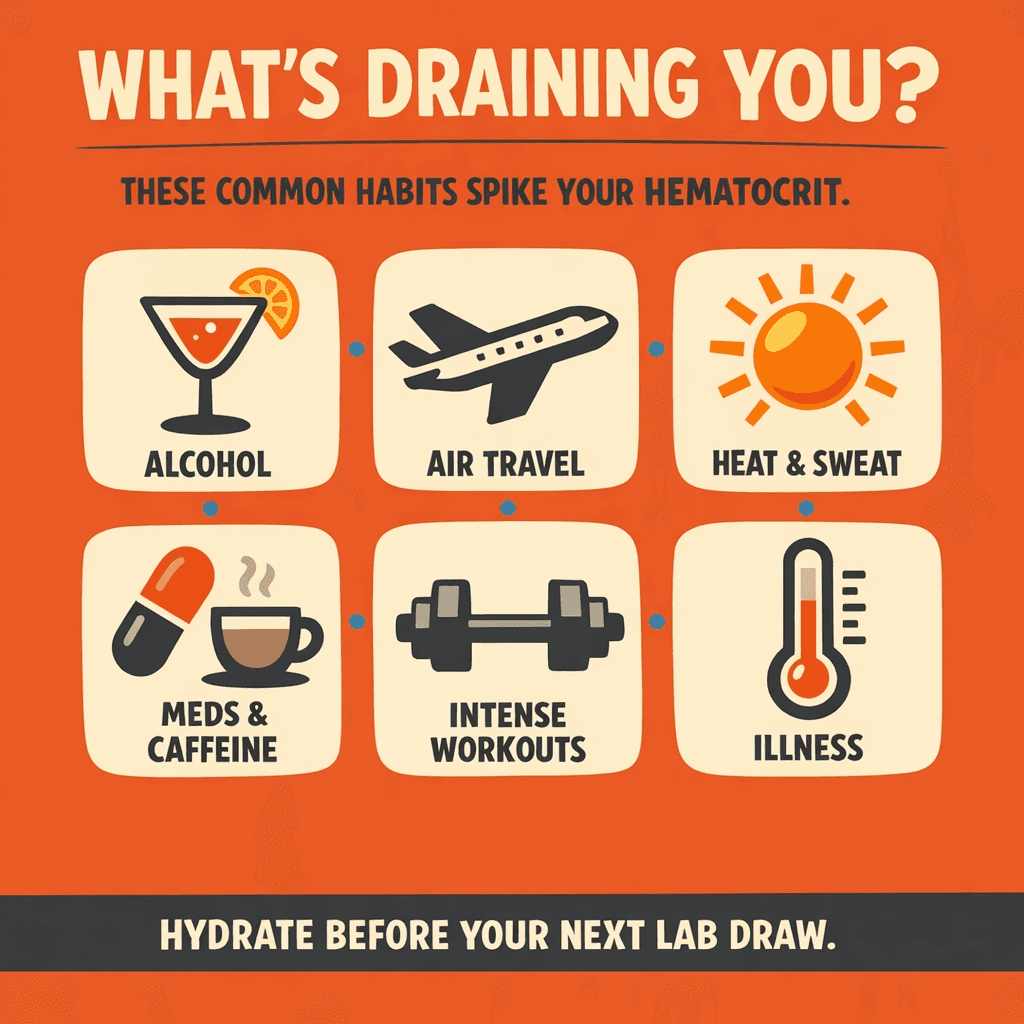
Many men underestimate how much fluid they lose without realizing it. Air travel is a major one - cabin air is extremely dry, and long flights can leave a person significantly depleted without any sense of thirst. Alcohol suppresses a hormone called ADH (antidiuretic hormone), which means alcohol causes the kidneys to excrete more fluid than you took in. A few drinks the night before labs can meaningfully affect your hydration status and therefore your hematocrit reading the next morning.
High heat and outdoor work or exercise cause substantial sweat losses, especially in men who sweat heavily or eat a high-sodium diet. Illness with fever, vomiting, or diarrhea can rapidly deplete fluid reserves. Certain medications and even high caffeine intake have mild diuretic effects. None of these are unusual parts of life, but they layer quickly and the cumulative effect hits harder than most men expect.
A useful, practical cue is urine color. Pale yellow, similar to lemonade, generally suggests reasonable hydration. Dark yellow to amber, like apple juice, suggests your body is conserving water and you are likely behind. This is not a medical diagnostic tool, but it is a real-time feedback system available to anyone, for free, several times a day.
Thirst itself is a cue, but an imperfect one. By the time you feel notably thirsty, you may already be mildly dehydrated. Making a habit of consistent fluid intake throughout the day, rather than reacting to thirst alone, tends to keep men in better balance.
Preparing for Labs: A Small Investment That Protects the Accuracy of Your Data
Your lab results are only as accurate as the conditions under which they were drawn. This is true for hematocrit, but it extends to other markers as well. Showing up to a blood draw in a dehydrated state can skew multiple values in ways that complicate interpretation.
A few practical considerations before getting labs drawn: avoid heavy alcohol consumption the night before, since it reliably affects hydration and can inflate hematocrit readings. Do not go into a blood draw after an unusually intense workout, since exercise temporarily shifts fluid balance and can also temporarily affect hematocrit. Try to be normally, routinely hydrated, not aggressively overhydrated but not depleted either.
Normal day-to-day hydration is the goal. The aim is not to game the results. It is to give your provider data that actually reflects your physiology so that clinical decisions are based on truth rather than artifact.
If your hematocrit has come back elevated on a prior test and you suspect dehydration played a role, mention it to your provider. A repeat test drawn under controlled conditions often tells a very different story.
When to Stop Troubleshooting and Start a Real Conversation
Hydration strategies and lifestyle adjustments are legitimate and useful tools. They are not, however, a substitute for clinical evaluation when something more serious is happening.
If you are experiencing persistent severe headaches that do not resolve with rest and hydration, shortness of breath, chest pain or pressure, heart palpitations, fainting or near-fainting, vision changes, or numbness and tingling, do not attribute these to dehydration or wait them out. These are symptoms that warrant prompt medical attention. If you are ever in doubt about whether something is an emergency, treat it like one.
For men on TRT, staying connected with their prescribing provider about how they feel between labs is equally important. Symptoms change. Life circumstances change. A good monitoring relationship means catching shifts early rather than waiting for a problem to become significant.
What Your Body Is Actually Telling You
There is a pattern that plays out more often than it should. A man starts TRT, feels better for a while, then hits a wall of fatigue and malaise. He assumes the therapy is failing, or that something in his blood work is wrong. He is anxious about his next labs. But when you peel back the layers, what you sometimes find is a man who is not sleeping enough, eating erratically, barely drinking water, having a few drinks most evenings, and working out hard without replacing what he loses.
Testosterone optimization is not a standalone solution. It works best in a body that is being taken care of. Hydration is foundational to that care. Not glamorous, not complicated, but foundational.
The connection between plasma volume, hematocrit, blood viscosity, and the lived experience of fatigue is real and measurable. Dehydration can make a man feel terrible and make his labs look worrying, and the most straightforward correction is also the one most often skipped.
Putting It Together for the Long Haul
Men who do well on TRT over time tend to be men who treat the therapy as one part of a larger picture. Lab monitoring matters. Symptom tracking matters. Lifestyle variables - sleep, nutrition, stress, and hydration - matter just as much, and they interact with therapy in ways that shape both how a man feels and what his numbers show.
Dehydration is not a dramatic diagnosis. It does not make for an interesting story. But it shows up constantly as a hidden driver of fatigue, a confounding variable in hematocrit readings, and an amplifier of symptoms that men are too quick to blame on their hormones or their dose.
If you are on TRT and something feels off, start with the basics before assuming the worst. Check your urine color. Think about how much water you have actually had. Consider what the last 24 hours looked like in terms of alcohol, exercise, heat, and sleep. Then have that conversation with your provider armed with honest information.
AlphaMD supports men through every stage of TRT, from initiation through ongoing monitoring, with a provider overseeing care who takes the full picture into account. Symptom patterns, lifestyle factors, and lab trends are all part of how good care gets delivered. If something in your numbers or how you feel is not adding up, that conversation is exactly where to start.
Have a question? Ask us.
At AlphaMD, we're here to help. Feel free to ask us any question you would like about TRT, medical weightloss, ED, or other topics related to men's health. Or take a moment to browse through our past questions.
People are asking...
If guys in places like Colorado have higher hematocrit levels from being at higher altitudes, why do guys on TRT have to donate blood when their hemat...
Mostly because of what it does to you & how each person is different. Their bodies may be doing that based on the strain of their environment & then utilizing the changes to better function. Someone n... See Full Answer
TLDR: high output / high stress life. Physically and mentally. Last 2 years feeling sluggish, burned out, and find doing challenging things extremely...
Providers very often hear "I have been feeling like shit for 6 months for 2 years, I have symptoms of low T" from people trying to figure out if TRT is right for them. It sounds like you're doing it r... See Full Answer
Have been zeroing on some health issues and I recently got a Testosterone test of 301 ng/dl. As a very healthy male ( train 6x a week, track every cal...
Based on your symptoms, a licensed provider would likely consider you a candidate for TRT. A provider would want to talk with you to dive a bit deeper into them, but at a glance, yes.Men who are very ... See Full Answer
Get $30 off your first month’s order
Enter your email address now to receive $30 off your first month’s cost, other discounts, and additional information about TRT.
Legal Disclaimer
This website is a repository of publicly available information and is not intended to form a physician-patient relationship with any individual. The content of this website is for informational purposes only. The information presented on this website is not intended to take the place of your personal physician's advice and is not intended to diagnose, treat, cure, or prevent any disease. Discuss this information with your own physician or healthcare provider to determine what is right for you. All information is intended for your general knowledge only and is not a substitute for medical advice or treatment for specific medical conditions. The information contained herein is presented in summary form only and intended to provide broad consumer understanding and knowledge. The information should not be considered complete and should not be used in place of a visit, phone or telemedicine call, consultation or advice of your physician or other healthcare provider. Only a qualified physician in your state can determine if you qualify for and should undertake treatment.