
TRT + NAD+: The Anti-Aging Combination Biohackers Love - But What Does It Actually Do?
Published on:
Updated on:
People are asking...
I see people post on various threads on steroids and how they age substantially in a few years. Does TRT have similar effects or is that more hardcore...
For traditional TRT, aka non-bodybuilding levels of Testosterone, this is generally considered almost the opposite. Testosterone in men helps to maintain metabolism & low Testosterone often leads to i... See Full Answer
38 with hormonal issues and it's attendant symptoms and effect since adolescence. Completely bald by 23, finger nails and pubic hair takes a very long...
Fatigue, confidence, libido, motivation, and erectile function are all things that improve on TRT. Head hair & likely nail growth speed is typically not improved with TRT. Body hair for most men tends... See Full Answer
What added benefits does HGH (not peptides) bring to a TRT routine?...
HGH Carrie’s the benefits of improving nitrogen retention beyond that of testosterone. It increases IGF-1 levels to a greater extent than testosterone. For these reasons it helps with recovery from ex... See Full Answer
Have a question? Ask us.
At AlphaMD, we're here to help. Feel free to ask us any question you would like about TRT, medical weightloss, ED, or other topics related to men's health. Or take a moment to browse through our past questions.
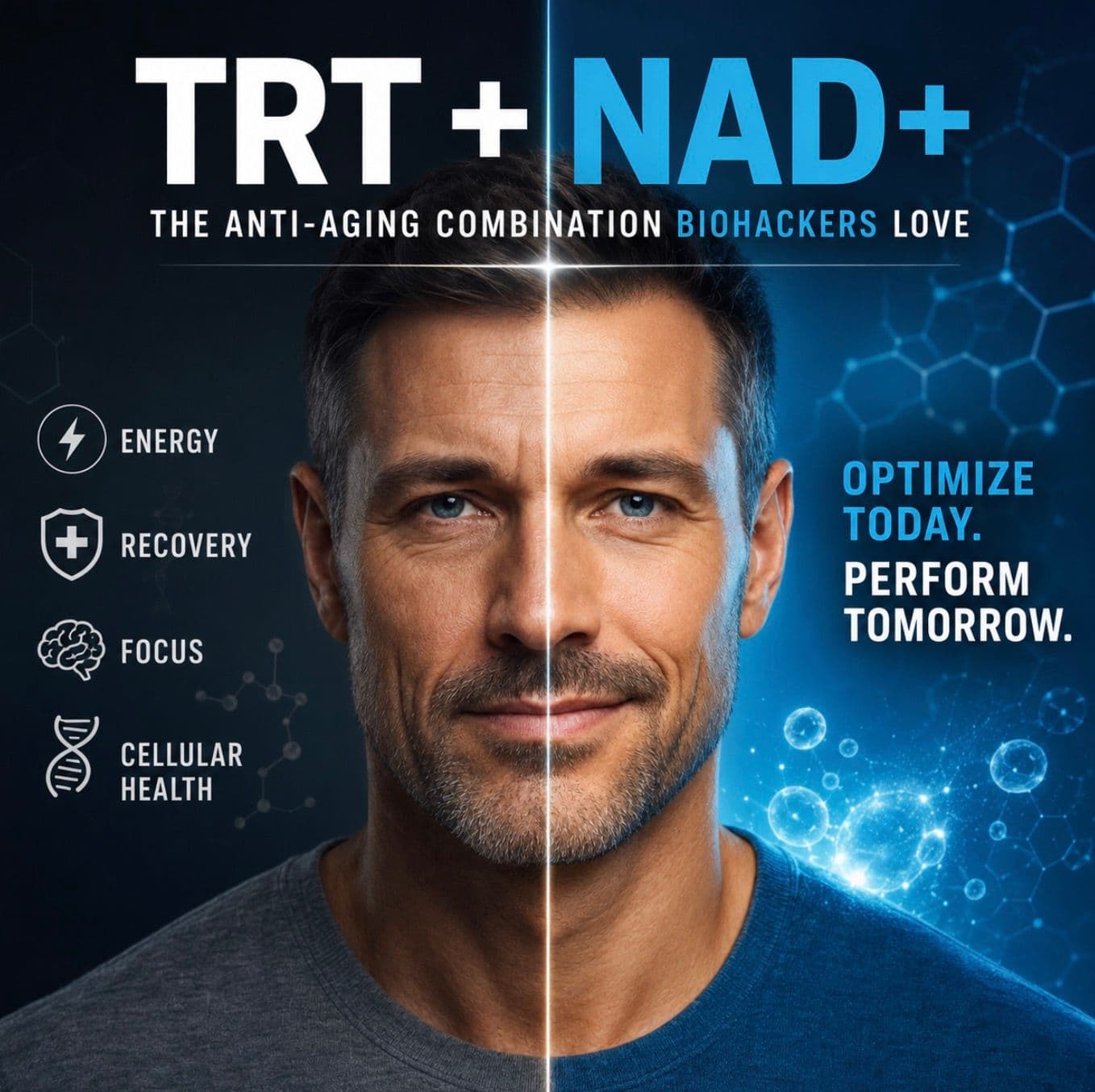
TRT and NAD+ have become one of the most talked-about combinations in men’s health, longevity, and performance circles.
The appeal is obvious.
TRT addresses one of the most measurable drivers of male decline: low testosterone. NAD+ targets something deeper and more cellular: how efficiently your body produces energy, repairs stress, and supports healthy aging.
That sounds like the perfect anti-aging stack.
But here’s the important part: TRT and NAD+ are not the same type of therapy, and they are not backed by the same level of evidence. TRT is a medical treatment for men with clinically low testosterone. NAD+ therapy is a cellular health strategy with promising mechanisms, growing interest, and still-evolving human research.
Used correctly, the two may complement each other. Used casually, they can become another expensive “biohack” with vague promises and no real plan.
Let’s break down what TRT and NAD+ actually do, why men are combining them, and how to think about this stack without falling for overhyped longevity marketing.
Quick Answer: Can You Combine TRT and NAD+?
Yes, TRT and NAD+ can be used together under medical supervision, but they work in different ways.
TRT restores testosterone levels in men with confirmed low testosterone. It may improve energy, libido, mood, strength, muscle mass, body composition, and recovery when low testosterone is part of the problem.
NAD+ supports cellular energy metabolism. NAD+ is involved in mitochondrial function, DNA repair, cellular stress response, and other processes tied to aging and metabolic health.
The combination is popular because TRT helps restore the hormonal signal for performance and recovery, while NAD+ may support the cellular machinery that helps the body produce energy and handle stress.
But NAD+ should not be described as a proven testosterone booster, and TRT should not be used as a general anti-aging shortcut. The smartest approach is lab testing, symptom evaluation, provider oversight, and realistic expectations.
What Is TRT?
Testosterone replacement therapy is a medical treatment for men whose testosterone levels are clinically low and who have symptoms consistent with testosterone deficiency.
Low testosterone can show up as:
- Low energy
- Reduced libido
- Erectile issues
- Brain fog
- Low motivation
- Depressed mood
- Loss of muscle
- Increased body fat
- Poor workout recovery
- Reduced drive or confidence
TRT is designed to restore testosterone into a healthier range, not push men into bodybuilding or steroid-abuse territory.
For the right patient, TRT can be a major quality-of-life treatment. But it requires proper diagnosis, dosing, follow-up labs, and ongoing monitoring.
What Is NAD+?
NAD+ stands for nicotinamide adenine dinucleotide. It is a coenzyme found in every cell of the body and plays a central role in cellular energy production.
Your cells use NAD+ to help convert food into usable energy. NAD+ is also involved in DNA repair, mitochondrial function, oxidative stress response, and several pathways linked to aging and metabolic health.
NAD+ levels tend to decline with age and can also be affected by poor sleep, alcohol, inflammation, stress, poor diet, and metabolic dysfunction.
That is why NAD+ has become so popular in longevity and wellness circles. The basic idea is simple: if NAD+ helps cells produce energy and handle stress, restoring NAD+ activity may help support better energy, recovery, and healthy aging.
The key word is “support.”
NAD+ is not a magic anti-aging injection. It is not a replacement for sleep, training, nutrition, or hormone optimization. And while early research is interesting, many NAD+ claims still run ahead of the evidence.
Why Men Are Combining TRT and NAD+
TRT and NAD+ appeal to the same type of man: usually someone in his late 30s, 40s, 50s, or beyond who feels like his body is no longer responding the way it used to.
He may still train. He may still eat reasonably well. He may still be disciplined. But the output is not matching the effort.
The logic behind combining TRT and NAD+ is that aging does not happen through one pathway.
Low testosterone can affect the hormonal side of the equation. Lower NAD+ activity may affect cellular energy and recovery. Poor sleep, stress, inflammation, alcohol, excess body fat, and insulin resistance can make both worse.
TRT may help restore the signal.
NAD+ may help support the cellular engine.
Lifestyle provides the foundation.
That is the real stack.
TRT vs. NAD+: What Each One Does
TRT and NAD+ should not be treated as interchangeable.
TRT is primarily a hormone therapy. It directly raises testosterone levels when prescribed appropriately. For men with confirmed low testosterone, this can improve symptoms tied to androgen deficiency.
NAD+ is primarily a cellular health and energy metabolism strategy. It does not replace testosterone and should not be marketed as a direct testosterone treatment.
A simple way to think about it:
TRT helps answer: Do you have enough testosterone signal?
NAD+ helps answer: Are your cells producing and managing energy efficiently?
Those are related questions, but they are not the same question.
Does NAD+ Increase Testosterone?
There is no strong clinical evidence that NAD+ therapy reliably raises testosterone in men.
That does not mean NAD+ is irrelevant to male health. Cellular energy, mitochondrial function, metabolic health, inflammation, and oxidative stress can all influence how the body functions. But claiming that NAD+ directly boosts testosterone is a stretch.
If a man has symptoms of low testosterone, the answer is not to guess with supplements or IV drips. The answer is to test total testosterone, free testosterone, SHBG, estradiol, LH, FSH, CBC, and other relevant markers depending on the situation.
NAD+ may be part of a broader optimization plan, but it should not be used as a substitute for diagnosing low testosterone.
What Benefits Might Men Notice From TRT + NAD+?
Men who combine TRT and NAD+ often do so for energy, recovery, performance, and longevity support.
Potential benefits may include:
- Better daily energy
- Improved workout recovery
- Better mental clarity
- More consistent motivation
- Improved body composition when paired with training and nutrition
- Better resilience after stress, poor sleep, or intense exercise
- More complete support for healthy aging
But the reason matters.
If low testosterone is the main bottleneck, TRT is likely to make the bigger difference.
If poor sleep, alcohol, under-eating protein, overtraining, or metabolic dysfunction are the main bottlenecks, NAD+ will not magically fix that.
If the goal is true optimization, the plan needs to include labs, lifestyle, recovery, and follow-up — not just adding another compound.
What the Science Actually Says
The science on TRT is stronger than the science on NAD+ for symptom improvement in men with confirmed testosterone deficiency.
TRT has been studied for effects on sexual function, mood, body composition, anemia, bone density, and other outcomes in men with low testosterone. It also has known monitoring requirements, including hematocrit, testosterone levels, estradiol when clinically indicated, PSA/prostate considerations based on age and risk, and symptom response.
NAD+ research is promising but less settled.
Human studies suggest that NAD+ precursors such as nicotinamide riboside and nicotinamide mononucleotide can increase NAD+ metabolism or related biomarkers in some settings. Some studies have explored physical function, muscle performance, metabolic markers, inflammation, and aging-related outcomes.
But there is still a difference between improving a biomarker and proving a major clinical outcome.
That is the nuance many NAD+ clinics skip.
The best evidence-based position is this: NAD+ is a legitimate area of research and may be useful as part of a supervised wellness or longevity plan, but it should not be marketed as a proven age-reversal therapy.
Who Might Be a Good Candidate for TRT + NAD+?
A man may be a reasonable candidate for a TRT and NAD+ conversation if he has symptoms of low testosterone, lab-confirmed testosterone deficiency, and goals related to energy, recovery, body composition, or healthy aging.
This may include men who are dealing with:
- Persistent fatigue
- Low libido
- Poor workout recovery
- Reduced muscle mass
- Increased belly fat
- Brain fog
- Lower motivation
- Declining performance despite training
- Age-related slowdown that does not improve with basic lifestyle changes
But TRT should start with diagnosis.
NAD+ should start with expectations.
The question is not, “Can I stack these?”
The question is, “What problem am I actually trying to solve?”
Who Should Be Careful?
TRT is not appropriate for every man. Men who are trying to preserve fertility, have elevated hematocrit, untreated severe sleep apnea, active prostate or breast cancer, or certain cardiovascular or clotting concerns need careful medical evaluation before considering testosterone therapy.
For men who are concerned about fertility, options like HCG may be discussed with a medical provider as part of a fertility-preserving strategy. TRT can suppress sperm production, which matters for men who want children. It can also raise hematocrit in some patients, which is why follow-up labs are not optional.
NAD+ is generally discussed as well tolerated, but side effects can occur depending on the form and dose. Some men report nausea, flushing, headache, chest tightness, or discomfort during IV infusions. The quality, source, and route of NAD+ products also matter.
The safest approach is to avoid self-prescribing and work with a provider who understands both hormone therapy and broader metabolic health.
How Long Does It Take to Feel Results?
TRT and NAD+ usually work on different timelines.
Some men notice changes from TRT within a few weeks, especially in energy, libido, mood, or motivation. More complete changes in body composition, muscle, strength, and recovery often take longer, commonly building over several months.
NAD+ effects can feel faster for some men, especially when the perceived benefit is energy or mental clarity. Others notice little or no obvious change.
That difference is important.
TRT is usually tracked through symptoms and lab markers over time.
NAD+ is harder to measure in routine clinical practice, so expectations should be more conservative.
The Real Anti-Aging Stack Is Not Just TRT + NAD+
TRT and NAD+ may be useful tools, but they are not the foundation.
The foundation is still:
- Sleep
- Strength training
- Protein
- Steps and cardiovascular fitness
- Body fat management
- Alcohol moderation
- Stress control
- Metabolic health
- Regular lab monitoring
Other therapies may also fit into a broader optimization plan for certain men. For example, some men explore peptides like sermorelin when discussing sleep, recovery, body composition, and growth-hormone support with a provider. But these should be viewed as targeted tools, not shortcuts.
A man with optimized testosterone but terrible sleep will still feel off.
A man using NAD+ while drinking heavily and under-eating protein is not biohacking. He is trying to outrun the basics.
TRT and NAD+ work best when they are part of a complete plan, not a replacement for one.
TRT + NAD+: Hype vs. Reality
Here is the cleanest way to think about it.
The hype: TRT and NAD+ will make you biologically younger.
The reality: TRT may help men with low testosterone restore healthier hormone function. NAD+ may support cellular energy pathways. Together, they may help some men feel, train, and recover better — but they do not reverse aging by themselves.
The hype: NAD+ boosts testosterone.
The reality: NAD+ is not a proven testosterone booster. If you suspect low testosterone, get labs.
The hype: More treatments equal better results.
The reality: Better diagnosis, better dosing, better monitoring, and better habits usually matter more than adding more compounds.
How to Get Started Safely
If you are considering TRT, NAD+, or both, start with a real evaluation.
That should include:
- A symptom review
- Total testosterone
- Free testosterone
- SHBG
- Estradiol when appropriate
- CBC/hematocrit
- Metabolic markers
- Discussion of fertility goals
- Review of sleep, training, nutrition, alcohol, and medications
The goal is not to chase every longevity trend. The goal is to identify what is actually limiting your energy, performance, recovery, and health.
For some men, TRT is the missing piece.
For others, sleep apnea, insulin resistance, alcohol, under-recovery, or poor nutrition may be the bigger issue.
And for some, NAD+ may be a useful add-on once the fundamentals are already in place.
You can learn more about available treatment options and program structure on AlphaMD’s TRT pricing page or explore more men’s health topics in the AlphaMD resources library.
Bottom Line
TRT and NAD+ are popular together because they target two different parts of age-related decline: hormones and cellular energy.
TRT has stronger clinical evidence for men with confirmed low testosterone. NAD+ is a promising cellular health tool, but many anti-aging claims are still ahead of the research.
The combination may make sense for some men, especially those who want a more complete approach to energy, recovery, body composition, and healthy aging. But it should be done with medical guidance, realistic expectations, and proper lab monitoring.
The smartest version of “biohacking” is not chasing hype.
It is finding the real bottleneck, measuring what matters, and building a plan that actually fits your body.
FAQ
Can you take NAD+ while on TRT?
Yes, many men use NAD+ while on TRT, but it should be done with medical guidance. TRT and NAD+ work differently. TRT restores testosterone levels in men with low testosterone, while NAD+ supports cellular energy metabolism.
Does NAD+ make TRT work better?
NAD+ may support cellular energy and recovery, but there is not enough clinical evidence to say that NAD+ directly makes TRT more effective. The two may complement each other, but they should not be marketed as a proven synergistic treatment.
Does NAD+ raise testosterone?
NAD+ is not a proven testosterone booster. Men with symptoms of low testosterone should get proper hormone labs instead of relying on NAD+ supplements or IV therapy to correct testosterone levels.
Is TRT anti-aging?
TRT is not an age-reversal treatment. It is a medical therapy for men with clinically low testosterone. When low testosterone is contributing to fatigue, low libido, poor recovery, mood changes, or body composition issues, TRT may help restore function and quality of life.
Is NAD+ anti-aging?
NAD+ is involved in cellular energy, DNA repair, and stress-response pathways that are relevant to aging. However, NAD+ therapy has not been proven to reverse aging in humans. It is better described as a cellular health strategy than an age-reversal treatment.
Who should avoid TRT?
Men trying to preserve fertility, men with elevated hematocrit, untreated severe sleep apnea, active prostate or breast cancer, or certain cardiovascular or clotting risks should be carefully evaluated before starting TRT.
What labs should men check before TRT?
Common baseline labs include total testosterone, free testosterone, SHBG, CBC, estradiol when appropriate, metabolic markers, and sometimes LH, FSH, PSA, thyroid markers, or additional testing depending on age, symptoms, and medical history.
What is the best way to use TRT and NAD+ together?
The best approach is to start with labs, confirm whether low testosterone is present, address sleep and metabolic health, and then consider NAD+ as a possible add-on for cellular energy and recovery support. The stack should follow the diagnosis, not the other way around.
Have a question? Ask us.
At AlphaMD, we're here to help. Feel free to ask us any question you would like about TRT, medical weightloss, ED, or other topics related to men's health. Or take a moment to browse through our past questions.
People are asking...
I see people post on various threads on steroids and how they age substantially in a few years. Does TRT have similar effects or is that more hardcore...
For traditional TRT, aka non-bodybuilding levels of Testosterone, this is generally considered almost the opposite. Testosterone in men helps to maintain metabolism & low Testosterone often leads to i... See Full Answer
38 with hormonal issues and it's attendant symptoms and effect since adolescence. Completely bald by 23, finger nails and pubic hair takes a very long...
Fatigue, confidence, libido, motivation, and erectile function are all things that improve on TRT. Head hair & likely nail growth speed is typically not improved with TRT. Body hair for most men tends... See Full Answer
What added benefits does HGH (not peptides) bring to a TRT routine?...
HGH Carrie’s the benefits of improving nitrogen retention beyond that of testosterone. It increases IGF-1 levels to a greater extent than testosterone. For these reasons it helps with recovery from ex... See Full Answer
Get $30 off your first month’s order
Enter your email address now to receive $30 off your first month’s cost, other discounts, and additional information about TRT.
Legal Disclaimer
This website is a repository of publicly available information and is not intended to form a physician-patient relationship with any individual. The content of this website is for informational purposes only. The information presented on this website is not intended to take the place of your personal physician's advice and is not intended to diagnose, treat, cure, or prevent any disease. Discuss this information with your own physician or healthcare provider to determine what is right for you. All information is intended for your general knowledge only and is not a substitute for medical advice or treatment for specific medical conditions. The information contained herein is presented in summary form only and intended to provide broad consumer understanding and knowledge. The information should not be considered complete and should not be used in place of a visit, phone or telemedicine call, consultation or advice of your physician or other healthcare provider. Only a qualified physician in your state can determine if you qualify for and should undertake treatment.