
The Peptide Quality Crisis Nobody in the Optimization Space Wants to Admit
Published on:
Updated on:
People are asking...
Where is the list for pricing from your peptide partner?...
Their practice philosophy is to meet with patients to understand their needs and teach them about peptides, then build a plan to reach their goals. From our discussions, I know they do not list their ... See Full Answer
Why does institutional endocrinology insist on horribly outdated treatment protocols, when modern evidence says they're wrong? eg: I asked my nearly ...
If you don't mind, I will be a bit blunt here because this kind of thing is the reason we started our company, so I hope it doesn't come off as overly rude. Providers, even specialists, are people. ... See Full Answer
Do you think people abusing (abusing may in most cases be a strong word) TRT for aesthetic purposes may hinder hypogonal men’s access to TRT?...
Yes. People are predictable and judgmental. Just like people assume all people with chronic pain and need narcotics are just addicts, people using AAS for aesthetic purposes have made society as a who... See Full Answer
Have a question? Ask us.
At AlphaMD, we're here to help. Feel free to ask us any question you would like about TRT, medical weightloss, ED, or other topics related to men's health. Or take a moment to browse through our past questions.
You can find peptide vials on the internet in under sixty seconds, shipped to your door with no prescription, no oversight, and no guarantee that what's inside matches the label. That convenience is exactly what makes the current peptide market so dangerous for the men who think they're optimizing their health.
Why Peptides Are Not Just Another Supplement
Peptides are short chains of amino acids, the same building blocks that make up proteins. Your body produces them naturally, and they act as signaling molecules, telling cells to do specific things: release growth hormone, repair tissue, regulate inflammation, support metabolic function. Because they mimic or influence natural biological processes, they have drawn serious attention from researchers, clinicians, and men looking to improve how they feel and perform.
But calling a peptide a "supplement" is a category error. Many peptides used in optimization protocols are injectable compounds that enter your bloodstream directly. They are not filtered by your digestive system the way a vitamin capsule is. Whatever impurities, contaminants, or dosing errors exist in that vial go straight into your body. The margin for error is narrow, and the consequences of poor quality can be meaningful.
That distinction matters enormously, and most of the content circulating in men's health communities glosses over it entirely.
How the Supply Chain Can Fall Apart Before It Reaches You
The journey a peptide takes from raw material to your refrigerator involves multiple steps, and quality can degrade at every single one of them.
It starts with the synthesis of the peptide itself. Pharmaceutical-grade peptide synthesis requires precise chemistry, controlled environments, and rigorous testing. The raw materials sourced by manufacturers vary widely in purity. Many research-grade peptides are produced by contract manufacturers in countries with limited regulatory oversight, and the documentation proving purity is often thin or fabricated.
Once synthesized, the peptide must be processed into a final product, typically a lyophilized (freeze-dried) powder in a sterile vial. This step requires cleanroom conditions, proper sterilization of equipment, and testing for bacterial endotoxins. Endotoxins are byproducts of bacterial cell walls that can cause serious inflammatory reactions even when the bacteria themselves are long dead. A vial can look perfectly clear and still contain enough endotoxin load to make you feel genuinely ill.
Then comes storage and shipping. Peptides are fragile molecules. Heat, light, and moisture degrade them. A vial that sits in a warm warehouse or spends three days in a delivery truck during summer can lose a significant portion of its potency before you ever open it. Most gray-market vendors have no cold chain protocols. Some don't even refrigerate during storage.
Finally, there's labeling. Research has documented substantial discrepancies between what peptide vials claim to contain and what independent testing actually finds. A vial labeled as one compound may contain a different compound, a lower concentration, a higher concentration, or a mixture. Some vials contain nothing useful at all.
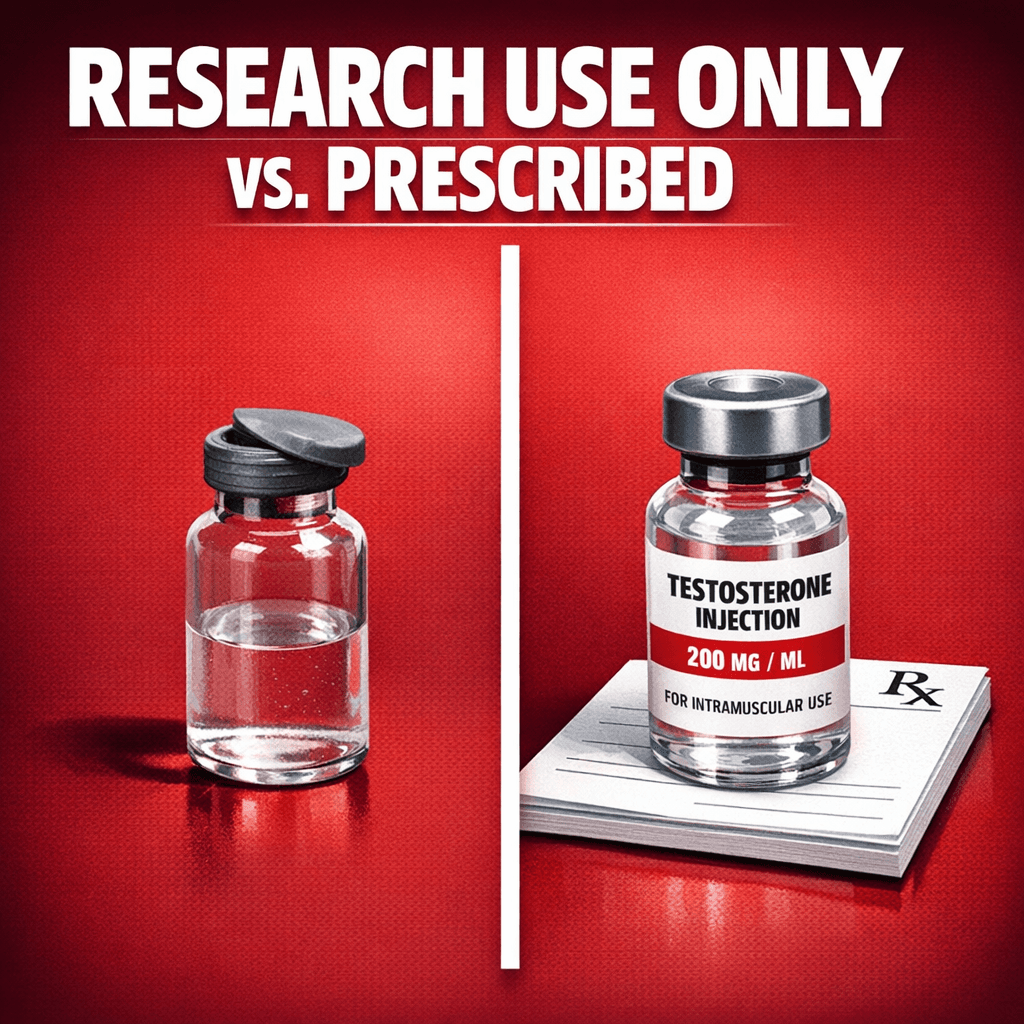
Research-Use-Only vs. Pharmacy-Compounded: A Line That Matters
There is an important regulatory distinction that most optimization content never explains clearly.
Research-use-only peptides are sold by chemical supply companies for laboratory and research purposes. They are explicitly not intended for human use. They are not produced under pharmaceutical manufacturing standards, and they are not subject to the same quality controls, sterility requirements, or purity verification that pharmaceutical products must meet. The "for research use only" label is not a technicality. It reflects a genuine difference in how the product was made and tested.
Pharmacy-compounded peptides are a different category. Licensed compounding pharmacies operating under proper oversight can legally prepare peptide medications for individual patients under a valid prescription. These pharmacies are subject to regulatory standards, facility inspections, and quality controls. The product is intended for human administration, and the standards for sterility and accurate dosing reflect that.
The gray market collapses this distinction deliberately. Vendors sell research-use-only products with marketing language that implies clinical-grade quality. They are not the same thing, and using one as if it were the other is a genuine health risk.
The Optimization Market's Unique Vulnerability
The men's health optimization space has characteristics that make it particularly susceptible to quality problems.
First, the audience is motivated and self-directed. Men researching peptides have often already decided they want to try them. They are looking for confirmation, not caution. Vendors and influencers who speak the language of optimization, who cite studies, use clinical-sounding terminology, and project confidence, earn trust quickly.
Second, social media has created an ecosystem where anecdote outranks evidence. A popular fitness influencer who reports feeling great after a protocol carries more persuasive weight than a conversation about supply chain documentation. The platforms amplify confidence and suppress nuance.
Third, the gap between clinical research and commercial availability is wide. Some peptides have genuinely interesting research behind them. Others are sold on the basis of one small animal study or no published human data at all. The market does not reliably distinguish between the two, and consumers often can't tell the difference.
This combination creates a perfect environment for low-quality products to thrive. When the primary marketing channel is testimonials and the primary customer is a motivated self-optimizer who has already decided to buy, the incentive to invest in quality control is low and the incentive to invest in compelling packaging is high.
What a Quality-Minded Clinic Actually Does Differently
Not all providers in this space operate the same way, and the differences matter.
A clinic that takes quality seriously starts with its supply chain. It sources from compounding pharmacies with verifiable credentials, documented quality systems, and a track record of regulatory compliance. It requires certificates of analysis, not just from the compounding pharmacy but from the underlying raw material supplier. It asks about sterility testing, endotoxin testing, and potency verification. It does not accept documentation that can't be authenticated.
Beyond sourcing, a quality-focused clinic treats peptide therapy as medicine, not as a supplement protocol. That means a physician evaluates you before any therapy begins. It means your history, goals, and health status are considered. It means someone qualified is monitoring what's happening and available when you have questions or concerns.
Transparency is another marker. A clinic that is confident in its quality doesn't become evasive when you ask where their products come from or how they've verified what's in them. Defensiveness or vague answers to sourcing questions are informative in their own right.
Red Flags, Real Questions, and What Testing Can and Cannot Tell You
If you are evaluating whether to pursue peptide therapy through a provider, there are questions worth asking directly.
Ask where the peptides are compounded and whether the pharmacy holds current accreditation. Ask whether certificates of analysis are available and what they test for. Ask whether the clinic uses a licensed physician to evaluate patients before prescribing. Ask what happens if you experience an unexpected reaction.
Certain red flags should give you pause. A vendor or clinic that doesn't ask about your health history before selling you injectable compounds is not practicing medicine. Pricing that seems implausibly low relative to the cost of legitimate pharmaceutical compounding should raise a question about how those margins are achieved. Claims that sound clinical but are unaccompanied by any real medical oversight are a signal, not a selling point.
On the question of testing: third-party lab results are better than nothing, but they have limits. A certificate of analysis confirms what was tested in a specific batch at a specific moment. It does not account for degradation during shipping, improper storage after testing, or whether the vial you received was even from the batch that was tested. Testing is one layer of quality assurance, not the whole answer.
Potency Errors Cut Both Ways
One point that often gets lost in discussions of underdosing is that overdosing is also a real problem.
If a vial contains significantly more active compound than labeled, a dose that seems conservative is actually aggressive. Side effects that should be mild become pronounced. Patterns that would look unusual to a monitoring clinician go unmonitored because there is no clinician involved. The error compounds because the person using the product assumes the issue is something other than what's in the vial.
This is not a hypothetical. Independent testing of gray-market peptide vials has documented concentration errors in both directions. A product does not have to be fake to be dangerous. An authentic compound at the wrong concentration, in a non-sterile environment, administered without medical context, is a problem regardless of how credible the vendor's website looks.
Peptide Therapy Requires the Right Context
Peptide therapies may not be appropriate for everyone. Certain health conditions, medications, and individual factors can affect whether a given therapy is suitable, how it should be administered, and how a patient should be monitored. These are clinical determinations that require a qualified provider who knows your history, not a decision made based on an online forum or a vendor's FAQ page.
This is not a reason to dismiss the space entirely. There is genuine clinical interest in peptide therapies, and legitimate providers are doing real work to bring evidence-based protocols to patients safely. But that work requires the infrastructure of actual medicine: physician evaluation, appropriate sourcing, patient monitoring, and honest communication about what is and is not known.
Quality and Oversight Are the Only Things That Actually Differentiate Providers
At the end of this conversation, the thing worth holding onto is simple. In a market crowded with vendors who sell confidence, the only differentiators that actually protect you are quality and oversight. The marketing is not the medicine. The packaging is not the purity certificate. The influencer's experience is not your clinical evaluation.
AlphaMD is built on a different set of priorities: evidence-based protocols, physician involvement, transparent sourcing, and a genuine commitment to patient safety over sales volume. That approach doesn't make for the most aggressive marketing, but it is what responsible care in this space actually looks like. When you're choosing where to pursue peptide therapy, that distinction is the one worth spending time on.
Have a question? Ask us.
At AlphaMD, we're here to help. Feel free to ask us any question you would like about TRT, medical weightloss, ED, or other topics related to men's health. Or take a moment to browse through our past questions.
People are asking...
Where is the list for pricing from your peptide partner?...
Their practice philosophy is to meet with patients to understand their needs and teach them about peptides, then build a plan to reach their goals. From our discussions, I know they do not list their ... See Full Answer
Why does institutional endocrinology insist on horribly outdated treatment protocols, when modern evidence says they're wrong? eg: I asked my nearly ...
If you don't mind, I will be a bit blunt here because this kind of thing is the reason we started our company, so I hope it doesn't come off as overly rude. Providers, even specialists, are people. ... See Full Answer
Do you think people abusing (abusing may in most cases be a strong word) TRT for aesthetic purposes may hinder hypogonal men’s access to TRT?...
Yes. People are predictable and judgmental. Just like people assume all people with chronic pain and need narcotics are just addicts, people using AAS for aesthetic purposes have made society as a who... See Full Answer
Get $30 off your first month’s order
Enter your email address now to receive $30 off your first month’s cost, other discounts, and additional information about TRT.
Legal Disclaimer
This website is a repository of publicly available information and is not intended to form a physician-patient relationship with any individual. The content of this website is for informational purposes only. The information presented on this website is not intended to take the place of your personal physician's advice and is not intended to diagnose, treat, cure, or prevent any disease. Discuss this information with your own physician or healthcare provider to determine what is right for you. All information is intended for your general knowledge only and is not a substitute for medical advice or treatment for specific medical conditions. The information contained herein is presented in summary form only and intended to provide broad consumer understanding and knowledge. The information should not be considered complete and should not be used in place of a visit, phone or telemedicine call, consultation or advice of your physician or other healthcare provider. Only a qualified physician in your state can determine if you qualify for and should undertake treatment.