
Stop Wasting $800/Month on These Peptide 'Stacks'
Published on:
Updated on:
People are asking...
What’s the most popular peptide stack out there that you’re currently seeing?...
Based on what providers can prescribe & how much peptides shift around in terms of pharmacy willingness to provide them, Sermorelin is the peptide most closely worked with & seen used on the platform.... See Full Answer
Why can’t you stay on HCG long term?...
It is generally more of a concern about cost more than anything for the average American. When taking HCG with Testosterone, it is not adding much in way of benefits that Testosterone itself isn't pro... See Full Answer
I am just getting ready to start trt through an online clinic. Waiting on my order. I was SHOCKED as to how expensive this is going to be and not sure...
That is far more expensive than it should be. You would be wise to spend some more time researching the pricing of other clinics.... See Full Answer
Have a question? Ask us.
At AlphaMD, we're here to help. Feel free to ask us any question you would like about TRT, medical weightloss, ED, or other topics related to men's health. Or take a moment to browse through our past questions.
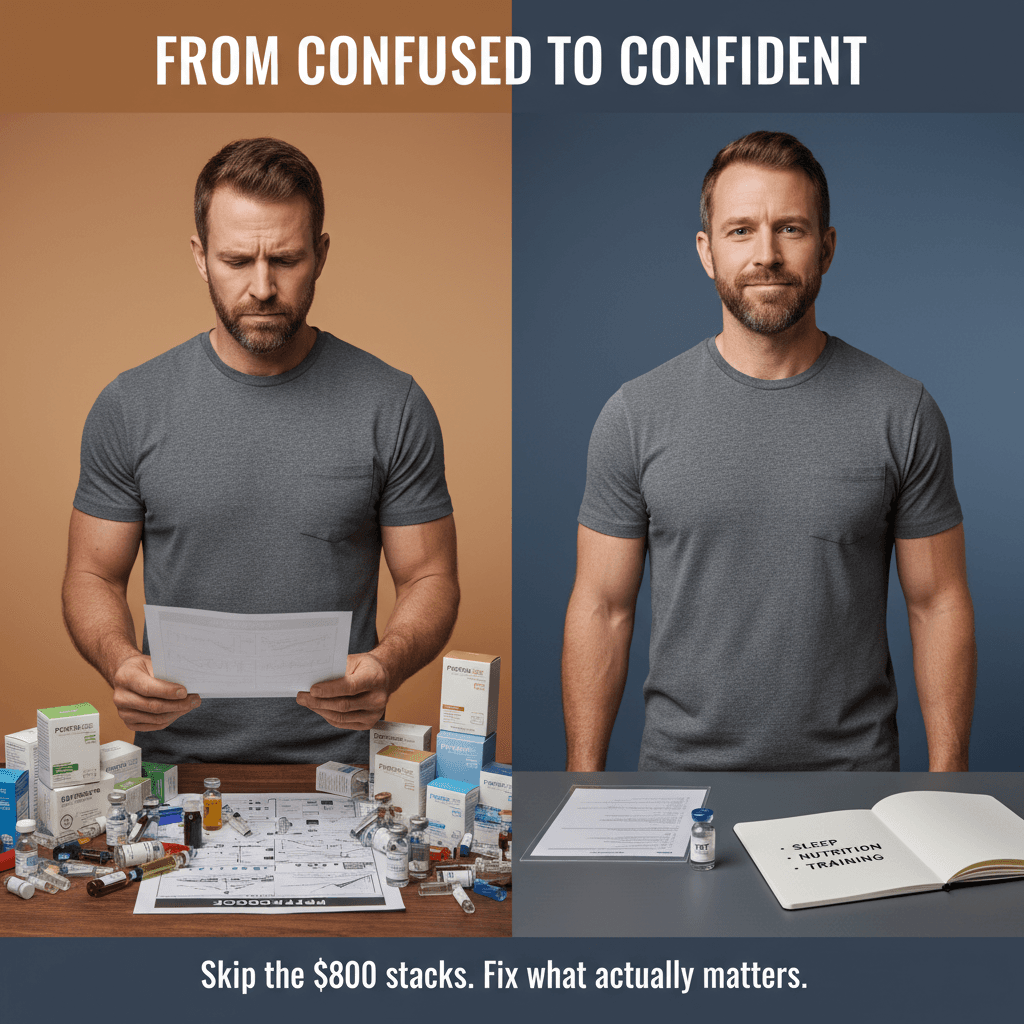
You're dropping hundreds of dollars every month on a peptide stack that promised to melt fat, build muscle, and turn back the clock, but three months in, you're not sure what you're actually getting for your money. Between the BPC, the CJC, the ipamorelin, the thymosin, and whatever else your clinic bundled into your protocol, you're spending more than most car payments and wondering if you're chasing expensive vapor.
This isn't about fear-mongering or dismissing peptides entirely. It's about recognizing that the peptide market has become a gold rush, with marketing claims racing far ahead of what the science actually supports, and men paying the price.
The Peptide Stack Promise vs. Reality
Peptide stacks have become the new frontier in men's health and performance clinics. Walk into the right telemedicine office or browse the right online forum, and you'll encounter elaborate protocols combining multiple peptides with promises that sound almost too good to be true: accelerated fat loss, lean muscle growth without extra gym time, deep restorative sleep, enhanced libido, smoother skin, faster recovery, and a general reversal of the aging process.
The appeal is obvious. These aren't anabolic steroids with their baggage of legal issues and harsh side effects. They're presented as natural signaling molecules, the body's own messengers, just given a little boost from the outside. The pitch suggests you're working with your biology, not against it.
But the gap between promise and evidence is wide.
Many of the peptides marketed in these expensive stacks have limited human research behind them. Some have interesting animal data or small pilot studies. Others have extrapolated benefits based on how they theoretically interact with growth hormone pathways or tissue repair mechanisms. Very few have the kind of large-scale, long-term clinical trials that would justify the confident claims and premium prices attached to them.
Marketing has a way of taking a promising early-stage finding and spinning it into a must-have protocol before the science has caught up. That's exactly what's happened in the peptide space.
What Peptides Actually Are (and Aren't)
Peptides are short chains of amino acids, smaller than full proteins, that act as signaling molecules in the body. They tell cells to perform certain functions, whether that's releasing growth hormone, promoting tissue repair, reducing inflammation, or modulating immune responses.
In theory, administering specific peptides can target specific pathways. Want more growth hormone release? There are peptides that stimulate the pituitary. Want faster healing in damaged tissue? There are peptides studied for their regenerative properties. Want better metabolic function? Certain peptides are being explored for their effects on insulin sensitivity and fat metabolism.
This is fundamentally different from hormone replacement therapy like testosterone. When you replace testosterone in someone with clinically low levels, you're directly restoring a hormone that's measurably deficient. You can test levels before treatment, monitor them during, and adjust based on clear lab markers and symptoms.
Peptides don't work that way. You're not replacing something missing. You're trying to nudge a complex signaling cascade in a particular direction, often without clear biomarkers to tell you whether it's working or how much you need. The feedback loop is murkier, the outcomes harder to measure, and the individual response more variable.
That murkiness creates opportunity for aggressive marketing and expensive stacking.
Why Your Stack Feels Like Expensive Smoke
Many men find themselves on peptide stacks that were never built around their actual medical needs. Instead, they're cookie-cutter protocols sold as premium packages.
The stack might include a growth hormone secretagogue, a tissue repair peptide, a sleep peptide, a metabolic peptide, and maybe something thrown in for good measure. Each one costs money. Each one requires reconstitution, refrigeration, and injection. The monthly bill climbs quickly.
But ask yourself: what specific, measurable problem is each peptide solving? What would success look like, and how would you know if you got there?
Often, the answer is vague. You feel a little better, maybe. Sleep might be slightly deeper, or maybe that's placebo. Recovery could be faster, or maybe you've just been training smarter. The promises were dramatic, but the results are subtle at best, leaving you wondering whether you're wasting money or just not giving it enough time.
This is the core problem with expensive, multi-peptide stacks sold without clear medical rationale. They create confusion instead of clarity.
The Overlap and Redundancy Trap
Another issue with many commercial stacks is redundancy. Some clinics load up protocols with multiple peptides that target the same pathway or produce overlapping effects.
You might be paying for two or three different growth hormone secretagogues when one would suffice, if any were truly indicated in the first place. You might have peptides aimed at inflammation and recovery that work through similar mechanisms, effectively doubling your cost without doubling your benefit.
The logic behind these stacks often isn't medical. It's commercial. More peptides mean higher prices and the perception of a more sophisticated, cutting-edge protocol. It's the supplement industry playbook applied to injectables.
The result is men paying for complexity they don't need, chasing marginal gains that may not even exist.
You're Chasing Novelty While Ignoring the Basics
The most painful irony in the peptide stack obsession is that many men spending hundreds per month on experimental protocols haven't fixed the fundamentals.
They're sleeping five or six hours a night, but they've added a peptide for sleep quality instead of addressing why they're not prioritizing rest. They're eating inconsistently or under-recovering from training, but they've stacked peptides for muscle growth and fat loss instead of dialing in nutrition and programming. They feel low energy and low libido, but they've never had comprehensive hormone testing to see if they have a genuine testosterone deficiency or thyroid issue.
Peptides become the shiny object, the biohack, the thing that lets you feel like you're taking action without doing the harder work of changing habits or confronting real medical issues.
This isn't to say habits alone fix everything. Plenty of men do the work, train hard, sleep well, eat right, and still struggle because they have legitimate hormonal deficiencies. That's where medical intervention makes sense.
But adding a five-peptide stack on top of a foundation of poor sleep, unmanaged stress, and guesswork nutrition is like putting premium fuel in a car with a blown engine. You're spending money on the wrong problem.
The Emotional Vulnerability Factor
It's worth acknowledging why peptide stacks are so appealing in the first place, especially to men in their mid-thirties and beyond who are starting to feel different.
You don't recover like you used to. Your body composition is shifting even though your habits haven't changed much. Your drive, whether in the gym, at work, or in the bedroom, feels muted. You're not sick, but you're not thriving.
That experience creates urgency. You want a solution, and you want it now. When a clinic or online provider shows you a protocol with four or five cutting-edge peptides and promises meaningful change in weeks, it's easy to say yes.
Marketing in this space is designed to tap into that urgency. It offers hope, optimization, and the sense that you're doing something proactive. The price tag reinforces the value. Surely something that costs this much, that sounds this advanced, must work.
But hope and marketing aren't the same as evidence and medical appropriateness. Recognizing your vulnerability to that pitch is the first step toward making better decisions.
When Peptides Might Actually Make Sense
This isn't a blanket condemnation of all peptides. Some have real potential in specific, well-defined contexts.
Certain peptides are being studied seriously for tissue repair, post-surgical recovery, or particular inflammatory conditions. Others may have a role as adjuncts in carefully managed hormone optimization protocols, used strategically rather than as a scattershot stack.
The key is context. A peptide used for a clear medical reason, with defined goals and some basis in evidence or clinical experience, is very different from a pre-packaged stack sold to every customer regardless of their individual situation.
If you're working with a knowledgeable clinician who evaluates your specific health picture, runs appropriate labs, and recommends a single peptide or a narrow combination with a clear rationale, that's a reasonable conversation to have.
But that's not what most men are getting when they sign up for an expensive stack.
What Actually Deserves Your Money and Attention
Before spending a dime on peptides, most men would benefit far more from a straightforward evaluation of their hormonal and metabolic health.
That means comprehensive lab work, not just a single testosterone reading, but a full look at free and total testosterone, estradiol, thyroid function, metabolic markers, and other relevant health indicators. It means an honest conversation about symptoms, goals, and lifestyle factors.
For many men, the revelation is simple: testosterone is genuinely low, and addressing that with medically supervised testosterone replacement makes a dramatic difference in energy, body composition, mood, and libido. No exotic stack required.
For others, the issue might be thyroid function, insulin resistance, chronic stress, or sleep apnea. These are fixable problems, but they require diagnosis, not guesswork.
Even when testosterone is in range, optimizing training, nutrition, sleep hygiene, and stress management often produces results that dwarf what any peptide stack could deliver, and it costs a fraction of the price.
The unglamorous truth is that fundamentals work. They're not exciting, they're not cutting-edge, and they don't come in vials with complicated reconstitution instructions. But they're effective, evidence-based, and sustainable.
A Different Approach to Men's Health Optimization
Companies like AlphaMD represent a shift away from the stack-selling model. Instead of leading with expensive peptide bundles, they make it easier to focus on what actually moves the needle for most men: a proper evaluation with a licensed provider, transparent pricing, and rational, provider-directed treatment plans centered on testosterone optimization and foundational health.
The emphasis is on diagnosing real deficiencies, using lab-driven care, and addressing the most impactful variables first. If your testosterone is low, fix that. If your sleep is broken, address that. If your nutrition is inconsistent, dial that in.
Only after those foundations are solid does it make sense to consider additional interventions, and even then, the approach should be targeted and purposeful, not a kitchen-sink stack of every trendy peptide on the market.
This model respects both your health and your wallet. It doesn't rely on selling complexity for complexity's sake or convincing you that more is always better.
Spending Smarter, Not Just More
The men spending hundreds per month on poorly designed peptide stacks aren't foolish. They're motivated, they're proactive, and they're willing to invest in themselves. Those are good instincts.
The problem is that those instincts are being exploited by a market that prioritizes profit over evidence and novelty over effectiveness.
You deserve better than that. You deserve care that starts with understanding your actual medical situation, that uses interventions with clear evidence and rationale, and that doesn't drain your bank account on speculative protocols.
Saving that money doesn't mean giving up on optimization. It means redirecting it toward approaches that actually work: proper testing, medically supervised hormone replacement when indicated, attention to training and recovery, and targeted interventions chosen for your specific needs, not someone's sales quota.
The path forward isn't about doing less. It's about doing what matters, guided by evidence and individualized care instead of marketing hype. That's how you stop wasting money and start getting real results.
Have a question? Ask us.
At AlphaMD, we're here to help. Feel free to ask us any question you would like about TRT, medical weightloss, ED, or other topics related to men's health. Or take a moment to browse through our past questions.
People are asking...
What’s the most popular peptide stack out there that you’re currently seeing?...
Based on what providers can prescribe & how much peptides shift around in terms of pharmacy willingness to provide them, Sermorelin is the peptide most closely worked with & seen used on the platform.... See Full Answer
Why can’t you stay on HCG long term?...
It is generally more of a concern about cost more than anything for the average American. When taking HCG with Testosterone, it is not adding much in way of benefits that Testosterone itself isn't pro... See Full Answer
I am just getting ready to start trt through an online clinic. Waiting on my order. I was SHOCKED as to how expensive this is going to be and not sure...
That is far more expensive than it should be. You would be wise to spend some more time researching the pricing of other clinics.... See Full Answer
Get $30 off your first month’s order
Enter your email address now to receive $30 off your first month’s cost, other discounts, and additional information about TRT.
Legal Disclaimer
This website is a repository of publicly available information and is not intended to form a physician-patient relationship with any individual. The content of this website is for informational purposes only. The information presented on this website is not intended to take the place of your personal physician's advice and is not intended to diagnose, treat, cure, or prevent any disease. Discuss this information with your own physician or healthcare provider to determine what is right for you. All information is intended for your general knowledge only and is not a substitute for medical advice or treatment for specific medical conditions. The information contained herein is presented in summary form only and intended to provide broad consumer understanding and knowledge. The information should not be considered complete and should not be used in place of a visit, phone or telemedicine call, consultation or advice of your physician or other healthcare provider. Only a qualified physician in your state can determine if you qualify for and should undertake treatment.