
The One Supplement Category With a 90% Failure Rate That Men Keep Buying Before They Consider TRT
Published on:
Updated on:
People are asking...
Why do TRT clinics just throw 200mg out to start...
They really shouldn't, but because many take the approach of uniform care over individual planning, they pick a dose that will *certainly* give results which is good for marketing, even if it will alm... See Full Answer
I’m not sure how honest you’ll be since you identified your clinic but how common is it for these fee for service clinics to approve someone just for ...
would say it is something that happens with some of our competitors. We get many men who transfer to us only for the provider overseeing their care to take them off of excess medication that, to be pe... See Full Answer
Is TRT only a viable long term strategy, or does the shutdown of other hormones (due to testes shutdown) cause issues after a while. Do you find most ...
Since low Testosterone is a life-long condition and there is no cure, which only gets worse with age, treatment is the only course to remain symptom free. In a sense, your choice is choosing which sit... See Full Answer
Have a question? Ask us.
At AlphaMD, we're here to help. Feel free to ask us any question you would like about TRT, medical weightloss, ED, or other topics related to men's health. Or take a moment to browse through our past questions.
Every year, men spend billions of dollars on a single supplement category that rarely delivers what it promises - and most of them cycle through multiple products before ever asking a doctor what is actually wrong.
The Category Everyone Knows but Nobody Talks About Honestly
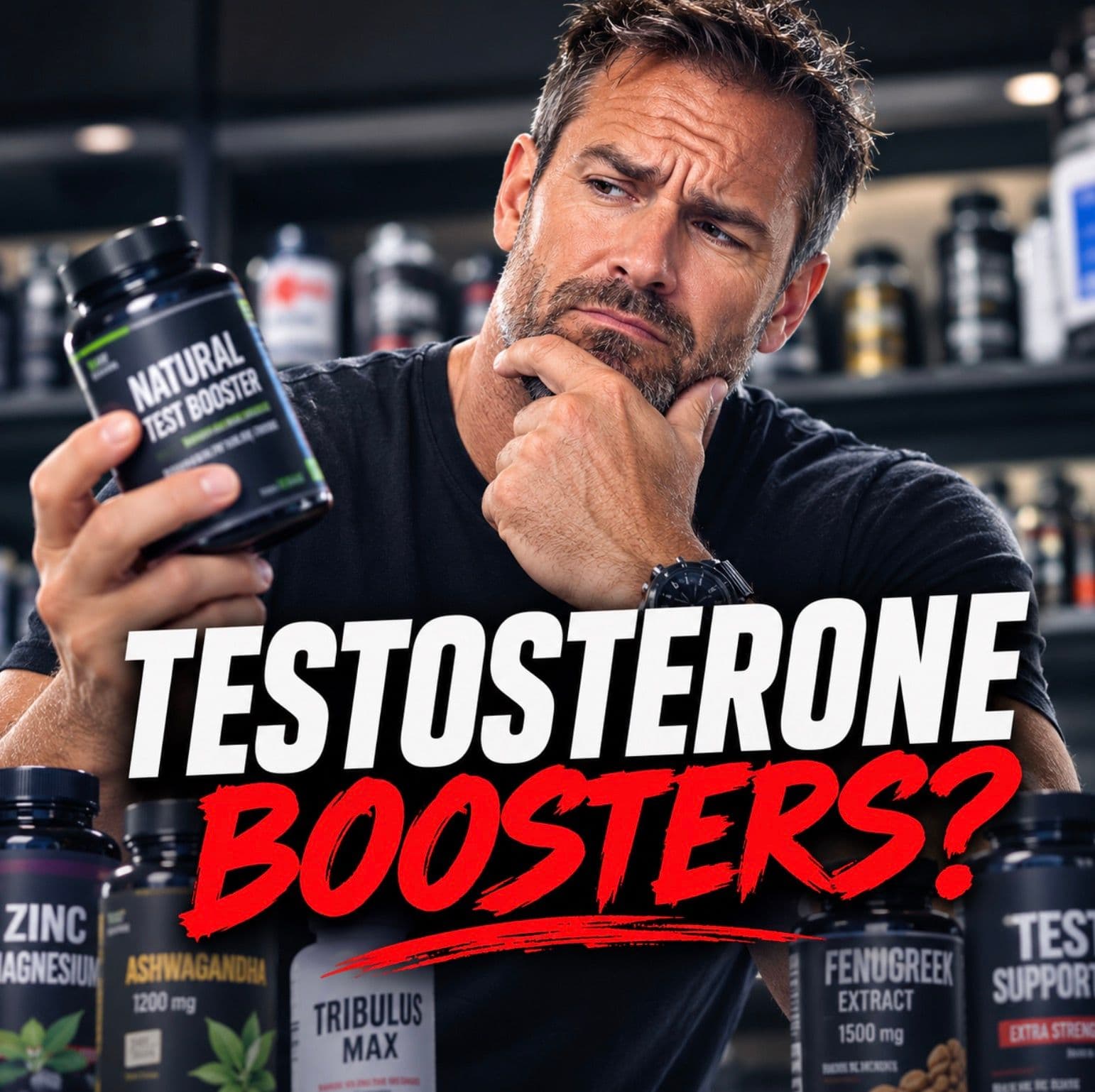
The supplement category in question is testosterone boosters. Walk into any big-box retailer, scroll through any fitness forum, or open a men's health website and you will find rows of products promising to "naturally support" testosterone levels, boost vitality, and restore the energy and drive that started disappearing sometime after 30. These products are aggressively marketed, often backed by compelling testimonials, and designed to feel like a logical first step before anything more serious.
The problem is that real-world evidence for their effectiveness is remarkably thin. While the exact figure varies depending on who is measuring and how "success" is defined, the idea that roughly nine out of ten men who try testosterone boosters get no meaningful or lasting symptom relief is widely echoed across clinical and consumer contexts. Practitioners who work in men's health hear it constantly: men who tried three or four different supplements over a year or two, noticed nothing substantial, and finally showed up asking for labs.
To be clear, the "90% failure rate" framing is a high-level characterization of how poorly these products tend to perform in the real world, not a single peer-reviewed statistic. Failure, in this context, means no meaningful improvement in the symptoms men are actually trying to address: low energy, poor sleep, reduced libido, mental fog, difficulty building or maintaining muscle, and a general sense that something is off.
Why Men Keep Reaching for the Supplement Aisle First
The reasons men gravitate toward testosterone boosters before seeking medical evaluation are deeply understandable. There is a cultural stigma around admitting that your hormones might need medical attention. Supplements feel like something you can control quietly, without involving a doctor or sitting in an uncomfortable conversation. They are available without a prescription, they are marketed with confidence, and they appeal to the very reasonable instinct that a "natural" approach should be tried first.
There is also a degree of hope involved. The marketing is sophisticated. Ingredients like ashwagandha, zinc, D-aspartic acid, fenugreek, and tribulus terrestris appear on labels alongside clinical-sounding language and images of lean, energetic men. Some of these ingredients do have modest research support for specific populations or conditions. Research published through the National Institutes of Health suggests that zinc deficiency, for example, can suppress testosterone production, and correcting a genuine deficiency may help. But "may help in a deficient population" is a far cry from "will restore your testosterone and solve your symptoms."
The gap between ingredient-level research and whole-product clinical outcomes is enormous. Most men buying testosterone boosters are not deficient in zinc or magnesium. They are experiencing symptoms that have a deeper, more specific hormonal or metabolic cause, and no supplement formulation addresses that root cause.
What the Frustration Usually Signals
Here is what experienced clinicians often observe: the men who have tried and abandoned multiple testosterone boosters are frequently the men who needed a clinical evaluation from the beginning. The frustration of failed supplements is often a signal, not a dead end.
Symptoms like persistent fatigue, declining libido, difficulty concentrating, mood changes, reduced muscle mass, and increased body fat do not always point to one cause. They can be driven by clinically low testosterone, yes, but they can also be influenced by poor sleep quality, elevated cortisol from chronic stress, thyroid dysfunction, elevated prolactin, metabolic issues, certain medications, or some combination of all of the above. A supplement cannot sort that out. A clinician with the right lab panel can.
This is why the supplement cycle tends to end the same way for so many men: not with a product that finally works, but with a conversation they should have had much earlier.
What a Real Clinical Evaluation Actually Looks At
If you have been living on testosterone boosters and still feel like yourself from five years ago never came back, a medically supervised evaluation is the logical next step. What does that actually involve?
A thorough hormonal evaluation goes well beyond a single testosterone number. A clinician typically looks at total and free testosterone, but also at sex hormone-binding globulin, luteinizing hormone, follicle-stimulating hormone, prolactin, thyroid markers, estradiol, complete metabolic markers, and often a full blood count. This broader picture matters because the same symptoms can have very different causes, and the treatment pathway depends entirely on understanding which factors are actually at play.
Sleep and stress history matter too. Chronic poor sleep alone can suppress testosterone meaningfully. Elevated cortisol from prolonged stress has a direct suppressive effect on the hypothalamic-pituitary-gonadal axis. A good clinician asks about these things rather than jumping straight to a number on a lab report.
Fertility goals are also part of the conversation. This is particularly important because some treatments affect the body's own hormone production differently than others. For men who want to preserve fertility, the evaluation and treatment path may look different than for men who do not. The American Urological Association provides clinical guidelines on evaluating and treating testosterone deficiency that reflect this nuance.
When Supplements Have a Legitimate Role and When They Do Not
Fairness requires acknowledging that supplements are not entirely without value. If a man is genuinely deficient in vitamin D, chronically sleep-deprived, or running on a nutritionally poor diet, addressing those foundations can improve how he feels. Lifestyle and nutritional optimization are real contributors to hormonal health.
But they are not a substitute for medical evaluation when the underlying issue is a hormonal deficit that the body cannot self-correct. There is a meaningful difference between optimizing a healthy hormonal system and trying to supplement your way out of a clinical deficiency. The former can be supported by lifestyle and targeted nutrition. The latter typically cannot.
The mistake most men make is spending a year or more in the first category when they actually belong in the second. The supplements are not failing because the men using them are doing something wrong. They are failing because the tool does not match the problem.
The Treatment Landscape That Most Men Have Not Fully Explored
For men whose labs and symptoms point toward genuine hypogonadism or clinically suboptimal testosterone levels, medically supervised testosterone replacement therapy is the most evidence-supported intervention available. It is not a shortcut or a performance drug. It is a medical treatment for a medical condition, and when it is indicated and properly managed, the outcomes can be meaningfully different from anything a supplement stack will produce.
For men where preserving testicular function or fertility is a priority, human chorionic gonadotropin is often part of the clinical conversation. HCG works differently than direct testosterone replacement and can support the body's own production pathway, which matters significantly for men who are thinking about future family planning.
For men whose primary concerns are energy, body composition, recovery, and the physical effects of aging on muscle and metabolism, Sermorelin represents another avenue worth discussing with a clinician. It works through the growth hormone axis rather than the testosterone axis, and it may be appropriate for a different subset of symptoms and goals.
The point is not that every man needs one of these therapies. The point is that the range of evidence-based options available through medical supervision is far broader and more targeted than anything the supplement aisle can offer.
Getting Labs Is Not a Commitment, It Is Information
One of the most common misconceptions men carry into this conversation is that getting their hormones evaluated means committing to a treatment. It does not. Labs are information. They tell you and your clinician what is actually happening in your body, which is the only honest starting point for any decision about what to do next.
Knowing your numbers does not obligate you to anything. It does, however, give you a foundation for a real conversation about whether what you are experiencing has a treatable cause and what the options actually are.
If you have been cycling through testosterone boosters and feeling like you are spinning your wheels, the answer is unlikely to be a better supplement. It is probably a better evaluation. Platforms like AlphaMD make it straightforward for men to connect with clinicians who specialize in hormone health, get proper lab work ordered, and receive a treatment plan tailored to their actual results and goals, without the guesswork that defines the supplement aisle experience.
The supplements are not going to stop being sold. The marketing is not going to get more honest. But you can stop being part of the cycle by making one decision that most men delay far too long: find out what is actually going on.
Have a question? Ask us.
At AlphaMD, we're here to help. Feel free to ask us any question you would like about TRT, medical weightloss, ED, or other topics related to men's health. Or take a moment to browse through our past questions.
People are asking...
Why do TRT clinics just throw 200mg out to start...
They really shouldn't, but because many take the approach of uniform care over individual planning, they pick a dose that will *certainly* give results which is good for marketing, even if it will alm... See Full Answer
I’m not sure how honest you’ll be since you identified your clinic but how common is it for these fee for service clinics to approve someone just for ...
would say it is something that happens with some of our competitors. We get many men who transfer to us only for the provider overseeing their care to take them off of excess medication that, to be pe... See Full Answer
Is TRT only a viable long term strategy, or does the shutdown of other hormones (due to testes shutdown) cause issues after a while. Do you find most ...
Since low Testosterone is a life-long condition and there is no cure, which only gets worse with age, treatment is the only course to remain symptom free. In a sense, your choice is choosing which sit... See Full Answer
Get $30 off your first month’s order
Enter your email address now to receive $30 off your first month’s cost, other discounts, and additional information about TRT.
Legal Disclaimer
This website is a repository of publicly available information and is not intended to form a physician-patient relationship with any individual. The content of this website is for informational purposes only. The information presented on this website is not intended to take the place of your personal physician's advice and is not intended to diagnose, treat, cure, or prevent any disease. Discuss this information with your own physician or healthcare provider to determine what is right for you. All information is intended for your general knowledge only and is not a substitute for medical advice or treatment for specific medical conditions. The information contained herein is presented in summary form only and intended to provide broad consumer understanding and knowledge. The information should not be considered complete and should not be used in place of a visit, phone or telemedicine call, consultation or advice of your physician or other healthcare provider. Only a qualified physician in your state can determine if you qualify for and should undertake treatment.