
The $8 Supplement That Dropped Estrogen 38% Without Touching an AI
Published on:
Updated on:
People are asking...
On daily cypionate and HCG but estrogen is high. Tried examestane and anastrazole which brings down to normal levels but I feel hollow sometimes and a...
It sounds like the goal is to maintain treatment and remove the need for AIs. With that in mind, you could consider reducing your HCG dose unless you're trying to have a child right now, as it can add... See Full Answer
My question is about gyno. Currently I am on my 4th bottle of test. My gyno (I think it’s gyno) started on my second bottle of test, 100mg a week, inj...
Your description of your symptoms is typical for gynecomastia. This is from an excess of estradiol. An AI is commonly considered in cases like yours — something the provider overseeing your care can e... See Full Answer
My question is have you heard of Calcium D-glucarate being substituted instead of an AI? And reducing E levels? My Endo seems to know nothing about AI...
Calcium D-glucarate has been shown to increase the metabolism of estrogen, meaning your body will eliminate it from your system faster. It does nothing to block the conversion of testosterone to estro... See Full Answer
Have a question? Ask us.
At AlphaMD, we're here to help. Feel free to ask us any question you would like about TRT, medical weightloss, ED, or other topics related to men's health. Or take a moment to browse through our past questions.
A guy orders a bottle of a cheap supplement online, takes it for six weeks, gets labs, and sees his estrogen drop by more than a third. No prescription aromatase inhibitor. No doctor visit. Just an $8 bottle from Amazon. Stories like this circulate constantly in TRT forums and men's health communities, sparking both curiosity and confusion. Can an inexpensive over-the-counter supplement really move the needle on estrogen levels? And more importantly, should you care?
The short answer is nuanced. Some men do see measurable changes in their estrogen markers from certain supplements and lifestyle interventions, but individual responses vary wildly. What works dramatically for one person might do absolutely nothing for another. More critically, chasing a specific lab number without understanding what estrogen actually does in your body, or why it might be elevated in the first place, can lead you down a path that ultimately undermines your hormone optimization goals.
Before we talk about what might lower estrogen, we need to understand why crushing it into the ground is often worse than leaving it slightly elevated.
Estrogen Isn't the Enemy You Think It Is
Most men approach testosterone replacement therapy with a simple mental model: testosterone good, estrogen bad. It's an understandable oversimplification, but it's wrong in ways that matter.
Estrogen plays essential roles in male physiology. It contributes to libido and sexual function, often more than men realize. It supports cardiovascular health, helping to maintain healthy cholesterol profiles and vascular function. It's critical for bone density, keeping your skeleton strong as you age. It modulates mood and cognition. It even plays a role in body composition, influencing how your body partitions nutrients and builds muscle.
The relationship between testosterone and estrogen is less like a seesaw and more like a dance. Your body converts some testosterone into estrogen through an enzyme called aromatase, which is found in fat tissue, the brain, blood vessels, and other tissues throughout the body. This conversion isn't a mistake or a flaw. It's a feature, not a bug.
When men start TRT and their testosterone levels rise into optimal ranges, some estrogen conversion is expected and healthy. The problem arises when estrogen climbs too high relative to testosterone, or when individual sensitivity creates symptoms even at levels that look reasonable on paper.
When High Estrogen Actually Becomes a Problem
There's a difference between estrogen being present and estrogen causing issues. Not every man with higher lab values feels symptomatic, and not every symptom attributed to high estrogen is actually caused by it.
That said, genuinely elevated estrogen can manifest in recognizable ways. Water retention is common, the kind that makes your face look puffy and your ring feel tight. Mood changes can occur, sometimes presenting as emotional volatility or irritability that feels out of character. Some men develop sensitive or tender tissue beneath the nipples, a condition that can progress if ignored. Libido might paradoxically decrease despite having excellent testosterone levels. Energy and motivation can feel blunted.
These symptoms matter, but they're not unique to high estrogen. Low estrogen can cause some of the same issues. So can thyroid problems, poor sleep, high stress, or a dozen other variables. This is why symptoms alone, without lab work, tell an incomplete story. And lab work alone, without considering symptoms, can lead to unnecessary interventions.
Many men on TRT never need to address estrogen at all. Their bodies find a comfortable balance, their symptoms improve, and they feel great. Others need a more active approach, and that's where the conversation about aromatase inhibitors versus alternative strategies becomes relevant.
Why Clinics Hand Out AIs Like Candy, and Why That's Often a Mistake
Aromatase inhibitors are powerful pharmaceutical drugs that block the conversion of testosterone to estrogen. They work efficiently and predictably, at least in terms of dropping lab numbers. This makes them appealing to clinics that want simple protocols and patients who want fast results.
The problem is that AIs are blunt instruments. They don't restore balance. They suppress a natural process. And when you suppress that process too much, you create new problems that are often worse than the ones you started with.
Crushed estrogen feels terrible. Men describe it as joint pain, terrible libido despite high testosterone, brittle mood, brain fog, and a general sense that something is deeply off. It can harm bone density over time. It can worsen cholesterol profiles. And recovering from chronically low estrogen can take weeks or months after stopping the AI, because these drugs can have lingering effects.
Despite these risks, some clinics prescribe AIs reflexively, sometimes even starting them at the same time as TRT without waiting to see if they're necessary. This approach treats estrogen like a problem that needs to be prevented rather than a hormone that needs to be balanced.
There are situations where AIs are appropriate. Some men aromatize heavily. Some have stubborn symptoms despite trying other approaches. But for many men, especially those just starting TRT or those with only mildly elevated levels, there are gentler first steps worth exploring.
The $8 Bottle That Changed One Man's Labs
This brings us back to that story. An inexpensive supplement, taken consistently, and a lab report showing estrogen dropping significantly without pharmaceutical intervention. Is this real? Possibly. Is it universal? Absolutely not.
Certain supplements have mechanisms that could theoretically influence estrogen metabolism. Some support liver function, helping your body process and clear estrogen more efficiently through its natural detoxification pathways. Others contain compounds that may modestly influence how estrogen is metabolized into different forms, some of which are less active or problematic than others. Still others might influence the activity of the aromatase enzyme itself, though far more gently than a prescription AI.
The catch is that these effects tend to be modest, variable, and highly individual. One man's dramatic response might be another man's expensive urine. Factors like genetics, body composition, liver health, gut function, diet, and existing hormone levels all play roles in determining who responds and how much.
This is why anecdotes, while interesting, should never be treated as guarantees. A single case study of a dramatic estrogen drop doesn't establish efficacy for the broader population. It establishes possibility, which is worth exploring, but with realistic expectations and proper monitoring.
The Lifestyle Foundation That Actually Moves the Needle
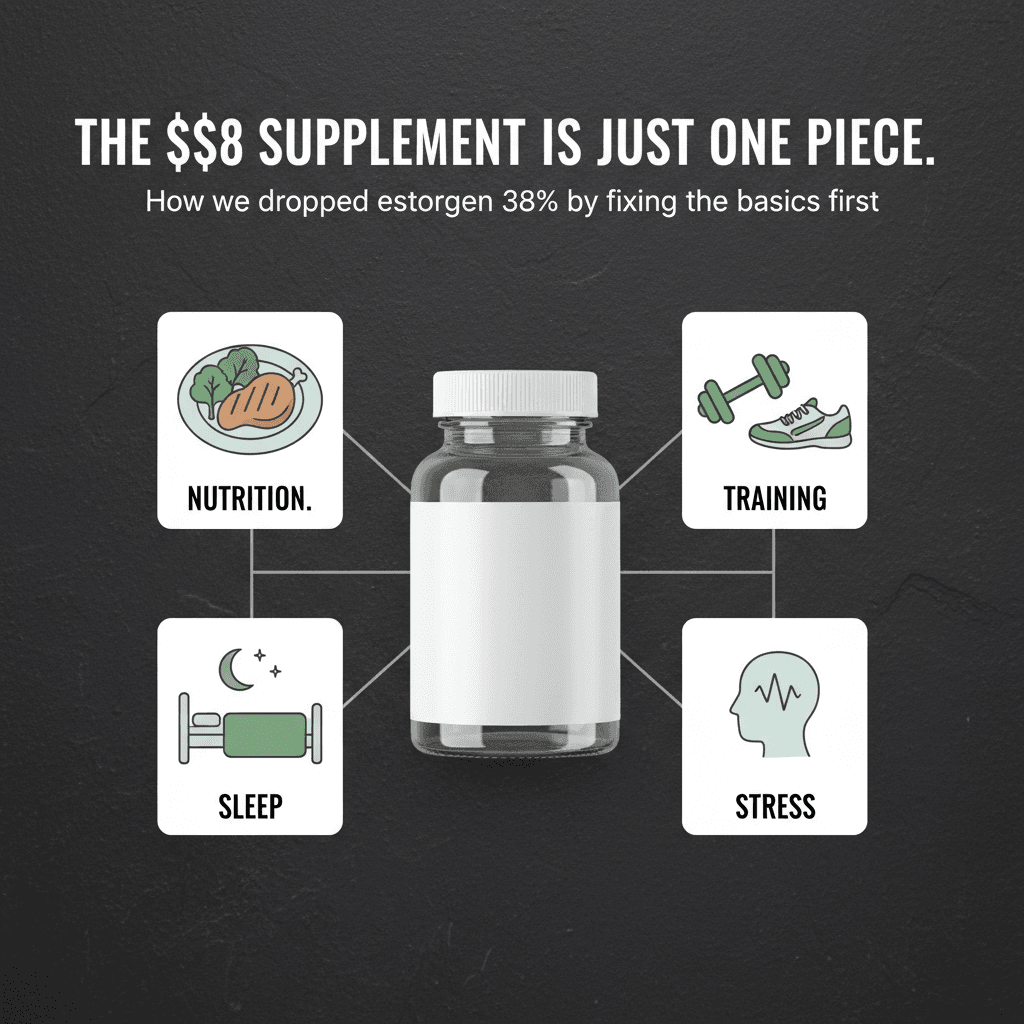
Before reaching for any supplement, whether it costs eight dollars or eighty, the most powerful levers for estrogen management don't come in a bottle.
Body composition matters enormously. Fat tissue, especially visceral fat around the midsection, is metabolically active and highly efficient at converting testosterone to estrogen. Losing excess body fat often reduces estrogen levels naturally, sometimes dramatically. This isn't a quick fix, but it's one of the most reliable long-term strategies.
Alcohol consumption affects estrogen metabolism through multiple pathways. It burdens the liver, which is responsible for clearing used hormones from the body. It can also directly influence aromatase activity. Men who drink frequently often see improvements in their hormone profiles when they cut back or eliminate alcohol entirely.
Sleep, stress management, and inflammation control all influence hormone balance indirectly but meaningfully. Chronic sleep deprivation and elevated cortisol can disrupt the entire endocrine system, making estrogen management harder regardless of what supplements you take.
These fundamentals aren't sexy. They don't promise rapid transformations. But they work, consistently, across populations, in ways that stack with other interventions rather than creating new problems.
Supplement Strategies That Might Help, With Caveats
Beyond lifestyle, certain categories of supplements show up repeatedly in discussions about estrogen management. Without naming specific products or doses, it's worth understanding the general approaches.
Compounds that support liver health and detoxification pathways can help your body process and eliminate estrogen more efficiently. Your liver conjugates estrogen metabolites so they can be excreted, and supporting this process can theoretically improve clearance.
Nutritional components that influence the metabolism of estrogen into different forms might shift the balance toward less active metabolites. Not all estrogen is created equal, and how your body breaks it down matters.
Some plant compounds have weak effects on aromatase activity or estrogen receptor signaling. These effects are nowhere near as powerful as pharmaceutical drugs, which is both their limitation and their advantage. They're less likely to crash your estrogen into the basement.
The critical point is that "natural" doesn't mean risk-free. Supplements can interact with medications, affect liver function, or cause side effects. They can also be contaminated or mislabeled. Taking them seriously means treating them like the biologically active compounds they are, not like harmless food.
Why You Still Need Labs and Professional Guidance
Experimenting blindly with hormones and supplements that affect them is a recipe for confusion at best and harm at worst. You can't feel your estrogen level with precision. Symptoms are suggestive but not diagnostic. Lab work provides objective data, but it needs to be interpreted in context.
Good hormone management involves testing before making changes, implementing one variable at a time when possible, retesting after sufficient time for effects to stabilize, and adjusting based on both labs and symptoms. It requires patience, something that's hard to come by when you feel lousy.
Working with a knowledgeable provider means having someone who understands that hormone optimization isn't about hitting arbitrary numbers. It's about finding the balance where you feel and function best, with sustainable interventions that don't create new problems down the road.
Not all providers approach estrogen this way. Some will reach for AIs at the first sign of elevation. Others might dismiss estrogen concerns entirely. Finding someone who takes a thoughtful, individualized approach makes all the difference.
Smart Optimization Beats Aggressive Intervention
The allure of a quick fix is understandable. You want to feel better now, not months from now. But hormone management is a long game, and aggressive moves often backfire.
That $8 supplement might be worth trying for some men, especially those looking to avoid or reduce AI use, but it should be part of a broader strategy that includes lifestyle optimization, regular monitoring, and professional oversight. It shouldn't be a replacement for medical care or a substitute for addressing root causes.
Estrogen management is ultimately about balance, not elimination. It's about finding what works for your individual biochemistry, your symptoms, and your goals. Some men will need pharmaceutical intervention. Others will do well with gentler approaches. Most will benefit from a combination of smart lifestyle choices, targeted supplementation when appropriate, and regular communication with a provider who actually listens.
If you're navigating TRT and estrogen questions, connecting with a provider through AlphaMD can give you the kind of individualized, thoughtful approach that prioritizes your long-term health over cookie-cutter protocols. The providers who take comprehensive hormone optimization seriously address estrogen intelligently when needed, not reflexively, and support your goals with education and monitoring rather than just writing prescriptions.
That dramatic estrogen drop from an inexpensive supplement might happen for you. It might not. Either way, the goal isn't chasing a specific number. It's feeling like yourself again, sustainably, with a strategy that actually makes sense for your body.
Have a question? Ask us.
At AlphaMD, we're here to help. Feel free to ask us any question you would like about TRT, medical weightloss, ED, or other topics related to men's health. Or take a moment to browse through our past questions.
People are asking...
On daily cypionate and HCG but estrogen is high. Tried examestane and anastrazole which brings down to normal levels but I feel hollow sometimes and a...
It sounds like the goal is to maintain treatment and remove the need for AIs. With that in mind, you could consider reducing your HCG dose unless you're trying to have a child right now, as it can add... See Full Answer
My question is about gyno. Currently I am on my 4th bottle of test. My gyno (I think it’s gyno) started on my second bottle of test, 100mg a week, inj...
Your description of your symptoms is typical for gynecomastia. This is from an excess of estradiol. An AI is commonly considered in cases like yours — something the provider overseeing your care can e... See Full Answer
My question is have you heard of Calcium D-glucarate being substituted instead of an AI? And reducing E levels? My Endo seems to know nothing about AI...
Calcium D-glucarate has been shown to increase the metabolism of estrogen, meaning your body will eliminate it from your system faster. It does nothing to block the conversion of testosterone to estro... See Full Answer
Get $30 off your first month’s order
Enter your email address now to receive $30 off your first month’s cost, other discounts, and additional information about TRT.
Legal Disclaimer
This website is a repository of publicly available information and is not intended to form a physician-patient relationship with any individual. The content of this website is for informational purposes only. The information presented on this website is not intended to take the place of your personal physician's advice and is not intended to diagnose, treat, cure, or prevent any disease. Discuss this information with your own physician or healthcare provider to determine what is right for you. All information is intended for your general knowledge only and is not a substitute for medical advice or treatment for specific medical conditions. The information contained herein is presented in summary form only and intended to provide broad consumer understanding and knowledge. The information should not be considered complete and should not be used in place of a visit, phone or telemedicine call, consultation or advice of your physician or other healthcare provider. Only a qualified physician in your state can determine if you qualify for and should undertake treatment.