
TB-500 and BPC-157: Is the "Wolverine Stack" Supported by Any Human Evidence?
Published on:
Updated on:
People are asking...
Men on TRT getting hair transplants - can they bolster recovery by layering on anything else over TRT? Fin/min is a given....
The peptides GHK-Cu and BPC-157 have shown some benefits in assisting with recovery and regrowth after a hair transplant.... See Full Answer
Is bcp157 only removed from compound pharmacy's?...
From all pharmacies that are for human consumption, though it is still available from locations for not human consumption.... See Full Answer
How about stacking TRT with peptide therapy. Are Sermorelin, Tesamorelin, or CJC w/ Ipamorelin actually safe to use with TRT? What are the real benef...
These are perfectly reasonable options. Currently, licensed providers can prescribe Sermorelin, though not long ago it was permissible to work with the other peptides you mentioned as well. Many men h... See Full Answer
Have a question? Ask us.
At AlphaMD, we're here to help. Feel free to ask us any question you would like about TRT, medical weightloss, ED, or other topics related to men's health. Or take a moment to browse through our past questions.
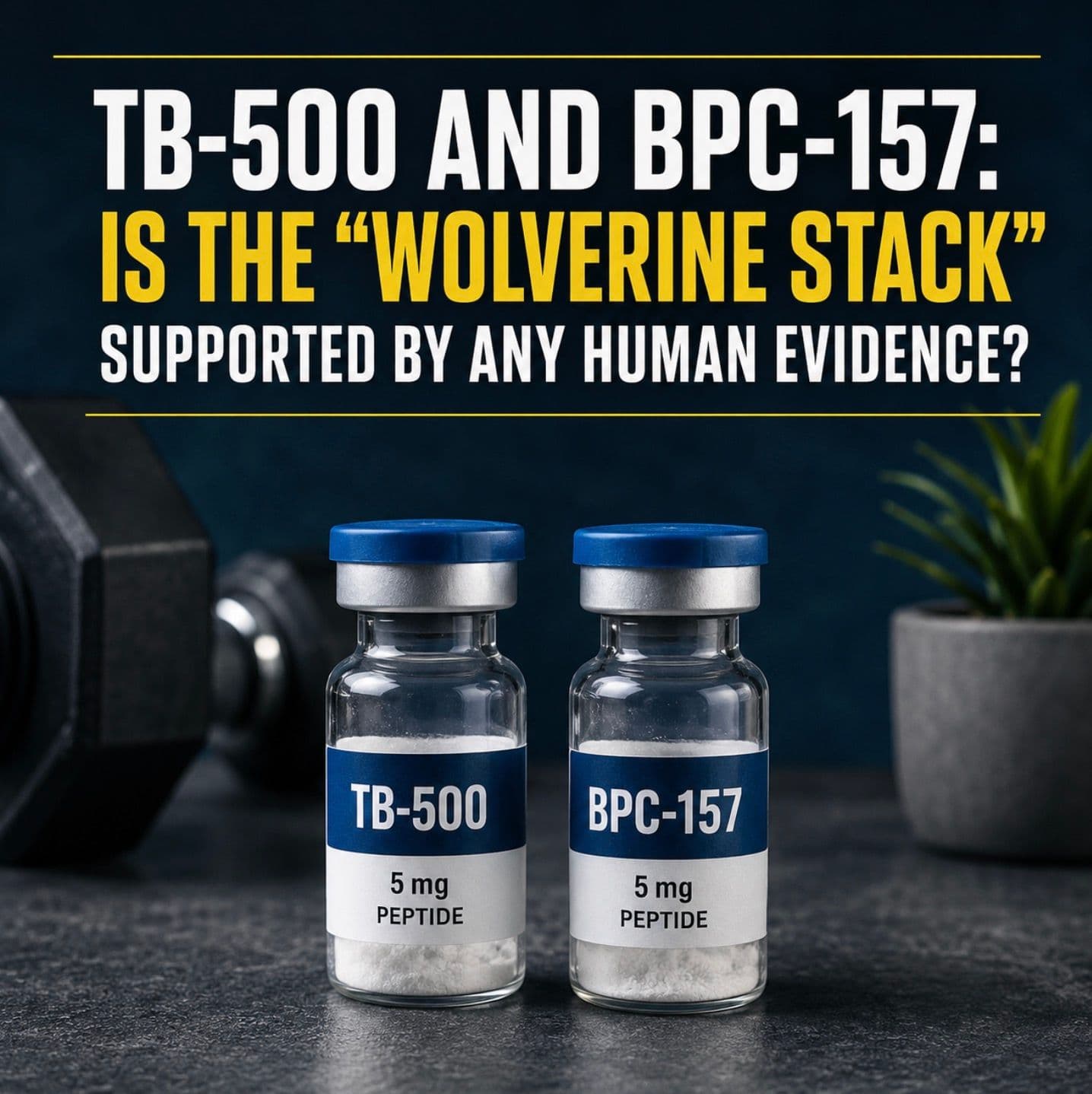
Online recovery communities call it the "Wolverine stack": BPC-157 paired with TB-500, sold together in a single vial and marketed as a combined healing protocol for tendons, ligaments, muscle, and soft tissue. AlphaMD's individual guides to each peptide already note that no adequate clinical trials establish the safety, effectiveness, or interaction profile of this combination. This article goes further and asks the question directly: what happens when two peptides, each already short on human evidence individually, are combined into one product and marketed as though the pairing itself has been tested?
The short answer is that it has not. No study, in any species, has ever compared BPC-157 plus TB-500 against either compound alone or against a placebo. Everything said about the combination is an extrapolation from two separate bodies of single-compound research, and even those individual bodies of research are thinner and more preclinical than most marketing acknowledges.
Why People Combine Them
The pitch behind the Wolverine stack is mechanistic and, on its surface, reasonable: BPC-157 is framed as a "local" repair peptide with gastric and angiogenic origins, while TB-500 is framed as a "systemic" peptide that helps cells migrate to an injury site. Combining a compound that allegedly supports blood vessel formation with one that allegedly supports cell migration sounds like covering two different steps of the same healing process. That framing is also commercially convenient: vendors sell the pair as a single premixed vial, which is easier to market and administer than two separate products. Neither the appeal of the mechanism nor the convenience of the packaging is the same thing as evidence that the combination works, or that it is safe.
The Different Biological Theories Behind Each Peptide
BPC-157 is a synthetic 15-amino-acid sequence originally derived from a protective protein found in human gastric juice. Its proposed mechanisms center on upregulation of growth hormone receptor expression in tendon fibroblasts and activation of the Akt-eNOS angiogenic pathway, meaning it is theorized to promote new blood vessel formation and reduce inflammation at an injury site. Nearly all of this mechanistic work comes from a single research group's decades of rodent studies.
TB-500 is marketed as a synthetic version of thymosin beta-4 (Tβ4), a naturally occurring protein involved in cell migration and wound repair. Here the biological theory gets more complicated than the marketing suggests. Independent laboratory analysis has identified the actual substance in commercial TB-500 as Ac-LKKTETQ, a seven-amino-acid, N-acetylated fragment corresponding to residues 17 through 23 of the full 43-amino-acid Tβ4 protein, not the full protein itself. Review the laboratory identification of TB-500 as the Tβ4 17-23 fragment. This is not a minor technicality. The fragment is roughly one-fifth the mass of the full protein, and it is the full protein, not the small fragment, that carries most of the published wound-healing and human clinical research described below. TB-500's theorized mechanism, binding and sequestering monomeric actin to influence how cells move and remodel their cytoskeleton during repair, is proposed to work differently from BPC-157's angiogenic mechanism, which is the entire rationale offered for stacking them. But a mechanism proposed for the full 43-amino-acid protein does not automatically transfer to a 7-amino-acid fragment of it, and no study has confirmed that the fragment reproduces the parent protein's activity at the doses and routes used in self-administered peptide protocols.
Whether Either Peptide Has Adequate Human Injury Trials
BPC-157: A 2025 systematic review in HSS Journal searched PubMed, Cochrane, and Embase for all English-language BPC-157 literature through June 2024 and found 36 qualifying studies. Thirty-five were preclinical (cell or animal) research. Exactly one was a clinical study, a retrospective case series of 12 patients who received intra-articular BPC-157 injections for unspecified chronic knee pain, of whom 7 reported pain relief lasting more than six months, with no control group and no blinding. The review's authors explicitly reported finding no clinical safety data for BPC-157. Review the systematic review of BPC-157 in orthopedic sports medicine. A separate, small pilot study published in 2025 tested intravenous BPC-157 safety in two healthy adults at doses up to 20 milligrams and found no adverse effects on cardiac, liver, kidney, thyroid, or glucose biomarkers, but it measured safety in healthy volunteers, not healing in injured patients, and involved a total of two people. Review the intravenous BPC-157 human safety pilot study. Twelve uncontrolled patients and two healthy volunteers is the entire published human injury and safety record for a peptide marketed as a tendon and ligament treatment.
TB-500: For the actual commercial substance, the Ac-LKKTETQ fragment, there are zero published human trials of any kind, injury-related or otherwise. AlphaMD's TB-500 benefits and risks overview notes that the FDA has reported it has not identified human exposure data involving drug products containing this fragment. The full-length Tβ4 protein does have a real human clinical trial history, but not for the musculoskeletal injuries the Wolverine stack is marketed for: RegeneRx's RGN-137 topical gel completed Phase 2 trials for pressure ulcers, venous stasis ulcers, and epidermolysis bullosa, and its RGN-259 eye-drop formulation completed three Phase 3 trials for dry eye disease, missing its primary endpoint in the largest trial while showing statistically significant improvement on some secondary symptom measures. Every one of those trials used a topical or ophthalmic formulation of the full 43-amino-acid protein, not an injected fragment for tendon or muscle repair. Even within the legitimate Tβ4 literature, the science has been genuinely contested: an early claim that Tβ4 was essential for cardiac development and repair was later contradicted by independent knockout-mouse studies that found no cardiac effect at all, a reminder that even the better-studied parent molecule has produced conflicting results. Review the knockout-mouse study contradicting earlier Tβ4 cardiac claims. None of this human trial history, contested or not, involved the injected heptapeptide fragment sold as TB-500 for injury recovery.
Whether the Combination Has Ever Been Formally Studied
No. A search of the published literature and clinical trial registries returns no study, in any species, at any dose, that has tested BPC-157 and TB-500 together against either compound alone or against a placebo. Every claim about the Wolverine stack's combined effect is an inference built by placing two separate single-compound literatures side by side and assuming their proposed mechanisms will add together in a living person the way they do on a whiteboard. That assumption has never been tested, which means the "synergy" the name implies is a marketing hypothesis, not a research finding.
Unknown Drug Interactions
Because no study has combined the two peptides, there is no data on what happens when they are given together: whether one affects the other's absorption, breakdown, or activity, whether combined use changes the injection-site or systemic side-effect profile described individually for each peptide, or how either interacts with other medications a patient might already be taking, from anticoagulants to immunosuppressants to the growing list of other unregulated peptides frequently stacked alongside them. The absence of a documented interaction is not the same as a documented absence of interaction. It simply means no one has looked.
Why Two Unproven Compounds Do Not Create a Proven Treatment
It is tempting to reason that if BPC-157 has some preclinical support and TB-500 has some preclinical support, combining them should be at least as good as either one alone. That reasoning does not hold up. Evidence does not add; it has to be generated for the specific thing being claimed. Combining two compounds whose individual human evidence bases are already limited to a handful of small, uncontrolled, or topical-formulation studies does not average out to a moderately-supported treatment. It multiplies the number of untested variables: two unconfirmed mechanisms, two unestablished dosing regimens, two unknown side-effect profiles, and now an unknown interaction between them, all being tested at once on the person using the product. Two unproven compounds used together are not a proven treatment; they are two open questions layered on top of each other.
Product-Quality and Dosing Variables
Because neither peptide is FDA-approved, products marketed as BPC-157 and TB-500 blends are typically sourced from unregulated research-chemical suppliers rather than licensed pharmacies. The FDA has specifically warned that compounded and research-grade peptide products carry risks around sterility, accurate labeling, and impurity profiles. Review the FDA overview of the risks of compounded drugs. A premixed two-peptide vial adds an additional layer of uncertainty on top of those general concerns: the two peptides can have different stability profiles and degrade at different rates once combined in solution, a single certificate of analysis for a blended product may not verify the potency of each component separately, and a patient experiencing a side effect from a combined vial has no way to determine which peptide, or which contaminant, was responsible. Both substances are also prohibited under the World Anti-Doping Agency's rules, which matters for any competitive athlete considering the stack regardless of the underlying science. Review the current WADA Prohibited List.
Why Testimonials Are Particularly Unreliable When Several Interventions Are Used Together
Testimonials for any single unproven peptide already carry the usual problems: no control group, no blinding, and a strong incentive for people who feel better to post about it while people who do not simply move on. Stacking compounds multiplies this problem rather than adding useful information to it.
- Multiple simultaneous variables: People who start a Wolverine stack rarely change only one thing. They typically also begin or intensify physical therapy, rest the injured area more deliberately, adjust their training load, and sometimes add other supplements or peptides at the same time. If the injury improves, there is no way to know whether BPC-157, TB-500, the combination of both, the physical therapy, the rest, or simple time did the healing.
- Natural healing and regression to the mean: Most soft-tissue injuries improve on their own over the weeks a typical peptide protocol runs. People tend to start a new intervention near their worst point of pain or dysfunction, which means substantial improvement is statistically likely regardless of what was injected.
- No way to attribute a result to either compound: Even setting aside every other confounder, a positive testimonial for the combination cannot tell a reader whether BPC-157 alone, TB-500 alone, or neither would have produced the same result, since almost no one running the stack also runs a matched trial of each compound separately on themselves.
A testimonial about a two-compound, unregulated, uncontrolled protocol layered on top of physical therapy and rest is one of the weakest forms of evidence available, and it is exactly the form of evidence the Wolverine stack's reputation is built on.
The Bottom Line
BPC-157 and TB-500 each have a real, if limited and largely preclinical, individual research record. BPC-157's human evidence amounts to one uncontrolled 12-patient case series and a two-person safety pilot. TB-500, as actually sold, has no published human studies at all; the human trials sometimes cited in its defense were conducted on a different, much larger molecule in topical and ophthalmic formulations for different conditions. No study of any kind has ever tested the two compounds together. There are no adequate clinical trials establishing the safety, effectiveness, or interaction profile of the BPC-157 and TB-500 combination, and combining two compounds that are each individually unproven does not create a treatment that is proven. Testimonials describing dramatic recoveries on the stack are typically confounded by physical therapy, rest, and natural healing, and cannot distinguish which component, if any, was responsible for the result.
For a closer look at each compound individually, see AlphaMD's TB-500 benefits, risks, and side effects overview, AlphaMD's BPC-157 benefits, risks, and FDA review, and AlphaMD's report on the FDA advisory vote involving BPC-157, TB-500, KPV, and MOTS-c.
Medical disclaimer: This article is for informational purposes only and does not constitute medical advice. Neither BPC-157 nor TB-500 is currently an FDA-approved drug. Speak with a licensed medical provider before using any medication, peptide, supplement, or injectable product, alone or in combination.
Have a question? Ask us.
At AlphaMD, we're here to help. Feel free to ask us any question you would like about TRT, medical weightloss, ED, or other topics related to men's health. Or take a moment to browse through our past questions.
People are asking...
Men on TRT getting hair transplants - can they bolster recovery by layering on anything else over TRT? Fin/min is a given....
The peptides GHK-Cu and BPC-157 have shown some benefits in assisting with recovery and regrowth after a hair transplant.... See Full Answer
Is bcp157 only removed from compound pharmacy's?...
From all pharmacies that are for human consumption, though it is still available from locations for not human consumption.... See Full Answer
How about stacking TRT with peptide therapy. Are Sermorelin, Tesamorelin, or CJC w/ Ipamorelin actually safe to use with TRT? What are the real benef...
These are perfectly reasonable options. Currently, licensed providers can prescribe Sermorelin, though not long ago it was permissible to work with the other peptides you mentioned as well. Many men h... See Full Answer
Get $30 off your first month’s order
Enter your email address now to receive $30 off your first month’s cost, other discounts, and additional information about TRT.
Legal Disclaimer
This website is a repository of publicly available information and is not intended to form a physician-patient relationship with any individual. The content of this website is for informational purposes only. The information presented on this website is not intended to take the place of your personal physician's advice and is not intended to diagnose, treat, cure, or prevent any disease. Discuss this information with your own physician or healthcare provider to determine what is right for you. All information is intended for your general knowledge only and is not a substitute for medical advice or treatment for specific medical conditions. The information contained herein is presented in summary form only and intended to provide broad consumer understanding and knowledge. The information should not be considered complete and should not be used in place of a visit, phone or telemedicine call, consultation or advice of your physician or other healthcare provider. Only a qualified physician in your state can determine if you qualify for and should undertake treatment.