
FDA Panel Backs BPC-157, TB-500, KPV, and MOTS-c: What Happens Next?
Published on:
Updated on:
People are asking...
Do you think any other compounds that are available for medical use in other countries in the past or currently like primobolan or paranolan can becom...
Regulations change almost monthly, so you never know. It would likely take a large study showing significant benefit in order to change the FDA’s and DEA’s mind on medicines like Primobolan. Even then... See Full Answer
Men on TRT getting hair transplants - can they bolster recovery by layering on anything else over TRT? Fin/min is a given....
The peptides GHK-Cu and BPC-157 have shown some benefits in assisting with recovery and regrowth after a hair transplant.... See Full Answer
What are the best peptides to pair with TRT for getting lean?...
In terms of current official pharmacy offerings, providers often recommend Sermorelin as a good boost. Anecdotally, Ipamorelin / CJC with or without dac is often described as a solid peptide for fitne... See Full Answer
Have a question? Ask us.
At AlphaMD, we're here to help. Feel free to ask us any question you would like about TRT, medical weightloss, ED, or other topics related to men's health. Or take a moment to browse through our past questions.
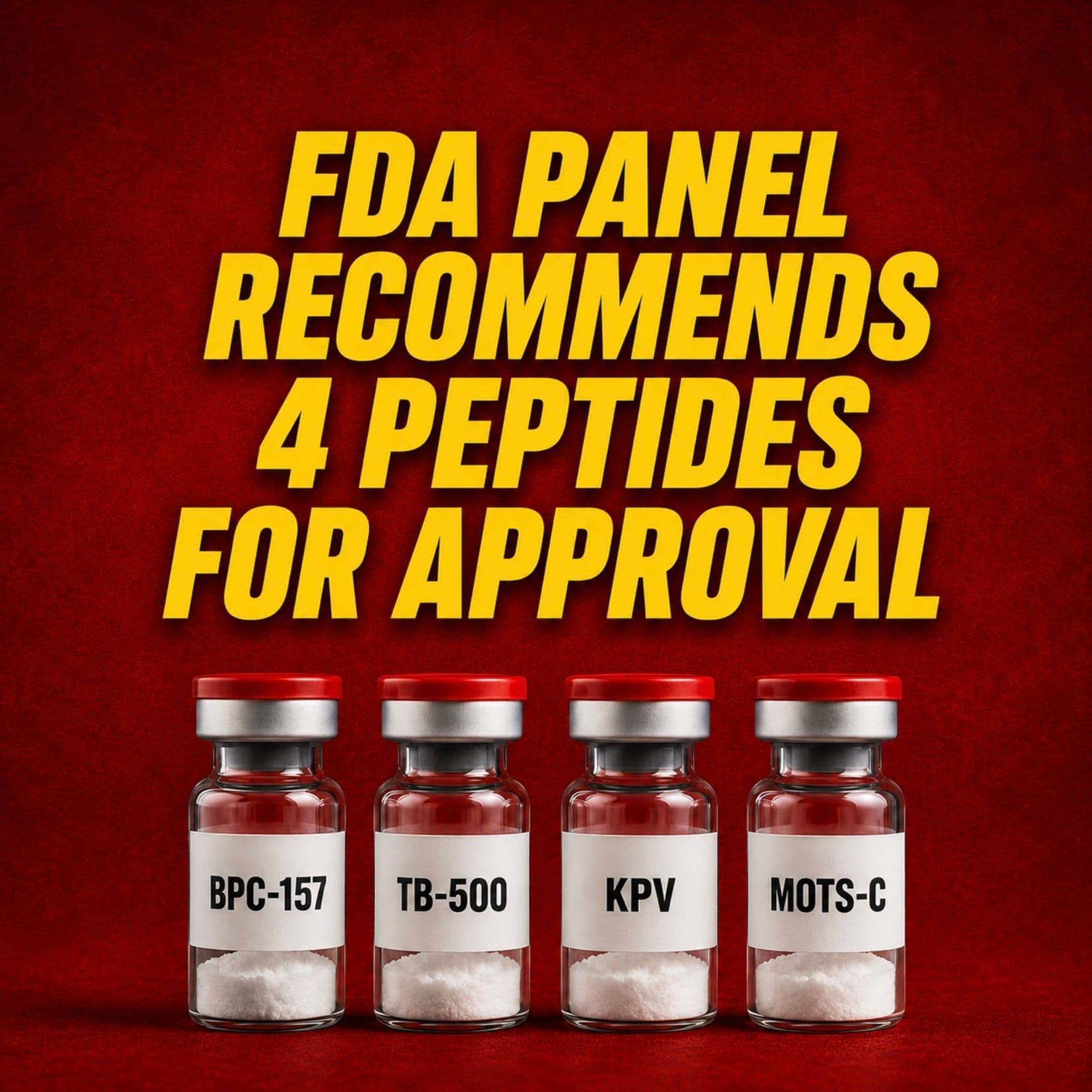
An FDA advisory committee has recommended allowing four popular peptides to move forward toward possible inclusion on the 503A Bulks List. Here is what the vote means, what it does not mean, and when access could realistically change.
Did the FDA Legalize BPC-157, TB-500, KPV and MOTS-c?
The answer is no.
The FDA did not legalize or approve BPC-157, TB-500, KPV, or MOTS-c on July 23, 2026.
Instead, the FDA’s Pharmacy Compounding Advisory Committee voted to recommend that these four peptides be included on the agency’s 503A Bulks List.
If the FDA ultimately accepts the recommendations and completes the necessary regulatory process, licensed 503A compounding pharmacies could eventually be permitted to prepare these peptides for individual patients with valid prescriptions.
For now, however:
- The FDA has not issued a final decision.
- The 503A Bulks List has not been updated.
- The peptides remain unapproved drugs.
- Pharmacies cannot begin compounding them simply because of the committee vote.
- The vote does not create a general right to purchase or use the peptides.
The recommendations represent a potentially important change in direction, but they are only one step in a longer regulatory process.
What Did the FDA Advisory Committee Vote On?
During the first day of its July 23–24 meeting, the Pharmacy Compounding Advisory Committee reviewed four groups of peptide-related bulk drug substances:
- BPC-157 free base and BPC-157 acetate
- KPV free base and KPV acetate
- TB-500 free base and TB-500 acetate
- MOTS-c free base and MOTS-c acetate
According to Reuters’ coverage of the FDA peptide votes, the committee voted in favor of adding all four to the 503A Bulks List.
The votes were:
- BPC-157: 8 in favor, 6 against, 1 abstention
- KPV: 8 in favor, 6 against, 1 abstention
- TB-500: 8 in favor, 6 against, 1 abstention
- MOTS-c: 7 in favor, 5 against, 2 abstentions
The relatively close results show that the committee was divided.
Members who supported inclusion emphasized the demand for these peptides and the potential safety advantages of moving patients away from unregulated research-chemical suppliers and toward licensed pharmacies.
Members who opposed inclusion raised concerns about limited human clinical evidence, uncertain dosing, product characterization, immunogenicity, and whether consumer demand was moving faster than the science.
The FDA’s own staff had recommended against adding the peptides to the list because of the limited evidence available to establish their safety and effectiveness.
What Is the FDA 503A Bulks List?
The 503A Bulks List is not a list of FDA-approved medications.
Section 503A of the Federal Food, Drug, and Cosmetic Act provides a pathway through which state-licensed pharmacies and qualifying physicians may compound medications for identified individual patients under specific conditions.
The FDA’s explanation of compounding under Section 503A outlines the requirements that apply to patient-specific compounded drugs.
In general, a compounding pharmacy cannot use just any bulk drug substance. The substance must meet one of the conditions established under federal law, such as:
- Being the active ingredient in an FDA-approved drug
- Having an applicable United States Pharmacopeia or National Formulary monograph
- Appearing on the FDA’s final 503A Bulks List
The advisory committee was considering whether the reviewed peptide substances should qualify through that third pathway.
Is Inclusion on the 503A Bulks List the Same as FDA Approval?
No.
This is the most important distinction in the entire story.
An FDA-approved drug has gone through a formal review process in which the agency evaluates evidence supporting its safety, effectiveness, manufacturing quality, labeling, and intended medical use.
A compounded drug is different.
Compounded medications are prepared for individual patients based on prescriptions when a licensed medical provider determines that a patient has a clinical need that cannot be met by an available FDA-approved product.
Compounded drugs are not reviewed and approved by the FDA in the same manner as commercially approved medications.
Therefore, even if BPC-157, TB-500, KPV, or MOTS-c are eventually added to the 503A Bulks List:
- They would not become FDA-approved drugs.
- The FDA would not be endorsing their use for specific medical conditions.
- Compounded versions would not have FDA-approved prescribing information.
- Their safety and effectiveness would not have been established through the traditional drug approval process.
- They would still need to be prescribed and compounded in compliance with applicable federal and state requirements.
The vote concerns whether pharmacies may be allowed to compound these substances. It does not establish that the substances are safe or effective treatments for any particular condition.
Are BPC-157, TB-500, KPV, and MOTS-c FDA Approved?
No. None of the four peptides is currently approved by the FDA for a medical indication.
BPC-157
- FDA-approved drug: No
- Added to the final 503A Bulks List: Not yet
- Advisory committee recommendation: Yes
TB-500
- FDA-approved drug: No
- Added to the final 503A Bulks List: Not yet
- Advisory committee recommendation: Yes
KPV
- FDA-approved drug: No
- Added to the final 503A Bulks List: Not yet
- Advisory committee recommendation: Yes
MOTS-c
- FDA-approved drug: No
- Added to the final 503A Bulks List: Not yet
- Advisory committee recommendation: Yes
The committee vote did not immediately change any of these regulatory facts.
Is BPC-157 Legal Now?
The question does not have a simple universal yes-or-no answer because “legal” can refer to several different activities, including possession, prescribing, pharmacy compounding, manufacturing, importing, marketing, or athletic use.
What can be said clearly is that the advisory committee vote did not make BPC-157 an FDA-approved drug and did not immediately authorize routine 503A compounding.
The same applies to TB-500, KPV, and MOTS-c.
A committee recommendation is not a final rule, approval, enforcement policy, or authorization for pharmacies to begin dispensing a substance.
Patients should be skeptical of advertisements claiming that the FDA has now “approved,” “legalized,” or “cleared” these peptides. Those descriptions overstate what occurred.
Can Doctors Prescribe These Peptides Now?
The July 23 vote did not itself create a new prescribing or compounding pathway.
A prescription alone does not automatically make it lawful for a pharmacy to compound a medication from a particular bulk substance. The pharmacy must also satisfy federal law, state pharmacy rules, sourcing requirements, quality standards, and the conditions that apply to the bulk substance being used.
If the FDA eventually adds these peptides to the final 503A Bulks List, appropriately licensed pharmacies may be able to prepare patient-specific prescriptions under the applicable requirements.
Until that happens, the committee vote does not independently authorize a clinician or pharmacy to begin offering them.
Does the FDA Have to Follow the Committee’s Recommendation?
No.
FDA advisory committees provide outside scientific, medical, and technical advice. Their votes are influential, but they are not legally binding.
The FDA’s overview of its advisory committees explains that the committees make recommendations while the agency retains responsibility for the final regulatory decision.
The FDA could:
- Accept all four recommendations
- Accept some recommendations and reject others
- Decline to move any of the substances forward
- Ask for additional scientific or manufacturing information
- Reevaluate the nominated uses, formulations, or routes of administration
- Delay a decision while it conducts further review
The favorable votes increase the likelihood of future action, but they do not guarantee it.
What Happens Next?
The committee vote completed an important step, but several additional steps may remain.
Step 1: Advisory Committee Review
Status: Completed
The committee reviewed the substances and voted in favor of recommending BPC-157, KPV, TB-500, and MOTS-c for inclusion on the 503A Bulks List.
Step 2: FDA Evaluation
Status: Next
The FDA will consider the committee’s recommendations together with:
- FDA staff assessments
- Scientific literature
- Safety information
- Human exposure data
- Product characterization concerns
- Proposed routes of administration
- Public comments
- Statements from the substances’ nominators
- Information presented during the committee meeting
The agency is not limited to a simple yes-or-no acceptance of the committee vote.
Step 3: FDA Regulatory Decision
The FDA must decide whether to move forward with one or more of the recommended substances.
The agency may treat the peptides differently based on their individual evidence, proposed uses, formulations, and safety concerns.
A favorable vote for all four does not necessarily mean all four will move forward together.
Step 4: Formal Rulemaking
If the FDA decides that a substance should be added to the 503A Bulks List, the agency would generally need to complete the required federal rulemaking process.
That process may include:
- Publishing a proposed rule
- Explaining the agency’s reasoning
- Opening a public-comment period
- Reviewing submitted comments
- Publishing a final rule
- Establishing an effective date
The substance would not be formally added to the final list until the applicable process is completed.
Step 5: Pharmacy and State-Level Implementation
Even after federal action, pharmacies would need to determine whether and how they could lawfully compound the peptides.
They would still need to comply with:
- State pharmacy laws
- Prescription requirements
- Patient-specific compounding rules
- Ingredient sourcing standards
- Quality and sterility requirements
- Applicable professional licensing rules
- Any conditions imposed by the FDA
Availability could therefore differ by pharmacy and state.
When Could BPC-157 Become Available Through Compounding Pharmacies?
The FDA has not announced an official timeline.
Any prediction should therefore be treated as an estimate, not a promised date.
The process is unlikely to be completed within days or a few weeks. If the FDA accepts a recommendation and proceeds through formal rulemaking, a realistic timeline would more likely be measured in months and could extend beyond a year.
A possible sequence is:
Near term: FDA review
The agency evaluates the committee’s recommendations and decides whether to advance one or more substances.
Following months: Proposed regulatory action
If the FDA moves forward, it may publish a proposed rule or other formal notice explaining the intended change.
Later stage: Public comments and final rule
The FDA reviews comments and determines whether to issue a final rule adding the substances to the 503A Bulks List.
Final stage: Pharmacy availability
Eligible pharmacies assess the final requirements, secure appropriate ingredients, validate their processes, and determine whether state law permits them to offer the compounded medication.
The earliest meaningful signal will be a formal announcement from the FDA. Until then, claims that these peptides will become legally available on a particular date are speculative.
Why Is This Vote So Significant?
The FDA has taken a cautious approach toward many compounded peptides because of concerns involving limited human data, immunogenicity, impurities, manufacturing consistency, and active pharmaceutical ingredient characterization.
The agency’s published safety concerns involving bulk drug substances used in compounding include concerns related to BPC-157, TB-500, and MOTS-c.
Against that background, four favorable advisory committee votes are notable.
The committee’s recommendation suggests that a majority of voting members believed a regulated compounding pathway could be preferable to leaving demand entirely within an unregulated or poorly regulated gray market.
Supporters argue that access through licensed pharmacies could provide:
- Better product traceability
- More consistent sourcing
- Professional pharmacy oversight
- Patient-specific prescriptions
- Greater accountability
- A pathway for reporting adverse events
- Reduced reliance on products labeled “for research use only”
Opponents argue that pharmacy compounding should not become a substitute for clinical trials and FDA drug approval.
They emphasize that regulated production cannot answer unanswered questions about:
- Effective doses
- Long-term safety
- Drug interactions
- Appropriate patient selection
- Differences between administration routes
- Risks associated with repeated exposure
- Whether the peptides produce meaningful clinical benefits
Both points can be true. A regulated pharmacy pathway may reduce some product-quality risks, while major questions about clinical safety and effectiveness remain unresolved.
What Could This Mean for Patients?
If the FDA ultimately accepts the recommendations, patients may eventually have a more structured pathway for accessing these peptides.
Potential changes could include:
- Access through licensed compounding pharmacies
- Prescriptions connected to an identified patient
- Greater involvement from licensed medical providers
- Improved sourcing and product traceability
- Reduced dependence on research-chemical websites
- More consistent pharmacy documentation
- Better mechanisms for identifying and reporting adverse reactions
However, access through a compounding pharmacy would not eliminate all risk.
Patients would still need to understand that these substances are unapproved drugs with limited clinical evidence. Pharmacy compounding can improve control over how a product is prepared, but it does not prove that the treatment works or establish its long-term safety.
What Could This Mean for Peptide Clinics and Telehealth Companies?
A final FDA decision in favor of compounding could create a clearer pathway for licensed clinics and telehealth companies interested in offering physician-directed peptide care.
However, companies would still need to consider:
- State-by-state prescribing laws
- Telehealth requirements
- Pharmacy partnerships
- Medical licensing
- Advertising restrictions
- Informed-consent standards
- Product sourcing
- Clinical protocols
- Documentation and monitoring
- Restrictions affecting competitive athletes
Businesses should not treat the advisory committee vote as permission to begin advertising the peptides as FDA approved or immediately available.
Any claims about treatment benefits would also need to accurately reflect the limited evidence and unapproved status of the products.
What Does the Vote Mean for the Peptide Gray Market?
The gray market is one of the central issues behind this regulatory debate.
BPC-157, TB-500, and other experimental peptides are widely advertised online, often as research chemicals that are supposedly not intended for human use. Consumers may have limited information about the manufacturer, ingredient identity, concentration, sterility, or presence of contaminants.
Supporters of 503A inclusion argue that prohibiting pharmacy compounding does not eliminate demand. Instead, they say, it may push consumers toward less accountable sources.
If the FDA allows regulated compounding, some consumers may shift away from research suppliers and toward prescriptions filled by licensed pharmacies.
That could improve traceability and oversight, but it would not eliminate unauthorized online sales. Enforcement, consumer education, and clinical research would still be necessary.
What About Athletic and Anti-Doping Rules?
FDA status and anti-doping status are separate issues.
A substance can be lawfully prescribed or compounded and still be prohibited in competitive sports.
Athletes subject to drug testing should review the current rules that apply to their sport and consult qualified anti-doping resources before using any peptide or performance-related substance.
An FDA decision allowing compounding would not automatically make BPC-157, TB-500, or another peptide acceptable under World Anti-Doping Agency, professional league, collegiate, military, or individual sports-organization rules.
What the Advisory Committee Vote Does Not Mean
The July 23 recommendation does not mean:
- BPC-157 has received FDA approval.
- TB-500 has received FDA approval.
- KPV has received FDA approval.
- MOTS-c has received FDA approval.
- The FDA has confirmed that the peptides are safe.
- The FDA has confirmed that the peptides are effective.
- The peptides can now be purchased legally without a prescription.
- Every physician can begin prescribing them.
- Every compounding pharmacy can begin preparing them.
- The FDA is required to accept the committee’s recommendations.
- The peptides are permitted for tested athletes.
- A final regulatory timeline has been established.
Frequently Asked Questions
Did the FDA approve BPC-157?
No. The FDA advisory committee recommended that BPC-157-related bulk drug substances be included on the 503A Bulks List. That is not FDA drug approval.
Is BPC-157 legal after the FDA vote?
The vote did not change BPC-157’s regulatory status by itself. The FDA must make a final decision and complete any required regulatory process before routine 503A compounding could become permissible.
Did the FDA approve TB-500?
No. The committee recommended TB-500 for inclusion on the 503A Bulks List, but TB-500 remains an unapproved drug.
What happened with KPV?
The committee voted 8–6, with one abstention, in favor of recommending KPV-related bulk drug substances for inclusion on the 503A Bulks List.
What happened with MOTS-c?
The committee voted 7–5, with two abstentions, in favor of recommending MOTS-c-related bulk drug substances for inclusion on the list.
Can compounding pharmacies sell these peptides now?
The advisory committee vote alone does not authorize pharmacies to begin routine compounding. The FDA must act on the recommendations and complete the applicable regulatory process.
Does a patient need a prescription under Section 503A?
Section 503A generally concerns patient-specific compounding based on the receipt of a valid prescription or a qualifying anticipatory-compounding circumstance associated with identified patients.
When will the FDA make its final decision?
The FDA has not announced a deadline or final-decision date.
Could the FDA reject the recommendations?
Yes. Advisory committee votes are non-binding. The FDA may accept, modify, delay, or reject the recommendations.
Would the peptides become FDA approved if added to the list?
No. Inclusion on the 503A Bulks List would create a potential compounding pathway. It would not constitute FDA approval of the peptides as commercial drugs.
Bottom Line: What Patients Should Know
The FDA advisory committee’s favorable votes are an important development for BPC-157, TB-500, KPV, and MOTS-c, but they are not the final regulatory decision.
The votes make future pharmacy compounding more plausible. They do not make it immediately permissible.
The FDA must now evaluate the recommendations and decide whether to begin the formal process of adding any of the substances to the 503A Bulks List. If it moves forward, proposed rulemaking, public comments, a final rule, state requirements, and pharmacy implementation may still stand between the committee vote and actual patient access.
For now, the most accurate conclusion is:
BPC-157, TB-500, KPV, and MOTS-c may be one step closer to a regulated compounding pathway, but they have not been FDA approved, legalized for unrestricted use, or made immediately available through compounding pharmacies.
Patients should avoid products advertised as newly “FDA approved” because of this vote and should discuss any peptide use with a qualified licensed medical provider.
Readers can follow future developments through the FDA’s official July 2026 Pharmacy Compounding Advisory Committee meeting page.
Have a question? Ask us.
At AlphaMD, we're here to help. Feel free to ask us any question you would like about TRT, medical weightloss, ED, or other topics related to men's health. Or take a moment to browse through our past questions.
People are asking...
Do you think any other compounds that are available for medical use in other countries in the past or currently like primobolan or paranolan can becom...
Regulations change almost monthly, so you never know. It would likely take a large study showing significant benefit in order to change the FDA’s and DEA’s mind on medicines like Primobolan. Even then... See Full Answer
Men on TRT getting hair transplants - can they bolster recovery by layering on anything else over TRT? Fin/min is a given....
The peptides GHK-Cu and BPC-157 have shown some benefits in assisting with recovery and regrowth after a hair transplant.... See Full Answer
What are the best peptides to pair with TRT for getting lean?...
In terms of current official pharmacy offerings, providers often recommend Sermorelin as a good boost. Anecdotally, Ipamorelin / CJC with or without dac is often described as a solid peptide for fitne... See Full Answer
Get $30 off your first month’s order
Enter your email address now to receive $30 off your first month’s cost, other discounts, and additional information about TRT.
Legal Disclaimer
This website is a repository of publicly available information and is not intended to form a physician-patient relationship with any individual. The content of this website is for informational purposes only. The information presented on this website is not intended to take the place of your personal physician's advice and is not intended to diagnose, treat, cure, or prevent any disease. Discuss this information with your own physician or healthcare provider to determine what is right for you. All information is intended for your general knowledge only and is not a substitute for medical advice or treatment for specific medical conditions. The information contained herein is presented in summary form only and intended to provide broad consumer understanding and knowledge. The information should not be considered complete and should not be used in place of a visit, phone or telemedicine call, consultation or advice of your physician or other healthcare provider. Only a qualified physician in your state can determine if you qualify for and should undertake treatment.