
He Tried Antidepressants for 3 Years. TRT Fixed His Depression in 3 Weeks. Here's the Science Behind Why.
Published on:
Updated on:
People are asking...
I’ve been struggling with a lot of depression and anxiety for 10 years on various medications. Believing that my hormones could have been unbalanced ...
Anxiety and depression are known symptoms of hypogonadism. However, they are rarely the only symptoms. While it’s true your level of 377 is on the lower end of the “normal” range, in the absence of ot... See Full Answer
Hi im questioning if i could benefit from trt. I'm 34m. 6' tall, 191lbs. in my late 20's i decided to try aas. since coming off my life has been a ro...
So the main questions here, did you feel good on AAS? How long ago was that? Typically with any steroid (Testosterone included, though we tend to not think of it as one) you'll have some natural suppr... See Full Answer
I felt great on aas. Physically and mentally. I never felt bad or lacked ambition anyway, but it made me more confident. Broke plateaus in the gym. Ma...
Great explanation. You felt better when your T was higher, it was good for your life, though the AAS were potentially illegal or bad for your organs. It was good that you swapped providers to someone ... See Full Answer
Have a question? Ask us.
At AlphaMD, we're here to help. Feel free to ask us any question you would like about TRT, medical weightloss, ED, or other topics related to men's health. Or take a moment to browse through our past questions.
Three years of antidepressants, a drawer full of therapy worksheets, and a mood that never quite lifted - then, within weeks of starting testosterone replacement therapy, a man feels like himself again. Stories like this are becoming harder to ignore, and the science behind them is more nuanced than either the skeptics or the enthusiasts want to admit.
When Depression Is Not Quite Depression
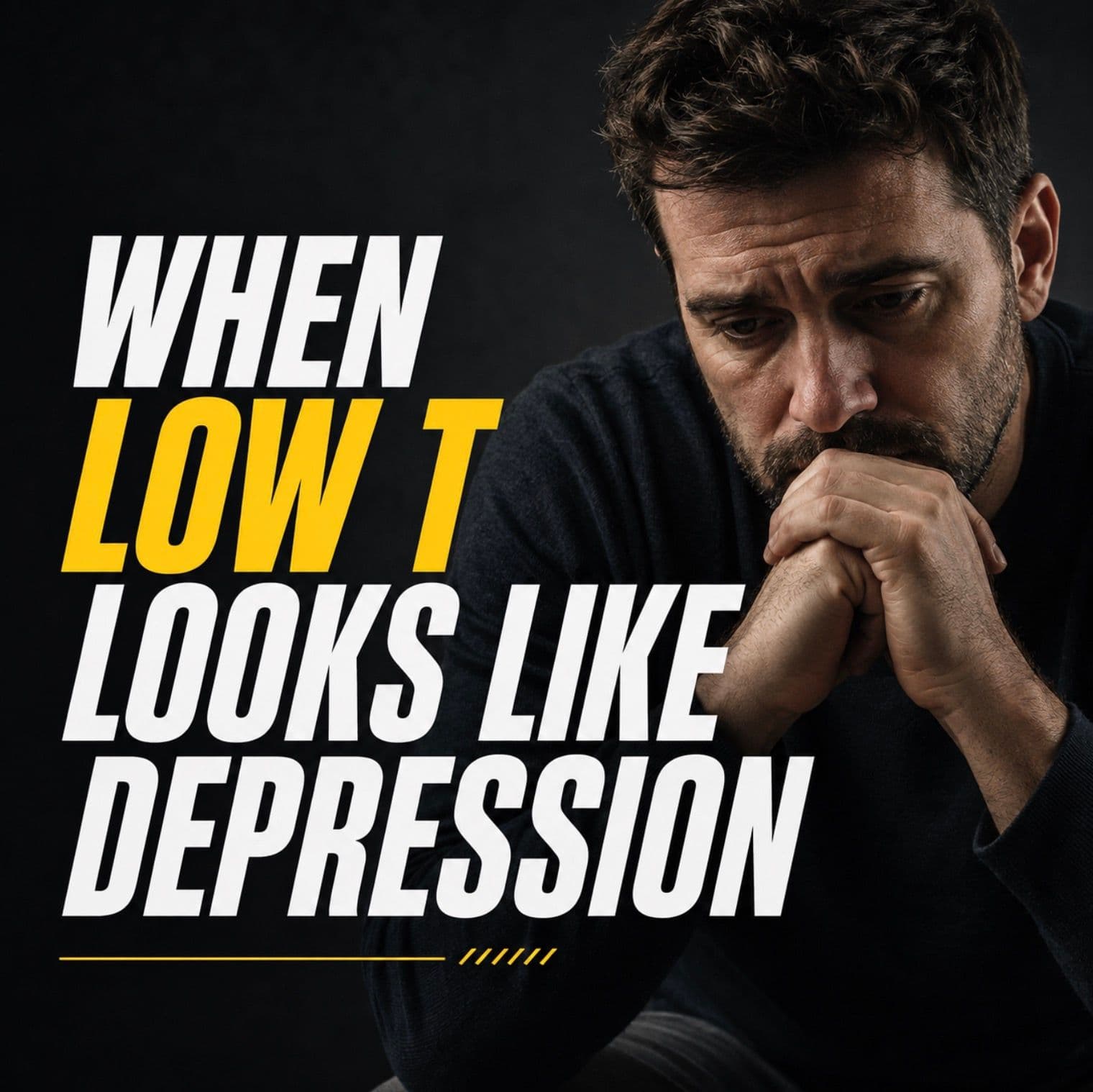
Major depressive disorder is a real, serious, and biologically complex condition. It involves disrupted neurotransmitter systems, altered brain structure over time, and often requires sustained psychiatric care. But there is a category of men who walk into a doctor's office reporting low mood, crushing fatigue, brain fog, zero motivation, poor sleep, reduced libido, and a general sense that the life has been drained out of them - and they get diagnosed with depression, because those symptoms fit the checklist.
The problem is that those same symptoms are also the textbook presentation of hypogonadism, the clinical term for chronically low testosterone. When the root cause is hormonal rather than purely psychiatric, antidepressants may do very little because they are treating the wrong system entirely.
This is not an argument against antidepressants. For millions of people, they are genuinely life-changing. But symptom overlap between hypogonadism and depression is substantial enough that clinicians and researchers have increasingly called for better hormonal screening before or alongside psychiatric treatment in men presenting with these complaints.
The Brain Has Androgen Receptors for a Reason
Testosterone does not just build muscle and drive libido. Androgen receptors are distributed throughout the brain, including in the prefrontal cortex, the hippocampus, and the amygdala - regions that govern mood regulation, memory, emotional reactivity, and executive function. When testosterone levels are low, these regions are operating in a suboptimal hormonal environment.
Research published in journals indexed by the National Institutes of Health has found associations between low testosterone and increased rates of depressive symptoms in men, with some studies showing that hormonal optimization can meaningfully reduce those symptoms in men who are genuinely hypogonadal. This is not a placebo story. The receptors are there, the hormonal signal matters, and restoring adequate levels can produce measurable changes in how the brain functions.
The speed at which some men report mood improvement after starting testosterone replacement therapy is itself telling. Antidepressants typically require weeks to months to produce noticeable effects because they rely on gradual receptor adaptation and neuroplasticity changes. Hormonal optimization, when it is addressing an actual deficiency, can begin influencing neurotransmitter activity, energy metabolism, and sleep architecture relatively quickly - which may explain why some men notice a difference within the first few weeks.
Dopamine, Serotonin, and the Hormonal Connection
Testosterone influences neurotransmitter systems in ways that are still being mapped by researchers, but the broad outlines are becoming clearer. Testosterone modulates dopaminergic activity - the reward, motivation, and drive system that is blunted in depression. Low testosterone has been associated with reduced dopamine receptor sensitivity, which creates a state that feels very much like anhedonia: the inability to feel pleasure or motivation even when life circumstances are objectively fine.
The serotonin connection is more indirect but still relevant. Testosterone appears to influence the availability of serotonin precursors and the sensitivity of serotonin receptors. This may partially explain why some men on antidepressants that target serotonin (SSRIs) see limited results - if the underlying hormonal environment is suppressing receptor sensitivity, the medication has less to work with.
There is also an inflammation angle. Chronically low testosterone is associated with elevated systemic inflammation, and inflammation is increasingly understood as a contributor to depression. Cytokines - the signaling proteins of the immune system - can cross the blood-brain barrier and directly affect mood-regulating circuits. Restoring testosterone to an optimal range can reduce some inflammatory markers, which may contribute to the mood-stabilizing effects observed clinically.
The HPA Axis, Stress, and Why Low T Men Feel Burned Out
The hypothalamic-pituitary-adrenal (HPA) axis governs the stress response, and it interacts directly with the hypothalamic-pituitary-gonadal (HPG) axis that regulates testosterone production. Chronic stress suppresses testosterone production. Low testosterone, in turn, can amplify the stress response, creating a feedback loop that leaves men feeling perpetually overwhelmed, emotionally reactive, and exhausted even without obvious external stressors.
This is why hypogonadal men often describe their experience not just as sadness, but as a kind of existential depletion. The battery is always low. Recovery from normal daily stressors takes longer. The resilience that used to feel automatic has disappeared. These are not personality failings. They reflect a hormonal environment that is dysregulating the systems designed to manage stress and recovery.
The Mayo Clinic notes that hypogonadism can manifest as depression, difficulty concentrating, and sleep disturbances - symptoms that are routinely misattributed to psychiatric conditions without adequate hormonal evaluation.
Sleep, Body Composition, and the Downstream Effects
Sleep is where a great deal of testosterone production occurs, and poor sleep suppresses testosterone levels. Low testosterone, in turn, worsens sleep quality and is associated with increased risk of sleep apnea. This bidirectional relationship means that a man with low testosterone may find himself in a cycle of poor sleep and declining hormonal output that is nearly impossible to interrupt through lifestyle changes alone.
Body composition is another layer. Low testosterone promotes fat accumulation, particularly visceral fat, and reduces lean muscle mass. Visceral fat is metabolically active in ways that further suppress testosterone and increase estrogen conversion through aromatase activity. The result is a body that feels foreign, energy that remains elusive, and a self-image that takes a hit - all of which compound mood problems that might otherwise be manageable.
When hormonal optimization addresses these underlying metabolic dynamics, the downstream effects on mood, energy, and body composition can reinforce each other in a positive direction. Men often report improved sleep, better recovery from exercise, and a more stable emotional baseline as part of the same treatment response.
Who Should Actually Consider an Evaluation
Not every man with depression or fatigue has low testosterone, and not every man with low testosterone needs treatment. The clinical picture matters more than any single number. Men who may benefit from a proper hormonal evaluation are those experiencing persistent low mood alongside fatigue, reduced drive, cognitive sluggishness, sexual dysfunction, and poor recovery from exercise - particularly if these symptoms have developed gradually over years and have not responded well to other treatments.
Risk factors that can contribute to low testosterone include obesity, type 2 diabetes, sleep apnea, chronic stress, certain medications, and simply aging. Men in their late thirties and beyond who notice a meaningful shift in energy, mood, and overall vitality compared to their earlier years are reasonable candidates for evaluation.
A proper workup involves more than a single blood draw. It includes a thorough symptom history, a review of overall health and medications, and appropriately timed lab testing - because testosterone levels fluctuate throughout the day and can be influenced by recent illness, sleep deprivation, and other factors. The evaluation should also rule out thyroid dysfunction, anemia, sleep disorders, and other contributors to overlapping symptoms before attributing everything to testosterone.
The Risks Are Real and Deserve Honest Discussion
TRT is not without tradeoffs, and anyone presenting it as a consequence-free upgrade is not being straight with you. Fertility is a significant consideration: exogenous testosterone suppresses the body's own production signal, which reduces sperm production. Men who wish to preserve fertility require a different approach, sometimes involving HCG to maintain testicular function alongside or instead of direct testosterone administration.
Erythrocytosis - an increase in red blood cell mass - is a known side effect that requires monitoring, as elevated hematocrit can affect cardiovascular dynamics. Acne and accelerated hair loss are possible in men who are genetically predisposed. Sleep apnea can worsen in some cases, making pre-treatment screening and ongoing monitoring important. Mood changes, including irritability, can occasionally occur, particularly if estrogen levels are not being appropriately tracked during treatment.
Prostate health is a topic that has generated significant debate and evolving guidance over the years, and men with existing prostate concerns should have detailed conversations with their physician before starting any hormonal treatment. None of these risks mean TRT is inappropriate - they mean it requires proper medical supervision, not self-administration based on online protocols.
Why the Timeline Sometimes Surprises People
For men whose low mood is genuinely rooted in hormonal deficiency, the response to treatment can feel rapid compared to antidepressant timelines. This makes sense mechanistically. Testosterone influences energy metabolism, dopamine activity, and sleep architecture through pathways that do not require the same degree of synaptic remodeling that antidepressant medications depend on. When the deficiency is corrected, some systems respond relatively quickly.
That said, full symptomatic improvement often continues to develop over several months as body composition changes, sleep quality stabilizes, and the cumulative effects of better hormonal signaling build over time. Men who expect immediate and complete transformation may be disappointed in the short term even when treatment is ultimately successful. Managing expectations while monitoring progress is part of good clinical care.
TRT Is Not an Antidepressant, but It Might Be What Some Men Actually Need
The man who tried antidepressants for three years and felt better in three weeks on TRT did not have a psychiatric disorder that mysteriously resolved. He likely had a hormonal deficiency that was producing psychiatric-looking symptoms, and once the underlying cause was addressed, the symptoms followed. This distinction matters enormously for how men are evaluated and treated.
This also does not mean TRT is a shortcut or a replacement for mental health care. Men with genuine major depressive disorder who also have low testosterone may need both interventions. Hormonal health and psychiatric health are not in competition - they interact, and treating both thoughtfully produces better outcomes than treating either in isolation.
For men who have spent years trying to fix a mood problem that never quite responded to the usual approaches, a medically supervised hormonal evaluation is a reasonable and often overdue step. AlphaMD offers exactly that kind of evaluation, connecting men with clinicians who can review symptoms, order appropriate labs, and design a treatment plan that addresses what is actually going on, not just what fits the first available diagnosis. This is not a disclaimer - it is just good medicine.
Have a question? Ask us.
At AlphaMD, we're here to help. Feel free to ask us any question you would like about TRT, medical weightloss, ED, or other topics related to men's health. Or take a moment to browse through our past questions.
People are asking...
I’ve been struggling with a lot of depression and anxiety for 10 years on various medications. Believing that my hormones could have been unbalanced ...
Anxiety and depression are known symptoms of hypogonadism. However, they are rarely the only symptoms. While it’s true your level of 377 is on the lower end of the “normal” range, in the absence of ot... See Full Answer
Hi im questioning if i could benefit from trt. I'm 34m. 6' tall, 191lbs. in my late 20's i decided to try aas. since coming off my life has been a ro...
So the main questions here, did you feel good on AAS? How long ago was that? Typically with any steroid (Testosterone included, though we tend to not think of it as one) you'll have some natural suppr... See Full Answer
I felt great on aas. Physically and mentally. I never felt bad or lacked ambition anyway, but it made me more confident. Broke plateaus in the gym. Ma...
Great explanation. You felt better when your T was higher, it was good for your life, though the AAS were potentially illegal or bad for your organs. It was good that you swapped providers to someone ... See Full Answer
Get $30 off your first month’s order
Enter your email address now to receive $30 off your first month’s cost, other discounts, and additional information about TRT.
Legal Disclaimer
This website is a repository of publicly available information and is not intended to form a physician-patient relationship with any individual. The content of this website is for informational purposes only. The information presented on this website is not intended to take the place of your personal physician's advice and is not intended to diagnose, treat, cure, or prevent any disease. Discuss this information with your own physician or healthcare provider to determine what is right for you. All information is intended for your general knowledge only and is not a substitute for medical advice or treatment for specific medical conditions. The information contained herein is presented in summary form only and intended to provide broad consumer understanding and knowledge. The information should not be considered complete and should not be used in place of a visit, phone or telemedicine call, consultation or advice of your physician or other healthcare provider. Only a qualified physician in your state can determine if you qualify for and should undertake treatment.