
Can Low Testosterone Cause Weight Gain? What Men Need to Know
Published on:
Updated on:
People are asking...
If you’re diagnosed with hypoganadism obesity and are put on trt. Then you drop a bunch of weight. Is it possible to stop trt and have healthy T leve...
Your Testosterone may improve with weight loss & your Estrogen certainly will with loss of fat. However Testosterone baseline production over *ever* goes down with time/age. It is likely that even if ... See Full Answer
What would cause your testosterone and E2 levels to decrease, but the patient has been taking the same dose? (Testosterone cypionate 200mg weekly) No...
This could be a number of things. The first could be simply due to the time of testing relative to the last injection being different from the last test. The second & what is potentially likely here b... See Full Answer
I’m 44. I did a T test only. Came in at 385ng, I don’t know my free T. Although I’ve gained some muscle and lost weight, I’m finding it difficult to ...
The recommended cutoff for low testosterone is now 400 based on recent data . So a level of 385 along with symptoms is the kind of picture a licensed provider would weigh when evaluating whether trea... See Full Answer
Have a question? Ask us.
At AlphaMD, we're here to help. Feel free to ask us any question you would like about TRT, medical weightloss, ED, or other topics related to men's health. Or take a moment to browse through our past questions.
Your pants fit differently than they did a year ago, your energy is flat, and no matter how many times you cut back on food or push through a workout, the scale barely moves. Before you blame willpower, there may be something hormonal going on worth understanding.
The Short Answer: Yes, Low Testosterone Can Contribute to Weight Gain
Low testosterone does not automatically cause every man to gain weight, but the hormonal, metabolic, and behavioral changes that come with it create conditions that make weight gain significantly more likely. Understanding why requires a closer look at what testosterone actually does in the body and what happens when levels fall.
How Testosterone Shapes Your Body Composition
Testosterone is one of the primary regulators of body composition in men. It promotes the development and maintenance of lean muscle mass while simultaneously working against the accumulation of body fat, particularly visceral fat, which is the metabolically active fat stored around the abdominal organs.
When testosterone levels are optimal, the body tends to favor muscle protein synthesis. Muscles are metabolically expensive tissue, meaning they burn more calories at rest than fat does. More lean mass means a higher resting metabolic rate. When testosterone levels decline, that metabolic advantage shrinks. Men begin losing muscle mass gradually, their resting calorie burn drops, and the body becomes more inclined to store energy as fat rather than build tissue.
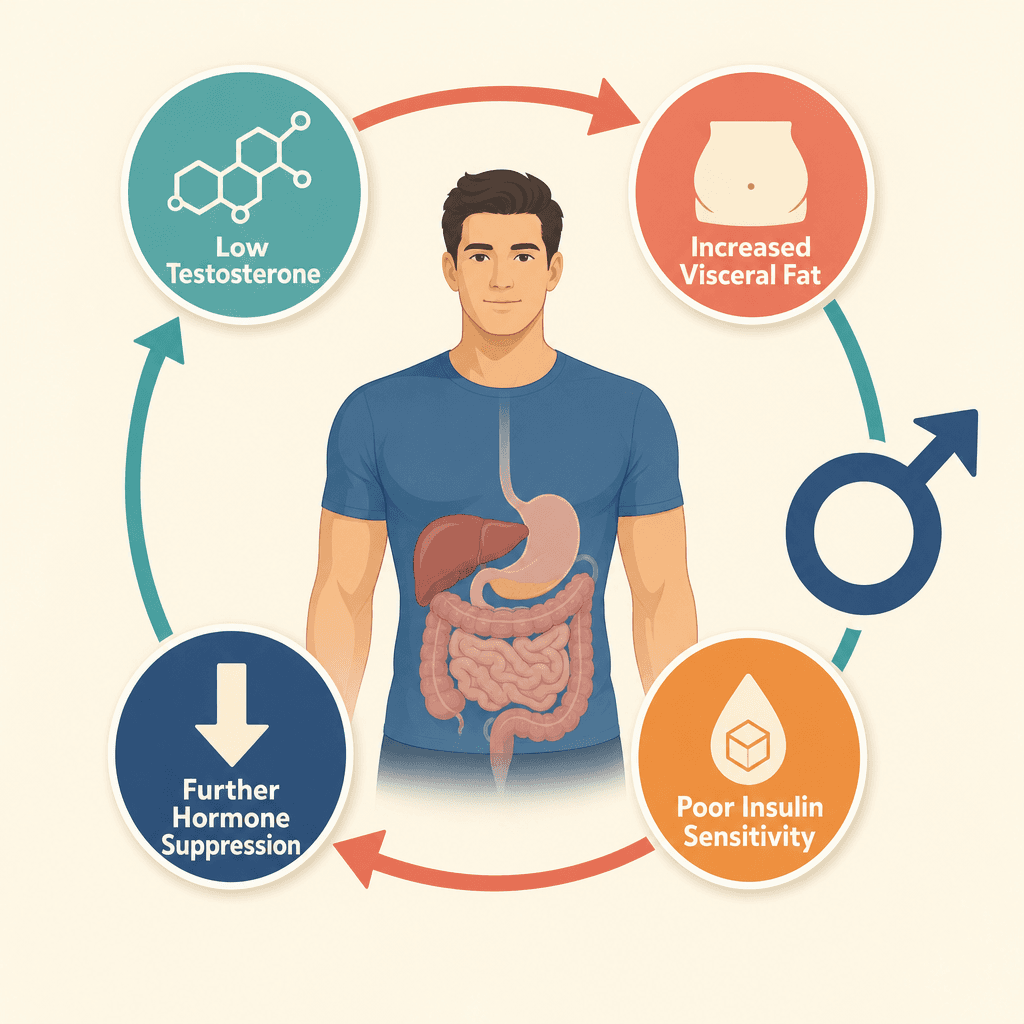
The relationship between low testosterone and increased visceral fat is well documented. Visceral fat is particularly problematic because it contributes to insulin resistance, systemic inflammation, and an elevated risk of cardiovascular and metabolic disease. It also produces an enzyme called aromatase, which converts testosterone into estrogen, further lowering testosterone levels in a self-reinforcing cycle.
Insulin Sensitivity, Metabolism, and the Hormonal Loop
Testosterone plays a meaningful role in how the body responds to insulin. Men with lower testosterone levels tend to have reduced insulin sensitivity, meaning the body needs to produce more insulin to manage blood sugar. Over time, this pattern contributes to fat storage, particularly around the midsection, and increases the risk of developing type 2 diabetes.
This creates a feedback loop that is difficult to interrupt through diet alone. Poor insulin sensitivity encourages fat accumulation. That fat, especially visceral fat, reduces testosterone further. Lower testosterone worsens insulin sensitivity. The cycle compounds quietly over months and years, which is why many men attribute the changes to aging without ever investigating the underlying hormonal picture.
According to research published by the National Institutes of Health on testosterone and metabolic health, low testosterone in men is independently associated with increased fat mass, reduced lean mass, and greater cardiometabolic risk.
Correlation vs. Causation: A Practical Distinction
It is worth pausing here to address something important. Just because low testosterone and weight gain frequently appear together does not mean one always directly causes the other. Obesity itself suppresses testosterone production. Chronic stress does the same. Poor sleep, heavy alcohol use, and certain medications all lower testosterone while also promoting fat gain through separate mechanisms.
In practice, this means the relationship between low testosterone and weight gain is often bidirectional. Weight gain can lower testosterone, and low testosterone can make weight gain more likely. Identifying which came first matters less than recognizing that the two conditions reinforce each other, and that addressing hormonal health alongside lifestyle factors tends to produce better outcomes than treating either in isolation.
Sleep, Stress, and Mood: The Overlooked Weight Drivers
Low testosterone rarely presents as a single symptom. It tends to disrupt several interconnected systems, many of which have a direct impact on weight.
Sleep is one of the clearest examples. The majority of testosterone production in men occurs during deep sleep, particularly during REM cycles. When testosterone is low, sleep quality often suffers. Poor sleep raises cortisol, the body's primary stress hormone. Elevated cortisol promotes fat storage, increases appetite for calorie-dense foods, and undermines the muscle-preserving effects of testosterone. It is a chain reaction that feeds itself.
Mood and motivation follow a similar pattern. Men with low testosterone frequently report low mood, reduced drive, and a general sense of flatness that makes it harder to stay consistent with exercise and healthy eating. This is not a character flaw. It is a physiological response to hormonal imbalance. When the hormonal foundation is unstable, behavioral consistency becomes genuinely harder to maintain.
Aging, Medications, Alcohol, and Lifestyle Factors
Testosterone levels in men begin declining gradually after the age of 30, typically at a rate of around one percent per year. This is a normal part of aging, but several factors can accelerate the process significantly.
Chronic illness, including obesity, type 2 diabetes, sleep apnea, and chronic kidney or liver disease, can suppress the hormonal signals that drive testosterone production. Certain medications, particularly opioids, corticosteroids, and some antidepressants, are known to lower testosterone as a side effect. Heavy or chronic alcohol use damages the Leydig cells in the testes responsible for testosterone production. Prolonged psychological stress elevates cortisol, which directly inhibits testosterone synthesis.
Lifestyle factors like physical inactivity, a diet high in processed foods and low in protein, and chronic sleep deprivation create a hormonal environment that is unfavorable for maintaining healthy testosterone levels and lean body mass. No single factor tells the whole story, which is why a thorough evaluation considers all of them.
Recognizing Low Testosterone Beyond the Scale
Weight gain around the midsection is one possible sign of low testosterone, but it is rarely the only one. Men experiencing declining testosterone commonly notice a combination of the following:
Reduced energy and stamina that does not improve with rest. Decreased libido or changes in sexual function. Difficulty building or maintaining muscle despite consistent training. Brain fog, poor concentration, or memory lapses. Increased irritability or low mood without a clear situational cause. Loss of morning erections. Thinning body or facial hair. In some cases, breast tissue tenderness or mild enlargement.
None of these symptoms alone confirms low testosterone, and many can be caused by other conditions. However, when several appear together, especially alongside notable changes in body composition, it is worth investigating further with proper lab work.
The Mayo Clinic's overview of male hypogonadism provides a thorough clinical summary of how low testosterone presents and when medical evaluation is appropriate.
What Men Can Do: The Lifestyle Foundation
Before considering any form of medical intervention, there are lifestyle strategies that have meaningful, evidence-backed effects on testosterone levels and body composition.
Resistance training is among the most potent natural stimulants of testosterone. Compound movements that recruit large muscle groups, such as squats, deadlifts, and presses, are particularly effective. Consistent training two to four days per week builds lean mass, improves insulin sensitivity, and creates a more favorable hormonal environment.
Protein intake matters more than most men realize. Adequate dietary protein supports muscle retention, especially as testosterone begins to decline. Prioritizing whole food protein sources across meals helps preserve lean mass and supports satiety, making overall calorie management easier without obsessive restriction.
Steady daily movement, not just structured workouts, plays an underappreciated role. Walking, taking stairs, staying generally active throughout the day, all of this contributes to calorie balance and metabolic health. Combined with seven to nine hours of quality sleep per night and meaningful stress reduction, these habits create conditions where the body can regulate hormones more effectively.
Moderate alcohol consumption is also worth examining honestly. Regular heavy drinking suppresses testosterone production and adds significant caloric load. Reducing intake is one of the more impactful changes many men can make without any clinical intervention.
When to Get Tested and What Clinicians Evaluate
If lifestyle adjustments are already in place and symptoms persist, or if the constellation of symptoms is significant enough to warrant investigation, lab testing is the appropriate next step. There is no way to know whether low testosterone is a contributing factor without measuring it.
A clinician evaluating testosterone status will typically look at total and free testosterone levels, along with a broader hormonal panel that might include luteinizing hormone, follicle-stimulating hormone, and estradiol to understand where in the hormonal axis any disruption originates. They will also consider thyroid function, blood glucose, lipids, and a complete blood count to rule out other contributing conditions and assess overall metabolic health.
The goal is not to treat a number in isolation. It is to understand the full clinical picture, including symptoms, lab values, health history, and lifestyle context, before recommending any course of action.
Treatment Options and What Medical Supervision Actually Means
For men who have confirmed low testosterone through lab testing and clinical evaluation, testosterone replacement therapy is the most widely used and studied medical treatment. It involves restoring testosterone to healthy physiological levels under a clinician's supervision, with the goal of improving symptoms, body composition, metabolic markers, and quality of life.
Benefits reported by men undergoing TRT commonly include improved energy, better mood, increased lean muscle mass, reduced fat mass, improved libido, and sharper mental clarity. However, TRT is not without considerations. It requires ongoing monitoring of red blood cell count, estradiol levels, cardiovascular markers, and, for men who are concerned about fertility, it is important to discuss that testosterone replacement therapy can suppress the body's natural production of sperm. In those cases, human chorionic gonadotropin is often used alongside or instead of testosterone therapy to help preserve fertility and testicular function.
For men whose hormonal decline is related more to growth hormone axis changes rather than testosterone alone, Sermorelin is another option that some clinicians use to support lean body composition, recovery, and sleep quality by stimulating the body's own growth hormone release.
None of these treatments should be self-administered or based on internet protocols. Dosing, monitoring frequency, and treatment selection require individualized clinical judgment. The risks of using these therapies without proper oversight are real, including cardiovascular stress, hormonal imbalance, and fertility suppression, which is why medical supervision is not optional, it is the standard of care.
Putting It Together
Weight gain in men is rarely a single-cause problem, and low testosterone is rarely a single-symptom condition. The two are connected through metabolism, muscle mass, insulin sensitivity, sleep, mood, and motivation in ways that compound quietly over time. Recognizing that connection is not about finding an excuse. It is about understanding the actual physiology so you can address it intelligently.
If what you have read here sounds familiar, the most productive step is getting evaluated by a clinician who takes hormone health seriously. AlphaMD makes men's health and hormone optimization accessible, with licensed providers delivering thorough lab-based evaluations and medically supervised care that accounts for the full picture, not just one lab value. Clarity about what is actually happening in your body is the starting point for making real, lasting change.
Have a question? Ask us.
At AlphaMD, we're here to help. Feel free to ask us any question you would like about TRT, medical weightloss, ED, or other topics related to men's health. Or take a moment to browse through our past questions.
People are asking...
If you’re diagnosed with hypoganadism obesity and are put on trt. Then you drop a bunch of weight. Is it possible to stop trt and have healthy T leve...
Your Testosterone may improve with weight loss & your Estrogen certainly will with loss of fat. However Testosterone baseline production over *ever* goes down with time/age. It is likely that even if ... See Full Answer
What would cause your testosterone and E2 levels to decrease, but the patient has been taking the same dose? (Testosterone cypionate 200mg weekly) No...
This could be a number of things. The first could be simply due to the time of testing relative to the last injection being different from the last test. The second & what is potentially likely here b... See Full Answer
I’m 44. I did a T test only. Came in at 385ng, I don’t know my free T. Although I’ve gained some muscle and lost weight, I’m finding it difficult to ...
The recommended cutoff for low testosterone is now 400 based on recent data . So a level of 385 along with symptoms is the kind of picture a licensed provider would weigh when evaluating whether trea... See Full Answer
Get $30 off your first month’s order
Enter your email address now to receive $30 off your first month’s cost, other discounts, and additional information about TRT.
Legal Disclaimer
This website is a repository of publicly available information and is not intended to form a physician-patient relationship with any individual. The content of this website is for informational purposes only. The information presented on this website is not intended to take the place of your personal physician's advice and is not intended to diagnose, treat, cure, or prevent any disease. Discuss this information with your own physician or healthcare provider to determine what is right for you. All information is intended for your general knowledge only and is not a substitute for medical advice or treatment for specific medical conditions. The information contained herein is presented in summary form only and intended to provide broad consumer understanding and knowledge. The information should not be considered complete and should not be used in place of a visit, phone or telemedicine call, consultation or advice of your physician or other healthcare provider. Only a qualified physician in your state can determine if you qualify for and should undertake treatment.