
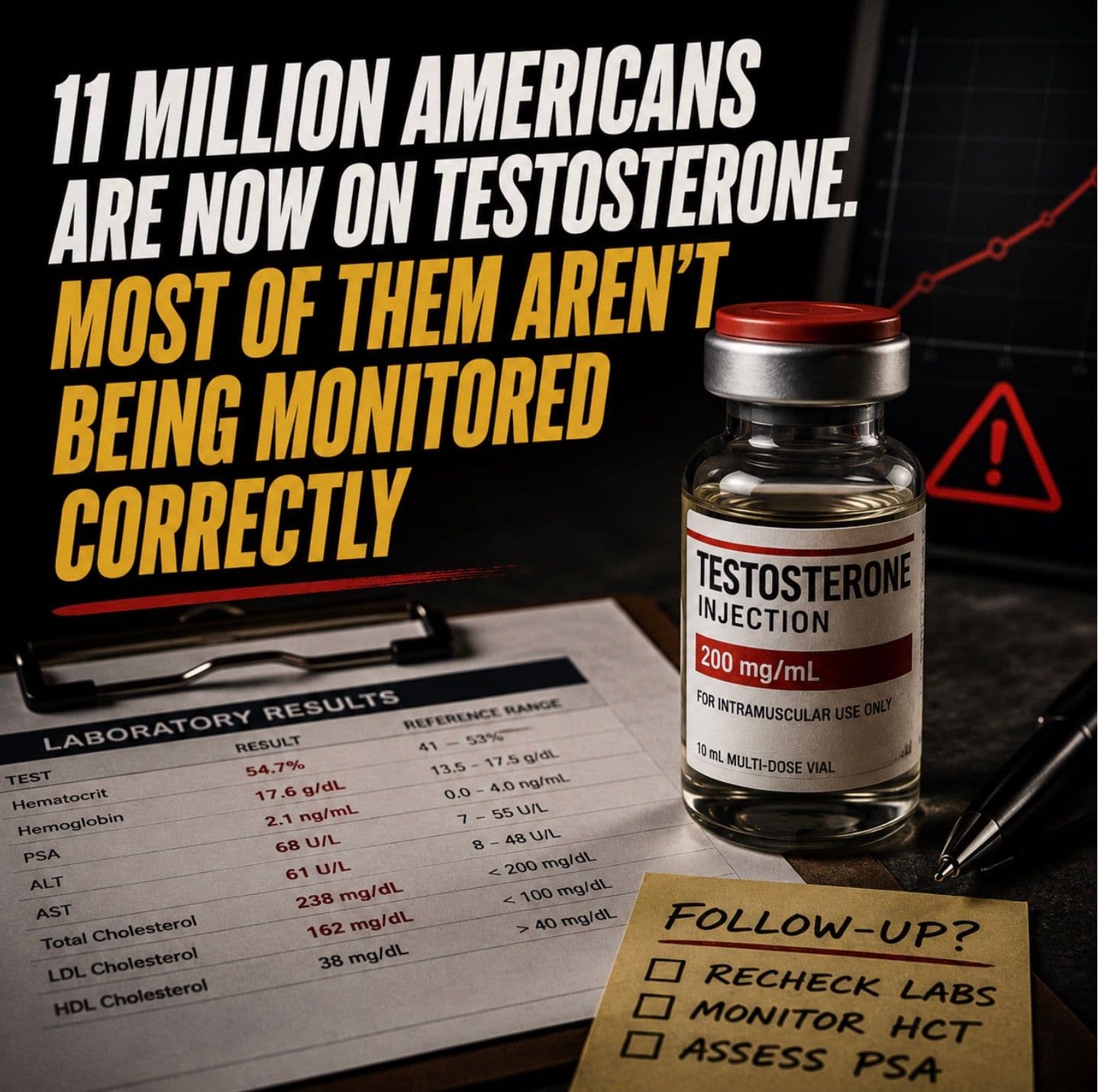
11 Million Americans Are Now on Testosterone. Most of Them Aren't Being Monitored Correctly.
Published on:
Updated on:
People are asking...
I am: 42 yo male, 5'11" 280 lbs with a BMI of 40 and 42% body fat. Pre trt blood work: TESTOSTERONE, TOTAL, MS 242 L TESTOSTERONE, FREE 35.7 I star...
In most cases a provider would want a patient to wait at least past the 6-7 week mark before adjusting dosages because that's around the point that your body truly accepts the extra Testosterone as it... See Full Answer
Do you have any theories as to why some people experience a honeymoon phase for a few weeks then lose the benefits of TRT?...
The most common reason for this in men tends to be a need for a simple dose adjustment. There's a general 8 week uptake period where injected levels increase week over week & then natural production ... See Full Answer
Why do TRT clinics just throw 200mg out to start...
They really shouldn't, but because many take the approach of uniform care over individual planning, they pick a dose that will *certainly* give results which is good for marketing, even if it will alm... See Full Answer
Have a question? Ask us.
At AlphaMD, we're here to help. Feel free to ask us any question you would like about TRT, medical weightloss, ED, or other topics related to men's health. Or take a moment to browse through our past questions.
Testosterone prescriptions in the United States have climbed more than fourfold over the past two decades, and the pace isn't slowing down. That growth has brought real relief to many men suffering from clinically low hormone levels - but it has also outpaced the medical infrastructure needed to keep those patients safe.
The phrase "11 Million Americans Are Now on Testosterone. Most of Them Aren't Being Monitored Correctly." isn't a scare headline. It reflects a pattern that endocrinologists, urologists, and men's health specialists have been documenting for years: a widening gap between who is being prescribed testosterone and who is receiving the follow-up care that makes that treatment appropriate and sustainable.
Why Testosterone Prescribing Exploded - and Why That's Not Entirely a Bad Thing
For much of the twentieth century, low testosterone was under-recognized and undertreated. Men experiencing fatigue, low libido, mood changes, reduced muscle mass, and cognitive fog were often told these were simply signs of aging. Research over the past two decades changed that narrative significantly.
Large-scale studies began confirming what clinicians had suspected: testosterone deficiency, or hypogonadism, is a genuine medical condition with measurable consequences for quality of life, metabolic health, bone density, and cardiovascular risk. The American Urological Association has published clinical guidelines recognizing testosterone deficiency as a diagnosable and treatable condition, which helped legitimize treatment for a broader population of men.
Direct-to-consumer advertising, the rise of telehealth, and a cultural shift toward men engaging more actively with their health all contributed to the surge in prescriptions. Many of the men who found their way to testosterone replacement therapy were genuinely symptomatic and had been suffering for years without answers. For them, appropriate treatment has been life-changing.
The problem isn't that testosterone is being prescribed. The problem is that prescription without proper evaluation and ongoing monitoring creates real risks - risks that are manageable when clinicians and patients stay engaged together.
What a Proper Baseline Evaluation Actually Looks Like
One of the most common failures in testosterone care happens before the first dose is ever given. Rushing a patient from symptom report to prescription, without a thorough baseline evaluation, sets up both the patient and the clinician for problems down the road.
A responsible baseline evaluation involves more than a single testosterone level drawn at the wrong time of day. Morning blood draws are standard because testosterone follows a diurnal rhythm, peaking in the early hours and declining through the afternoon. A result drawn at 3 p.m. may look very different from one drawn at 8 a.m. on the same day.
Beyond timing, baseline labs typically include assessment of related hormones - including those that regulate how the body produces testosterone naturally - as well as a complete blood count, metabolic markers, and a prostate-specific antigen measurement for appropriate-aged men. This snapshot matters because it tells the clinician not just where a patient is starting from, but why testosterone may be low in the first place.
Symptoms matter just as much as numbers. A patient with borderline lab values but significant, debilitating symptoms presents differently than a patient with similar numbers and no complaints. Good clinical judgment integrates both, rather than relying on a single lab figure to make or break a treatment decision.
The Monitoring That Should Happen After Starting Treatment
Initiating treatment is the beginning of the clinical relationship, not the end of it. Appropriate follow-up involves a combination of symptom reassessment, side effect screening, and periodic lab surveillance - and it needs to happen on a consistent schedule.
Early follow-up, typically within the first few months, allows clinicians to confirm that the patient is responding as expected, that administration technique is correct, and that no early side effects have emerged. One of the most clinically significant concerns with testosterone therapy is an increase in red blood cell production, a condition called erythrocytosis or polycythemia. When red blood cell counts rise too high, blood viscosity increases and clotting risk goes up. This is not a rare occurrence - it is a known physiological response to testosterone that requires regular monitoring and, when necessary, clinical intervention.
Hematocrit, a measure of red blood cell concentration, is one of the most important values to track on an ongoing basis. So is PSA, particularly in men over a certain age or with a family history of prostate conditions. The National Institutes of Health has published research reinforcing that regular lab surveillance is essential to the safe long-term use of testosterone therapy.
Clinicians should also be screening for cardiovascular symptoms, mood changes, sleep disturbances (testosterone can worsen sleep apnea in some individuals), and skin or hair changes. These aren't minor inconveniences - they're clinical signals that inform ongoing treatment decisions.
Fertility, Testicular Function, and the Conversation That Often Gets Skipped
One of the most consequential gaps in testosterone monitoring is the failure to discuss fertility before starting treatment. Testosterone therapy suppresses the body's natural hormone signaling pathway, which in turn reduces sperm production. For men who have already completed their families or have no fertility goals, this may not be a significant concern. For men who may want children in the future - including younger men who are increasingly being prescribed testosterone - it is critical information that must be addressed upfront.
Testicular atrophy is another consequence of this hormonal suppression that patients are frequently not warned about. When the brain stops sending signals to the testes because it detects adequate circulating testosterone, the testes reduce their activity and can decrease in size over time.
For men where fertility preservation is a goal, adjunct therapies are sometimes considered alongside or instead of testosterone. Human chorionic gonadotropin, or HCG, mimics the signal that the brain normally sends to the testes, helping to maintain testicular function and sperm production during testosterone therapy. This is an area where individualized clinical guidance is essential - there is no one-size-fits-all approach, and the right strategy depends heavily on a patient's age, goals, and baseline fertility status.
Any man of reproductive age who is considering testosterone therapy should have an explicit conversation about fertility with their clinician before starting.
Who Needs to Be Especially Careful
Testosterone therapy is not appropriate for everyone, and certain medical histories require extra scrutiny before treatment is considered.
Men with a history of prostate cancer, or those with untreated or suspected prostate cancer, represent a population where testosterone therapy has traditionally been considered contraindicated, though evolving research has begun to nuance this conversation. Men with a history of breast cancer, severe untreated sleep apnea, elevated red blood cell counts at baseline, or a recent history of cardiovascular events require thorough evaluation before any treatment decision is made.
Erythrocytosis deserves particular attention. Men who already have elevated hematocrit at baseline are at higher risk for the blood-thickening effects of testosterone and need careful monitoring - or may not be appropriate candidates at all.
Men with a history of blood clots, those on anticoagulant therapy, and men with certain liver conditions also fall into a category where the risk-benefit calculus is more complex. None of this means testosterone is automatically off the table - it means that clinical judgment, a thorough review of personal and family history, and ongoing communication between patient and clinician are non-negotiable.
The Common Mistakes That Leave Patients at Risk
Beyond inadequate baseline evaluation and inconsistent monitoring, several other patterns consistently show up in substandard testosterone care.
Overreliance on a single lab number is a persistent issue. A testosterone level, taken in isolation, tells only a small part of the story. How much of that testosterone is biologically active? What are the upstream hormones doing? What symptoms is the patient experiencing? Good clinical care synthesizes all of these data points together.
Poor education on administration and expectations is another common failure. Patients who don't understand how to administer injections correctly, what a normal adjustment period looks like, or what side effects warrant an immediate call to their clinician are set up to either have a poor experience or miss important warning signs.
Ignoring contraindications during the initial screening - whether due to time pressure, incomplete history-taking, or over-reliance on patient self-report - is a patient safety issue. Clinicians need to ask about sleep apnea, prostate symptoms, cardiovascular history, fertility goals, and medication use before writing a first prescription.
Finally, the absence of any structured follow-up is perhaps the most common failure. Some patients receive a prescription with instructions to return only if they have problems. Without scheduled monitoring visits and lab draws, problems can develop silently - and by the time they become symptomatic, they may have progressed further than necessary.
Questions Worth Asking Your Clinician Before and During Treatment
Patients who are active participants in their own care tend to have better outcomes. If you are considering testosterone therapy or are currently on it, these are worth raising directly with your provider.
Ask whether your initial evaluation included a full hormonal panel drawn at the appropriate time of day, not just a single testosterone level. Ask what monitoring schedule your clinician recommends, and what labs will be checked at each visit. Ask specifically about hematocrit and PSA monitoring, and ask what findings would prompt a dose adjustment or treatment pause.
If you are under forty or have not yet completed your family, ask explicitly about the effects of testosterone on fertility and whether fertility preservation strategies are appropriate for your situation. Ask what symptoms should prompt you to contact the clinic between scheduled visits. And ask whether your clinician has experience managing the full range of side effects that can emerge with long-term testosterone use.
These aren't aggressive questions. They're the baseline of engaged, informed patient care.
The Difference Between Access and Appropriate Care
Expanded access to testosterone therapy has been a genuine improvement for many men whose symptoms went unaddressed for too long. Telehealth has removed geographic and logistical barriers that previously kept men from getting care they legitimately needed. These are real benefits.
But access and appropriate care are not the same thing. A prescription without monitoring is not a complete treatment plan - it is an incomplete one. The goal of testosterone therapy isn't to get a number on a lab report into a certain range. It's to help a patient feel and function better, safely, over the long term.
Platforms like AlphaMD are designed around this principle: that testosterone therapy done well requires ongoing clinical engagement, not just an initial consultation. Monitoring isn't a bureaucratic hurdle. It's the part of care that keeps the benefits sustainable and the risks manageable - and for the millions of Americans currently on testosterone, it's the part that matters most.
Have a question? Ask us.
At AlphaMD, we're here to help. Feel free to ask us any question you would like about TRT, medical weightloss, ED, or other topics related to men's health. Or take a moment to browse through our past questions.
People are asking...
I am: 42 yo male, 5'11" 280 lbs with a BMI of 40 and 42% body fat. Pre trt blood work: TESTOSTERONE, TOTAL, MS 242 L TESTOSTERONE, FREE 35.7 I star...
In most cases a provider would want a patient to wait at least past the 6-7 week mark before adjusting dosages because that's around the point that your body truly accepts the extra Testosterone as it... See Full Answer
Do you have any theories as to why some people experience a honeymoon phase for a few weeks then lose the benefits of TRT?...
The most common reason for this in men tends to be a need for a simple dose adjustment. There's a general 8 week uptake period where injected levels increase week over week & then natural production ... See Full Answer
Why do TRT clinics just throw 200mg out to start...
They really shouldn't, but because many take the approach of uniform care over individual planning, they pick a dose that will *certainly* give results which is good for marketing, even if it will alm... See Full Answer
Get $30 off your first month’s order
Enter your email address now to receive $30 off your first month’s cost, other discounts, and additional information about TRT.
Legal Disclaimer
This website is a repository of publicly available information and is not intended to form a physician-patient relationship with any individual. The content of this website is for informational purposes only. The information presented on this website is not intended to take the place of your personal physician's advice and is not intended to diagnose, treat, cure, or prevent any disease. Discuss this information with your own physician or healthcare provider to determine what is right for you. All information is intended for your general knowledge only and is not a substitute for medical advice or treatment for specific medical conditions. The information contained herein is presented in summary form only and intended to provide broad consumer understanding and knowledge. The information should not be considered complete and should not be used in place of a visit, phone or telemedicine call, consultation or advice of your physician or other healthcare provider. Only a qualified physician in your state can determine if you qualify for and should undertake treatment.