
Why Your Metabolism Is Broken: The Testosterone-Weight Connection
Published on:
Updated on:
People are asking...
If you’re diagnosed with hypoganadism obesity and are put on trt. Then you drop a bunch of weight. Is it possible to stop trt and have healthy T leve...
Your Testosterone may improve with weight loss & your Estrogen certainly will with loss of fat. However Testosterone baseline production over *ever* goes down with time/age. It is likely that even if ... See Full Answer
What would cause your testosterone and E2 levels to decrease, but the patient has been taking the same dose? (Testosterone cypionate 200mg weekly) No...
This could be a number of things. The first could be simply due to the time of testing relative to the last injection being different from the last test. The second & what is potentially likely here b... See Full Answer
36 y/o morbidly obese male total testosterone is 107 and free is 26.1. Should I lose weight first or should I combine my new lifestyle (losing weight...
You will lose weight much faster with TRT than without. You will have more energy and motivation to do workouts, recover quicker with less muscle soreness, and have the benefit of a higher basal metab... See Full Answer
Have a question? Ask us.
At AlphaMD, we're here to help. Feel free to ask us any question you would like about TRT, medical weightloss, ED, or other topics related to men's health. Or take a moment to browse through our past questions.
You've cut calories, logged more miles on the treadmill, and you're still carrying weight around your midsection that refuses to budge. Chances are, your metabolism isn't broken because you lack willpower or discipline, but because your hormones have quietly shifted the rules of the game.
For men, testosterone sits at the center of this metabolic shift. It's not just about libido or muscle size. Testosterone plays a direct role in how efficiently your body burns calories, where it stores fat, how much muscle you maintain, and even how motivated you feel to move. When testosterone declines, whether from aging, lifestyle factors, or excess body fat itself, your metabolism can start working against you in ways that feel impossible to overcome through diet and exercise alone.
What makes this especially frustrating is that low testosterone and weight gain feed into each other, creating a cycle that's hard to break without understanding what's actually happening under the hood.
When Your Hormones Hit the Metabolic Brakes
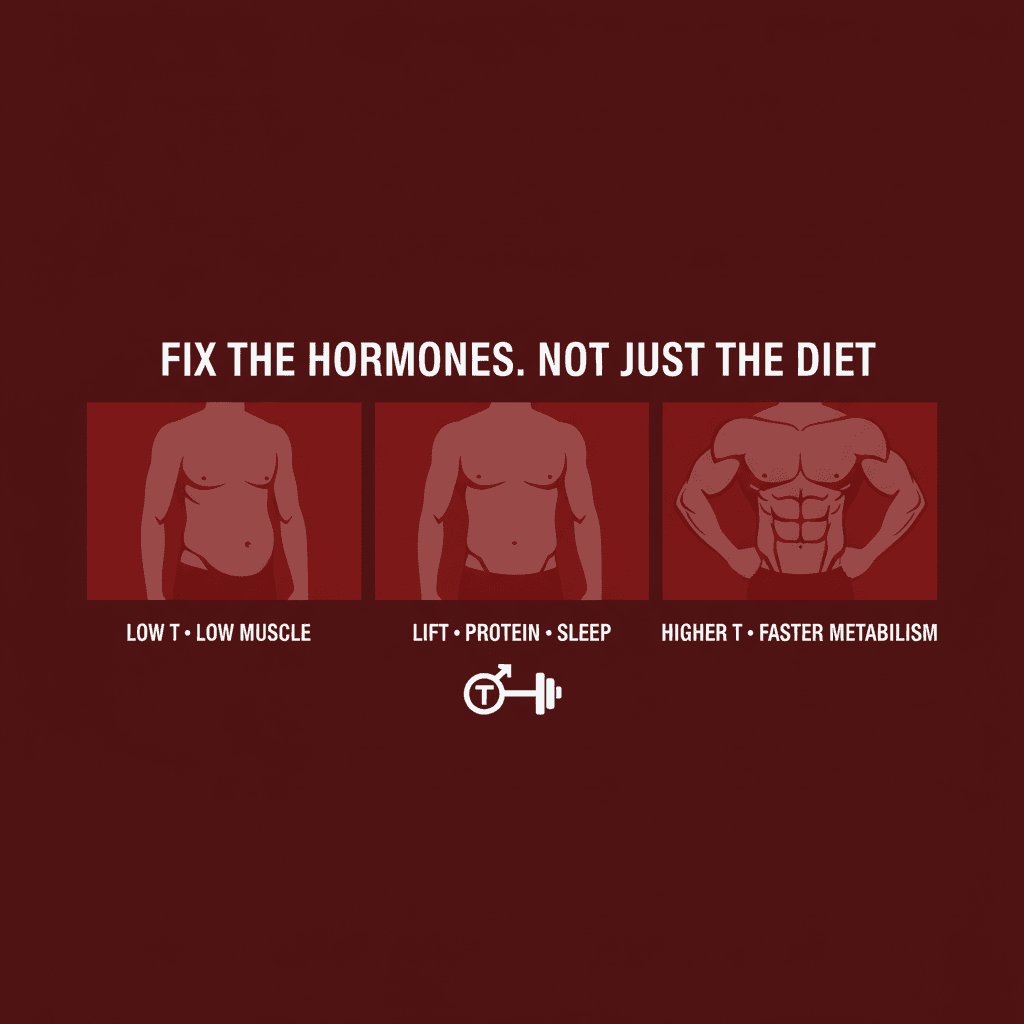
Testosterone is anabolic. That means it builds and maintains tissue, particularly muscle. Muscle tissue is metabolically active, burning calories even when you're sitting on the couch. The more muscle you carry, the higher your resting metabolic rate. When testosterone levels drop, your body loses its ability to preserve muscle mass as effectively. Over time, you start losing muscle, and your calorie-burning engine starts to idle lower.
This happens gradually. You might not notice it year to year, but compare yourself at 40 to yourself at 25, and the difference becomes obvious. You're eating roughly the same amount, maybe even less, but the scale keeps creeping up. Your body composition shifts. You feel softer, weaker, less defined.
Meanwhile, lower testosterone also makes it easier for your body to store fat, particularly around the abdomen. Visceral fat, the kind that wraps around your organs, is hormonally active in its own right. It produces enzymes like aromatase, which converts testosterone into estrogen. More body fat means more aromatase activity, which means less testosterone and more estrogen. This hormonal imbalance further slows your metabolism and encourages more fat storage.
You're caught in a feedback loop. Lower testosterone leads to more fat. More fat leads to even lower testosterone.
Why Extra Belly Fat Is Not Just About Willpower
Belly fat gets blamed on beer, laziness, or poor food choices. Sometimes those factors play a role. But when testosterone is low, your body preferentially stores fat in the abdominal region, regardless of how clean your diet is or how many crunches you do.
Visceral fat is particularly stubborn because it's influenced by hormones, stress, and insulin sensitivity. Men with low testosterone often develop insulin resistance, meaning their cells don't respond as well to insulin's signal to take up glucose. The pancreas compensates by producing more insulin, and chronically elevated insulin promotes fat storage, especially around the waist.
At the same time, low testosterone reduces your body's ability to mobilize fat for energy. Even when you're in a calorie deficit, your body may preferentially break down muscle tissue instead of fat, especially if resistance training isn't part of your routine. You lose weight on the scale, but you're losing the wrong kind of weight. Your metabolism slows further. Your body composition worsens.
This is why so many men feel stuck. They do everything right on paper, cutting carbs, increasing cardio, eating salads for lunch, but they still can't shed the belly fat or feel strong again.
The Energy Drain You Can't Outrun
Testosterone doesn't just affect your body composition. It affects your brain and your behavior. Low testosterone is strongly associated with fatigue, low motivation, and reduced mental clarity. You wake up tired. You drag through the afternoon. The idea of going to the gym after work feels like climbing a mountain.
This isn't laziness. It's biology.
Testosterone influences dopamine signaling in the brain, which affects motivation, reward, and drive. When levels drop, so does your desire to pursue challenging activities. You're less likely to push hard in a workout. You're less likely to stay active throughout the day. You might find yourself sitting more, moving less, and choosing convenience over effort.
All of this compounds the metabolic problem. Lower activity levels mean fewer calories burned. Less intense exercise means less stimulus for muscle growth and maintenance. Your body adapts by becoming even more efficient at conserving energy, which is another way of saying your metabolism slows down.
Men often describe this as feeling like their body has betrayed them. They remember feeling strong, energetic, and capable in their 20s and early 30s, and now everything feels harder. Recovery takes longer. Workouts feel flat. The same effort produces worse results.
The Vicious Cycle Between Fat and Hormones
The relationship between testosterone and body fat isn't one-directional. It's a cycle. Low testosterone makes it easier to gain fat and harder to build muscle. Excess body fat, in turn, suppresses testosterone production through multiple mechanisms.
First, as mentioned, fat tissue contains aromatase, which converts testosterone into estradiol. Higher estrogen levels signal the hypothalamus and pituitary gland to reduce the production of luteinizing hormone, which is what tells the testes to make testosterone. The more fat you carry, the more this feedback loop works against you.
Second, obesity is associated with chronic low-grade inflammation. Inflammatory cytokines interfere with the hormonal signaling pathways that regulate testosterone production. Your body is stuck in a state of metabolic stress, and hormone production suffers.
Third, excess weight often comes with other metabolic disturbances like insulin resistance, sleep apnea, and elevated cortisol. Each of these independently suppresses testosterone. Sleep apnea, for instance, disrupts deep sleep, which is when most testosterone is produced. Men with untreated sleep apnea often have significantly lower testosterone levels, and losing weight can help, but it's hard to lose weight when your hormones and sleep are working against you.
Breaking this cycle requires addressing both sides of the equation. You need to support healthy testosterone levels while also creating the conditions for fat loss and muscle gain. That's easier said than done when you're stuck in the middle of the loop.
What Else Is Sabotaging Your Metabolism
Testosterone is a key player, but it doesn't act in isolation. Several lifestyle factors directly influence both testosterone levels and metabolic health.
Sleep is one of the most underrated. Poor sleep, whether from sleep apnea, stress, or just bad habits, crushes testosterone production. One study found that men who slept fewer than five hours per night had significantly lower testosterone than those who slept seven to eight hours. Sleep deprivation also increases hunger hormones like ghrelin and decreases satiety hormones like leptin, making it harder to control your appetite.
Chronic stress is another metabolic killer. Elevated cortisol, the primary stress hormone, interferes with testosterone production. Cortisol and testosterone share common precursor molecules, and when your body is in a constant state of stress, it prioritizes cortisol production over testosterone. High cortisol also promotes abdominal fat storage and muscle breakdown.
Alcohol, especially in excess, suppresses testosterone and increases estrogen. It also disrupts sleep quality, adds empty calories, and impairs recovery from exercise. A few drinks here and there probably won't tank your hormones, but regular heavy drinking is a reliable way to sabotage both testosterone and metabolism.
On the flip side, resistance training is one of the most effective ways to support both. Lifting weights builds muscle, which increases your metabolic rate. It also stimulates testosterone production, especially when you focus on compound movements and progressive overload. Muscle is protective. It buffers against metabolic decline and helps maintain healthy hormone levels as you age.
Cardio has its place, but doing excessive amounts of steady-state cardio, especially in a calorie deficit, can backfire. It burns calories in the moment, but it doesn't build muscle, and it can increase cortisol if overdone. Men who rely solely on running or cycling to lose weight often find themselves frustrated, losing muscle and strength while their body fat percentage stays stubbornly high.
Why the Same Old Advice Stops Working
Most weight loss advice is built on the premise that your metabolism is static and predictable. Eat less, move more, and you'll lose weight. For young men with healthy testosterone levels, this often works. But as testosterone declines, the equation changes.
Your body becomes less responsive to calorie restriction. It holds onto fat more stubbornly. It breaks down muscle more readily. Your hunger and cravings increase. Your energy and motivation drop.
This is why men in their 40s and 50s often feel like the strategies that worked in their 20s no longer apply. They're not wrong. The metabolic context has shifted. Willpower and discipline are still important, but they're not enough when your hormones are actively working against you.
Addressing testosterone as part of a broader strategy can help reset the system. It won't make fat loss effortless, but it can restore the conditions under which effort actually produces results. Muscle becomes easier to build and maintain. Energy improves. Motivation returns. Fat becomes easier to lose, especially when combined with the right training and nutrition.
Getting Your Metabolism Back on Track
Fixing a broken metabolism isn't about one magic intervention. It's about addressing the interconnected factors that drive metabolic health: hormones, sleep, stress, nutrition, and training.
If you suspect low testosterone is part of the picture, it's worth getting evaluated. Symptoms like stubborn weight gain, especially around the belly, decreased strength, persistent fatigue, low motivation, and poor recovery are all red flags. Blood work can clarify whether your testosterone levels are in a healthy range or if they're contributing to the metabolic struggles you're experiencing.
For men with clinically low testosterone, addressing the hormone directly, whether through lifestyle optimization or medical treatment, can make a significant difference. It's not about chasing supraphysiological levels or looking for shortcuts. It's about restoring a baseline hormonal environment that allows your body to function the way it's supposed to.
Combining that with resistance training, adequate protein intake, quality sleep, stress management, and reducing excess body fat creates a synergistic effect. Each piece supports the others. Muscle gain supports testosterone. Testosterone supports fat loss. Better sleep supports recovery and hormone production. Lower stress supports everything.
The goal isn't perfection. It's creating a sustainable approach that works with your biology instead of fighting against it.
A Practical Path Forward
Understanding the testosterone-weight connection is the first step. The second is taking action based on that understanding. For many men, this means working with a provider who specializes in hormone health and men's optimization.
AlphaMD is an online men's health service focused on testosterone replacement therapy and hormonal optimization. It's designed for men who are dealing with symptoms like stubborn weight, low energy, decreased strength, and poor recovery, and who want to understand whether low testosterone is part of the problem. Through the AlphaMD platform, men connect with licensed providers who use telehealth consultations, lab testing, and personalized treatment plans to address the hormonal factors that may be sabotaging their metabolism and overall vitality.
Your metabolism isn't broken because you're weak or undisciplined. It's likely responding to hormonal signals that have shifted over time, creating a cycle that's difficult to break without addressing the root cause. Testosterone is a powerful piece of that puzzle. When it's optimized, alongside the right lifestyle strategies, your body can start working with you again instead of against you.
Have a question? Ask us.
At AlphaMD, we're here to help. Feel free to ask us any question you would like about TRT, medical weightloss, ED, or other topics related to men's health. Or take a moment to browse through our past questions.
People are asking...
If you’re diagnosed with hypoganadism obesity and are put on trt. Then you drop a bunch of weight. Is it possible to stop trt and have healthy T leve...
Your Testosterone may improve with weight loss & your Estrogen certainly will with loss of fat. However Testosterone baseline production over *ever* goes down with time/age. It is likely that even if ... See Full Answer
What would cause your testosterone and E2 levels to decrease, but the patient has been taking the same dose? (Testosterone cypionate 200mg weekly) No...
This could be a number of things. The first could be simply due to the time of testing relative to the last injection being different from the last test. The second & what is potentially likely here b... See Full Answer
36 y/o morbidly obese male total testosterone is 107 and free is 26.1. Should I lose weight first or should I combine my new lifestyle (losing weight...
You will lose weight much faster with TRT than without. You will have more energy and motivation to do workouts, recover quicker with less muscle soreness, and have the benefit of a higher basal metab... See Full Answer
Get $30 off your first month’s order
Enter your email address now to receive $30 off your first month’s cost, other discounts, and additional information about TRT.
Legal Disclaimer
This website is a repository of publicly available information and is not intended to form a physician-patient relationship with any individual. The content of this website is for informational purposes only. The information presented on this website is not intended to take the place of your personal physician's advice and is not intended to diagnose, treat, cure, or prevent any disease. Discuss this information with your own physician or healthcare provider to determine what is right for you. All information is intended for your general knowledge only and is not a substitute for medical advice or treatment for specific medical conditions. The information contained herein is presented in summary form only and intended to provide broad consumer understanding and knowledge. The information should not be considered complete and should not be used in place of a visit, phone or telemedicine call, consultation or advice of your physician or other healthcare provider. Only a qualified physician in your state can determine if you qualify for and should undertake treatment.