
Meet the Leydig Cell: Your Testosterone Factory (And Why It Breaks Down)
Published on:
Updated on:
People are asking...
With continued estrogenification of our environment in societal wide decreases in testosterone and sperm count, not everyone is going to necessarily f...
The question really comes down to do you have primary or secondary hypogonadism. If you have primary hypogonadism, you could take all the enclomiphene in the world and it would not adequately raise th... See Full Answer
How normal is it for someone on TRT or even a blasting steroid cycle to have low hematocrite and smaller red blood cells? My last tests showed it whil...
Testosterone increases red blood cell production. Increased red blood cell production requires more iron, so iron stores can get exhausted if your red blood cell production increases. If your iron sto... See Full Answer
What’s relative hypogonadism?...
Relative hypogonadism is a term for men who have symptoms of hypogonadism, despite having lab tests that fall within the normal range based on lab values. So, since the normal lab value range for tot... See Full Answer
Have a question? Ask us.
At AlphaMD, we're here to help. Feel free to ask us any question you would like about TRT, medical weightloss, ED, or other topics related to men's health. Or take a moment to browse through our past questions.
Every minute of every day, deep inside your testes, specialized cells are working around the clock to produce the hormone that shapes nearly every aspect of your life as a man. When these cells start to falter, the effects ripple through your energy, your sex drive, your mood, and even how your body stores fat and builds muscle.
These microscopic powerhouses are called Leydig cells, and they're the reason you feel like yourself. Understanding how they work, and more importantly why they sometimes stop working well, is the first step toward making sense of symptoms that millions of men experience but few can explain.
The Hidden Testosterone Factories Inside Your Testes
Leydig cells live in the interstitial space of your testes, tucked between the seminiferous tubules where sperm are made. Think of them as scattered throughout the landscape of your testicular tissue, positioned perfectly to manufacture testosterone and release it directly into your bloodstream.
Unlike many cells in your body that have multiple jobs, Leydig cells are specialists. Their primary mission is testosterone production, and they're remarkably good at it when everything is functioning properly. A healthy adult male produces several milligrams of testosterone each day, almost entirely thanks to these cells.
The process itself is a biochemical marvel. Leydig cells take cholesterol as their raw material and, through a series of enzymatic reactions, transform it into testosterone. This isn't a simple one-step conversion. It requires multiple enzymes working in sequence, each one dependent on the previous step succeeding. When this assembly line runs smoothly, you maintain steady testosterone levels that support everything from your morning energy to your ability to put on muscle at the gym.
The Signal That Starts Everything
Your Leydig cells don't operate independently. They're part of an intricate communication system that starts in your brain, specifically in a region called the hypothalamus.
When your brain detects that testosterone levels are dropping, the hypothalamus releases gonadotropin-releasing hormone, or GnRH. This hormone travels a short distance to your pituitary gland, a pea-sized structure at the base of your brain that acts as your body's hormonal control center.
The pituitary responds to GnRH by secreting luteinizing hormone, commonly known as LH. This is the direct signal your Leydig cells are waiting for. LH travels through your bloodstream until it reaches your testes, where it binds to receptors on the surface of Leydig cells. That binding action is like turning a key in an ignition. It triggers the cells to ramp up testosterone production.
This system works on a feedback loop. When testosterone levels rise high enough, your brain senses it and dials back GnRH production. Less GnRH means less LH, which means Leydig cells ease off the gas pedal. When testosterone drops again, the cycle restarts. In a young, healthy man, this feedback system maintains remarkably stable testosterone levels throughout life.
At least, that's how it's supposed to work.
When the Assembly Line Starts to Slow
Aging is the most universal factor affecting Leydig cell function. Starting around age 30, most men experience a gradual decline in testosterone production. This isn't a sudden drop but a slow, steady decrease that compounds over decades.
The Leydig cells themselves change with age. Their numbers may decrease slightly, but more significantly, the remaining cells become less responsive to LH. It's as if the ignition key still turns, but the engine doesn't roar to life the way it once did. The enzymatic machinery inside the cells becomes less efficient. The mitochondria, which power the cells' energy-intensive work, start to show wear and tear.
This age-related decline is natural, but it's not the only reason Leydig cells can underperform.
Chronic illnesses place enormous stress on your endocrine system. Conditions like type 2 diabetes, obesity, and metabolic syndrome create an inflammatory environment that directly damages Leydig cells. Insulin resistance, which underlies many of these conditions, appears to interfere with the cells' ability to convert cholesterol into testosterone efficiently.
Obesity deserves special mention. Fat tissue isn't just passive storage; it's metabolically active and produces an enzyme called aromatase that converts testosterone into estrogen. The more body fat you carry, especially around your midsection, the more testosterone gets converted away before it can do its job. This creates a vicious cycle where low testosterone makes it harder to lose fat, and excess fat further suppresses testosterone.
Chronic stress and elevated cortisol levels also suppress Leydig cell function. Cortisol, your primary stress hormone, can interfere with the signals from LH and redirect your body's resources away from testosterone production. Your body essentially decides that survival in the moment matters more than maintaining optimal hormone levels.
Certain medications can impair Leydig cell function as well. Opioid pain medications are particularly notorious for suppressing the entire hypothalamic-pituitary-testicular axis. Even men taking prescription opioids for legitimate pain conditions often develop significantly reduced testosterone production.
When the Brain Stops Sending the Right Signals
Sometimes the problem isn't with the Leydig cells themselves but with the command center that controls them.
Secondary hypogonadism, as doctors call it, occurs when your hypothalamus or pituitary gland fails to produce adequate amounts of GnRH or LH. Without sufficient LH reaching your testes, even perfectly healthy Leydig cells sit idle, producing minimal testosterone.
This can happen for several reasons. Pituitary tumors, though rare, can interfere with LH production. More commonly, the same chronic conditions and lifestyle factors that damage Leydig cells also disrupt signaling from the brain. Sleep apnea, for instance, fragments your sleep and prevents the normal nighttime surge in GnRH and LH production that should occur during deep sleep.
Poor sleep in general, even without apnea, undermines the entire hormonal axis. Your body does much of its hormonal housekeeping during sleep, and chronic sleep deprivation leaves you operating on a weakened signal.
Extreme caloric restriction or eating disorders can shut down the hypothalamic-pituitary axis as well. Your brain interprets severe energy deficit as a crisis and deprioritizes reproduction-related functions, including testosterone production.
What It Feels Like When Your Testosterone Factory Shuts Down
The symptoms of declining Leydig cell function often develop so gradually that men attribute them to normal aging or stress. But they're worth paying attention to because they can significantly impact quality of life.
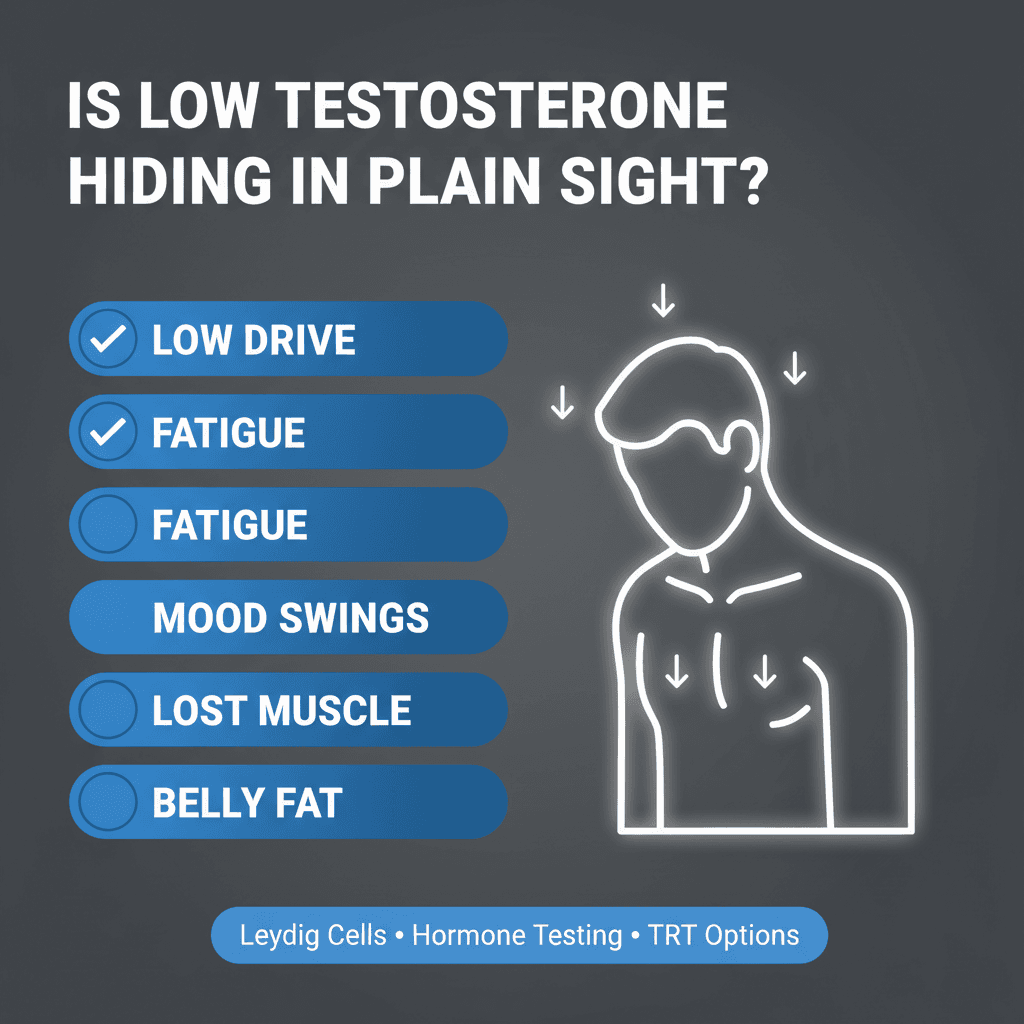
Fatigue is one of the earliest and most common complaints. This isn't just feeling tired after a long day. It's a persistent lack of energy that doesn't improve with rest, a feeling that you're operating at 70 percent capacity even on your best days.
Libido typically declines as well. You might notice that sexual thoughts occur less frequently, or that the drive to initiate sex isn't as strong as it used to be. Physical arousal may become more difficult to achieve or maintain.
Mood changes often accompany low testosterone. Irritability, difficulty concentrating, a sense of mental fog, and even depression can result from inadequate testosterone levels. The hormone plays important roles in brain function beyond just mood, including memory and cognitive processing.
Physical changes become apparent over time. Muscle mass becomes harder to build and easier to lose. Body fat increases, particularly around the abdomen. Some men notice reduced bone density, though this typically only becomes obvious if a fracture occurs.
Sleep quality often suffers. Low testosterone can contribute to insomnia or poor sleep quality, which in turn further suppresses testosterone production, creating another negative feedback loop.
These symptoms aren't exclusive to low testosterone, which is why proper evaluation is essential. Many other conditions can produce similar effects. But when they cluster together, especially in men over 35, declining Leydig cell function should be on the list of possibilities to investigate.
Taking Stock and Taking Action
If you're experiencing several of these symptoms, the logical first step is getting your hormone levels evaluated. This means blood work that measures not just testosterone but also LH and other relevant hormones. The pattern of these levels tells your doctor whether the issue lies with your Leydig cells themselves or with the signaling from your brain.
Timing matters. Testosterone levels fluctuate throughout the day, typically peaking in the morning. Accurate assessment usually requires testing done in the morning hours, and often your doctor will want to confirm results with a second test.
Once you have data, you can have an informed conversation about what's happening and what options make sense for your situation.
Lifestyle interventions often form the foundation of any approach. Weight loss, if needed, can significantly improve Leydig cell function by reducing inflammation and decreasing the conversion of testosterone to estrogen. Regular resistance training and adequate protein intake support muscle mass and may help optimize hormone levels. Improving sleep quality, managing stress, and limiting alcohol consumption all support your body's natural testosterone production.
For some men, these lifestyle changes are enough to improve symptoms and optimize whatever testosterone production their Leydig cells can still muster.
For others, particularly when Leydig cells have significantly declined in function or when secondary hypogonadism is present, testosterone replacement therapy becomes a consideration. TRT involves supplementing your body's natural testosterone production through injections, gels, patches, or other delivery methods. When properly managed by a qualified clinician, TRT can effectively relieve symptoms and restore quality of life.
The decision to pursue TRT isn't one to make casually. It requires careful evaluation of your symptoms, lab work, overall health, and personal goals. It also requires ongoing monitoring to ensure treatment remains safe and effective.
This is where modern men's health services have evolved to meet a real need. Companies like AlphaMD have built their practice around helping men navigate exactly these questions. They provide structured evaluation of symptoms and lab work, connect men with experienced clinicians who specialize in hormone health, and offer ongoing management tailored to individual needs. The approach recognizes that testosterone optimization isn't one-size-fits-all and that the goal is helping you feel like yourself again, not just hitting arbitrary numbers on a lab report.
Understanding Your Body's Signals
Your Leydig cells are biological machinery that, like any machinery, can wear down or malfunction. Age, illness, lifestyle, and disrupted hormonal signals can all interfere with their ability to produce the testosterone your body needs.
Recognizing this isn't about fixating on a single hormone or chasing youth. It's about understanding why you might feel different than you used to and knowing that effective evaluation and treatment options exist. The symptoms of declining testosterone production are real, they're common, and they're often treatable.
Whether your Leydig cells have slowed due to age, chronic health conditions, or problems with hormonal signaling, the path forward starts with accurate information and qualified medical guidance. Your testosterone factory may not be operating at full capacity anymore, but understanding why puts you in a position to make informed decisions about your health and quality of life moving forward.
Have a question? Ask us.
At AlphaMD, we're here to help. Feel free to ask us any question you would like about TRT, medical weightloss, ED, or other topics related to men's health. Or take a moment to browse through our past questions.
People are asking...
With continued estrogenification of our environment in societal wide decreases in testosterone and sperm count, not everyone is going to necessarily f...
The question really comes down to do you have primary or secondary hypogonadism. If you have primary hypogonadism, you could take all the enclomiphene in the world and it would not adequately raise th... See Full Answer
How normal is it for someone on TRT or even a blasting steroid cycle to have low hematocrite and smaller red blood cells? My last tests showed it whil...
Testosterone increases red blood cell production. Increased red blood cell production requires more iron, so iron stores can get exhausted if your red blood cell production increases. If your iron sto... See Full Answer
What’s relative hypogonadism?...
Relative hypogonadism is a term for men who have symptoms of hypogonadism, despite having lab tests that fall within the normal range based on lab values. So, since the normal lab value range for tot... See Full Answer
Get $30 off your first month’s order
Enter your email address now to receive $30 off your first month’s cost, other discounts, and additional information about TRT.
Legal Disclaimer
This website is a repository of publicly available information and is not intended to form a physician-patient relationship with any individual. The content of this website is for informational purposes only. The information presented on this website is not intended to take the place of your personal physician's advice and is not intended to diagnose, treat, cure, or prevent any disease. Discuss this information with your own physician or healthcare provider to determine what is right for you. All information is intended for your general knowledge only and is not a substitute for medical advice or treatment for specific medical conditions. The information contained herein is presented in summary form only and intended to provide broad consumer understanding and knowledge. The information should not be considered complete and should not be used in place of a visit, phone or telemedicine call, consultation or advice of your physician or other healthcare provider. Only a qualified physician in your state can determine if you qualify for and should undertake treatment.