
When You Inject May Matter Almost as Much as What You Inject. The Circadian Timing Problem in TRT Protocols.
Published on:
Updated on:
People are asking...
Does timing matter for HCG injections? Husband is adding hCG (3x/week MWF) to usual TRT (2x/week Sun/Thurs) to regain fertility, and didn’t know if AM...
Generally no. With hCG it is less direct than with TRT, as it's not the medication itself causing a level to change but the downstream effects which persist that cause the changes. It does not need to... See Full Answer
Does it matter what time of day I inject? I’ve always been doing it at night when I’m not in a rush....
Time of day doesn’t matter. Whenever is most convenient for your schedule is all that matters.... See Full Answer
Can you speak to pinning frequency/time of day and what bearing it has on sleep, if any. Thank you!...
Most men notice increased quality of sleep on TRT. Some however do note having a harder time sleeping, which can sometimes be the case if they're less exhausted. In even more rare cases their dose nee... See Full Answer
Have a question? Ask us.
At AlphaMD, we're here to help. Feel free to ask us any question you would like about TRT, medical weightloss, ED, or other topics related to men's health. Or take a moment to browse through our past questions.
Your body does not experience time the way a clock on the wall does. It experiences time biologically, through a finely tuned internal system that governs nearly every hormone, enzyme, and cellular process you have. When you are on testosterone replacement therapy, that biological timing system does not switch off. It keeps running, and it may have more influence over how you feel day to day than most men ever realize.
Your Body Runs on an Internal Clock, Not Just a Calendar
The circadian rhythm is your body's roughly 24-hour internal cycle. It controls when you feel alert or sleepy, when cortisol peaks in the morning to help you wake up, when growth hormone pulses during deep sleep, and when your cardiovascular system prepares for the demands of a new day. Almost every organ and tissue in your body has its own local clock that syncs to a master timekeeper in the brain, a small region called the suprachiasmatic nucleus.
Hormones are deeply embedded in this system. According to research published by the National Institutes of Health on circadian hormone regulation, testosterone itself follows a natural diurnal pattern in men who are not on TRT, peaking in the early morning and declining through the afternoon and evening. When you introduce exogenous testosterone on a protocol, you are working within, or sometimes against, this existing biological rhythm.
That rhythm matters for sleep quality, mood stability, energy levels, libido, training recovery, and appetite. Disrupting it, even subtly, can produce symptoms that feel confusing because they do not obviously point to a hormone issue on paper.
Why Injection Timing Is a Variable Worth Taking Seriously
Most conversations about TRT focus on total weekly dose, injection frequency, and lab values. Those factors matter enormously. But timing, meaning the actual hour of day you inject, is a variable that gets surprisingly little attention in standard protocol discussions.
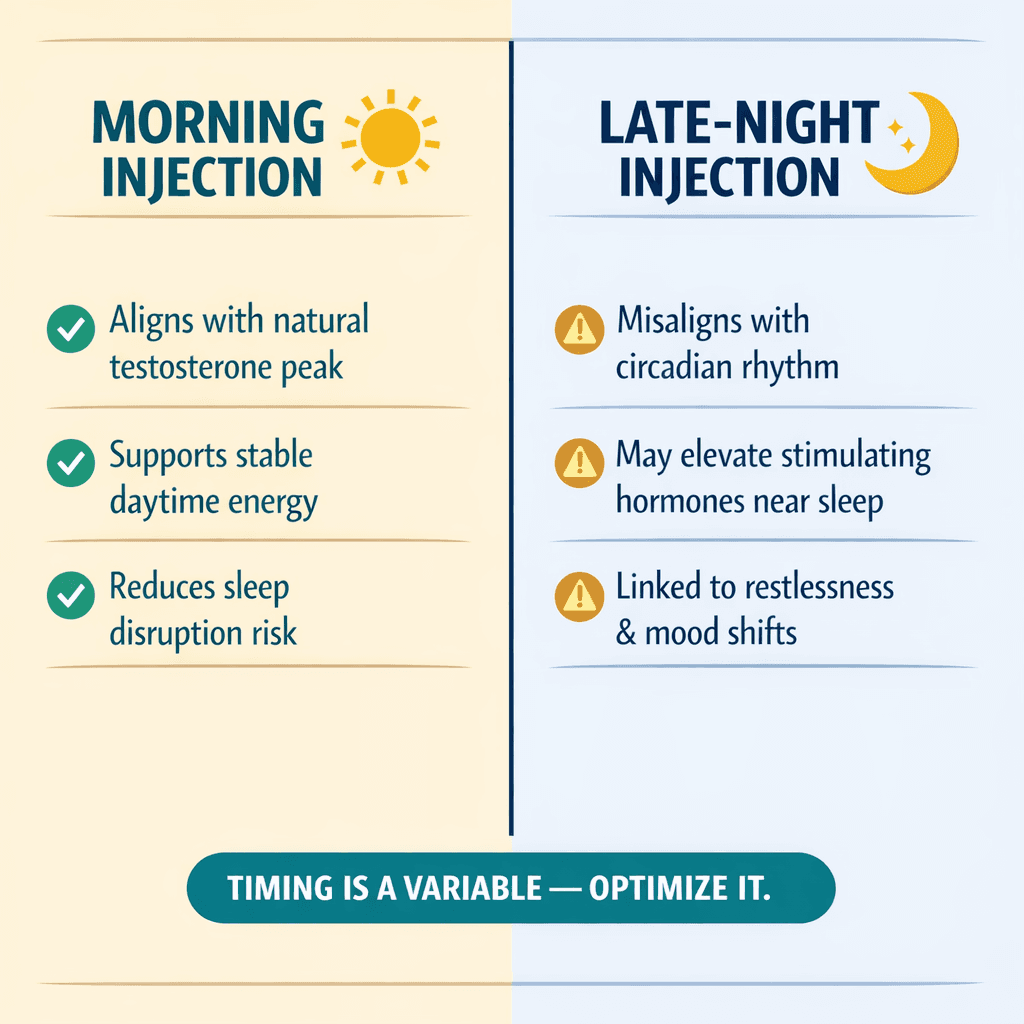
Here is the core issue. When you inject testosterone, levels rise over the following hours and days depending on the ester and your metabolism. That rise is not just a number on a lab report. It is a physiological signal that interacts with your body's existing hormonal environment at that specific time of day. A sharp rise in the evening may interact differently with your sleep architecture than a rise in the morning, when cortisol is naturally high and your nervous system is already transitioning toward wakefulness.
Some men on TRT report that switching from evening to morning injections improved their sleep quality. Others report the opposite. Neither group is imagining things. The effect of exogenous testosterone on sleep, alertness, and sympathetic nervous system tone can vary depending on when it hits peak absorption relative to your natural circadian patterns.
Morning vs. Evening: What Some Patients Actually Notice
Anecdotally, and increasingly in clinical conversation, some men who inject in the evening report difficulty falling asleep, lighter sleep, or feeling slightly wired on injection nights. This may relate to the stimulating effects of rising testosterone levels interacting with a nervous system that is trying to wind down. Testosterone has documented effects on dopamine and norepinephrine pathways, which are excitatory systems.
On the other hand, some men who switch to morning injections report a brief energy boost that aligns well with their daily activity demands, or find that any mild anxiety-like symptoms they were experiencing are reduced. The hypothesis is that a morning injection works with the body's natural cortisol awakening response rather than fighting against the wind-down process at night.
It is worth noting that these effects are not universal. Plenty of men inject in the evening with no sleep disruption whatsoever, and some men feel better on precisely that schedule. The timing variable does not override everything else. But for men who are troubleshooting symptoms they cannot otherwise explain, timing is a legitimate place to look.
Why Some Men Feel This and Others Do Not
Individual variability is real and substantial. Several factors influence whether injection timing produces noticeable effects.
Your chronotype matters. If you are a natural night owl, your cortisol and alertness curves peak later than someone who is a morning person. What counts as a disruptive evening injection for one person might fall right in the middle of the day for another, biologically speaking.
Sleep debt, shift work, and chronic stress all disrupt circadian rhythm baseline function. Men already dealing with fragmented sleep or irregular schedules may find that any perturbation to their hormonal environment, including TRT timing, creates a more noticeable symptom effect. The same is true for men who consume significant amounts of caffeine or alcohol, both of which alter sleep architecture and modify how the body responds to hormonal fluctuations.
Body composition plays a role as well. Men with higher body fat levels tend to aromatize testosterone more readily, converting it to estrogen. Aromatization rate affects not just estrogen levels but the timing and magnitude of hormonal shifts after each injection. This adds another layer of variability to how timing interacts with how you feel.
Baseline sex hormone-binding globulin levels also matter. SHBG affects how much testosterone is biologically active and how quickly levels shift after an injection. Someone with very high SHBG may have a blunted and delayed response to each injection, while someone with low SHBG may feel sharper peaks and valleys. That difference changes how sensitive someone will be to the specific time of day they inject.
Injection frequency is another piece of this. Men on twice-weekly or every-other-day protocols experience smaller peaks and steadier levels compared to once-weekly injections. Steadier levels mean the timing of any single injection has a proportionally smaller influence on day-to-day experience. Men on less frequent injection schedules may feel timing effects more acutely.
How Protocol Structure Interacts With Timing
Common TRT protocol structures vary considerably, and each interacts with timing differently. Some men use once-weekly injections, which produce more pronounced peaks and troughs. Others use twice-weekly schedules to smooth out fluctuations. Some use more frequent small injections to maintain very stable levels throughout the week.
For men on less frequent protocols, the specific timing of the injection can have a bigger practical impact on their week. If you inject once weekly and you do it on Sunday evening before a demanding Monday, a poor night's sleep from injection-related stimulation could affect your entire start to the week. Small logistical choices like this compound over time.
For men on more frequent protocols, the peaks are smaller and steadier, so any single injection's timing has less acute impact. That said, consistency still matters for overall hormonal rhythm. Injecting at erratic times across the week can introduce variability that the body's own systems struggle to adapt to.
The Endocrine Society's clinical practice guidelines on testosterone therapy emphasize individualization of protocols, which implicitly includes attention to how a protocol is structured in the context of a patient's real life, including their sleep habits, work schedule, and daily rhythms.
Adjunct Therapies and Their Own Timing Considerations
Some men on TRT also use adjunct therapies that introduce their own timing considerations. HCG, or human chorionic gonadotropin, is sometimes used alongside testosterone therapy to preserve testicular function and maintain intratesticular testosterone production. HCG has its own effects on hormone signaling and mood, and some clinicians and patients pay attention to its administration timing relative to testosterone injections.
Sermorelin, a growth hormone-releasing peptide sometimes discussed in men's health optimization, is typically administered at night because it works by stimulating natural growth hormone pulses, which are most active during deep sleep. This is a direct example of circadian timing being built into the therapeutic rationale itself, not just an afterthought.
When you are on a protocol that includes multiple therapies, the timing interactions become more complex. That is another reason why working with a qualified clinician rather than adjusting timing on your own is important.
How to Think About Timing Without Overcorrecting
If you are currently on TRT and feel generally well, there is no reason to start experimenting with injection timing. Consistency is more important than chasing an optimal hour. Your body adapts to patterns, and disrupting a working routine to find a marginally better one can introduce more variability than it resolves.
If, however, you are experiencing symptoms like disrupted sleep on injection days, unexplained anxiety or restlessness in the evenings, afternoon energy crashes, or mood instability that does not correspond to obvious lifestyle causes, timing is worth raising with your clinician. Track your symptom patterns relative to your injection schedule. Note whether symptoms appear within a day or two of injection, and whether they correlate with time of day. That kind of structured observation gives your provider something concrete to work with.
Avoiding drastic, unguided changes to your protocol is a genuine safety concern, not just a formality. Changing injection timing while simultaneously changing frequency or dose makes it impossible to isolate what is actually causing a shift in symptoms. If you want to explore timing adjustments, make one change at a time and give it enough time, typically several weeks at minimum, before drawing conclusions.
The Bigger Picture: Personalization Is the Standard, Not the Exception
TRT is not a single protocol that works identically for every man. The variables are numerous: ester type, injection frequency, timing, adjunct therapies, individual metabolism, lifestyle factors, and circadian biology all interact. That complexity is not a reason to feel overwhelmed. It is a reason to work with a clinical team that takes a genuinely personalized approach.
When you inject may matter almost as much as what you inject. Not because timing is magic, but because your body is a biological system that runs on rhythms, and anything you introduce into that system, including therapeutic hormones, interacts with those rhythms in ways that are real and measurable.
AlphaMD specializes in exactly this kind of individualized care, helping men think through not just what protocol makes sense, but how to structure it around their real lives, their sleep patterns, their work schedules, and the symptoms they are actually experiencing. If you are wondering whether your current timing is working for you, that conversation is worth having with a clinician who takes circadian biology seriously.
Have a question? Ask us.
At AlphaMD, we're here to help. Feel free to ask us any question you would like about TRT, medical weightloss, ED, or other topics related to men's health. Or take a moment to browse through our past questions.
People are asking...
Does timing matter for HCG injections? Husband is adding hCG (3x/week MWF) to usual TRT (2x/week Sun/Thurs) to regain fertility, and didn’t know if AM...
Generally no. With hCG it is less direct than with TRT, as it's not the medication itself causing a level to change but the downstream effects which persist that cause the changes. It does not need to... See Full Answer
Does it matter what time of day I inject? I’ve always been doing it at night when I’m not in a rush....
Time of day doesn’t matter. Whenever is most convenient for your schedule is all that matters.... See Full Answer
Can you speak to pinning frequency/time of day and what bearing it has on sleep, if any. Thank you!...
Most men notice increased quality of sleep on TRT. Some however do note having a harder time sleeping, which can sometimes be the case if they're less exhausted. In even more rare cases their dose nee... See Full Answer
Get $30 off your first month’s order
Enter your email address now to receive $30 off your first month’s cost, other discounts, and additional information about TRT.
Legal Disclaimer
This website is a repository of publicly available information and is not intended to form a physician-patient relationship with any individual. The content of this website is for informational purposes only. The information presented on this website is not intended to take the place of your personal physician's advice and is not intended to diagnose, treat, cure, or prevent any disease. Discuss this information with your own physician or healthcare provider to determine what is right for you. All information is intended for your general knowledge only and is not a substitute for medical advice or treatment for specific medical conditions. The information contained herein is presented in summary form only and intended to provide broad consumer understanding and knowledge. The information should not be considered complete and should not be used in place of a visit, phone or telemedicine call, consultation or advice of your physician or other healthcare provider. Only a qualified physician in your state can determine if you qualify for and should undertake treatment.