
VO₂max Is the Single Best Predictor of How Long You'll Live - And TRT Affects It Directly
Published on:
Updated on:
People are asking...
I see people post on various threads on steroids and how they age substantially in a few years. Does TRT have similar effects or is that more hardcore...
For traditional TRT, aka non-bodybuilding levels of Testosterone, this is generally considered almost the opposite. Testosterone in men helps to maintain metabolism & low Testosterone often leads to i... See Full Answer
It makes no rational sense to me that total testosterone “far more important”…. even for starting dose. When subjects can have the same total testoste...
Maybe think of it a different way. Your FT level varies a lot based on your SHBG and your albumin levels. And since no one knows to what degree your body will respond to TRT, initial dosing, for the T... See Full Answer
TLDR: high output / high stress life. Physically and mentally. Last 2 years feeling sluggish, burned out, and find doing challenging things extremely...
Providers very often hear "I have been feeling like shit for 6 months for 2 years, I have symptoms of low T" from people trying to figure out if TRT is right for them. It sounds like you're doing it r... See Full Answer
Have a question? Ask us.
At AlphaMD, we're here to help. Feel free to ask us any question you would like about TRT, medical weightloss, ED, or other topics related to men's health. Or take a moment to browse through our past questions.
Your ability to sustain physical effort is one of the most powerful predictors of how long you will live - and most men have no idea where they stand. VO₂max, the measure of your body's peak capacity to consume and use oxygen, outperforms cholesterol, blood pressure, and even smoking status as a predictor of all-cause mortality in large population studies. That is not a minor claim. It is a reason to pay attention.
What VO₂max Actually Measures
VO₂max stands for maximal oxygen uptake. It reflects how efficiently your heart, lungs, blood, and muscles work together at full effort to pull in oxygen and convert it into usable energy. Think of it as the ceiling of your aerobic engine.
At peak exertion, your heart pumps oxygenated blood out to working muscles. Those muscles extract the oxygen and use it to produce ATP - the fuel that keeps you moving. VO₂max is determined by how much blood your heart can pump per beat, how fast it beats, how well your blood delivers oxygen, and how effectively your muscle cells pull that oxygen out and use it. Every link in that chain matters.
When researchers track large groups of people over decades, the men in the lowest fitness categories - those with the poorest VO₂max scores - consistently face dramatically higher rates of cardiovascular disease, cancer mortality, and death from any cause. The relationship is not linear and gentle. It is steep. Moving from low to moderate aerobic fitness produces some of the biggest mortality risk reductions seen in any area of preventive medicine.
Why This Is Not Just an Athlete's Metric
Many men hear "VO₂max" and picture elite cyclists or marathon runners gasping on treadmills in research labs. That association misses the point entirely.
Your aerobic capacity governs everyday life more than you probably realize. It determines whether you feel winded after two flights of stairs or barely notice them. It shapes how quickly you recover from a stressful week, a bad night of sleep, or a minor illness. It influences your energy in the afternoon, your capacity to handle physical demands at work, and your resilience as your body ages.
After roughly age 30, VO₂max declines at a rate of about one percent per year in sedentary individuals - a gradual erosion that compounds quietly over decades until ordinary tasks start to feel like genuine effort. The men who age with vitality are, in large part, the men who maintained or improved their aerobic fitness. That is not coincidence.
How VO₂max Is Measured - and Where the Numbers Can Mislead
The gold standard is a maximal exercise test in a laboratory - typically on a treadmill or cycle ergometer - while wearing a mask that analyzes the air you breathe in and out. It is accurate, but not everyone has access to it.
Field estimates use formulas based on age, heart rate, and performance in a timed run or step test. These are less precise but reasonably useful for tracking trends over time. Many modern wearables - smartwatches and fitness trackers - also estimate VO₂max using heart rate data during exercise. These consumer estimates can be helpful as general guides, but they carry meaningful error margins and should not be treated as clinical-grade measurements.
Several factors can distort any reading. Altitude reduces available oxygen and will suppress performance-based estimates. Illness, even mild, suppresses aerobic output. Poor sleep can meaningfully reduce what your body produces on a given day. Certain medications affect heart rate response, making formula-based estimates unreliable. A reading taken during a period of detraining, high stress, or illness tells a different story than one taken at your genuine baseline. Trends across multiple measurements matter more than any single number.
The Testosterone-Aerobic Capacity Connection
Testosterone is not just a muscle hormone. It plays a direct and indirect role in aerobic performance through several physiological pathways, and understanding those connections helps explain why hormonal health and cardiovascular fitness are more intertwined than most men appreciate.
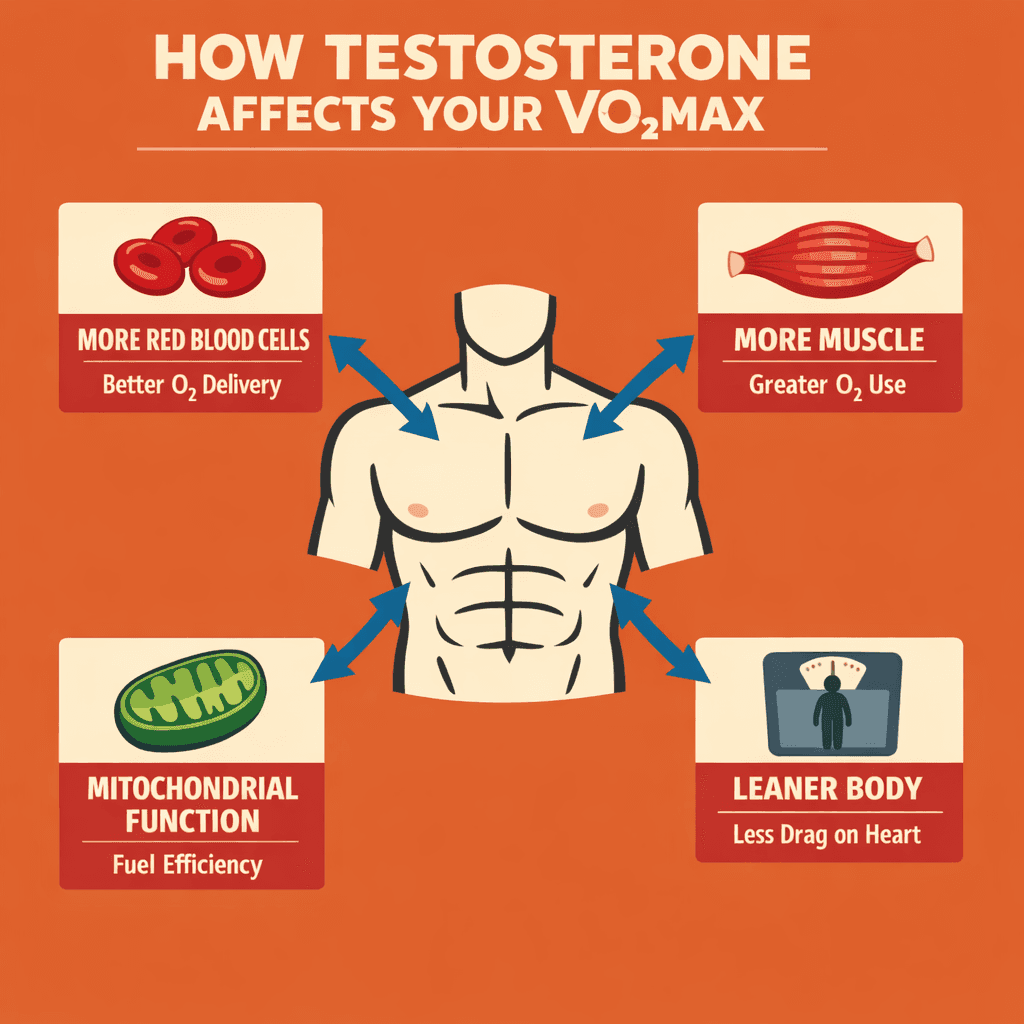
On the direct side, testosterone stimulates erythropoiesis - the production of red blood cells - which increases the blood's oxygen-carrying capacity. More red blood cells means more oxygen delivered to working muscles per heartbeat. This is one reason testosterone levels correlate with aerobic endurance in research settings, and it is also why manipulation of red blood cell production has been a target of doping in competitive sports.
Testosterone also supports skeletal muscle mass and influences mitochondrial density within muscle fibers. Mitochondria are where oxygen is actually used to generate energy. Muscle with higher mitochondrial content is more aerobically efficient. As testosterone declines with age, muscle loss - sarcopenia - tends to accelerate, and with it goes some of that metabolic machinery.
Indirectly, testosterone affects body composition. Higher levels are generally associated with less body fat and more lean mass. Carrying excess fat increases the work demand on the cardiovascular system and reduces relative VO₂max, which is expressed per kilogram of body weight. Beyond physiology, testosterone influences motivation, drive, and training consistency - factors that are harder to measure but genuinely matter for whether a man gets on the track or stays on the couch.
It is worth being honest about complexity here. The relationship between testosterone and aerobic performance is real but not simple. Hormones do not operate in isolation, and low testosterone is often accompanied by other factors - poor sleep, metabolic dysfunction, inactivity, stress - that independently suppress aerobic capacity. Sorting out cause from effect requires careful evaluation.
How TRT Can Shift VO₂max - In Both Directions
For men with clinically low testosterone, testosterone replacement therapy can influence VO₂max through several of the mechanisms above. The potential benefits are meaningful and supported by research, but the tradeoffs deserve equal attention.
On the benefit side, TRT may improve a man's capacity to train consistently and recover between sessions - which in itself drives VO₂max improvements over time. If low testosterone was contributing to anemia or suppressed red blood cell production, correcting it can restore oxygen-carrying capacity. Improvements in body composition - more lean mass, less fat - also shift relative VO₂max in a favorable direction.
On the risk side, TRT reliably increases hematocrit - the proportion of red blood cells in the blood. In appropriate ranges this supports performance, but when it rises too high, blood viscosity increases and cardiovascular risk can follow. This is a real tradeoff that requires monitoring, not something to ignore. TRT can also affect blood pressure in some men, and changes in lipid profiles - particularly reductions in HDL cholesterol in some cases - warrant attention.
Sleep apnea is another consideration. Testosterone can worsen obstructive sleep apnea in susceptible men, and untreated sleep apnea is itself a significant drag on aerobic recovery, cardiovascular health, and hormonal balance. Men with symptoms of sleep apnea should be evaluated before or alongside any hormonal therapy.
The conclusion is not that TRT is good or bad for VO₂max. It is that the relationship is physiologically real, clinically meaningful, and highly individual. What it does in any given man depends on his baseline, his health status, how his body responds, and whether training is part of the picture.
Training to Raise VO₂max - What Actually Works
Regardless of where a man's hormones stand, exercise is the most evidence-backed tool available to improve aerobic capacity. The fundamentals are straightforward, even if the details require personalization.
Building an aerobic base means spending meaningful time at moderate intensities - effort levels where you can hold a conversation but feel you are working. This trains the heart to pump more blood per beat and trains muscles to use oxygen more efficiently. Consistency over weeks and months matters far more than occasional heroic sessions.
High-intensity interval training - alternating short bursts of near-maximal effort with recovery periods - is one of the most time-efficient ways to push VO₂max higher. The physiological stress of those hard intervals signals the body to adapt upward. The caveat is that intensity needs to be appropriate for the individual. Men with cardiac symptoms, known heart disease, or significant deconditioning should get medical clearance before pushing into high-intensity work.
Progressive overload applies to aerobic training as much as it does to lifting weights. Gradually increasing duration, intensity, or frequency over time keeps the adaptation stimulus alive as fitness improves. Without progression, the body plateaus.
Recovery is not a secondary consideration - it is where adaptation actually happens. Sleep, nutrition, and stress management all influence how well the body responds to training. Men on TRT sometimes feel their recovery improves, which can support training frequency. But the same energy can lead to overtraining if the increased drive outpaces actual tissue adaptation. More is not always better.
Work with a clinician or qualified fitness professional to design a program that fits your current capacity and health status. VO₂max can improve at any age, but the path there looks different for a 35-year-old recreational athlete than it does for a 58-year-old man returning to exercise after a decade away.
Thinking Clearly About TRT and Whether It Is Right for You
TRT is a legitimate medical treatment for men with clinically diagnosed testosterone deficiency. The key word is clinically. Symptoms alone are not sufficient - fatigue, low libido, difficulty building muscle, and mood changes overlap with dozens of other conditions. A thorough evaluation includes laboratory testing, symptom assessment, and a review of overall health and medications.
Chasing a number without health context is where men get into trouble. Optimizing a hormone level while ignoring cardiovascular risk factors, sleep quality, metabolic health, or body composition misses the larger picture entirely. Testosterone does not fix a broken lifestyle, and it does not replace the cardiovascular benefits of sustained exercise.
When TRT is appropriate and well-managed, it can be a meaningful component of a broader health strategy - one that includes training, nutrition, sleep, and regular monitoring. When it is pursued improperly, without evaluation or supervision, the risks are real and the benefits are uncertain.
Who Should Be Especially Cautious
Certain men should approach any testosterone therapy with additional care and should not proceed without thorough medical evaluation. A history of cardiovascular disease - particularly heart attack, stroke, or significant coronary artery disease - requires careful risk-benefit discussion with a cardiologist and endocrinologist together. Men with elevated clotting risk or a history of blood clots face increased concern given TRT's effect on red blood cell production. Untreated or severe obstructive sleep apnea, as noted, can be worsened. Men with prostate concerns require appropriate screening and follow-up. None of these situations represent absolute prohibitions in every case, but they do require a higher level of scrutiny and ongoing oversight.
Connecting the Threads
VO₂max is not a number reserved for competitive athletes or lab researchers. It is a window into how well your body is aging at a functional level - and one of the most meaningful levers you can pull for long-term health. The fact that testosterone status influences this metric, both directly through physiology and indirectly through training capacity and body composition, makes hormonal health a legitimate part of the longevity conversation for men.
Approaching TRT thoughtfully means getting properly evaluated, understanding the tradeoffs alongside the benefits, and pairing any hormonal support with genuine lifestyle investment. Providers like AlphaMD specialize in exactly this kind of individualized, clinician-guided men's health care - where TRT decisions are grounded in your complete health picture, not a single number.
Aerobic capacity can improve. Hormonal health can be optimized. The two are connected in ways that deserve your attention - and the approach that serves you best is always the one built around who you actually are.
---This article is intended for general educational purposes only and does not constitute medical advice. Always consult a qualified healthcare provider before making decisions about hormone therapy, exercise programming, or any aspect of your health.
Have a question? Ask us.
At AlphaMD, we're here to help. Feel free to ask us any question you would like about TRT, medical weightloss, ED, or other topics related to men's health. Or take a moment to browse through our past questions.
People are asking...
I see people post on various threads on steroids and how they age substantially in a few years. Does TRT have similar effects or is that more hardcore...
For traditional TRT, aka non-bodybuilding levels of Testosterone, this is generally considered almost the opposite. Testosterone in men helps to maintain metabolism & low Testosterone often leads to i... See Full Answer
It makes no rational sense to me that total testosterone “far more important”…. even for starting dose. When subjects can have the same total testoste...
Maybe think of it a different way. Your FT level varies a lot based on your SHBG and your albumin levels. And since no one knows to what degree your body will respond to TRT, initial dosing, for the T... See Full Answer
TLDR: high output / high stress life. Physically and mentally. Last 2 years feeling sluggish, burned out, and find doing challenging things extremely...
Providers very often hear "I have been feeling like shit for 6 months for 2 years, I have symptoms of low T" from people trying to figure out if TRT is right for them. It sounds like you're doing it r... See Full Answer
Get $30 off your first month’s order
Enter your email address now to receive $30 off your first month’s cost, other discounts, and additional information about TRT.
Legal Disclaimer
This website is a repository of publicly available information and is not intended to form a physician-patient relationship with any individual. The content of this website is for informational purposes only. The information presented on this website is not intended to take the place of your personal physician's advice and is not intended to diagnose, treat, cure, or prevent any disease. Discuss this information with your own physician or healthcare provider to determine what is right for you. All information is intended for your general knowledge only and is not a substitute for medical advice or treatment for specific medical conditions. The information contained herein is presented in summary form only and intended to provide broad consumer understanding and knowledge. The information should not be considered complete and should not be used in place of a visit, phone or telemedicine call, consultation or advice of your physician or other healthcare provider. Only a qualified physician in your state can determine if you qualify for and should undertake treatment.