
Visceral Fat Is an Endocrine Organ - And It's Working Against Your TRT Protocol in Real Time
Published on:
Updated on:
People are asking...
What do i do if i am fat(37 BMI) and and have low SHGB(11 nmol/l) low test(1-2 ng/ml over several measurements). I do go to the gym 4 times a week, ha...
Additional Testosterone is converted into Estrogen because the body sees it as "maintaining the balance" and isn't directly related to body fat content. Estrogen is fat soluble which does mean that wh... See Full Answer
My SHBG is currently 12.0 nmol/L I am on 100mg/wk of test cyp - daily injections 1500iu hCG/wk Before TRT it was ~ 14 So bottom of the range. I r...
Your insights regarding why you have low SHBG seem accurate. First, being pre-diabetic, your body has been overproducing insulin for awhile. It often takes several years for you to return to normal in... See Full Answer
My SHBG is currently 12.0 nmol/L I am on 100mg/wk of test cyp - daily injections 1500iu hCG/wk Before TRT it was ~ 14 So bottom of the range. I r...
Your insights regarding why you have low SHBG seem accurate. First, being pre-diabetic, your body has been overproducing insulin for awhile. It often takes several years for you to return to normal in... See Full Answer
Have a question? Ask us.
At AlphaMD, we're here to help. Feel free to ask us any question you would like about TRT, medical weightloss, ED, or other topics related to men's health. Or take a moment to browse through our past questions.
Most men on testosterone replacement therapy expect to feel transformed - better energy, sharper focus, stronger libido, and a body that responds to training again. What nobody warned them about is that the fat packed around their organs can actively work against every benefit TRT is supposed to deliver.
The Fat You Cannot See Is the Fat That Matters Most
Visceral fat is not the soft layer you can pinch at your waist. It sits deep inside the abdominal cavity, wrapping around the liver, pancreas, intestines, and kidneys. Unlike subcutaneous fat, which is relatively inert from a hormonal standpoint, visceral fat is metabolically aggressive. It has its own blood supply, its own nerve connections, and its own capacity to produce and release signaling molecules that travel throughout the body.
Think of it less like a storage tank and more like a rogue gland. A gland that did not come with an off switch.
This distinction matters enormously for any man pursuing hormone optimization. When clinicians talk about body composition in the context of TRT, they are not talking about aesthetics. They are talking about a competing endocrine system operating inside the body, one that can blunt, distort, or outright undermine the hormonal environment you are trying to build.
Why Visceral Fat Behaves Like an Endocrine Organ
Fat tissue, particularly visceral fat, secretes a class of signaling proteins called adipokines. These include leptin, adiponectin, resistin, and several others that communicate directly with the brain, the liver, the pancreas, and the hypothalamic-pituitary axis - the command center for hormone production.
Leptin, often called the satiety hormone, is produced in large amounts by excess fat tissue. In healthy concentrations it helps regulate appetite and energy expenditure. But when visceral fat accumulates, leptin levels can rise to the point where the brain stops responding to the signal properly, a state known as leptin resistance. The result is a disrupted feedback loop that affects hunger, energy regulation, and downstream hormonal signaling.
Adiponectin tells a different story. This adipokine improves insulin sensitivity and has anti-inflammatory properties. The problem is that visceral fat actively suppresses adiponectin production. The more visceral fat a man carries, the less of this protective molecule circulates in his blood. Lower adiponectin correlates with increased inflammation, worsening insulin resistance, and a hormonal environment that is increasingly hostile to testosterone activity.
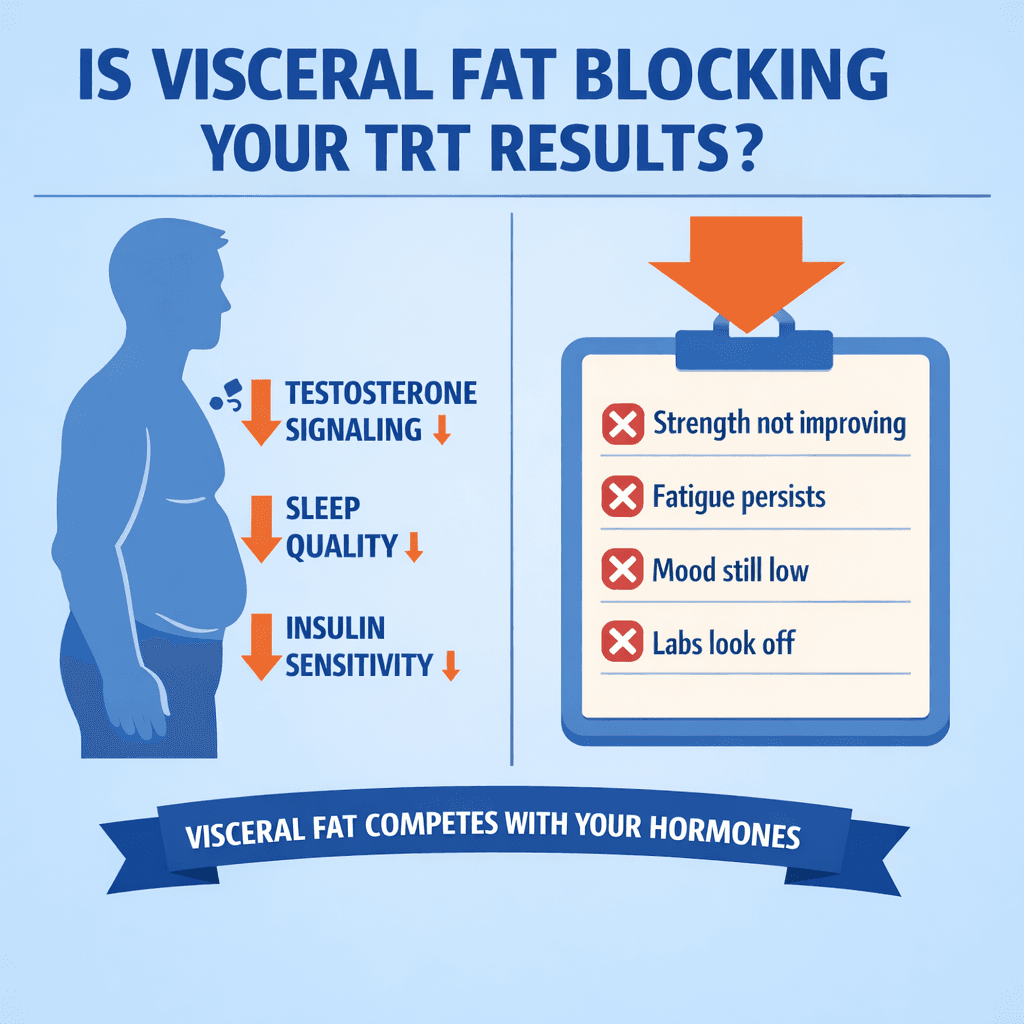
Then there are the inflammatory cytokines - molecules like interleukin-6, tumor necrosis factor-alpha, and others that visceral fat releases in sustained, low-grade quantities. This is not the acute inflammation of a hard workout or a healing injury. This is chronic, systemic inflammation that quietly suppresses testosterone signaling, impairs recovery, disrupts sleep architecture, and contributes to cardiovascular risk over time.
The Aromatase Problem: How Visceral Fat Converts Your Testosterone
One of the most direct and clinically significant ways visceral fat interferes with TRT is through aromatase activity. Aromatase is an enzyme that converts testosterone into estradiol, and fat tissue - especially visceral fat - is one of the most concentrated sources of aromatase in the male body.
For a man on TRT, this creates a real-time conversion problem. The testosterone being introduced through his protocol does not simply circulate freely and bind to androgen receptors. A meaningful portion of it gets intercepted and converted to estradiol by aromatase enzymes sitting inside visceral fat deposits.
Elevated estradiol in men is not inherently dangerous - estrogen plays important roles in bone density, cardiovascular health, and libido. But when estradiol climbs too high relative to testosterone, the hormonal ratio shifts in ways that can produce symptoms: water retention, mood instability, reduced libido, softer erections, and breast tissue sensitivity. Managing estradiol becomes significantly more complex when visceral fat is driving excess aromatization in the background.
This is why two men on the same TRT protocol can have very different experiences. The man carrying substantial visceral fat is running his testosterone through a conversion machine that the other man simply does not have.
Insulin Resistance, Cortisol, and the Hormonal Cascade
Visceral fat and insulin resistance are locked in a feedback loop that reinforces itself. Visceral fat secretes free fatty acids and inflammatory signals directly into the portal circulation, which leads to the liver first. This contributes to hepatic insulin resistance, which then elevates systemic insulin levels, which promotes further fat storage, particularly in the abdomen.
Elevated insulin suppresses sex hormone-binding globulin (SHBG). SHBG is the protein that binds testosterone in circulation, and while lower SHBG might sound like it would mean more free testosterone available, the reality is more complicated. SHBG shifts driven by metabolic dysfunction reflect a disordered hormonal environment, not an optimized one, and they can make interpreting lab results and managing a TRT protocol significantly harder.
Cortisol adds another layer of interference. Visceral fat tissue contains enzymes that locally amplify cortisol activity. Chronic low-grade inflammation and poor sleep - both common consequences of excess visceral fat - keep cortisol elevated at a systemic level as well. Cortisol is catabolic. It breaks down muscle, promotes fat storage in the abdomen, suppresses testosterone production, and impairs the quality of sleep. Chronically elevated cortisol essentially counteracts much of what TRT is trying to accomplish.
What Men Actually Feel: Symptoms That Don't Add Up
A man who is doing everything right on paper - consistent with his protocol, following up with his clinic, taking his medication as directed - but is also carrying significant visceral fat may find himself frustrated by a set of symptoms that seem contradictory.
His energy might be better than it was before TRT, but not as good as he expected. His libido improved initially but has plateaued or become inconsistent. His erections are functional but not where he remembers them being at their best. His training recovery feels sluggish relative to the effort he is putting in. He may notice he is retaining water, that his sleep is still not restorative, or that his blood pressure trends a little higher than he would like.
None of these symptoms mean his TRT is failing. They often mean his visceral fat is creating a hostile hormonal environment that his protocol is fighting against in real time.
Sleep quality is particularly worth calling out. Visceral fat accumulation significantly raises the risk of obstructive sleep apnea, a condition where the airway repeatedly collapses during sleep, fragmenting sleep architecture and triggering repeated cortisol and adrenaline surges throughout the night. Sleep apnea also contributes to elevated hematocrit over time - one of the key lab markers that gets monitored during TRT. Managing hematocrit trends becomes more complex when sleep apnea is driving additional physiological stress on the body. Any man on TRT who snores heavily, wakes unrefreshed, or has been told he stops breathing during sleep should be screened.
Lab Markers Get More Complicated, Not Less
Visceral fat does not just affect how a man feels - it makes the clinical management of TRT more challenging across multiple lab panels.
Estradiol management becomes harder because aromatization is elevated and variable, making it more difficult to achieve consistent hormone ratios. SHBG fluctuations driven by insulin resistance mean that the relationship between total testosterone and free testosterone shifts in ways that require closer monitoring. Lipid trends can worsen as visceral fat-driven inflammation affects how the liver processes cholesterol. Fasting glucose and insulin markers may reflect an escalating insulin resistance pattern that, if left unaddressed, leads toward metabolic syndrome.
None of these complications are insurmountable. But they underscore why TRT is not simply a matter of optimizing one hormone in isolation. The metabolic environment surrounding that hormone determines how effectively the therapy can actually work.
Reducing Visceral Fat Is Hormone Optimization
This is the reframe that matters: losing visceral fat is not about fitting into a smaller size. It is about removing a competing endocrine organ that is actively undermining the hormonal environment you are trying to build.
The good news is that visceral fat is highly responsive to lifestyle intervention - often more so than subcutaneous fat. The body tends to mobilize visceral fat relatively readily when the right inputs are applied consistently.
Resistance training is foundational. Building and preserving lean muscle mass improves insulin sensitivity, raises resting metabolic rate, and shifts body composition in ways that directly reduce visceral fat accumulation. Cardiovascular training, particularly moderate-intensity sustained effort, has demonstrated significant impact on visceral fat independent of weight loss on the scale. Both modalities together are more effective than either alone.
Nutrition does not need to be dogmatic to be effective. Emphasizing protein supports muscle retention during fat loss and keeps appetite more manageable. Emphasizing fiber - from vegetables, legumes, and whole food sources - supports gut health, reduces inflammation, and improves insulin sensitivity. Reducing ultra-processed foods, refined carbohydrates, and added sugars targets the primary dietary drivers of visceral fat accumulation and insulin resistance without requiring extreme restriction.
Alcohol deserves a straightforward mention. It is metabolized as a priority fuel by the liver, promoting fat storage, disrupting sleep quality, elevating estrogen, and contributing to visceral fat accumulation over time. Moderation is not a moral position - it is a hormonal one.
Sleep quality and stress management are not optional recovery tools. They are core components of visceral fat reduction. Chronically elevated cortisol from poor sleep and unmanaged stress directly drives abdominal fat storage. Addressing sleep apnea, prioritizing sleep duration and consistency, and actively managing psychological stress are all part of improving the hormonal environment - not peripheral concerns to address later.
Consistency across all of these areas matters more than perfection in any single one. Visceral fat accumulates over years. It responds to sustained behavioral change, not short bursts of effort.
The Bigger Picture of Hormone Optimization
TRT is a powerful tool. Used well, it restores physiological testosterone levels, supports lean mass, improves energy, protects cardiovascular and bone health, and meaningfully improves quality of life for men with low testosterone. But it functions inside a larger biological system, and that system is shaped by everything from sleep quality to stress hormones to the metabolic activity of visceral fat tissue.
A man who addresses only his testosterone levels while ignoring the visceral fat environment surrounding his hormone system is working at a fraction of his potential. The men who get the most from TRT are typically the men who treat hormone optimization as a comprehensive project - one that includes body composition, metabolic health, sleep quality, and ongoing monitoring as equal partners to the therapy itself.
This is exactly the approach that AlphaMD is built around. Comprehensive hormone optimization means more than writing a prescription. It means partnering with men to understand the full picture - tracking how lifestyle factors are influencing lab markers, providing health coaching alongside clinical monitoring, and adjusting the protocol as the overall physiological environment improves. If your TRT results have felt incomplete, the conversation worth having is not just about your testosterone levels. It is about everything that is shaping the environment those levels are operating in.
Have a question? Ask us.
At AlphaMD, we're here to help. Feel free to ask us any question you would like about TRT, medical weightloss, ED, or other topics related to men's health. Or take a moment to browse through our past questions.
People are asking...
What do i do if i am fat(37 BMI) and and have low SHGB(11 nmol/l) low test(1-2 ng/ml over several measurements). I do go to the gym 4 times a week, ha...
Additional Testosterone is converted into Estrogen because the body sees it as "maintaining the balance" and isn't directly related to body fat content. Estrogen is fat soluble which does mean that wh... See Full Answer
My SHBG is currently 12.0 nmol/L I am on 100mg/wk of test cyp - daily injections 1500iu hCG/wk Before TRT it was ~ 14 So bottom of the range. I r...
Your insights regarding why you have low SHBG seem accurate. First, being pre-diabetic, your body has been overproducing insulin for awhile. It often takes several years for you to return to normal in... See Full Answer
My SHBG is currently 12.0 nmol/L I am on 100mg/wk of test cyp - daily injections 1500iu hCG/wk Before TRT it was ~ 14 So bottom of the range. I r...
Your insights regarding why you have low SHBG seem accurate. First, being pre-diabetic, your body has been overproducing insulin for awhile. It often takes several years for you to return to normal in... See Full Answer
Get $30 off your first month’s order
Enter your email address now to receive $30 off your first month’s cost, other discounts, and additional information about TRT.
Legal Disclaimer
This website is a repository of publicly available information and is not intended to form a physician-patient relationship with any individual. The content of this website is for informational purposes only. The information presented on this website is not intended to take the place of your personal physician's advice and is not intended to diagnose, treat, cure, or prevent any disease. Discuss this information with your own physician or healthcare provider to determine what is right for you. All information is intended for your general knowledge only and is not a substitute for medical advice or treatment for specific medical conditions. The information contained herein is presented in summary form only and intended to provide broad consumer understanding and knowledge. The information should not be considered complete and should not be used in place of a visit, phone or telemedicine call, consultation or advice of your physician or other healthcare provider. Only a qualified physician in your state can determine if you qualify for and should undertake treatment.