
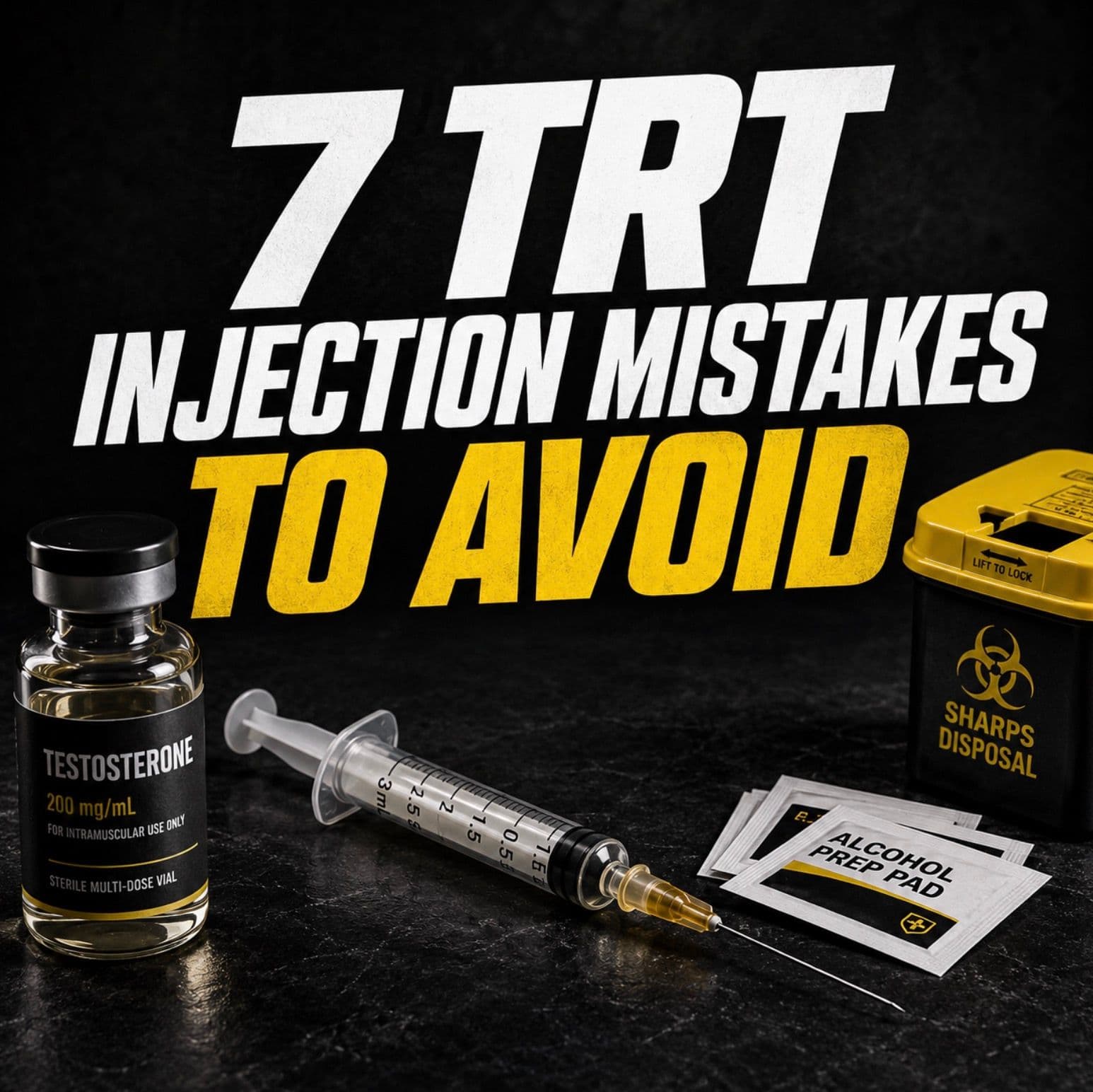
7 TRT Injection Mistakes That Are Easy to Avoid
Published on:
Updated on:
People are asking...
Do you have any theories as to why some people experience a honeymoon phase for a few weeks then lose the benefits of TRT?...
The most common reason for this in men tends to be a need for a simple dose adjustment. There's a general 8 week uptake period where injected levels increase week over week & then natural production ... See Full Answer
For someone who is new to this topic, yet interested in TRT if needed, would a pill or topical form be a reliable method of TRT? I have no experienc...
In general oral medications tend to be the least successful with the most amount of side effects. Topical or injectable medications are more direct applications of Testosterone & much better for bene... See Full Answer
My current level has rebounded to 550. In December, it was 400 and I'm assuming at the end of the marathon season it was 200 or less. I might just lo...
For Testosterone, injections are much better than creams and gels. They are more consistent, potent, accurate, take less time investment, and generally cost way less. For a lot of people the idea of i... See Full Answer
Have a question? Ask us.
At AlphaMD, we're here to help. Feel free to ask us any question you would like about TRT, medical weightloss, ED, or other topics related to men's health. Or take a moment to browse through our past questions.
Injectable testosterone is one of the most common and effective ways to administer testosterone replacement therapy, but getting good results depends on more than simply remembering to take your medication. Small mistakes involving dose measurement, injection supplies, cleanliness, storage or scheduling can make injections less comfortable, less consistent and potentially unsafe.
Fortunately, most TRT injection mistakes are easy to prevent once you understand the basics.
What Are the Most Common TRT Injection Mistakes?
The seven most common testosterone injection mistakes are:
- Confusing milligrams with milliliters
- Skipping proper injection preparation
- Injecting into the same location repeatedly
- Using the wrong needle or syringe
- Storing testosterone incorrectly
- Taking injections on an inconsistent schedule
- Disposing of needles improperly
Patients should always follow the instructions supplied by their pharmacy and licensed medical provider. Injection route, dose, frequency, needle selection and approved injection sites can differ between patients and testosterone products.
1. Confusing Milligrams With Milliliters
One of the easiest mistakes to make is confusing the prescribed testosterone dose with the amount of liquid that needs to be drawn into the syringe.
Testosterone is commonly prescribed in milligrams, abbreviated as mg. Syringes measure liquid volume in milliliters, abbreviated as mL. These measurements are related, but they are not interchangeable.
For example, a prescription might instruct a patient to inject 100 mg of testosterone. The amount of liquid needed depends on the concentration shown on the vial.
If the vial contains 200 mg of testosterone per mL:
100 mg ÷ 200 mg/mL = 0.5 mL
A different vial concentration would require a different volume for the same milligram dose.
How to avoid this mistake
Before drawing an injection:
- Read the concentration printed on the vial.
- Confirm the prescribed dose in milligrams.
- Confirm the corresponding volume in milliliters.
- Use the syringe markings demonstrated by your provider or pharmacy.
- Ask for clarification if the written dose and syringe instructions appear inconsistent.
Do not assume that a line on a syringe represents a certain number of milligrams. Syringe markings measure volume. They do not automatically indicate the amount of testosterone in that volume.
This is especially important when using syringes marked in “units.” Those markings still represent volume and should not be interpreted as milligrams of testosterone without specific instructions.
2. Skipping Proper Injection Preparation
TRT injections are often performed at home, but that does not mean cleanliness is optional.
The Centers for Disease Control and Prevention recommends using aseptic technique when preparing and administering injections. This includes performing hand hygiene, preparing medication in a clean area and using a new sterile needle and syringe for every injection.
A safer preparation routine
Before beginning:
- Wash your hands thoroughly with soap and water.
- Place your supplies on a clean, dry surface.
- Check the medication name, concentration and expiration date.
- Inspect the liquid for unexpected discoloration, cloudiness or particles.
- Clean the vial stopper with a fresh alcohol wipe.
- Allow the alcohol to dry before inserting the needle.
- Prepare the injection using unopened, sterile supplies.
- Clean the provider-approved injection site and allow it to dry.
Avoid touching the needle, the cleaned vial stopper or the prepared injection site. If the needle touches an unclean surface, discard it safely and use a new sterile needle.
The CDC also recommends preparing injections as close as possible to the time they will be administered rather than leaving filled syringes sitting unnecessarily. You can review the CDC’s safe injection practices for additional guidance.
Never reuse a needle or syringe, even when you are the only person using the medication. Once a needle and syringe have been used, they should be considered contaminated.
3. Injecting Into the Same Location Every Time
Repeatedly injecting into the exact same location can lead to persistent soreness, irritation, bruising, hardened tissue or scar tissue.
Scarred or irritated tissue may also make future injections more uncomfortable. In some cases, repeatedly using one small area can make it more difficult to administer the medication consistently.
How to rotate TRT injection sites
Use only the injection sites approved for your prescribed route. Then alternate between those sites according to the instructions provided by your licensed medical provider.
A simple rotation system may involve:
- Alternating between the left and right sides
- Moving slightly within an approved injection area
- Keeping a note of the last injection location
- Avoiding any area that remains sore or irritated
Do not inject into skin that is red, swollen, bruised, tender, hardened, infected or visibly damaged.
The correct site also depends on whether the medication was prescribed for intramuscular or subcutaneous administration. Do not switch routes or select a new injection location based solely on a social media post or online diagram.
4. Using the Wrong Needle or Syringe
Needles and syringes are not one-size-fits-all.
The appropriate equipment depends on several factors, including:
- The prescribed injection route
- The injection location
- The thickness of the medication
- The amount of medication being administered
- The patient’s body composition
- The instructions for the specific testosterone product
A needle intended for drawing medication may not be the same needle recommended for administering it. Similarly, a syringe that is much larger than the prescribed injection volume can make small doses harder to measure accurately.
Why syringe size matters
A smaller-capacity syringe may provide more detailed markings for low-volume injections. However, patients should use the supplies recommended by their provider or pharmacy rather than changing syringe types independently.
Using an incorrect needle can result in:
- Increased discomfort
- Difficulty drawing the oil-based medication
- Incorrect injection depth
- Medication being delivered through the wrong route
- Greater irritation at the injection site
Do not select a needle based only on what another TRT patient uses. Two patients taking the same medication may have different routes, doses, injection sites and supply requirements.
When there is any uncertainty, contact the prescribing provider or dispensing pharmacy before injecting.
5. Storing Testosterone Incorrectly
Medication storage is easy to overlook, particularly when TRT supplies are kept in a bathroom, gym bag, vehicle or travel case.
Many testosterone cypionate products are stored at controlled room temperature and protected from light. However, exact storage instructions can vary between products and pharmacies.
The FDA-approved labeling for one testosterone cypionate product instructs patients to store it at 59°F to 77°F, or 15°C to 25°C, and keep it in its carton to protect it from light. That does not mean every testosterone product has identical instructions.
General TRT storage mistakes include:
- Leaving the vial in a hot vehicle
- Exposing it to direct sunlight
- Storing it near a heater
- Refrigerating it without instructions
- Allowing children or pets to access it
- Using medication after the expiration date
- Using medication that looks cloudy or contains unexpected particles
The best rule is to follow the storage instructions printed on your specific medication label.
Keep testosterone in its original packaging whenever possible. Store it in a secure, dry location with a stable temperature. Bathrooms are often less suitable because heat and humidity can fluctuate.
If the medication has been exposed to extreme heat or cold, or its appearance has changed, contact the pharmacy before using it. Do not attempt to repair, heat, cool or alter the medication based on advice found online.
6. Taking Injections on an Inconsistent Schedule
TRT is not designed to be taken whenever it is convenient. Your injection schedule is part of the prescription.
Injecting on inconsistent days, repeatedly delaying doses or taking injections too close together may produce unnecessary fluctuations in testosterone levels. That can make it more difficult to evaluate whether the prescribed protocol is working.
Inconsistency can also complicate bloodwork. Lab results may be difficult to interpret when the time between injections changes from week to week.
How to stay consistent
Use a simple system:
- Choose regular injection days.
- Inject at approximately the same time when practical.
- Add recurring reminders to your phone.
- Record completed injections.
- Plan ahead for travel.
- Refill supplies before they run out.
- Keep your schedule consistent before follow-up bloodwork.
Do not double the next injection because you missed one. Contact your licensed medical provider or pharmacist for instructions, especially when several days have passed or your next scheduled injection is approaching.
Also avoid changing the dose or injection frequency based on a few days of symptoms. TRT adjustments should be based on the complete clinical picture, including symptoms, bloodwork, side effects and the timing of laboratory testing.
7. Throwing Used Needles in the Trash
Used needles should never be left loose in a trash bag, bathroom bin, travel bag or recycling container.
Loose needles can injure family members, children, pets, housekeepers, sanitation workers and anyone else who handles the waste.
The FDA recommends placing used needles and syringes into an FDA-cleared sharps disposal container immediately after use. These containers are puncture-resistant, leak-resistant and designed with a secure lid.
Safe sharps disposal basics
After completing an injection:
- Place the used needle and syringe directly into the sharps container.
- Do not leave the needle on a table or counter.
- Do not place loose sharps in household trash or recycling.
- Do not flush needles down the toilet.
- Keep the container away from children and pets.
- Do not overfill the container.
- Follow state or local rules for final disposal.
Having the sharps container next to you during the injection reduces the temptation to recap, carry or temporarily set down the used needle.
FDA-cleared sharps containers are available through many pharmacies, medical supply companies and online retailers. When an approved container is unavailable, the FDA notes that a heavy-duty plastic household container may sometimes be used as an alternative. It should have a tight-fitting, puncture-resistant lid, remain upright and be clearly labeled. Local regulations may differ, so check the rules in your community before disposal.
The FDA provides additional instructions on safe sharps use and disposal.
A Simple TRT Injection Checklist
Before every testosterone injection, confirm the following:
- I have the correct medication.
- I checked the vial concentration.
- I confirmed my prescribed dose and injection volume.
- I am using the correct syringe and needle.
- My hands and preparation area are clean.
- I cleaned the vial stopper.
- I inspected the medication.
- I am using an approved injection site.
- I am rotating away from the previous location.
- I am following my prescribed injection schedule.
- My sharps container is within reach.
A 30-second review can prevent many of the most common testosterone injection errors.
When Should You Contact a Medical Provider After an Injection?
Minor soreness or a small amount of redness can occur after an injection. However, contact a licensed medical provider when an injection site becomes increasingly painful, swollen, warm, hard or red, particularly when symptoms continue to worsen.
Seek medical guidance for:
- Spreading redness
- Significant swelling
- Drainage or pus
- Fever or chills
- Severe or increasing pain
- Persistent bleeding
- A growing lump
- Numbness or weakness
- A rash or signs of an allergic reaction
- Questions about whether the correct dose was injected
Seek immediate medical attention for difficulty breathing, chest pain, fainting, facial or throat swelling or other signs of a severe reaction.
Do not administer an extra injection to compensate for medication that may have leaked from the site. Contact your provider if you believe a substantial portion of a dose was lost.
Frequently Asked Questions About TRT Injections
Can you reuse a TRT needle if it still looks clean?
No. Needles and syringes are single-use supplies. A used needle is no longer sterile and should be placed directly into a sharps container.
Can you use the same needle to draw and inject testosterone?
This depends on the supplies and instructions provided with your treatment. Some protocols use separate drawing and injection needles. Others use a single sterile needle. Follow the instructions from your provider or pharmacy rather than changing the process yourself.
Should testosterone be kept in the refrigerator?
Not unless the label or dispensing pharmacy specifically instructs you to refrigerate it. Many testosterone cypionate products are stored at controlled room temperature and protected from light.
Can you switch between intramuscular and subcutaneous injections?
Only under the direction of the licensed medical provider overseeing your treatment. Injection route affects needle selection, injection site and how the medication should be administered.
What happens if you miss a TRT injection?
Do not automatically double the next dose. Contact your provider or pharmacy for instructions based on how late the dose is and when the next injection is scheduled.
Why does my TRT injection site hurt?
Temporary soreness can be related to needle movement, injection location, repeated use of the same site, equipment selection or local irritation. Pain that becomes severe, spreads or is accompanied by warmth, swelling, drainage or fever should be medically evaluated.
The Bottom Line
TRT injections usually become routine with practice, but routine should not lead to carelessness.
The most important TRT injection best practices are straightforward: confirm the dose, use sterile supplies, rotate approved injection sites, use the correct equipment, store the medication properly, remain consistent with the prescribed schedule and dispose of every needle safely.
When something is unclear, do not guess. Your licensed medical provider or dispensing pharmacist can confirm the correct dose, route, equipment and injection process for your specific prescription.
Have a question? Ask us.
At AlphaMD, we're here to help. Feel free to ask us any question you would like about TRT, medical weightloss, ED, or other topics related to men's health. Or take a moment to browse through our past questions.
People are asking...
Do you have any theories as to why some people experience a honeymoon phase for a few weeks then lose the benefits of TRT?...
The most common reason for this in men tends to be a need for a simple dose adjustment. There's a general 8 week uptake period where injected levels increase week over week & then natural production ... See Full Answer
For someone who is new to this topic, yet interested in TRT if needed, would a pill or topical form be a reliable method of TRT? I have no experienc...
In general oral medications tend to be the least successful with the most amount of side effects. Topical or injectable medications are more direct applications of Testosterone & much better for bene... See Full Answer
My current level has rebounded to 550. In December, it was 400 and I'm assuming at the end of the marathon season it was 200 or less. I might just lo...
For Testosterone, injections are much better than creams and gels. They are more consistent, potent, accurate, take less time investment, and generally cost way less. For a lot of people the idea of i... See Full Answer
Get $30 off your first month’s order
Enter your email address now to receive $30 off your first month’s cost, other discounts, and additional information about TRT.
Legal Disclaimer
This website is a repository of publicly available information and is not intended to form a physician-patient relationship with any individual. The content of this website is for informational purposes only. The information presented on this website is not intended to take the place of your personal physician's advice and is not intended to diagnose, treat, cure, or prevent any disease. Discuss this information with your own physician or healthcare provider to determine what is right for you. All information is intended for your general knowledge only and is not a substitute for medical advice or treatment for specific medical conditions. The information contained herein is presented in summary form only and intended to provide broad consumer understanding and knowledge. The information should not be considered complete and should not be used in place of a visit, phone or telemedicine call, consultation or advice of your physician or other healthcare provider. Only a qualified physician in your state can determine if you qualify for and should undertake treatment.