
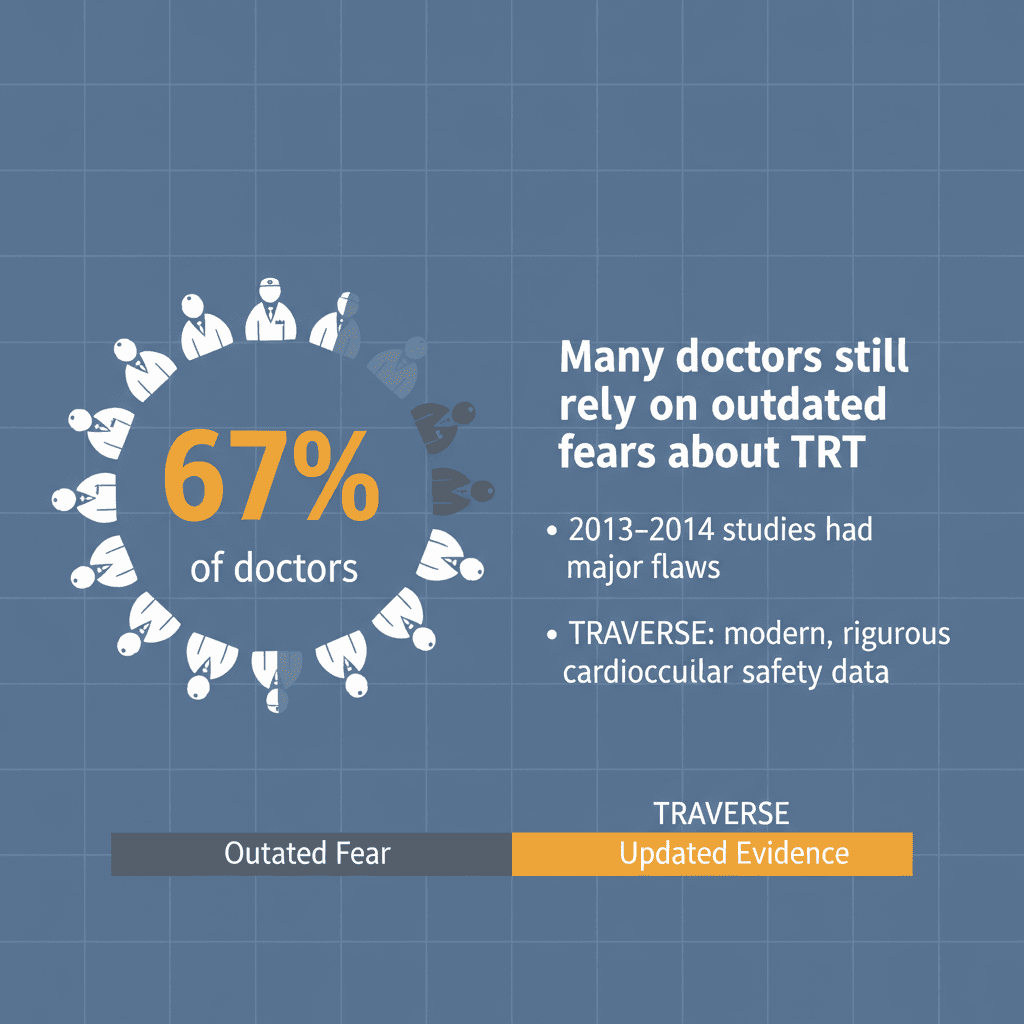
TRAVERSE Changed the Game, But 67% of Doctors Still Haven't Read It
Published on:
Updated on:
People are asking...
Why does institutional endocrinology insist on horribly outdated treatment protocols, when modern evidence says they're wrong? eg: I asked my nearly ...
If you don't mind, I will be a bit blunt here because this kind of thing is the reason we started our company, so I hope it doesn't come off as overly rude. Providers, even specialists, are people. ... See Full Answer
I want to start with a telemedicine clinic but I’m worried about what I’ve read on the rules changing in November with the dea requiring A in doctor v...
I'm going to copy another recent reply we made to this comment, if you don't mind, and expand on it. The main issue with the TRT telemedicine concerns is focused on other controlled substances & tele... See Full Answer
Do you foresee patients currently dependent on TRT to sort of be “screwed” at any point due to increased regulations that make it so they can no longe...
I don’t have a crystal ball, but I don’t see that being a problem. Treatment is becoming more prevalent because providers are better at recognizing the symptoms, more open about talking about it, and ... See Full Answer
Have a question? Ask us.
At AlphaMD, we're here to help. Feel free to ask us any question you would like about TRT, medical weightloss, ED, or other topics related to men's health. Or take a moment to browse through our past questions.
In 2023, the medical world got its most comprehensive answer yet to one of the most contested questions in men's health: does testosterone replacement therapy increase the risk of heart attacks and strokes? The TRAVERSE trial delivered a landmark verdict, but surveys and informal polls suggest that more than two-thirds of practicing doctors still haven't read it, much less changed how they counsel men about TRT.
That gap between evidence and practice matters. It means men with legitimate symptoms of low testosterone are still hearing outdated warnings based on fear rather than data. It means some doctors are reflexively saying no to treatment that could improve quality of life, while others might not be screening carefully enough for the men who shouldn't be on TRT at all. Understanding what TRAVERSE actually found, and why so many physicians haven't caught up, is essential for any man trying to make an informed decision about his hormonal health.
One Study That Forced Everyone To Pay Attention
The TRAVERSE trial wasn't just another small study published in an obscure journal. It was a massive, multi-year effort specifically designed to answer the cardiovascular safety question that had hung over testosterone therapy for more than a decade. Funded in part by the FDA and conducted at over 300 sites across the United States, TRAVERSE followed more than 5,000 middle-aged and older men with low testosterone and preexisting or high risk for cardiovascular disease.
These weren't young, healthy guys looking for a performance edge. These were men between 45 and 80 years old, many with obesity, diabetes, high blood pressure, and other conditions that put them at elevated cardiovascular risk already. In other words, exactly the population doctors had been most nervous about treating with testosterone.
The trial was randomized and placebo-controlled, the gold standard in clinical research. Half the men received testosterone gel, while the other half received a placebo. Researchers tracked them for an average of about three years, watching closely for major adverse cardiovascular events: heart attacks, strokes, and cardiovascular death.
When the results were published in the New England Journal of Medicine in 2023, they showed that testosterone therapy did not significantly increase the risk of these serious cardiovascular events compared to placebo. The findings challenged a decade of anxiety that had been triggered by earlier, smaller, and more controversial studies that suggested TRT might be dangerous for the heart.
TRAVERSE didn't declare testosterone therapy universally safe for everyone. It found what it found in the specific population it studied, under medical supervision, with careful monitoring. But it did provide the most rigorous evidence to date that, in appropriately selected men with symptoms and lab-confirmed low testosterone, TRT does not appear to carry the catastrophic cardiovascular risk some had feared.
The Shadow of 2013 Still Looms Large
To understand why TRAVERSE matters so much, you have to rewind to 2013 and 2014, when two studies sent shockwaves through the TRT world. One study published in JAMA and another in PLOS ONE suggested that testosterone therapy might increase heart attacks, strokes, and death. The findings were alarming enough that the FDA added warnings to testosterone products and required manufacturers to conduct further safety studies.
Those studies had significant methodological problems that were pointed out by many experts at the time. Critics noted issues with how cardiovascular events were defined and counted, and concerns about the populations studied. But the damage was done. Prescriptions for testosterone dropped. Doctors became more hesitant. Lawyers started running ads. And an entire generation of physicians trained during that era absorbed the message that TRT was risky business.
The problem is that medical education, once absorbed, is hard to update. Doctors who finished residency between 2013 and 2023 may have been taught that testosterone is a cardiovascular landmine. Even if they've heard TRAVERSE mentioned at a conference or seen a headline, many haven't taken the time to actually read the study, understand its implications, or rethink their approach.
Medical practice tends to lag behind medical evidence by years, sometimes decades. It's not necessarily because doctors are lazy or incompetent. It's because they're overwhelmed.
Why So Many Doctors Still Practice From Old Fears
The average primary care physician in the United States sees between 20 and 30 patients a day. They're managing diabetes, hypertension, depression, infections, cancer screenings, and a thousand other things. Keeping up with the latest research across every field is nearly impossible.
New studies are published every single day. Thousands of them. Even specialists struggle to keep current within their own narrow fields. For a family doctor or internist, testosterone therapy is just one small corner of a vast clinical landscape. When they were trained to be cautious about TRT, and when being cautious means simply not prescribing it, the path of least resistance is to keep saying no.
There's also the liability question. Doctors worry about being sued. If a patient on testosterone has a heart attack, even if it had nothing to do with the therapy, a lawyer might argue the doctor should never have prescribed it. Old FDA warnings, even if based on flawed studies, provide cover for inaction. TRAVERSE provides evidence for treatment, but evidence requires explanation and defense. Saying no is easier to justify in a courtroom than saying yes.
Another factor is institutional inertia. Many doctors practice within large healthcare systems that have protocols, guidelines, and formularies that don't update quickly. Even if an individual doctor reads TRAVERSE and wants to change their practice, they may face barriers from insurance pre-authorizations, pharmacy restrictions, or institutional policies that still reflect 2013-era caution.
And then there's simple human psychology. Once we form a belief, especially one tied to patient safety, we're reluctant to change it. A doctor who spent ten years telling patients that testosterone is dangerous for the heart doesn't easily reverse course. It feels like admitting they were wrong, or that they denied treatment to men who might have benefited. That's uncomfortable.
What TRAVERSE Actually Found About Heart Risk
The primary finding of TRAVERSE was straightforward: among men with low testosterone and high cardiovascular risk, those treated with testosterone gel had a similar rate of major adverse cardiovascular events compared to those who received placebo. The difference was not statistically significant.
This was true even though the men in the trial were, on average, older and sicker than the typical TRT patient. They had high rates of metabolic syndrome, prior cardiovascular disease, and other risk factors. If testosterone were going to cause heart problems, this was the population where you'd expect to see it.
TRAVERSE also looked at other outcomes. Men on testosterone reported improvements in sexual function and modest improvements in some aspects of mood and quality of life. There were some increases in markers like hematocrit, which means the blood became slightly thicker, a known effect of testosterone that requires monitoring. There was also a slight increase in the need for interventions related to coronary artery disease in the testosterone group, though the overall event rates were low and not statistically different.
The trial had limitations. It studied only one form of testosterone delivery, a topical gel. It didn't include younger men with low cardiovascular risk, so it doesn't tell us everything about TRT safety across all populations. It also didn't run long enough to capture very long-term outcomes over decades.
But within its scope, TRAVERSE provided reassurance that TRT, when used appropriately in men with confirmed low testosterone and symptoms, does not appear to be the cardiovascular menace some feared. It shifted the conversation from whether TRT is safe to who should get it, how it should be monitored, and what realistic expectations should be.
The Men Caught in the Middle
The real victims of this evidence gap are men with legitimate symptoms of low testosterone who can't get their doctors to take them seriously. They're tired, their libido has disappeared, they've gained weight they can't lose, and they feel like a shadow of themselves. They've done their homework, maybe even read about TRAVERSE, and they come to their doctor hoping for help.
Instead, they hear that testosterone is dangerous, that it will give them a heart attack, or that low testosterone is just a normal part of aging and they should accept it. Some doctors dismiss the idea of treating low testosterone altogether, viewing it as vanity or pseudoscience peddled by men's health clinics.
This leaves men in a frustrating position. They know something is wrong. They've seen evidence that treatment can help and may be safer than their doctor believes. But they're not medical experts, and challenging a physician's judgment feels uncomfortable or even impossible.
Other men, frustrated by conventional medical gatekeeping, turn to less reputable sources: underground labs, online pharmacies, or clinics that prescribe TRT without proper screening or follow-up. This creates real risk, because while TRAVERSE is reassuring for appropriately selected men, TRT is not safe or appropriate for everyone. Men with untreated prostate cancer, severe untreated sleep apnea, very high red blood cell counts, or certain other conditions should not be on testosterone. Proper care requires proper evaluation.
How To Talk To Your Doctor When You Know More About TRAVERSE
If you're a man considering TRT and your doctor seems hesitant or uninformed about current evidence, the conversation doesn't have to be confrontational. Start by asking open-ended questions. Ask what their concerns are about testosterone therapy. Ask if they're familiar with the TRAVERSE trial. If they're not, you can mention it as a recent, large study published in a top-tier journal that addressed cardiovascular safety.
Bring printed copies of abstracts or summaries if it feels appropriate. Frame it as collaborative: you're not trying to tell your doctor what to do, but you want to make sure you're both working from the same information. Emphasize that you understand TRT isn't right for everyone and that you're willing to do the necessary lab work, screenings, and follow-up.
If your doctor remains dismissive or unwilling to consider current evidence, it's worth asking why. Sometimes there are good, individualized reasons. Maybe you have a medical history that makes TRT genuinely risky for you. Maybe your symptoms don't fit the pattern of low testosterone, and something else is going on. Those are legitimate clinical judgments.
But if the reason is simply that they're uncomfortable with TRT in general, or they're relying on outdated information, you have options. You can seek a second opinion. You can ask for a referral to an endocrinologist or urologist. Or you can consider a men's health focused service that specializes in hormone optimization and stays current with the evidence.
A New Generation of TRT-Focused Care
The gap between research and practice has created space for a new model of men's health care, one that prioritizes staying current with studies like TRAVERSE and focuses specifically on the nuances of testosterone therapy. Telemedicine platforms and specialty clinics have emerged that connect men with physicians who treat low testosterone regularly, follow the latest guidelines, and understand both the benefits and the limits of TRT.
AlphaMD is one example of this approach. As an online men's health service, AlphaMD focuses on testosterone replacement therapy and related issues, and the providers on its platform are well-versed in current evidence including TRAVERSE. The model emphasizes thorough initial screening, appropriate lab testing, and ongoing monitoring to catch potential side effects early.
This doesn't mean that every man who contacts AlphaMD will be prescribed testosterone. Responsible TRT care still means saying no when treatment isn't appropriate. It means checking for contraindications, evaluating symptoms carefully, and having honest conversations about realistic expectations. But it does mean that men are evaluated by clinicians who understand the current state of the evidence and aren't practicing from decade-old fears.
For men who have been frustrated by conventional doctors who won't consider TRT despite appropriate symptoms and lab findings, a specialized service can provide an alternative path. For others, it might be a useful second opinion or a way to get questions answered by someone who treats low testosterone as a legitimate medical issue rather than a fringe concern.
Evidence Only Matters When It's Used
TRAVERSE represents a major milestone in understanding testosterone therapy and cardiovascular risk. It's the kind of large, rigorous, prospective trial that medicine needs more of. But a study sitting in a journal doesn't help anyone if doctors don't read it and patients don't benefit from its findings.
The 67% of doctors who haven't engaged with TRAVERSE aren't necessarily bad doctors. They're busy, they're overwhelmed, and they're practicing in a system that doesn't always reward staying current. But their lack of familiarity with this pivotal study has real consequences for the men sitting in their exam rooms.
For men dealing with symptoms of low testosterone, the lesson is this: you have a right to informed, evidence-based care. That means care informed by TRAVERSE and other current research, not by decade-old fears or outdated warnings. It means a doctor who will evaluate you as an individual, not dismiss you with a blanket policy.
Whether that care comes from your longtime family doctor, a specialist, or a provider you see through a focused service like AlphaMD, the key is finding a clinician who respects the evidence, understands the nuances, and is willing to have a real conversation about whether TRT is right for you. The research has moved forward. Your care should too.
Have a question? Ask us.
At AlphaMD, we're here to help. Feel free to ask us any question you would like about TRT, medical weightloss, ED, or other topics related to men's health. Or take a moment to browse through our past questions.
People are asking...
Why does institutional endocrinology insist on horribly outdated treatment protocols, when modern evidence says they're wrong? eg: I asked my nearly ...
If you don't mind, I will be a bit blunt here because this kind of thing is the reason we started our company, so I hope it doesn't come off as overly rude. Providers, even specialists, are people. ... See Full Answer
I want to start with a telemedicine clinic but I’m worried about what I’ve read on the rules changing in November with the dea requiring A in doctor v...
I'm going to copy another recent reply we made to this comment, if you don't mind, and expand on it. The main issue with the TRT telemedicine concerns is focused on other controlled substances & tele... See Full Answer
Do you foresee patients currently dependent on TRT to sort of be “screwed” at any point due to increased regulations that make it so they can no longe...
I don’t have a crystal ball, but I don’t see that being a problem. Treatment is becoming more prevalent because providers are better at recognizing the symptoms, more open about talking about it, and ... See Full Answer
Get $30 off your first month’s order
Enter your email address now to receive $30 off your first month’s cost, other discounts, and additional information about TRT.
Legal Disclaimer
This website is a repository of publicly available information and is not intended to form a physician-patient relationship with any individual. The content of this website is for informational purposes only. The information presented on this website is not intended to take the place of your personal physician's advice and is not intended to diagnose, treat, cure, or prevent any disease. Discuss this information with your own physician or healthcare provider to determine what is right for you. All information is intended for your general knowledge only and is not a substitute for medical advice or treatment for specific medical conditions. The information contained herein is presented in summary form only and intended to provide broad consumer understanding and knowledge. The information should not be considered complete and should not be used in place of a visit, phone or telemedicine call, consultation or advice of your physician or other healthcare provider. Only a qualified physician in your state can determine if you qualify for and should undertake treatment.