
Testosterone Cypionate vs. Enanthate: The Pharmacokinetic Difference That Actually Matters
Published on:
Updated on:
People are asking...
I am in Australia, where my provider isn't able to provide Test C anymore. They have given me Test E now, and I feel like I have gone back to my pre t...
The testosterone molecule is exactly chemically the same, whether it comes attached to cypionate, propionate, enanthate, undecanoate, isocaproate, hexyloxyphenylpropionate, or any other carbon side ch... See Full Answer
What is your opinion on using short esters vs long esters for TRT? Do you see particular situations where one would work better than the other?...
There may be cases where one works better than another, but generally the most accepted form of Testosterone (Testosterone Cypionate) tends to do best for multiple reasons. Your body prefers to have t... See Full Answer
In what situations would you recommend a person switch from Cypionate to Enanthate or a different ester? I’ve only taken Cypionate and I’m considering...
So, this is a bit of a subjective area. Some men will swear by one over the other & feel very validated in their reasoning. The biggest change is just the half life, though, same with the longer ester... See Full Answer
Have a question? Ask us.
At AlphaMD, we're here to help. Feel free to ask us any question you would like about TRT, medical weightloss, ED, or other topics related to men's health. Or take a moment to browse through our past questions.
Most men prescribed testosterone replacement therapy spend more time debating which ester to use than they do understanding why it actually matters. The cypionate-versus-enanthate question is one of the most common in TRT circles, and the honest answer is more nuanced, and more interesting, than most forums will tell you.
What an Ester Actually Does Inside Your Body
Testosterone on its own is fast-acting and clears the body quickly. That sounds efficient, but it creates a clinical problem: maintaining stable, therapeutic levels with a molecule that disappears almost immediately is essentially impossible through practical injection schedules. Esterification solves this.
When a fatty acid chain, called an ester, is chemically bonded to the testosterone molecule, it changes the compound's behavior dramatically. The esterified testosterone is oil-soluble and largely insoluble in water, which means it does not immediately enter circulation when injected into muscle tissue. Instead, it forms what pharmacologists call a depot, a slow-releasing reservoir at the injection site. Enzymes in the surrounding tissue gradually cleave the ester chain off the testosterone molecule, releasing free, active testosterone into the bloodstream over days rather than hours.
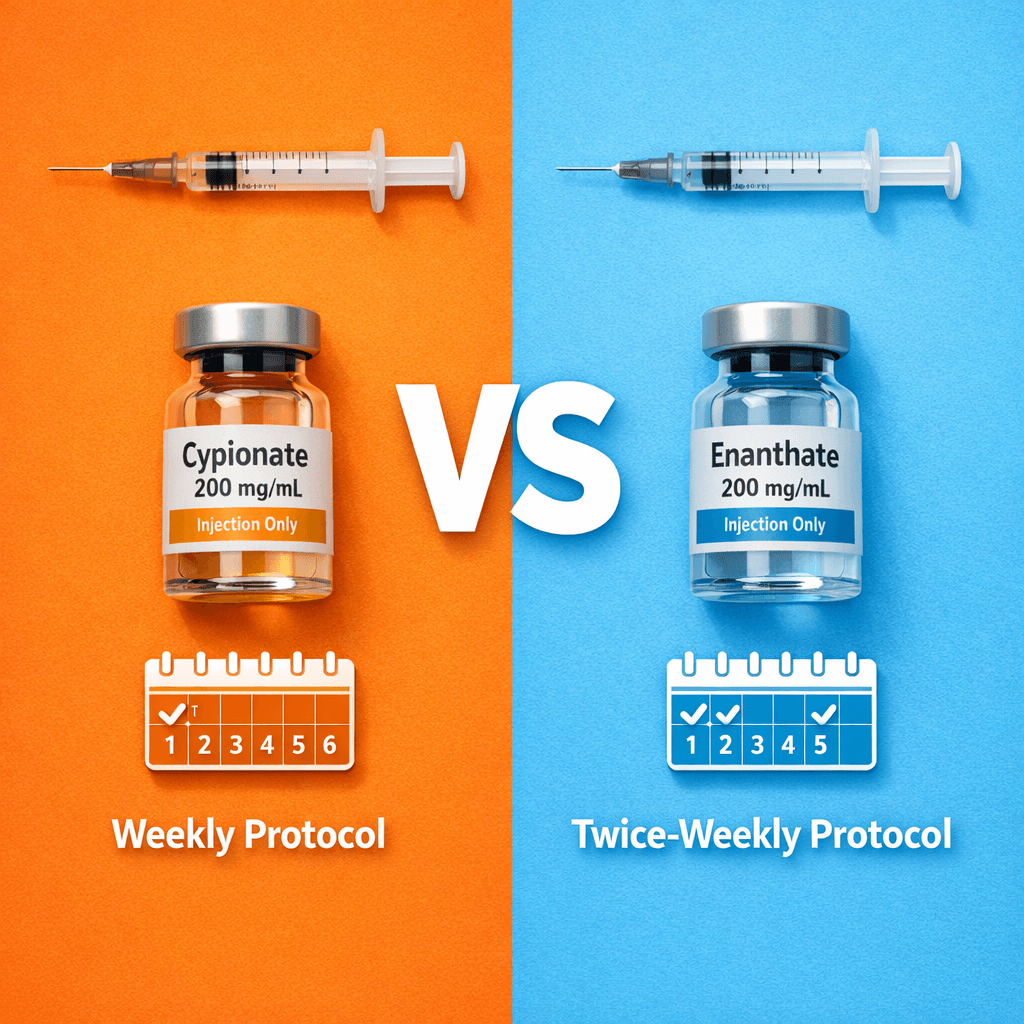
Cypionate and enanthate are both long-chain esters designed to create this sustained-release effect. The difference between them comes down to the length and structure of those chains. Cypionate carries an eight-carbon chain; enanthate carries a seven-carbon chain. One carbon. That single structural difference is the foundation of everything that follows, and it turns out to be simultaneously meaningful and frequently overstated.
Reading the Absorption Curve: Why the Shape of the Line Matters
Pharmacokinetics is the study of how a drug moves through the body over time, covering absorption, distribution, metabolism, and elimination. For practical purposes, what most patients need to understand is the concept of a concentration-time curve: a graph that shows how much active testosterone is in your bloodstream at any given moment after an injection.
Every injectable testosterone ester produces a curve that rises as the ester is cleaved and testosterone enters circulation, reaches a peak, then gradually falls as the body metabolizes and clears it. Two numbers define the practical behavior of that curve more than anything else: the time to peak concentration and the half-life, which is the time it takes for the blood level to fall by half from its peak.
Why does the shape of that curve matter to a real patient? Because testosterone does not just exist as a number on a lab report. It influences energy, mood, libido, cognitive sharpness, and a range of physiological processes. A curve that rises steeply, peaks high, then crashes before the next injection creates a different lived experience than a flatter, more sustained curve. Patients sometimes describe this as feeling great the first few days after an injection, then feeling like themselves again only briefly before the next dose arrives. This is peak-and-trough behavior, and managing it is one of the central goals of a well-designed TRT protocol.
Cypionate vs. Enanthate: Where the Numbers Actually Diverge
Testosterone enanthate has a half-life generally cited in the range of four to five days. Testosterone cypionate's half-life is commonly estimated at five to seven days. These are approximations, not fixed values, and individual variation makes the real-world ranges wider than textbooks suggest. But the directional implication is consistent: cypionate tends to stay in circulation slightly longer before dropping off.
In practical terms, this means that after a single injection, enanthate may reach peak blood levels somewhat faster and may begin declining sooner. Cypionate's slightly longer tail means levels might remain elevated for a marginally extended period before the trough arrives. For someone injecting weekly, this distinction can translate into a slightly more pronounced trough with enanthate in the days leading up to the next injection, compared to cypionate, which may produce a marginally smoother ride toward the end of the dosing interval.
The key phrase there is "may." These differences are real on a population level but are often imperceptible at the individual level, particularly when injection frequency is optimized. A person injecting either ester twice weekly will experience far less peak-and-trough swing than someone injecting either ester once weekly, regardless of which compound they choose. Frequency and consistency routinely outperform ester selection as variables that shape how a patient actually feels.
The Myths That Refuse to Die
The internet is full of confident claims about these two compounds that deserve scrutiny.
One persistent myth is that cypionate is stronger than enanthate. This misunderstands how esters work. Neither compound is inherently more potent. The ester itself is biologically inactive; it is just a delivery mechanism. What matters is the amount of free testosterone released over time, and that is determined by dosing and protocol design, not by which ester is attached.
Another common misconception is that one is significantly safer than the other. Both compounds carry the same safety profile because both ultimately deliver the same active hormone. Side effects, cardiovascular considerations, hematocrit changes, and other monitoring concerns are identical in nature between the two. Choosing enanthate over cypionate will not meaningfully reduce risk, nor will the reverse.
A third myth, perhaps more subtle, is that they are completely interchangeable for every patient without any adjustment period. While many patients do transition between them without noticeable disruption, some individuals report feeling a difference, particularly in the first few weeks of switching. Whether this reflects a genuine pharmacokinetic shift, a psychological expectation effect, or subtle differences in individual enzyme activity is difficult to disentangle. Clinicians generally advise treating a switch between esters similarly to starting fresh: allow time to assess response before drawing conclusions.
How Providers Actually Think About the Choice
In clinical practice, the decision between cypionate and enanthate is rarely driven by pharmacokinetic theory alone. Several practical factors shape the conversation.
Availability is a major one. Testosterone cypionate is the predominant option in the United States, where it is widely produced and stocked by compounding pharmacies and commercial manufacturers. Testosterone enanthate is more commonly used in Europe and many other parts of the world. A patient's geographic location and their provider's pharmacy relationships often make the decision before pharmacology even enters the picture.
Patient preference and prior experience also guide choices. If a patient has responded well, tolerated a compound without notable side effects, and maintained consistent adherence on one ester, there is rarely a compelling clinical reason to switch. The friction of changing a working protocol is real, both in terms of readjustment time and in managing patient expectations.
Individual response history matters too. Some patients genuinely report feeling better on one compound versus the other, and while placebo effects are difficult to rule out, clinical practice is pragmatic. If a patient consistently reports better energy, mood stability, or symptom control on one formulation, that report carries weight in protocol decisions even when the mechanistic explanation is unclear.
Finally, supply issues periodically force substitutions, and providers familiar with the pharmacokinetic similarities between the two can navigate those transitions for patients with appropriate guidance.
Individual Variability: The Factor That Overshadows Everything
No discussion of testosterone pharmacokinetics is complete without acknowledging how dramatically individual variation affects real-world outcomes. Two men on the same dose of the same compound, injecting on the same schedule, can show meaningfully different blood levels and report strikingly different subjective experiences.
Body composition plays a role. Testosterone is lipophilic, meaning it has an affinity for fat tissue, and differences in body fat percentage can influence distribution and clearance. Injection site and technique affect how the depot forms and releases. Metabolic rate, liver function, and individual enzyme expression all shape how quickly testosterone is cleared. Adherence patterns, something as simple as injecting consistently at the same time each week versus drifting by a day or two, can create more variability in blood levels than the difference between cypionate and enanthate ever could.
This is not a reason to dismiss pharmacokinetics. It is a reason to hold it in appropriate proportion. Understanding the science matters. Letting minor theoretical differences drive outsized decision-making often does not serve patients well.
Safety, Monitoring, and the Supervision Imperative
Both testosterone esters require the same framework for safe use: medical supervision, regular monitoring, and honest communication between patient and provider. Blood work at appropriate intervals tracks markers that can shift with testosterone therapy, including red blood cell parameters, lipid panels, and hormone levels. These are not optional courtesies. They are necessary tools for catching problems early and adjusting protocols before issues become serious.
Self-experimentation with either compound, whether sourced without a prescription or dosed without clinical guidance, removes the safety net that makes TRT a medically defensible intervention. The risks of unsupervised use are not hypothetical. They include cardiovascular strain, fertility suppression, and hormonal disruption that can persist long after use stops. No preference for one ester over another changes these fundamental realities.
Side effects are possible with both compounds, and individual susceptibility varies. Estrogen conversion, fluid retention, acne, mood changes, and effects on cardiovascular risk markers are all part of the clinical picture that a knowledgeable provider monitors and manages. The goal of any well-run TRT program is not simply elevated testosterone levels but a stable, optimized hormonal environment that improves quality of life without introducing disproportionate risk.
What Actually Moves the Needle
After examining the pharmacology, the myths, and the clinical decision-making process, the central truth about cypionate versus enanthate becomes clear: the difference that most meaningfully affects how a patient feels is not which ester they use but how consistently and thoughtfully their protocol is managed.
Injection frequency, dose stability, monitoring quality, and attentive provider oversight shape the lived TRT experience far more than the single carbon atom separating these two esters. A patient on a well-managed enanthate protocol will almost certainly feel better than a patient on a poorly managed cypionate protocol, and vice versa.
For men navigating this decision, the most productive question is not "which ester is better" but "which protocol, supervised by which team, will give me the most consistent and individualized care." Clinics like AlphaMD are built around exactly that philosophy, helping men understand the options available to them, interpret their own response over time, and adjust protocols based on how they actually feel alongside objective monitoring data. The ester is just the starting point. What happens after that is where outcomes are really made.
Have a question? Ask us.
At AlphaMD, we're here to help. Feel free to ask us any question you would like about TRT, medical weightloss, ED, or other topics related to men's health. Or take a moment to browse through our past questions.
People are asking...
I am in Australia, where my provider isn't able to provide Test C anymore. They have given me Test E now, and I feel like I have gone back to my pre t...
The testosterone molecule is exactly chemically the same, whether it comes attached to cypionate, propionate, enanthate, undecanoate, isocaproate, hexyloxyphenylpropionate, or any other carbon side ch... See Full Answer
What is your opinion on using short esters vs long esters for TRT? Do you see particular situations where one would work better than the other?...
There may be cases where one works better than another, but generally the most accepted form of Testosterone (Testosterone Cypionate) tends to do best for multiple reasons. Your body prefers to have t... See Full Answer
In what situations would you recommend a person switch from Cypionate to Enanthate or a different ester? I’ve only taken Cypionate and I’m considering...
So, this is a bit of a subjective area. Some men will swear by one over the other & feel very validated in their reasoning. The biggest change is just the half life, though, same with the longer ester... See Full Answer
Get $30 off your first month’s order
Enter your email address now to receive $30 off your first month’s cost, other discounts, and additional information about TRT.
Legal Disclaimer
This website is a repository of publicly available information and is not intended to form a physician-patient relationship with any individual. The content of this website is for informational purposes only. The information presented on this website is not intended to take the place of your personal physician's advice and is not intended to diagnose, treat, cure, or prevent any disease. Discuss this information with your own physician or healthcare provider to determine what is right for you. All information is intended for your general knowledge only and is not a substitute for medical advice or treatment for specific medical conditions. The information contained herein is presented in summary form only and intended to provide broad consumer understanding and knowledge. The information should not be considered complete and should not be used in place of a visit, phone or telemedicine call, consultation or advice of your physician or other healthcare provider. Only a qualified physician in your state can determine if you qualify for and should undertake treatment.