
Stop Using Mouthwash Every Morning: The Nitric Oxide Connection to Erections Nobody Is Talking About
Published on:
Updated on:
People are asking...
Why for the first two weeks of treatment did I start getting morning wood again but after about two weeks it has stopped. No issues with ED, I’m just ...
When you first undergo TRT your levels can fluctuate significantly. Initially this doesn’t mean the TRT program isn’t working, but if you’re finding a complete cessation of “morning wood” that could m... See Full Answer
Do you have any patients where trt has made erection quality worse? I’ve been on trt for 4 months with all bloods in range but feel like my erection q...
So, hormones are only a small part of erection quality, though an important part. As a general rule of thumb, if you get morning wood, but have ED during other times, then the cause of your ED is very... See Full Answer
Just started 200 mg split in 2 doses a week. Felt great first few week with high sex drive, full erections, morning wood, and strength in the gym. Wee...
There is a very common phenomenon around the 6 week mark of TRT, where some of the benefits seem to diminish. No one knows why that is, though we believe it is because that is the usual time window wh... See Full Answer
Have a question? Ask us.
At AlphaMD, we're here to help. Feel free to ask us any question you would like about TRT, medical weightloss, ED, or other topics related to men's health. Or take a moment to browse through our past questions.
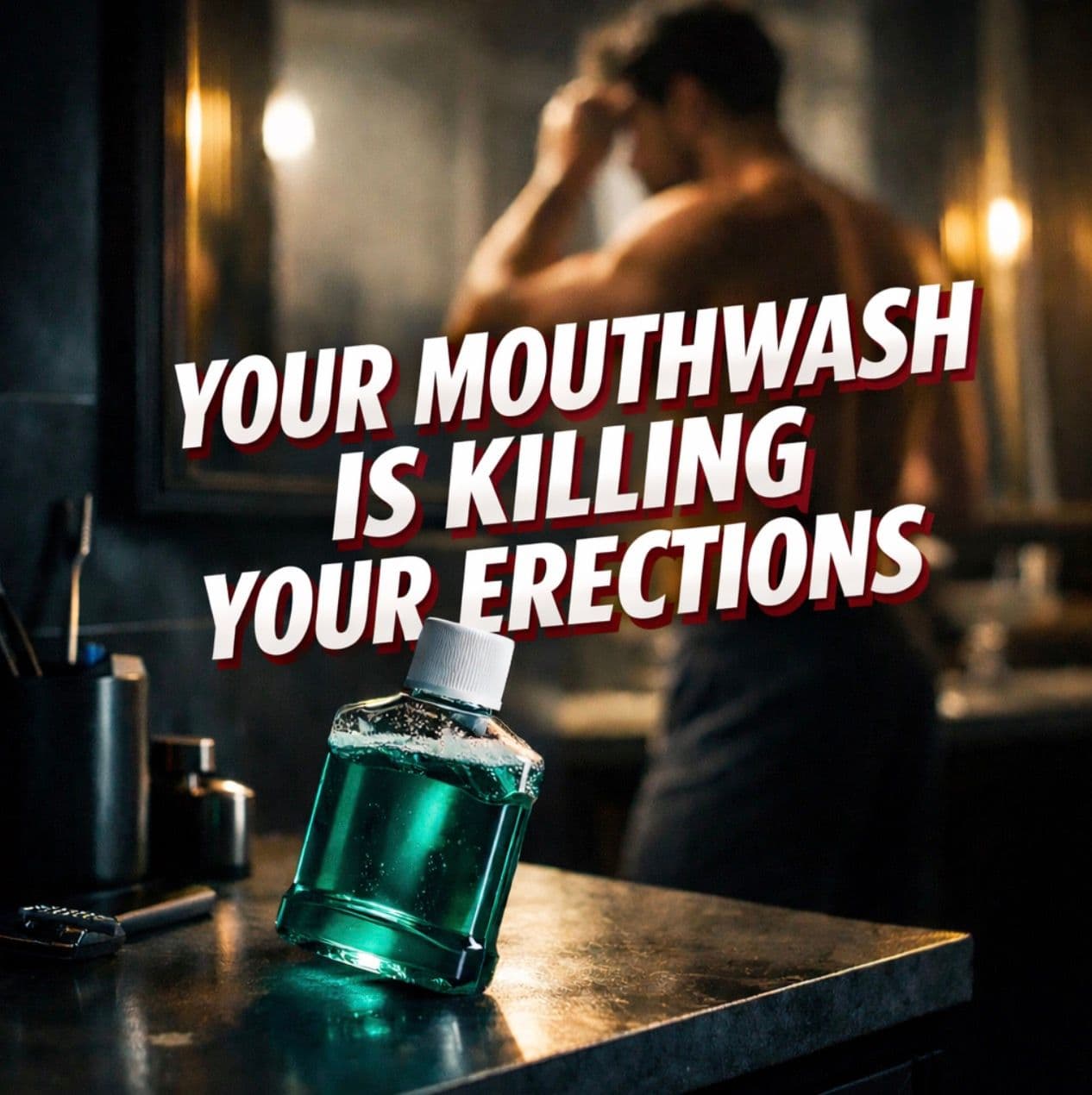
Something you do every morning before you even eat breakfast could be quietly working against your erections, your blood pressure, and your cardiovascular health. The culprit is not a drug, not a processed food, and not a habit anyone warned you about, because it is sitting in a blue bottle next to your toothbrush.
The Molecule That Makes Erections Physically Possible
Nitric oxide is not a supplement you take or a compound you can inject. It is a signaling gas your body manufactures on its own, and it is arguably the most important molecule in male sexual function that most men have never heard of.
When you become sexually aroused, your nervous system sends a signal to the inner lining of the blood vessels in penile tissue. That lining, called the endothelium, releases nitric oxide in response. Nitric oxide then causes the smooth muscle surrounding those vessels to relax, the vessels widen, blood rushes in, and an erection forms. Without sufficient nitric oxide, that cascade cannot happen properly. The vessels stay constricted, blood flow is inadequate, and erection quality suffers regardless of how healthy your testosterone levels are.
This is not speculative physiology. It is the same mechanism that PDE5 inhibitors, the class of medications that includes widely prescribed erectile dysfunction drugs, are designed to amplify. Those medications work by preventing the breakdown of a compound that nitric oxide activates. They do not create nitric oxide themselves. They depend on your body already making it.
If your nitric oxide production is chronically low, even pharmaceutical support has less to work with.
A Blood Flow Problem That Starts in Your Sink
Your body has two main ways of producing nitric oxide. The first is through an enzyme in your endothelial cells called eNOS, which synthesizes nitric oxide directly. The second is an external pathway that relies on bacteria, specifically bacteria that live in your mouth.
Here is where your morning mouthwash enters the picture.
Dietary nitrates, found in leafy greens, beets, celery, and other vegetables, are absorbed in the gut and eventually concentrate in saliva. Certain oral bacteria, particularly species that live on the surface of the tongue, convert those nitrates into nitrite. Nitrite travels to the stomach and bloodstream, where it gets further reduced into nitric oxide. This pathway is a meaningful contributor to your overall nitric oxide availability, not a minor footnote.
The problem is that broad-spectrum antiseptic mouthwash does not discriminate. It kills harmful bacteria, yes. But it also kills the beneficial bacterial communities that perform this nitrate conversion. When those bacteria are wiped out regularly, the second nitric oxide pathway gets interrupted.
What the Research Actually Shows
The evidence here is worth examining carefully rather than overstating. A study published in the journal Free Radical Biology and Medicine found that twice-daily use of antiseptic mouthwash was associated with a meaningful increase in blood pressure compared to a placebo rinse in healthy adults. The proposed mechanism was exactly what you would expect: reduced oral bacterial conversion of nitrates led to less nitric oxide, which led to less vascular dilation and higher blood pressure.
A separate body of research has connected regular antiseptic mouthwash use to changes in oral microbiome composition that persist for hours to days after a single use, and even longer with daily use. The bacterial species most affected tend to be the nitrate-reducing ones.
Does this mean mouthwash causes erectile dysfunction? That direct causal link has not been established in clinical trials, and it would be an overreach to state it as fact. What the evidence does support is a biologically plausible chain of events: regular antiseptic mouthwash use can reduce beneficial oral bacteria, which can reduce nitrite production from dietary nitrates, which can reduce circulating nitric oxide, which can impair vascular function, which affects both blood pressure and erection quality.
For men who are already dealing with suboptimal vascular health, poor metabolic markers, or declining erectile function, this is a compounding factor worth taking seriously.
Why Your Erections Are a Cardiovascular Report Card
Men's health clinicians often say that the penis is a barometer of vascular health. That is not a crude metaphor. It reflects real physiology.
The arteries that supply blood to erectile tissue are small-caliber vessels. Endothelial dysfunction, the earliest stage of vascular disease before plaques form or cholesterol builds up, tends to manifest in smaller vessels first. This is why changes in erection quality often precede a cardiovascular diagnosis by years. The erection problem is not separate from the heart health problem. It is frequently an earlier expression of the same underlying issue.
Endothelial dysfunction is characterized by reduced ability of blood vessels to dilate properly, and nitric oxide is the primary mediator of that dilation. When the endothelium is dysfunctional, it produces less nitric oxide in response to stimulation. Anything that further reduces nitric oxide availability, including habitual suppression of the oral nitrate-to-nitrite pathway, adds to the deficit.
If you are noticing changes in erection quality and you are otherwise healthy on paper, that signal deserves attention rather than dismissal.
The Mouth Bacteria You Actually Need
The human oral microbiome is not an enemy to be sterilized. It is a complex ecosystem shaped by millions of years of coevolution. Certain species of bacteria, particularly Veillonella, Rothia, and related genera, are specifically adapted to reduce nitrate to nitrite as part of their normal metabolism. These are not pathogenic organisms. They are not causing gum disease or cavities. They are performing a function your cardiovascular system depends on.
The irony is that the pursuit of a clean, fresh mouth, an aspiration heavily marketed by oral hygiene brands, can actively undermine a system your body needs working well.
That said, oral hygiene genuinely matters. Gum disease is independently associated with cardiovascular risk, systemic inflammation, and erectile dysfunction. Letting harmful bacteria proliferate in the name of protecting the good ones is not the answer. The goal is more targeted, not more extreme in either direction.
When Mouthwash Is and Is Not Appropriate
Mouthwash is not inherently harmful, and there are genuine clinical situations where antiseptic rinses are appropriate. Post-surgical recovery, active gum infections, and certain dentist-directed treatment protocols are examples where short-term antiseptic use makes clear sense.
The habit worth questioning is daily preventive use of strong antiseptic mouthwash as a substitute for good mechanical cleaning, particularly first thing in the morning when it would immediately disrupt overnight bacterial activity that may have contributed to nitric oxide production during sleep.
If your concern is bad breath, that is worth addressing at the source rather than masking it daily with an antiseptic rinse. Persistent halitosis can signal gum disease, dry mouth, post-nasal drip, or metabolic conditions including poorly controlled blood sugar. A conversation with your dentist will be more useful than a stronger bottle of mouthwash.
For most healthy men without active oral disease, the mechanical basics are what matter most: thorough brushing twice daily, consistent flossing, and cleaning the tongue. Tongue cleaning in particular directly addresses the bacterial communities most responsible for bad breath and most important for nitrate conversion. It is one of the most underutilized tools in oral hygiene.
Hydration also plays a role. Dry mouth reduces saliva flow, which changes the oral environment in ways that favor harmful bacteria over helpful ones. If you breathe through your mouth at night, address that with your doctor, since sleep apnea is associated with both erectile dysfunction and poor cardiovascular health through its own separate mechanisms.
The Rest of the Vascular Picture
Mouthwash is one piece of a larger system. Nitric oxide production and endothelial function are influenced by a range of lifestyle factors that, when combined, have a far larger effect than any single habit.
Sleep is foundational. Growth hormone release, testosterone production, and vascular repair all depend on adequate, quality sleep. Chronic poor sleep is directly associated with reduced nitric oxide bioavailability and elevated cardiovascular risk.
Exercise, particularly cardiovascular exercise and resistance training, stimulates eNOS activity and increases nitric oxide production through the endothelial pathway. This is one reason why physically active men tend to have better erectile function at every age.
Diet matters in the context of nitric oxide because the dietary nitrate pathway needs substrate. Green leafy vegetables, beets, and nitrate-rich whole foods are the raw material your oral bacteria work with. A diet low in these foods starves the pathway regardless of whether your oral bacteria are intact.
Tobacco use, in any form, directly damages endothelial cells and reduces nitric oxide production through multiple mechanisms. Alcohol in excess impairs vascular function and suppresses testosterone. Chronic psychological stress elevates cortisol, which competes with and suppresses testosterone, while also driving inflammation that impairs endothelial function.
Testosterone, Metabolism, and Where Nitric Oxide Fits
Testosterone and nitric oxide are not independent systems. Testosterone supports the expression of eNOS, the enzyme responsible for endothelial nitric oxide production. Low testosterone is associated with reduced nitric oxide availability, which in part explains why testosterone deficiency contributes to erectile dysfunction even when psychological factors are minimal.
Insulin resistance and metabolic dysfunction follow a similar pattern. Excess visceral fat drives inflammation, suppresses testosterone, impairs endothelial function, and reduces nitric oxide bioavailability through several overlapping mechanisms. Men dealing with weight gain, energy problems, and declining sexual function are often experiencing these systems deteriorating together, not separately.
This is why addressing men's health comprehensively tends to produce better results than targeting one variable in isolation. Optimizing testosterone without addressing vascular health, or improving diet without correcting sleep, leaves significant gains on the table.
A Small Habit Worth Reconsidering
The morning mouthwash ritual feels hygienic, almost virtuous. It is quick, inexpensive, and deeply ingrained. That is part of what makes it worth examining, because low-effort daily habits are exactly the kind of thing that can accumulate real physiological consequences without anyone ever connecting the dots.
You do not need to abandon oral hygiene. You need to reconsider what good oral hygiene actually consists of, and whether a daily antiseptic rinse is contributing to it or quietly working against a system your heart and your erections depend on.
If you have persistent erectile dysfunction, hypertension, gum disease, diabetes, or sleep apnea, these are not issues to self-manage through habit adjustments alone. They warrant a real clinical conversation with a provider who looks at the full picture.
For men interested in taking a more comprehensive approach to hormonal and vascular health, AlphaMD offers clinically guided men's health support, including hormone optimization and the kind of evidence-informed guidance that connects these seemingly unrelated dots into a coherent picture of how your body actually works.
Have a question? Ask us.
At AlphaMD, we're here to help. Feel free to ask us any question you would like about TRT, medical weightloss, ED, or other topics related to men's health. Or take a moment to browse through our past questions.
People are asking...
Why for the first two weeks of treatment did I start getting morning wood again but after about two weeks it has stopped. No issues with ED, I’m just ...
When you first undergo TRT your levels can fluctuate significantly. Initially this doesn’t mean the TRT program isn’t working, but if you’re finding a complete cessation of “morning wood” that could m... See Full Answer
Do you have any patients where trt has made erection quality worse? I’ve been on trt for 4 months with all bloods in range but feel like my erection q...
So, hormones are only a small part of erection quality, though an important part. As a general rule of thumb, if you get morning wood, but have ED during other times, then the cause of your ED is very... See Full Answer
Just started 200 mg split in 2 doses a week. Felt great first few week with high sex drive, full erections, morning wood, and strength in the gym. Wee...
There is a very common phenomenon around the 6 week mark of TRT, where some of the benefits seem to diminish. No one knows why that is, though we believe it is because that is the usual time window wh... See Full Answer
Get $30 off your first month’s order
Enter your email address now to receive $30 off your first month’s cost, other discounts, and additional information about TRT.
Legal Disclaimer
This website is a repository of publicly available information and is not intended to form a physician-patient relationship with any individual. The content of this website is for informational purposes only. The information presented on this website is not intended to take the place of your personal physician's advice and is not intended to diagnose, treat, cure, or prevent any disease. Discuss this information with your own physician or healthcare provider to determine what is right for you. All information is intended for your general knowledge only and is not a substitute for medical advice or treatment for specific medical conditions. The information contained herein is presented in summary form only and intended to provide broad consumer understanding and knowledge. The information should not be considered complete and should not be used in place of a visit, phone or telemedicine call, consultation or advice of your physician or other healthcare provider. Only a qualified physician in your state can determine if you qualify for and should undertake treatment.