
Semax Is Used for Stroke Recovery in Russia. Why Is the Evidence Still Uncertain?
Published on:
Updated on:
People are asking...
Do you think any other compounds that are available for medical use in other countries in the past or currently like primobolan or paranolan can becom...
Regulations change almost monthly, so you never know. It would likely take a large study showing significant benefit in order to change the FDA’s and DEA’s mind on medicines like Primobolan. Even then... See Full Answer
Same with men on TRT getting cosmetic surgery like a jaw surgery, can anything else added to TRT speed recovery?...
outside of TRT, the main medicine shown in studies to assist with recovery after a cosmetic surgery would be sermorelin.... See Full Answer
Do you have any data on enclomophine with exogenous testosterone?...
Very little. There still are no scientific studies that have been published on concurrent TRT and enclomiphene use. Though one is ongoing now. Providers on the AlphaMD platform have reviewed patients ... See Full Answer
Have a question? Ask us.
At AlphaMD, we're here to help. Feel free to ask us any question you would like about TRT, medical weightloss, ED, or other topics related to men's health. Or take a moment to browse through our past questions.
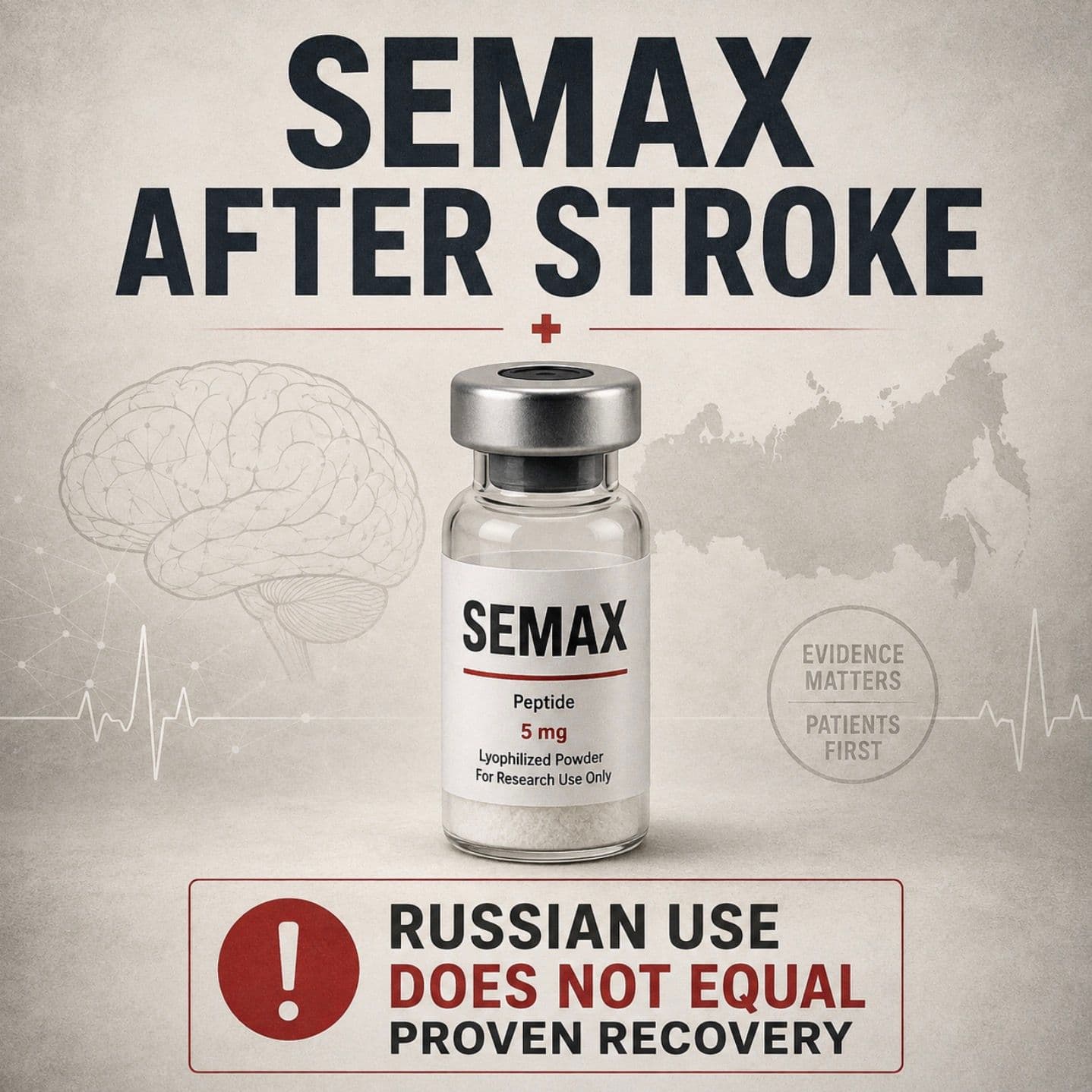
Semax is registered as a pharmaceutical in Russia and has been used there for decades as part of stroke care, which is exactly why it gets marketed elsewhere as a proven stroke recovery aid. Those two facts, real registration and real clinical use, are often presented as if they settle the question of whether Semax works. They do not. Regulatory registration in one country, clinical tradition, and controlled proof of benefit are three different things, and Semax's stroke evidence sits mostly in the first two categories rather than the third.
In July 2026, the FDA's own scientific staff reviewed Semax specifically for cerebral ischemia, among other proposed uses, and concluded that the available evidence was insufficient. An advisory committee later voted to recommend Semax-related substances for the pharmacy-compounding bulk drug substances list anyway, but that nonbinding recommendation is not the same thing as proof that Semax aids stroke recovery, and it does not overturn the FDA staff's evidence review. This article walks through why Semax was built for this purpose in the first place, what its actual Russian-language and English-indexed studies show, and why those studies have specific design problems that make their results hard to interpret.
The key point: Semax has real clinical infrastructure behind it in Russia, but the published studies supporting its use in stroke are small, mostly non-randomized, and measure short-term neurological scores more often than long-term independence. Spontaneous recovery, a well-documented biological process that accounts for a large share of post-stroke improvement on its own, is a serious unaddressed confounder in that literature. The FDA's own reviewers concluded that the evidence for cerebral ischemia was insufficient, and nothing about Semax's Russian history changes that a person's actual, safe treatment for stroke should never be delayed or substituted.
Why Semax Was Developed for Cerebral Ischemia
Semax was not designed as a general-purpose wellness peptide. It grew directly out of Soviet-era research into adrenocorticotropic hormone (ACTH) and its fragments, which researchers had shown could affect learning and behavior independent of ACTH's classic hormonal role in cortisol production. A research team led by Ivan Ashmarin and Nikolai Myasoedov at Russia's Institute of Molecular Genetics set out to build a longer-acting version of the ACTH(4-10) fragment, since the natural fragment's effects lasted only 30 to 60 minutes in the body. By attaching a proline-glycine-proline sequence (a "glyproline") to the end of the molecule, they extended its activity to roughly 20 to 24 hours, calling the result Semax (see the detailed account of Semax's development). The goal from early on was a stable, neuroprotective compound that could be used clinically in ischemic brain injury, which is why nearly all of Semax's specific human research, not just its marketing, centers on stroke.
What Cerebral Ischemia Actually Means
Cerebral ischemia is a broader medical term than "stroke," though the two overlap heavily. It describes any state in which blood flow to brain tissue is inadequate to meet its metabolic demand, whether flow is reduced or completely stopped (see this clinical overview of cerebral ischemia). Physicians divide it into two categories: focal ischemia, confined to the territory of a single blocked or narrowed artery, and global ischemia, affecting the whole brain at once, typically from cardiac arrest or severe hypotension. The American Heart Association's updated definition of stroke specifically limits "ischemic stroke" to focal ischemia, because focal and global ischemia differ in cause, evaluation, and emergency treatment.
Once blood flow drops, brain cells are deprived of oxygen and glucose within seconds, triggering a fast cascade of excitotoxic neurotransmitter release, oxidative stress, inflammation, and, if flow is not restored, cell death. Semax's proposed neuroprotective mechanisms, including antioxidant activity, shifting inflammatory signaling, and increasing BDNF, are aimed at slowing or limiting that cascade. Understanding this cascade matters because it explains why researchers hypothesized Semax could help, but a plausible mechanism acting on a well-understood injury process is still not the same thing as demonstrated clinical benefit in people.
Semax's Reported Medical Use in Russia
Semax is a registered pharmaceutical in the Russian Federation, sold as intranasal drops under a marketing authorization that Russia's official drug registry lists as currently renewed under registration number Р N000812/01. According to that Russian pharmaceutical registry entry, the approved indication is the acute period of moderate-to-severe ischemic stroke, used as part of combination therapy, not as a standalone treatment. Semax has also reportedly been included on Russia's list of vital and essential drugs, a designation tied to the country's drug-supply and pricing system rather than to any particular strength of clinical evidence.
It is worth being direct about what that status does and does not mean. Russian drug registration reflects Russia's own regulatory framework, which has historically accepted smaller, less rigorously controlled trials and a greater reliance on mechanistic and open-label data than the FDA requires. A medication being registered, prescribed, and used clinically in one country is real information, but it is not equivalent to FDA approval, and it does not substitute for the kind of large, randomized, blinded, placebo-controlled trials that would be needed to establish efficacy by international evidentiary standards. The FDA's own briefing document on Semax, discussed throughout this article, reached its insufficient-evidence conclusion with full awareness that Semax has a genuine history of Russian medical use.
The Studies Involving Semax Plus Standard Rehabilitation
The core human stroke literature on Semax comes down to a small number of Russian studies, almost all built around adding Semax to standard stroke care rather than testing it alone.
Gusev et al., 1997: In the foundational study, Usage of Neurospecific Peptide Substance "Semax" in Acute Period of Ischemic Insult, 30 patients in the acute period of hemispheric ischemic stroke received Semax added to intensive therapy. They were compared with 80 patients who received only standard unified therapy, plus a smaller comparison group who received other neuroprotective drugs (cerebrolysin and cronassial). The authors reported that adding Semax sped the resolution of general cerebral and focal, especially motor, neurological deficits, tracked using clinical rating scales, EEG mapping, and somatosensory evoked potentials. The published report does not describe random allocation to groups.
Gusev et al., 1999: A follow-up study, Investigation of Mechanisms of the Neuroprotective Effect of Semax in the Acute Period of Ischemic Stroke, looked specifically at inflammatory biology, reporting that Semax shifted the balance of post-stroke inflammatory signaling toward anti-inflammatory mediators, interleukin-10 and tumor necrosis factor-alpha, and away from interleukin-8 and C-reactive protein, markers associated with ongoing inflammation. This is a plausible, biologically interesting mechanism. It is also, by the authors' own description, a "retrospective comparative" analysis, a design that is more vulnerable to selection bias than a prospective randomized trial.
The 2018 rehabilitation-timing study: A more recent report, The Efficacy of Semax in the Treatment of Patients at Different Stages of Ischemic Stroke, examined 110 stroke patients, divided first by whether they entered early or late rehabilitation, and divided again within each group by whether they happened to receive Semax. This design measured plasma BDNF, a motor-performance scale, and the Barthel Index. It is the most clinically relevant of the available studies, and it is also not a randomized comparison: patients were not assigned to receive Semax by chance, so anything that influenced a physician's decision to prescribe it, such as perceived stroke severity or patient factors, could also explain the outcome differences.
Across all three studies, "Semax plus standard rehabilitation" describes the treatment pattern accurately, but "randomized, controlled comparison of Semax plus rehabilitation versus rehabilitation alone" does not. That distinction is the difference between a study that can suggest an association and one that can establish cause and effect.
Neurological Scores Versus Long-Term Independence
Stroke researchers generally distinguish between impairment-level measures, such as an EEG pattern, a reflex, a specific muscle-strength grade, or the presence of a neurological sign, and participation-level outcomes, such as whether someone can walk safely, dress independently, return to work, or live without daily assistance. The Barthel Index used in the 2018 Semax study is a genuine step toward the second category, since it scores basic activities of daily living rather than an isolated neurological sign. Even so, the available reporting on that study does not describe a long-term follow-up window of many months or years, the timeframe generally needed to know whether an early functional gain is durable rather than temporary.
The 1997 study relied more heavily on the first category: EEG mapping, somatosensory evoked potentials, and clinical rating scales completed during the acute hospital stay. A faster resolution of a focal neurological sign during acute hospitalization is a real, measurable event, but it is not automatically the same as a patient being more functionally independent a year later. Marketing materials that cite "faster neurological recovery" often do not draw this distinction, even though it is central to whether the finding matters for a patient's actual daily life.
Why Spontaneous Recovery Complicates Uncontrolled Stroke Studies
Stroke recovery is not a blank slate that only moves when a drug is given. Johns Hopkins Medicine's overview of the stroke recovery timeline describes a well-documented phenomenon called spontaneous recovery, in which abilities that seemed lost return on their own as the brain forms new connections, concentrated heavily in the first three to six months after a stroke. Research on rehabilitation trial design puts a number on this: one analysis found that roughly 80 percent of the neurological improvement seen in longitudinal stroke studies happens spontaneously within the first 5 to 10 weeks, independent of any specific treatment (see the discussion in this trial-design analysis published in Trials).
This is precisely why trial-design experts flag "differences in the natural trajectory of recovery" and "timing of enrollment" as specific threats to a stroke study's internal validity, capable of producing an apparent treatment effect that is really just a difference in how far along two groups already were in their own natural healing (see the consensus recommendations from the Stroke Recovery and Rehabilitation Roundtable). None of the available Semax stroke studies used randomization to control for this. When 30 patients who received Semax are compared against 80 patients who did not, and allocation to each group was not determined by chance, it is not possible to rule out that the groups were already on different recovery trajectories before treatment began, for reasons unrelated to Semax itself.
Whether Semax Affected BDNF, or BDNF Just Reflected Recovery That Was Already Happening
The 2018 study's central finding, that Semax use was associated with higher plasma BDNF and better functional scores, is frequently presented online as if it proves Semax directly drives recovery through BDNF. That interpretation skips over an important confound: BDNF rises during stroke recovery generally, not only in people given a specific drug. A systematic review and meta-analysis published in the journal Stroke pooling 17 studies and 687 participants found that both a single session and a sustained program of aerobic exercise significantly raised circulating BDNF in stroke survivors, describing BDNF as a general biomarker of neuroplasticity tied to the recovery process itself, not a marker unique to any one intervention.
That means an observation like "patients with higher BDNF also had better Barthel Index scores" is compatible with at least three different explanations: Semax specifically raised BDNF and that increase caused better recovery; Semax was given more often to patients who were already recovering well and generating more BDNF through their own neuroplasticity and rehabilitation; or some combination of both, impossible to separate without randomization. Because the Semax stroke studies did not randomize patients and did not control for rehabilitation intensity, they cannot distinguish "Semax raised BDNF and that helped" from "the patients who were recovering well anyway also had higher BDNF and happened to be the ones who received Semax."
Why Semax Must Never Delay Emergency Stroke Care
Every study discussed here involves Semax added to patients who were already receiving standard hospital stroke treatment, not Semax used instead of it. That distinction is critical. Ischemic stroke treatment is extremely time-sensitive: clot-dissolving medication and mechanical clot removal only work within narrow windows after symptoms begin, and every additional minute without treatment costs brain tissue. The National Institute of Neurological Disorders and Stroke explains why recognizing stroke symptoms, sudden facial drooping, arm weakness, slurred speech, severe imbalance, or a sudden severe headache, and calling emergency services immediately, is the single most important action a person can take.
Semax is marketed and studied as a stroke-recovery or neuroprotective adjunct, not as an emergency treatment, and it has no established role in place of thrombolysis, thrombectomy, or emergency stroke evaluation. Nothing in the Russian literature described above tested Semax as a substitute for emergency care, and nothing about Semax's registration status changes how urgently a suspected stroke needs to be evaluated.
The Bottom Line
Semax has a genuine origin story rooted in stroke-specific neuroscience, a real, decades-old registration history in Russia, and a small collection of studies that describe adding it to standard stroke rehabilitation. What it does not have is a randomized, placebo-controlled trial that isolates its effect from the substantial spontaneous recovery every stroke patient experiences, or a study following patients long enough to show that early neurological gains translate into lasting, independent daily function. The 2018 study's BDNF finding is a genuinely interesting biological signal, but it cannot currently be separated from the well-documented fact that recovery itself raises BDNF. Taken together, that pattern of evidence is consistent with the FDA's own conclusion: real biological plausibility and real clinical tradition, but insufficient proof under the kind of controlled trial design that would be needed to know whether Semax itself is doing anything beyond what a stroke patient's brain and standard rehabilitation would do on their own.
For a broader audit of Semax's human research beyond stroke, see AlphaMD's Semax Human Studies review, and for the full FDA 2026 findings and safety picture, see the Semax benefits, risks, and side effects overview.
Medical disclaimer: This article is for informational purposes only and does not constitute medical advice. Semax is not currently an FDA-approved drug. Semax should never be used as a substitute for emergency stroke evaluation and treatment. Speak with a licensed medical provider before using any medication, peptide, supplement, nasal product, or injectable substance.
Have a question? Ask us.
At AlphaMD, we're here to help. Feel free to ask us any question you would like about TRT, medical weightloss, ED, or other topics related to men's health. Or take a moment to browse through our past questions.
People are asking...
Do you think any other compounds that are available for medical use in other countries in the past or currently like primobolan or paranolan can becom...
Regulations change almost monthly, so you never know. It would likely take a large study showing significant benefit in order to change the FDA’s and DEA’s mind on medicines like Primobolan. Even then... See Full Answer
Same with men on TRT getting cosmetic surgery like a jaw surgery, can anything else added to TRT speed recovery?...
outside of TRT, the main medicine shown in studies to assist with recovery after a cosmetic surgery would be sermorelin.... See Full Answer
Do you have any data on enclomophine with exogenous testosterone?...
Very little. There still are no scientific studies that have been published on concurrent TRT and enclomiphene use. Though one is ongoing now. Providers on the AlphaMD platform have reviewed patients ... See Full Answer
Get $30 off your first month’s order
Enter your email address now to receive $30 off your first month’s cost, other discounts, and additional information about TRT.
Legal Disclaimer
This website is a repository of publicly available information and is not intended to form a physician-patient relationship with any individual. The content of this website is for informational purposes only. The information presented on this website is not intended to take the place of your personal physician's advice and is not intended to diagnose, treat, cure, or prevent any disease. Discuss this information with your own physician or healthcare provider to determine what is right for you. All information is intended for your general knowledge only and is not a substitute for medical advice or treatment for specific medical conditions. The information contained herein is presented in summary form only and intended to provide broad consumer understanding and knowledge. The information should not be considered complete and should not be used in place of a visit, phone or telemedicine call, consultation or advice of your physician or other healthcare provider. Only a qualified physician in your state can determine if you qualify for and should undertake treatment.