
Scientists 3D Printed the Cells That Produce Testosterone - The Implications Are Larger Than They Appear
Published on:
Updated on:
People are asking...
Please explain the role of androgens in PCOS? The condition is already caused by androgen excess...
Women produce more testosterone in their lifespan than estrogen. In fact young women produce 3-4x as much testosterone than estrogen daily. Women also have a much, much larger amount of the aromatase... See Full Answer
With continued estrogenification of our environment in societal wide decreases in testosterone and sperm count, not everyone is going to necessarily f...
The question really comes down to do you have primary or secondary hypogonadism. If you have primary hypogonadism, you could take all the enclomiphene in the world and it would not adequately raise th... See Full Answer
Is there any correlation to an imbalance of hormones and an increase in WBC count particularly when estrogen is spiked when there is no infection insi...
Not necessarily, but the latter may be related to something else. Some men have reported this phenomenon, but it seems to occur primarily when first starting TRT and resolves with time. I believe that... See Full Answer
Have a question? Ask us.
At AlphaMD, we're here to help. Feel free to ask us any question you would like about TRT, medical weightloss, ED, or other topics related to men's health. Or take a moment to browse through our past questions.
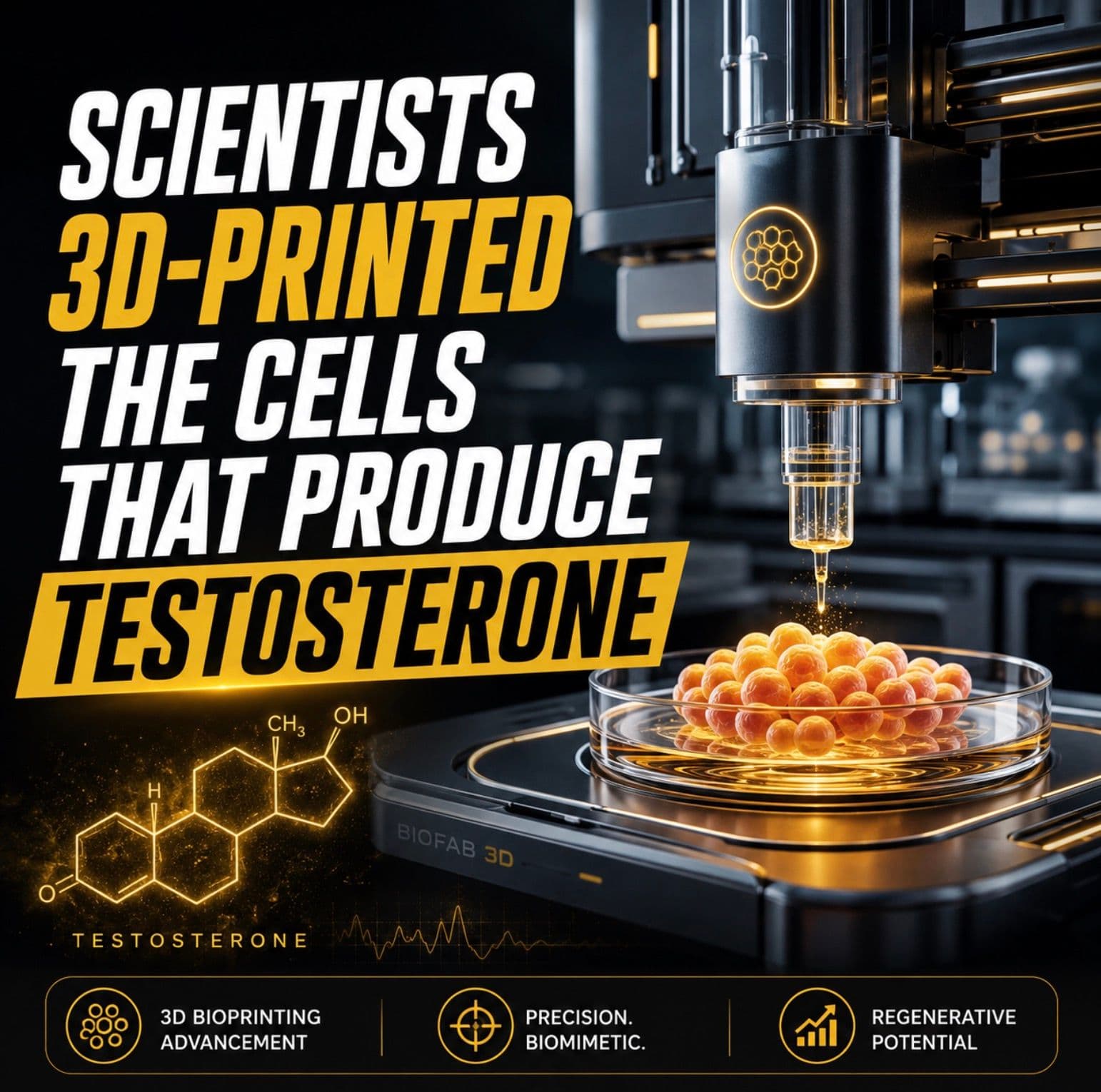
A group of researchers recently managed to bioprint functional steroidogenic cells, the kind that produce testosterone, and keep them alive long enough to actually do their job. That single sentence contains more nuance than most headlines have room for.
To understand why this matters, and why it matters differently than the coverage suggests, it helps to start with the biology that researchers are trying to replicate.
How the Body Actually Makes Testosterone
Testosterone is not simply a chemical the body switches on and off. Its production is governed by a tightly regulated feedback loop called the hypothalamic-pituitary-gonadal axis. The hypothalamus releases a signaling hormone that prompts the pituitary gland to release luteinizing hormone, or LH, into the bloodstream. LH then travels to the testes, where it binds to Leydig cells, the specialized interstitial cells that synthesize and secrete testosterone.
Leydig cells convert cholesterol into testosterone through a sequence of enzymatic steps, and the resulting hormone feeds back up to the brain to signal that enough has been made. When levels drop, the signal goes out again. This loop runs continuously, and its precision is part of why disrupting it, either by disease, injury, or synthetic supplementation, has wide-reaching effects on the body.
When researchers talk about 3D-printing testosterone-producing cells, they are specifically talking about recreating something that functions like Leydig cells, outside the body, and ideally in a way that could eventually be implanted or used as a research tool.
What Bioprinting These Cells Actually Involves
Bioprinting, in this context, does not mean extruding a solid object. It refers to the deposition of living cells within a supportive biological scaffold, often a hydrogel, in a spatial arrangement that allows them to survive, communicate, and function. The scaffold mimics the extracellular matrix that cells normally rest within inside the body.
For steroidogenic cells specifically, researchers have worked with Leydig-like cells derived from stem cells or from isolated primary cells, embedding them in three-dimensional structures that allow for nutrient exchange and, in some studies, measurable testosterone output. Research published through the National Institutes of Health has documented early-stage constructs where these printed cell clusters demonstrated hormonal activity under laboratory conditions, responding to LH stimulation in ways that partially mirror in-vivo behavior.
The key phrase there is "partially mirror." The gap between a lab result and a clinical therapy is not a small one.
Why This Research Matters Beyond the Headlines
The clinical excitement around this work is real, even if it is sometimes misrepresented. The applications researchers are most seriously pursuing are not necessarily the ones that get the most attention.
Fertility preservation is one of the most compelling near-term applications. Boys and young men who undergo chemotherapy or radiation for cancer often sustain damage to testicular tissue, including the Leydig cells that would later be responsible for testosterone production and the Sertoli cells that support sperm development. If testicular tissue could be banked before treatment and then reimplanted in a functional bioprinted construct afterward, it could restore both hormonal and reproductive function without lifelong dependence on external hormones.
Testicular injury from trauma, torsion, or surgical removal presents a similar case. Men who lose testicular function due to physical damage currently have limited options: accept the hormonal deficit, or begin hormone therapy.
Beyond direct therapy, these constructs have significant value as research platforms. Drug toxicology testing, endocrine disruption studies, and pharmaceutical development all currently rely on animal models that do not perfectly predict human responses. A human-derived testicular cell construct that responds to hormonal signals could provide a more accurate testing environment for compounds that affect the male endocrine system. This is less dramatic than implanting printed organs, but arguably more immediately useful.
Personalized medicine is another direction. Constructs derived from a patient's own cells could theoretically be used to predict how that individual's endocrine system will respond to a given drug or condition, a kind of living pharmacological model.
What Is Still Experimental, and What the Limitations Are
This is where the science requires honest accounting.
Cell maturation is a significant challenge. Leydig-like cells derived from stem cells do not always achieve the same functional profile as native adult Leydig cells. Their enzyme activity can be incomplete, meaning testosterone output may be lower or less consistent than what the body naturally produces.
Vascularization is another obstacle. Any implanted construct needs a blood supply to survive long-term. Bioprinted tissues thicker than a fraction of a millimeter struggle to receive enough oxygen and nutrients through diffusion alone. Without vascularization, implanted constructs tend to develop necrotic cores. Researchers are working on printing vascular channels into constructs, but this remains one of the hardest problems in the field, as noted by experts at institutions including the Mayo Clinic's regenerative medicine programs.
Immune rejection is a serious concern for constructs made from donor or stem-cell-derived cells that are not genetically matched to the recipient. The body's immune system will recognize foreign cells and attack them. Autologous approaches, using the patient's own cells, reduce this risk but add complexity and cost.
Tumor risk cannot be dismissed. Pluripotent stem cells, which have the broadest differentiation potential, carry a theoretical risk of forming teratomas if any undifferentiated cells remain in the final construct. Differentiation protocols are improving, but the risk needs long-term study.
Controlling output is also non-trivial. The body's testosterone production is dynamic, rising and falling in response to dozens of inputs. A static implanted construct would need to be either self-regulating or its output would need to be predictable enough that physicians could manage it. Neither is straightforward.
Realistic timelines for human clinical use range from ten to twenty-plus years, depending on which application is being pursued. Research-tool applications are much closer. Implantable therapeutic constructs face a longer path through safety trials, regulatory review, and manufacturing scale-up.
How This Compares to Current Standard-of-Care Approaches
Men with clinically symptomatic low testosterone today have well-established treatment options. Testosterone replacement therapy comes in several forms, including injectable, topical, and pellet-based delivery, and when properly managed it is effective at restoring testosterone to normal physiological ranges and relieving symptoms like fatigue, reduced libido, mood changes, and loss of lean muscle mass.
For men where preserving fertility is a priority, human chorionic gonadotropin is often used alongside or instead of direct testosterone supplementation, because it stimulates the body's own Leydig cells to produce testosterone rather than bypassing them entirely.
These current approaches work. They have decades of clinical data behind them, established dosing protocols, and known risk profiles. What they do not do is restore the underlying biology. A man on testosterone therapy is supplementing a deficient system, not repairing it. Bioprinted cell therapies, if they mature, would represent a fundamentally different category of treatment: one that attempts to restore endogenous production rather than replace it pharmacologically.
That is the meaningful distinction, and it is why the research is worth watching even if clinical translation is years away.
How to Read Sensational Headlines About This Research
When a headline says scientists have "3D-printed testosterone," it is worth pausing on what that claim actually requires to be clinically meaningful.
For a bioprinted cell construct to become a real therapy, it would need to: survive implantation in a living human body, integrate with surrounding tissue, establish sufficient vascularization to remain viable long-term, produce testosterone at a physiologically relevant rate, respond appropriately to the body's feedback signals, avoid triggering immune rejection, demonstrate no tumor-forming potential over years of follow-up, and be manufacturable at a scale and cost that makes it accessible.
None of the current published research meets all of those criteria. That is not a criticism of the researchers. It is simply a description of where the science is. Early-stage demonstrations of functional cell constructs in laboratory conditions are genuinely important milestones, but they are the beginning of a long development process, not the end of it.
The distinction between "scientists demonstrated a proof-of-concept" and "a new treatment is coming" matters enormously for patients, particularly those who are managing hormonal conditions right now and may be weighing their options.
The Larger Picture
What makes this research significant is not any single published result. It is the direction the field is moving. Regenerative medicine and bioprinting are converging with endocrinology in ways that could eventually change how hormonal deficiencies are treated at their source, rather than managed at the surface.
For now, the practical reality for most men with hypogonadism is that proven, well-managed hormonal therapies remain the standard of care. Platforms like AlphaMD exist precisely to make that standard of care more accessible, through evidence-based protocols overseen by licensed clinicians. The science of bioprinted cells is a reason to stay engaged with where medicine is heading. It is not yet a reason to change what works today.
Have a question? Ask us.
At AlphaMD, we're here to help. Feel free to ask us any question you would like about TRT, medical weightloss, ED, or other topics related to men's health. Or take a moment to browse through our past questions.
People are asking...
Please explain the role of androgens in PCOS? The condition is already caused by androgen excess...
Women produce more testosterone in their lifespan than estrogen. In fact young women produce 3-4x as much testosterone than estrogen daily. Women also have a much, much larger amount of the aromatase... See Full Answer
With continued estrogenification of our environment in societal wide decreases in testosterone and sperm count, not everyone is going to necessarily f...
The question really comes down to do you have primary or secondary hypogonadism. If you have primary hypogonadism, you could take all the enclomiphene in the world and it would not adequately raise th... See Full Answer
Is there any correlation to an imbalance of hormones and an increase in WBC count particularly when estrogen is spiked when there is no infection insi...
Not necessarily, but the latter may be related to something else. Some men have reported this phenomenon, but it seems to occur primarily when first starting TRT and resolves with time. I believe that... See Full Answer
Get $30 off your first month’s order
Enter your email address now to receive $30 off your first month’s cost, other discounts, and additional information about TRT.
Legal Disclaimer
This website is a repository of publicly available information and is not intended to form a physician-patient relationship with any individual. The content of this website is for informational purposes only. The information presented on this website is not intended to take the place of your personal physician's advice and is not intended to diagnose, treat, cure, or prevent any disease. Discuss this information with your own physician or healthcare provider to determine what is right for you. All information is intended for your general knowledge only and is not a substitute for medical advice or treatment for specific medical conditions. The information contained herein is presented in summary form only and intended to provide broad consumer understanding and knowledge. The information should not be considered complete and should not be used in place of a visit, phone or telemedicine call, consultation or advice of your physician or other healthcare provider. Only a qualified physician in your state can determine if you qualify for and should undertake treatment.