
Retatrutide: Everything You Need to Know About the Triple-Agonist Weight Loss Drug
Published on:
Updated on:
People are asking...
Can guys at 18% bodyfat benefit from adding the anorectic peptides like semaglutide, trizep, etc for a weight loss phase? Or is it only feasible for ...
Anyone will lose weight by adding a GLP-1RA like semaglutide or tirzepatide. They are the most popular drugs on the market and work well, regardless of the amount of weight someone needs to lose. The ... See Full Answer
I am 42 and have been unable to lose weight or build muscle for years now even working with trainers and nutritionists. Semagultide makes me horribly ...
Providers on the AlphaMD platform have treated men at 700 before. Relative hypogonadism is far more rare than normal than traditional low Testosterone, but if you're suffering then you still deserve c... See Full Answer
36 y/o morbidly obese male total testosterone is 107 and free is 26.1. Should I lose weight first or should I combine my new lifestyle (losing weight...
You will lose weight much faster with TRT than without. You will have more energy and motivation to do workouts, recover quicker with less muscle soreness, and have the benefit of a higher basal metab... See Full Answer
Have a question? Ask us.
At AlphaMD, we're here to help. Feel free to ask us any question you would like about TRT, medical weightloss, ED, or other topics related to men's health. Or take a moment to browse through our past questions.
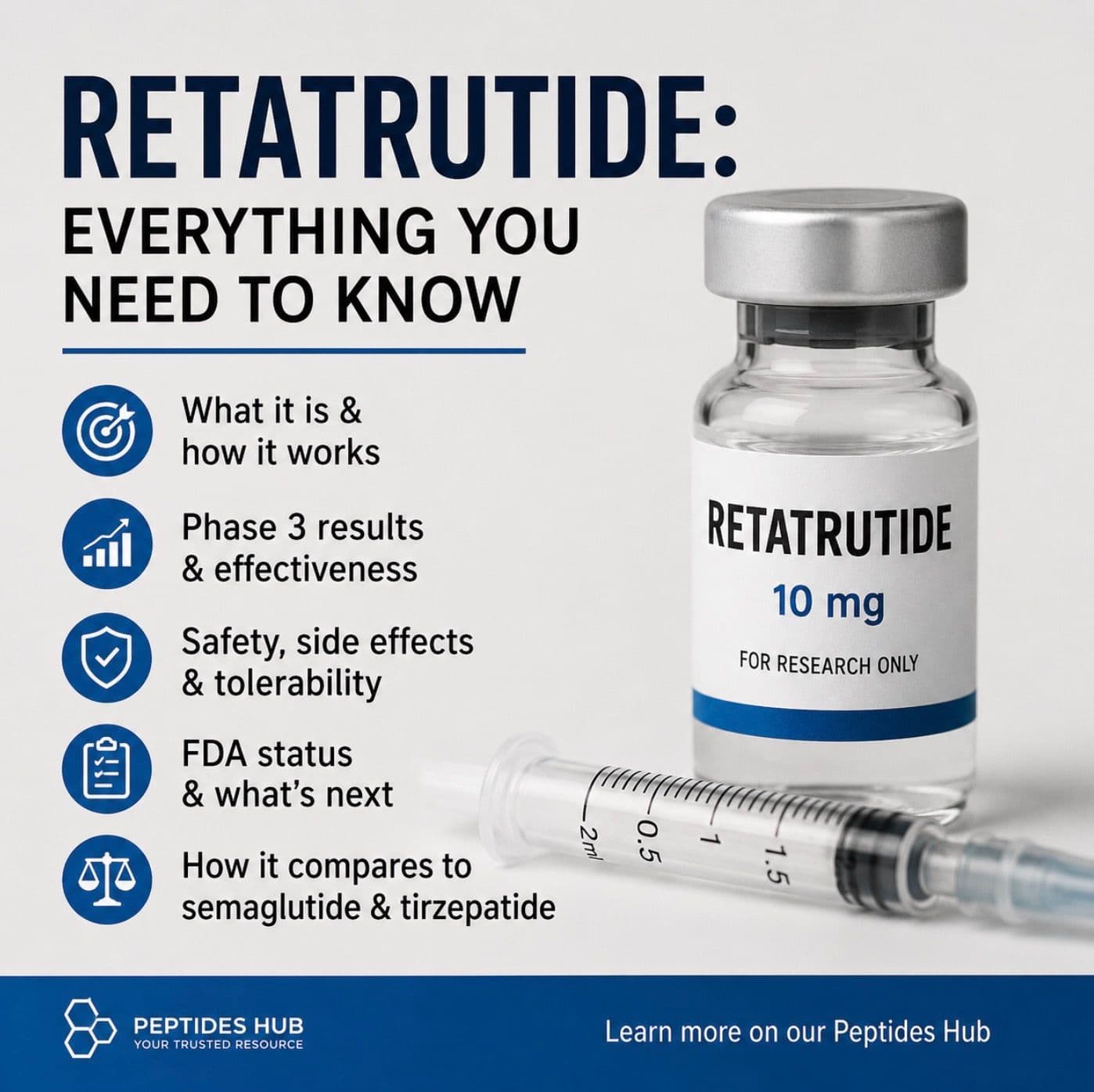
Retatrutide is one of the most closely watched weight loss drugs in development. The once-weekly injectable medication from Eli Lilly activates three metabolic hormone receptors at the same time: GLP-1, GIP, and glucagon.
That makes retatrutide different from semaglutide drugs such as Wegovy and Ozempic, which primarily target GLP-1, and tirzepatide drugs such as Zepbound and Mounjaro, which target GLP-1 and GIP.
The reason for the excitement is the amount of weight loss seen in clinical trials. In the Phase 3 TRIUMPH-1 obesity trial, participants taking 12 mg of retatrutide lost an average of 28.3% of their body weight at 80 weeks. Among a subset of participants with a starting BMI of at least 35 who continued into a 104-week extension, average weight loss reached 30.3% at the highest dose.
But there is an important catch: retatrutide is still investigational.
As of August 2026, retatrutide is not FDA approved. Eli Lilly says its clinical data package is now complete to support regulatory submissions for obesity, obstructive sleep apnea, and knee osteoarthritis pain, and the company plans to submit a Biologics License Application to the FDA in the first quarter of 2027.
So what exactly is retatrutide, how does it work, how much weight could it help people lose, how does it compare with semaglutide and tirzepatide, and when might it actually become available?
Here is what we know.
Retatrutide at a Glance
- What is it? An investigational once-weekly injectable metabolic medication.
- Who makes it? Eli Lilly.
- What does it target? GLP-1, GIP, and glucagon receptors.
- Is it a peptide? Yes, retatrutide is a peptide-based molecule.
- How much weight loss has been reported? Up to an average of 28.3% at 80 weeks in a major Phase 3 obesity trial.
- Is it FDA approved? No.
- Can it legally be compounded? No. The FDA currently states that retatrutide cannot be used in compounding under federal law.
- When could it reach the FDA? Lilly plans to submit it in Q1 2027.
- Is it the same as Ozempic or Zepbound? No. Retatrutide targets three receptors instead of one or two.
What Is Retatrutide?
Retatrutide, also known by its development code LY3437943, is an investigational medication being developed primarily for obesity, type 2 diabetes, and complications associated with excess body weight.
It is a peptide engineered to activate three hormone receptors:
- GLP-1
- GIP
- Glucagon
This is why retatrutide is frequently described as a triple agonist or triple hormone receptor agonist.
The concept is not simply to create a stronger GLP-1 drug. Researchers are attempting to combine several complementary metabolic signals into one molecule.
Retatrutide is also part of a much broader wave of interest in peptide-based therapies. For more information about how different peptide compounds work, their regulatory status, and the evidence behind them, visit the AlphaMD peptide therapy hub.
It is important to distinguish retatrutide from other peptides, however. Evidence, safety, regulatory status, and potential benefits associated with one peptide should never automatically be applied to another.
Retatrutide specifically remains investigational.
How Does Retatrutide Work?
Retatrutide's potential advantage comes from activating GLP-1, GIP, and glucagon receptors simultaneously.
Each affects metabolism differently.
GLP-1
GLP-1 receptor activation can:
- reduce hunger
- increase feelings of fullness
- decrease food intake
- stimulate insulin secretion when glucose is elevated
- help regulate blood sugar
- slow gastric emptying
GLP-1 is the principal target of semaglutide, the active ingredient in Ozempic and Wegovy.
GIP
GIP, or glucose-dependent insulinotropic polypeptide, also plays a role in insulin secretion and energy metabolism.
Tirzepatide combines GLP-1 and GIP activity, which differentiates it from earlier GLP-1-only medications.
Glucagon
Retatrutide adds a third component: glucagon receptor activation.
Glucagon is best known for its role in raising blood glucose, which might seem counterintuitive in a weight loss or diabetes drug. But glucagon signaling also influences energy expenditure, lipid metabolism, and fat oxidation.
The theory is that GLP-1 and GIP activity can help regulate appetite and glucose while glucagon receptor activation may increase energy expenditure.
In simplified terms, retatrutide may affect both how much energy someone consumes and how much energy the body uses.
Early clinical evidence supporting the triple-agonist approach was reported in a peer-reviewed Phase 2 retatrutide trial published in The New England Journal of Medicine, which found substantial dose-dependent weight loss and helped lead to the larger Phase 3 program.
Is Retatrutide a GLP-1 Drug?
Yes, but calling retatrutide simply a GLP-1 drug leaves out most of what makes it different.
Semaglutide primarily targets:
GLP-1
Tirzepatide targets:
GLP-1 + GIP
Retatrutide targets:
GLP-1 + GIP + glucagon
That third receptor is why retatrutide is sometimes described as the next generation after drugs such as Wegovy and Zepbound.
Is Retatrutide Really a “GLP-3”?
No.
“GLP-3” has become an informal nickname for retatrutide online, presumably because it acts on three receptors.
But there is no GLP-3 receptor involved.
Retatrutide targets GLP-1, GIP, and glucagon, so “triple agonist” is a more scientifically accurate description.
How Much Weight Can You Lose on Retatrutide?
This is where retatrutide has generated extraordinary attention.
In the Phase 3 TRIUMPH-1 trial, adults with obesity or overweight and at least one weight-related health condition, but without diabetes, received retatrutide or placebo for 80 weeks.
Average weight loss was:
- 19.0% with retatrutide 4 mg
- 25.9% with retatrutide 9 mg
- 28.3% with retatrutide 12 mg
- 2.2% with placebo
Participants started at an average weight of 248.5 pounds. Those taking 12 mg lost an average of 70.3 pounds.
The percentage of participants achieving very large reductions in body weight was also notable.
Among participants taking 12 mg:
- 62.5% lost at least 25% of their body weight
- 45.3% lost at least 30%
- 27.2% lost at least 35%
In the prespecified TRIUMPH-1 extension, participants who had started with a BMI of at least 35 and continued treatment for 104 weeks lost an average of as much as 30.3% of their starting body weight at the highest dose.
These are averages from clinical trials, not predictions for individual patients. Some people lose substantially more or less weight than a study average.
Retatrutide vs. Semaglutide: What's the Difference?
Semaglutide is the active ingredient in Wegovy and Ozempic.
The most important biological difference is the number of hormone receptors targeted.
Semaglutide:
GLP-1
Retatrutide:
GLP-1 + GIP + glucagon
In the landmark STEP 1 trial, adults with overweight or obesity taking semaglutide 2.4 mg lost an average of 14.9% of their body weight at 68 weeks, compared with 2.4% with placebo. The study was published in The New England Journal of Medicine.
By comparison, TRIUMPH-1 reported average weight loss of up to 28.3% at 80 weeks with retatrutide.
That does not mean retatrutide has been proven to cause almost twice as much weight loss as semaglutide.
The numbers come from different clinical trials involving different participants, treatment durations, protocols, and statistical methods. Cross-trial comparisons can be useful for context, but they cannot prove that one medication is superior to another.
Weight on the scale is also only part of the story. Fat mass and lean mass are particularly relevant for men attempting to improve body composition while losing weight. We take a closer look at that issue in our analysis of retatrutide vs. semaglutide on TRT and the available body composition data.
What can be said is that the average weight reduction observed in retatrutide's clinical development program has been unusually large compared with pivotal trials of earlier incretin medications.
Retatrutide vs. Tirzepatide: Is It Better Than Zepbound?
This may ultimately be the most important comparison.
Tirzepatide is the active ingredient in Mounjaro and Zepbound.
Tirzepatide targets:
GLP-1 + GIP
Retatrutide targets:
GLP-1 + GIP + glucagon
In the pivotal SURMOUNT-1 obesity trial, tirzepatide produced average weight loss of up to approximately 20.9% at 72 weeks at the highest dose studied. The results were published in The New England Journal of Medicine.
TRIUMPH-1 reported average weight loss of up to 28.3% with retatrutide at 80 weeks.
Again, these separate studies cannot prove that retatrutide is superior to tirzepatide.
Fortunately, that comparison is being studied directly.
The TRIUMPH-5 Phase 3 clinical trial is comparing retatrutide head-to-head with tirzepatide in adults with obesity.
Until results from a direct comparison are available, headlines declaring retatrutide the definitive winner over Zepbound are premature.
Does Retatrutide Work for Type 2 Diabetes?
Retatrutide is also showing substantial effects on blood glucose.
In the Phase 3 TRANSCEND-T2D-1 trial, adults with type 2 diabetes experienced average A1C reductions ranging from 1.7 to 2.0 percentage points at 40 weeks, depending on dose.
Participants taking retatrutide 12 mg also lost an average of 16.8% of their body weight, or approximately 36.6 pounds.
Additional Phase 3 results have strengthened the picture.
In TRIUMPH-2, which studied adults with obesity or overweight and type 2 diabetes for 80 weeks, average weight loss reached:
- 12.7% with 4 mg
- 19.1% with 9 mg
- 20.8% with 12 mg
- 4.0% with placebo
Average A1C reductions reached as much as 1.6 percentage points.
As has been seen with several obesity medications, average weight loss tends to be lower among people with type 2 diabetes than among study participants without diabetes.
Retatrutide remains investigational for diabetes and is not currently FDA approved for diabetes treatment.
Could Retatrutide Help With Sleep Apnea?
Potentially.
Obstructive sleep apnea is strongly associated with obesity, and significant weight reduction can improve airway obstruction in some patients.
In a TRIUMPH-1 substudy involving participants with moderate-to-severe obstructive sleep apnea, retatrutide reduced the apnea-hypopnea index by as much as 36.1 events per hour, or 60.6% from baseline, at the highest studied dose.
These findings are one reason Lilly plans to include obstructive sleep apnea among the indications in its initial U.S. regulatory submission.
What About Retatrutide and Knee Osteoarthritis?
Retatrutide is also being studied in people with obesity and knee osteoarthritis.
In clinical trial data reported by Lilly, retatrutide produced substantial weight loss along with reductions in knee osteoarthritis pain. A TRIUMPH-1 substudy reported a reduction of up to 73.1% in WOMAC knee pain scores from baseline.
A separate Phase 3 study, TRIUMPH-4, previously reported average weight loss of 28.7% at 68 weeks among participants receiving 12 mg retatrutide who had obesity or overweight and knee osteoarthritis.
Weight loss itself can substantially reduce the mechanical load placed on the knees, so researchers will continue evaluating how much of the improvement is related to weight reduction and whether other mechanisms contribute.
What Could Retatrutide Do for Cardiovascular Health?
Large amounts of weight loss can improve many cardiovascular risk factors, and retatrutide studies have reported changes in several of them.
TRIUMPH-1 reported improvements that included reductions in:
- waist circumference
- triglycerides
- non-HDL cholesterol
- systolic blood pressure
- high-sensitivity C-reactive protein
For example, the study reported reductions of up to 41% in triglycerides, 24.2% in non-HDL cholesterol, and 12.3 mmHg in systolic blood pressure.
However, improving cardiovascular risk markers is not the same thing as proving that a medication prevents heart attacks, strokes, cardiovascular death, or kidney failure.
Those questions require dedicated long-term outcome trials.
The ongoing TRIUMPH-OUTCOMES clinical trial is designed to determine whether retatrutide can reduce serious cardiovascular complications or worsening kidney function in higher-risk adults with overweight or obesity.
That study is expected to provide some of the most important long-term evidence about the drug.
Does Retatrutide Cause Muscle Loss?
Any substantial weight loss can include a combination of fat loss and lean tissue loss.
That is true with dieting, bariatric surgery, GLP-1 medications, tirzepatide, and retatrutide.
The question is whether retatrutide causes an unusually large proportion of lean mass loss.
So far, the evidence does not suggest that it does.
A 2025 body-composition substudy measured participants using DXA scans and found substantial reductions in total fat mass with retatrutide. Importantly, the researchers reported that the proportion of lean mass lost relative to total weight loss was similar to that seen with other obesity treatments, despite the large overall reductions in body weight.
You can review the retatrutide body composition study indexed by the National Library of Medicine.
That does not mean muscle preservation should be ignored.
When someone is losing 20%, 25%, or potentially 30% of their starting body weight, preserving lean tissue becomes especially important.
Strategies commonly used to support muscle retention during significant weight loss include:
- resistance training
- adequate protein intake
- sufficient overall nutrition
- adequate sleep and recovery
- avoiding unnecessarily severe calorie restriction
For men receiving testosterone replacement therapy, body composition may be an especially relevant part of evaluating a weight loss strategy. Our deeper comparison of retatrutide and semaglutide on TRT examines this issue in more detail.
What Are the Side Effects of Retatrutide?
Retatrutide's most commonly reported adverse effects have been similar to those associated with other incretin-based medications.
In TRIUMPH-1, the most common side effects included:
- nausea
- diarrhea
- constipation
- vomiting
- upper respiratory tract infection
Side effects generally became more common as the dose increased.
For example, nausea occurred in:
- 28.6% of participants taking 4 mg
- 38.4% taking 9 mg
- 42.4% taking 12 mg
- 14.8% receiving placebo
Vomiting occurred in 10.6%, 22.8%, and 25.3% of the respective retatrutide groups compared with 4.8% receiving placebo.
What Is Dysesthesia and Why Is It Associated With Retatrutide?
One side effect that has received particular attention in retatrutide trials is dysesthesia.
Dysesthesia describes abnormal or unpleasant sensations such as:
- tingling
- burning
- unusual sensitivity
- numbness
- skin discomfort
In TRIUMPH-1, dysesthesia occurred in:
- 5.1% of participants taking 4 mg
- 12.3% taking 9 mg
- 12.5% taking 12 mg
- 0.9% receiving placebo
Lilly reported that most cases were mild to moderate, most resolved during treatment, and most affected participants continued taking the medication.
It remains an adverse effect worth monitoring as larger numbers of people are studied and longer-term safety data accumulate.
How Many People Stop Retatrutide Because of Side Effects?
Treatment discontinuation also increased with dose in TRIUMPH-1.
Participants discontinuing because of adverse events included:
- 4.1% at 4 mg
- 6.9% at 9 mg
- 11.3% at 12 mg
- 4.9% with placebo
This matters because the highest dose produced the greatest average weight loss but also had the highest discontinuation rate.
If retatrutide is ultimately approved, dosing and titration strategies will likely be important considerations in balancing effectiveness and tolerability.
How Is Retatrutide Taken?
In clinical trials, retatrutide is given as a once-weekly subcutaneous injection.
Clinical trials have studied maintenance doses including:
- 4 mg
- 9 mg
- 12 mg
Participants generally undergo gradual dose escalation rather than starting immediately at the maximum dose.
These are experimental research protocols, not dosing instructions for consumers.
Because retatrutide has not been approved, there is currently no FDA-approved dose, titration schedule, prescribing information, or official product label.
Is Retatrutide FDA Approved?
No.
As of August 2026, retatrutide remains investigational.
Eli Lilly announced in August 2026 that its Phase 3 data package is complete to support global regulatory submissions for:
- obesity
- obstructive sleep apnea
- knee osteoarthritis pain
Lilly plans to submit a Biologics License Application to the U.S. FDA during the first quarter of 2027.
An FDA submission does not guarantee approval.
Regulators still have to review clinical effectiveness, safety, manufacturing, product quality, labeling, and other data before determining whether the drug can be marketed.
When Will Retatrutide Be Available?
There is currently no confirmed U.S. launch date.
Lilly's planned Q1 2027 submission gives us a better idea of the regulatory timeline, but it is not possible to say exactly when, or whether, approval will occur.
Even after an application is submitted, the FDA review process takes time and can result in requests for additional information or other delays.
For now, any specific consumer launch date is speculation.
Can You Buy Retatrutide Right Now?
This is one of the most important sections of this article.
There is currently no FDA-approved retatrutide product available to consumers in the United States.
Despite this, websites, social media sellers, peptide vendors, and some wellness businesses have advertised products claiming to contain retatrutide.
The FDA has specifically addressed this issue.
According to the FDA's current guidance on unapproved GLP-1 drugs used for weight loss, retatrutide cannot be used in compounding under federal law and has not been found safe and effective for any condition.
The FDA has also sent warning letters to companies marketing purported retatrutide products directly to consumers.
In a March 2026 warning letter, for example, the FDA said products advertised as retatrutide were unapproved new drugs even though the seller labeled them “research use only” and “not intended for human consumption.”
This means consumers should be extremely cautious about products marketed as:
- compounded retatrutide
- research retatrutide
- “Reta”
- GLP-3
- retatrutide peptide
- research-use-only weight loss injections
Unapproved products sold online have not gone through the FDA approval process to establish their identity, potency, purity, sterility, dosing accuracy, safety, or effectiveness.
Can Retatrutide Be Compounded?
No, not under current federal law.
The FDA states explicitly that retatrutide and cagrilintide cannot be used in compounding.
This makes retatrutide different from situations involving some FDA-approved drugs where lawful compounding may be permitted under specific circumstances.
If a clinic or website currently advertises “compounded retatrutide,” consumers should understand that the FDA does not consider retatrutide eligible for legal compounding.
Is Retatrutide a Peptide?
Yes.
Retatrutide is a peptide-based molecule engineered to interact with GLP-1, GIP, and glucagon receptors.
Peptides are chains of amino acids that can function as signaling molecules within the body. Many naturally occurring hormones are peptides, and researchers have learned to engineer peptide-based drugs that mimic or modify these signaling pathways.
That does not mean all peptides are interchangeable or have comparable evidence.
Some peptide compounds are FDA approved for specific conditions. Others remain experimental. Some have extensive human clinical data, while others have little or no high-quality evidence in humans.
If you want to explore the broader landscape, the AlphaMD peptide hub covers the science, emerging research, regulatory developments, and availability of several widely discussed peptide therapies.
Why Is Retatrutide Called the “Trillion-Dollar Drug”?
Retatrutide has occasionally been described in media coverage as a potential “trillion-dollar drug.”
The phrase reflects the extraordinary commercial expectations surrounding obesity medications rather than a realistic prediction that one drug will generate $1 trillion in annual revenue.
The potential market extends far beyond people who simply want to lose a few pounds.
Obesity is closely associated with conditions including:
- type 2 diabetes
- cardiovascular disease
- obstructive sleep apnea
- osteoarthritis
- chronic kidney disease
- metabolic liver disease
A medication capable of producing substantial weight loss while also improving several obesity-related conditions could potentially have an enormous impact.
But the commercial hype is less important for patients than three basic questions:
Does it work? Is it safe? And will patients be able to access it?
The evidence surrounding effectiveness is becoming increasingly strong.
The complete long-term answers to the safety and access questions are still developing.
Is Retatrutide Better Than Bariatric Surgery?
We do not know.
The amount of average weight loss seen in some retatrutide trials has entered a range historically associated with certain forms of metabolic and bariatric surgery.
That is one of the reasons the TRIUMPH-1 results attracted so much attention.
But medication and surgery cannot be compared solely by percentage weight loss.
Bariatric surgery has decades of evidence evaluating:
- long-term weight maintenance
- type 2 diabetes remission
- cardiovascular outcomes
- mortality
- nutritional consequences
- surgical complications
- long-term safety
Retatrutide does not yet have comparable long-term evidence.
The important point is not that retatrutide has “replaced” bariatric surgery. It is that pharmacologic obesity treatment may be entering a range of effectiveness that was difficult to imagine only a few years ago.
Will You Regain Weight After Stopping Retatrutide?
This remains an important unanswered question.
We do not yet have sufficient long-term withdrawal data to know exactly how much weight people would regain after stopping retatrutide.
Evidence from other incretin-based obesity medications shows that significant weight regain can occur when treatment is discontinued.
That fits with the modern medical understanding of obesity as a chronic disease influenced by biological mechanisms controlling appetite, metabolism, energy expenditure, and body-weight regulation.
If retatrutide is approved, one of the major long-term questions will be whether patients need continuous therapy to maintain its benefits.
What Do We Still Not Know About Retatrutide?
Despite the impressive results, several major questions remain.
Long-term safety
Clinical trials can identify common and many uncommon adverse events, but some risks only become clear after a medication has been used by much larger populations for longer periods.
Long-term weight maintenance
We need more information about whether weight loss stabilizes, continues, or reverses over several years.
What happens after stopping treatment
Long-term withdrawal data will help determine how much weight is typically regained.
Cardiovascular outcomes
Risk factors have improved, but dedicated cardiovascular outcome research is still underway.
Kidney outcomes
Retatrutide's effects on long-term kidney disease progression remain under investigation.
Head-to-head effectiveness
The ongoing comparison with tirzepatide should provide much better evidence about whether retatrutide actually produces greater weight loss than Zepbound.
Real-world tolerability
Clinical trial participants receive extensive monitoring. Real-world adherence and side-effect rates can look different once a medication reaches millions of patients.
Cost and insurance coverage
No official U.S. retail price exists because retatrutide has not been approved.
The Bottom Line on Retatrutide
Retatrutide could represent the next major step in medical weight management.
It is a once-weekly investigational peptide that combines three metabolic mechanisms in a single molecule:
GLP-1 + GIP + glucagon
Phase 3 studies have reported:
- average weight loss of up to 28.3% at 80 weeks in adults without diabetes
- average weight loss reaching 30.3% at 104 weeks in a subgroup with higher starting BMI
- average weight loss of up to 20.8% at 80 weeks among adults with type 2 diabetes and overweight or obesity
- A1C reductions of up to approximately 2 percentage points
- substantial improvements in obstructive sleep apnea severity
- reductions in knee osteoarthritis pain
- improvements in several cardiovascular risk factors
These results make retatrutide one of the most promising obesity drugs studied to date.
But retatrutide is not FDA approved, its full long-term safety profile is still being established, and the FDA says retatrutide cannot currently be legally compounded. Lilly plans to submit the drug to the FDA in Q1 2027.
Until then, products claiming to contain retatrutide that are sold through peptide websites or other unregulated sources should not be treated as substitutes for an FDA-approved prescription medication.
People interested in medical weight management should discuss currently approved options with a licensed medical provider.
Frequently Asked Questions About Retatrutide
What is retatrutide?
Retatrutide is an investigational once-weekly injectable medication developed by Eli Lilly that activates GLP-1, GIP, and glucagon receptors.
Is retatrutide a GLP-1?
Retatrutide activates GLP-1 receptors, but it also activates GIP and glucagon receptors. This makes it a triple receptor agonist rather than a GLP-1-only medication.
Is retatrutide GLP-3?
No. “GLP-3” is an informal nickname. Retatrutide targets three separate receptors: GLP-1, GIP, and glucagon.
Is retatrutide a peptide?
Yes. Retatrutide is a peptide-based triple receptor agonist. You can learn more about peptide research and emerging therapies through the AlphaMD peptide therapy hub.
How much weight can you lose on retatrutide?
In the Phase 3 TRIUMPH-1 trial, participants taking 12 mg lost an average of 28.3% of their body weight at 80 weeks. A subgroup with a starting BMI of at least 35 that continued treatment reached average weight loss of 30.3% at 104 weeks.
Is retatrutide better than semaglutide?
Retatrutide has produced greater average weight loss in its clinical trials than was reported in pivotal semaglutide obesity trials, but these were separate studies. That does not prove retatrutide is superior. For a deeper look at body composition specifically, see our analysis of retatrutide vs. semaglutide on TRT.
Is retatrutide better than Zepbound?
We do not know yet. The Phase 3 TRIUMPH-5 trial is comparing retatrutide directly with tirzepatide, the active ingredient in Zepbound.
What are the most common retatrutide side effects?
The most commonly reported side effects include nausea, diarrhea, constipation, and vomiting. Dysesthesia, or abnormal skin sensations, has also been reported and appears to occur more frequently at higher doses.
Does retatrutide cause muscle loss?
Some lean mass loss occurs during substantial weight reduction. Available body-composition research found that the proportion of lean mass loss with retatrutide was similar to that seen with other obesity treatments rather than disproportionately high.
Is retatrutide available in 2026?
No FDA-approved retatrutide product is commercially available in the United States as of August 2026.
Can I buy compounded retatrutide?
The FDA states that retatrutide cannot be used in compounding under federal law.
When will retatrutide be FDA approved?
There is no guaranteed approval date. Eli Lilly plans to submit a Biologics License Application to the FDA in the first quarter of 2027. FDA review would occur after submission.
Is retatrutide once weekly?
Yes. Retatrutide has been administered as a once-weekly subcutaneous injection in clinical trials.
Who makes retatrutide?
Retatrutide is being developed by Eli Lilly and Company.
Is retatrutide currently safe to use?
Retatrutide remains investigational, so there is not yet an FDA-approved prescribing label establishing its complete safety profile, contraindications, warnings, and dosing instructions. Consumers should not use unapproved products marketed online as retatrutide.
This article is for educational purposes only and does not constitute medical advice. Retatrutide is an investigational medication and has not been approved by the FDA. Medical treatment decisions should be made with a licensed medical provider.
Have a question? Ask us.
At AlphaMD, we're here to help. Feel free to ask us any question you would like about TRT, medical weightloss, ED, or other topics related to men's health. Or take a moment to browse through our past questions.
People are asking...
Can guys at 18% bodyfat benefit from adding the anorectic peptides like semaglutide, trizep, etc for a weight loss phase? Or is it only feasible for ...
Anyone will lose weight by adding a GLP-1RA like semaglutide or tirzepatide. They are the most popular drugs on the market and work well, regardless of the amount of weight someone needs to lose. The ... See Full Answer
I am 42 and have been unable to lose weight or build muscle for years now even working with trainers and nutritionists. Semagultide makes me horribly ...
Providers on the AlphaMD platform have treated men at 700 before. Relative hypogonadism is far more rare than normal than traditional low Testosterone, but if you're suffering then you still deserve c... See Full Answer
36 y/o morbidly obese male total testosterone is 107 and free is 26.1. Should I lose weight first or should I combine my new lifestyle (losing weight...
You will lose weight much faster with TRT than without. You will have more energy and motivation to do workouts, recover quicker with less muscle soreness, and have the benefit of a higher basal metab... See Full Answer
Get $30 off your first month’s order
Enter your email address now to receive $30 off your first month’s cost, other discounts, and additional information about TRT.
Legal Disclaimer
This website is a repository of publicly available information and is not intended to form a physician-patient relationship with any individual. The content of this website is for informational purposes only. The information presented on this website is not intended to take the place of your personal physician's advice and is not intended to diagnose, treat, cure, or prevent any disease. Discuss this information with your own physician or healthcare provider to determine what is right for you. All information is intended for your general knowledge only and is not a substitute for medical advice or treatment for specific medical conditions. The information contained herein is presented in summary form only and intended to provide broad consumer understanding and knowledge. The information should not be considered complete and should not be used in place of a visit, phone or telemedicine call, consultation or advice of your physician or other healthcare provider. Only a qualified physician in your state can determine if you qualify for and should undertake treatment.