
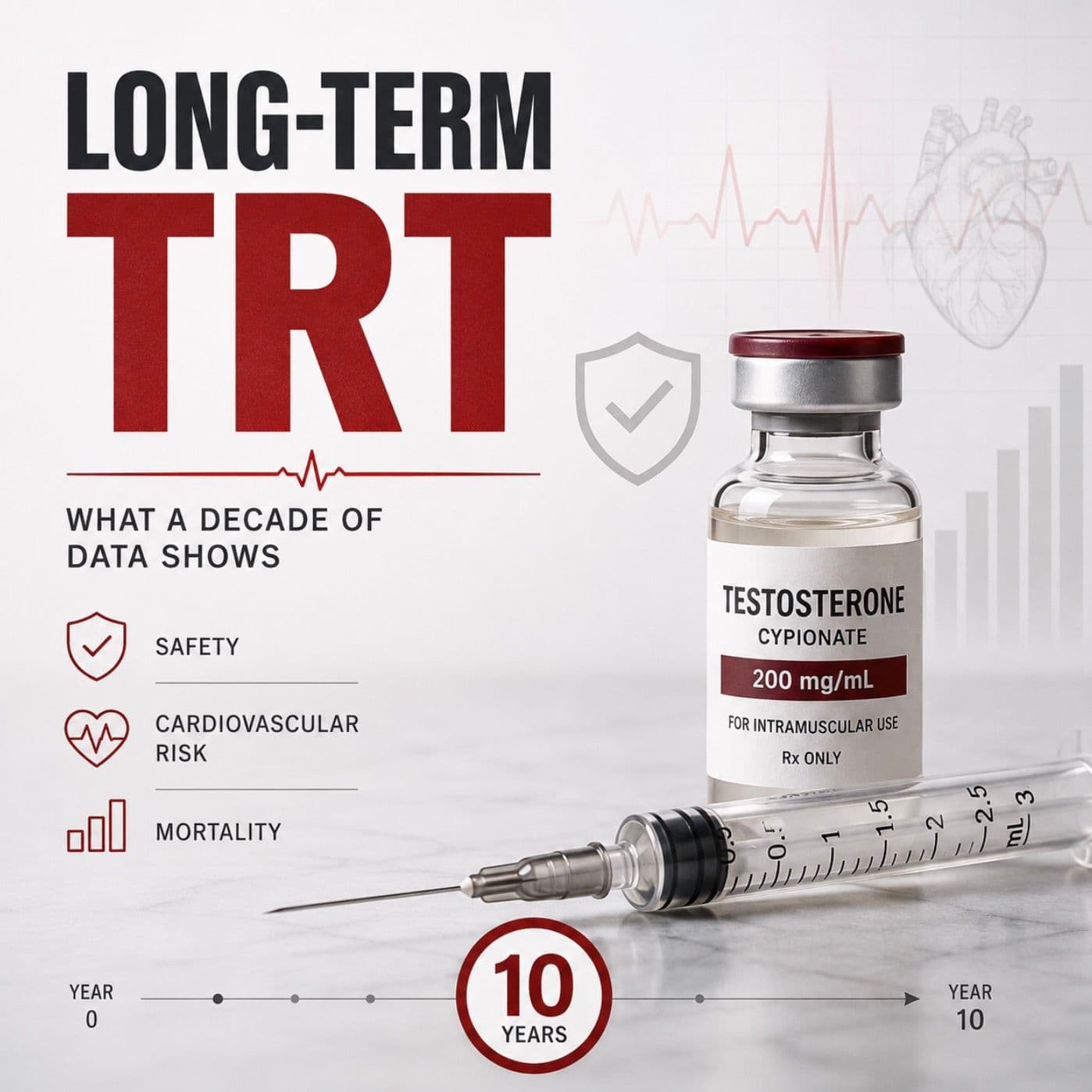
Long-Term TRT: What a Decade of Data Actually Shows About Safety, Cardiovascular Risk, and Mortality
Published on:
Updated on:
People are asking...
How long does using trt, or using full cycles take to from a blockage or, worsen a blockage of the heart?...
TRT does not increase risk of heart attack at all. In fact, it seems to reduce the risk TRT has been proven to lower cholesterol Long term TRT has been proven to cause significant reductions in sys... See Full Answer
My primary physician says it’s a bad idea to start TRT and she says she gets patients all the time who have long-term complications directly related t...
Men who abuse anabolic steroids certainly can experience long term complications. These men use testosterone at levels far higher than TRT doses. They also use drugs never meant for use in humans. I t... See Full Answer
I see people post on various threads on steroids and how they age substantially in a few years. Does TRT have similar effects or is that more hardcore...
For traditional TRT, aka non-bodybuilding levels of Testosterone, this is generally considered almost the opposite. Testosterone in men helps to maintain metabolism & low Testosterone often leads to i... See Full Answer
Have a question? Ask us.
At AlphaMD, we're here to help. Feel free to ask us any question you would like about TRT, medical weightloss, ED, or other topics related to men's health. Or take a moment to browse through our past questions.
For years, testosterone replacement therapy lived in a cloud of uncertainty, with clinicians and patients alike asking the same uncomfortable question: what happens when you stay on it for a decade or more? The answer, drawn from roughly ten years of accumulating clinical data, is more nuanced than either its strongest advocates or harshest critics would have you believe.
What "Long-Term" Actually Means in TRT Research
Testosterone replacement therapy has been prescribed for decades, but rigorous, long-duration follow-up studies are a relatively recent development. Most earlier trials ran for months, not years, which made it genuinely difficult to draw conclusions about sustained use. When researchers and clinicians talk about "long-term" data today, they generally mean studies following patients for five to fifteen years, either through randomized controlled trials, large registry analyses, or observational cohort studies.
The landmark TRAVERSE trial, published in 2023 and tracking outcomes over several years, represented one of the most significant steps forward in understanding cardiovascular safety. Combined with real-world registry data from Europe and the United States, the field now has a more complete picture than it did in 2015, when a wave of alarming observational studies briefly triggered regulatory scrutiny.
But here is what matters for interpreting any of this data: longer follow-up does not automatically mean cleaner answers. Study design, patient selection, and how outcomes are measured can shift conclusions dramatically.
The Cardiovascular Question That Would Not Go Away
No topic has generated more debate in TRT research than cardiovascular risk, specifically the risk of heart attack, stroke, and blood clots. The controversy has its roots in two observational studies from around 2013 and 2014 that suggested elevated risk in certain populations. Those findings triggered a wave of media coverage and a subsequent FDA label update requiring a warning about cardiovascular risk.
What followed was a decade of studies pulling in different directions. Some showed benefit, particularly in men with pre-existing cardiovascular disease and confirmed low testosterone. Others showed neutral effects. A handful raised concerns about specific subgroups, especially men with uncontrolled cardiovascular risk factors starting therapy.
The TRAVERSE trial, designed specifically to evaluate cardiovascular safety in men with hypogonadism and elevated cardiovascular risk, found that TRT was non-inferior to placebo for major adverse cardiovascular events. That was a meaningful result, because it came from a properly randomized, placebo-controlled trial rather than an observational dataset. The American Heart Association has acknowledged this evolving evidence while continuing to emphasize the importance of individualized risk assessment.
Venous thromboembolism, meaning blood clots in the deep veins or lungs, remains a legitimate monitoring concern. TRT can increase red blood cell production, which raises blood viscosity. For men who develop polycythemia on therapy, that elevation in hematocrit is associated with increased clotting risk. This is not a reason to avoid therapy across the board, but it is one of the clearest pharmacological mechanisms explaining why regular blood monitoring is a non-negotiable part of responsible long-term management.
What Observational Data Can and Cannot Prove
A significant portion of the ten-year dataset on TRT comes from observational research, which tracks real patients in real clinical settings. This type of research is invaluable for identifying signals and generating hypotheses, but it carries inherent limitations that are easy to overlook when reading a headline.
Two biases consistently distort findings in TRT observational studies. The first is healthy user bias: men who seek out and maintain TRT tend to be more health-conscious, more likely to exercise, and more likely to engage with preventive care than men who do not. This makes TRT users look healthier than average, potentially inflating apparent benefits.
The second is indication bias, which cuts the other way. Men prescribed TRT often have low testosterone because of underlying illness, obesity, metabolic syndrome, or aging-related decline. If researchers compare TRT users to the general male population without accounting for these baseline differences, the therapy group will appear sicker simply because they were sicker to begin with.
Randomized controlled trials eliminate much of this confounding by distributing risk factors evenly across groups. That is why TRAVERSE carries more weight than most prior observational analyses, and why researchers continue to call for longer and larger randomized datasets.
Mortality Outcomes: A Signal Worth Taking Seriously
Several large observational studies have found associations between clinically confirmed low testosterone and higher all-cause mortality in men. This does not automatically mean TRT extends life, but it does support the biological plausibility that correcting a deficiency in a key hormone could have meaningful systemic effects.
A registry analysis out of the United Kingdom, involving tens of thousands of men with hypogonadism, found lower mortality rates in men who received treatment compared to those who did not, after adjusting for multiple confounders. Similar patterns have emerged in data from veteran populations in the United States.
What these studies cannot prove is causation. Men who tolerate and maintain TRT for years may do so because they are healthier than those who discontinue. Discontinuation itself is often a marker of illness or poor health trajectory. Separating the effect of the therapy from the effect of the underlying health status of the person taking it remains one of the central methodological challenges in this field.
The honest clinical interpretation is this: long-term TRT in men with confirmed hypogonadism does not appear to increase all-cause mortality, and some data suggests it may be associated with reduced risk. That is meaningfully different from claiming it definitively extends life.
Why Baseline Risk and Population Differences Change Everything
Not every man on TRT faces the same risk profile, and one of the clearest lessons from a decade of data is that population differences matter enormously. A 45-year-old with well-controlled blood pressure, no prior cardiac events, and confirmed symptomatic hypogonadism occupies a very different risk category than a 68-year-old with prior myocardial infarction, sleep apnea, and poorly managed type 2 diabetes.
Age, severity of baseline testosterone deficiency, cardiovascular history, hematocrit trends, and comorbidities all interact with how a person responds to therapy and what risks they carry. This is why the Endocrine Society's clinical practice guidelines emphasize individualized assessment over blanket recommendations, and why the evidence does not support a one-size-fits-all conclusion.
Men who were most symptomatic and had the lowest pre-treatment testosterone levels consistently appear to derive the greatest functional and possibly the greatest cardiovascular benefit from treatment, while men with borderline low levels and milder symptoms show less consistent benefit across studies.
The Monitoring Framework That Separates Good Practice from Risky Practice
Long-term TRT without structured monitoring is a fundamentally different intervention than supervised therapy with regular clinical review. This distinction matters because many of the risks associated with long-term use are manageable when caught early.
Hematocrit elevation is the most consistently documented lab change requiring attention. As TRT stimulates red blood cell production, hematocrit can rise into ranges that increase blood viscosity and clotting risk. Clinicians managing long-term patients routinely check this and adjust accordingly, whether through dose modification, frequency changes, or therapeutic phlebotomy in select cases.
Blood pressure, lipid panels, and markers of metabolic health are also part of responsible ongoing monitoring, as TRT can affect each of these in ways that compound or mitigate baseline cardiovascular risk. Sleep apnea screening matters because TRT can worsen existing sleep apnea, and untreated sleep apnea is independently associated with cardiovascular risk.
For men who want to preserve fertility, the picture requires additional consideration. TRT suppresses the body's own signaling to the testes, reducing sperm production. Human chorionic gonadotropin, or HCG, is often used alongside or instead of TRT in men who wish to maintain fertility, as it mimics the pituitary signal that keeps the testes active. This is not a minor footnote, it is an important part of the conversation for any man of reproductive age starting therapy.
Prostate-specific antigen monitoring continues to be part of standard care, particularly in older men, though the long-standing fear that TRT causes prostate cancer has not been supported by the decade of evidence that has accumulated. Most guidelines now support monitoring without treating TRT as a prostate cancer risk driver per se.
When Caution Is the Clinically Correct Position
Clinicians are most guarded about TRT initiation in men with a recent history of major cardiovascular events, poorly controlled polycythemia vera, untreated severe sleep apnea, or active prostate concerns pending evaluation. These are not necessarily permanent contraindications, but they are reasons to stabilize other conditions first and approach therapy with careful sequencing.
Men with multiple overlapping risk factors benefit most from specialist oversight, whether from an endocrinologist, urologist with hormone expertise, or a dedicated men's health clinic with longitudinal monitoring capabilities. The goal is not to gatekeep access but to ensure that the decision is made with full awareness of baseline risk and a plan for managing what emerges over time.
A Decade of Data, A Clearer But Incomplete Picture
Ten years of more rigorous long-term TRT research has moved the field from "we genuinely do not know" toward "we have a reasonable signal that properly monitored therapy in appropriate candidates carries manageable risk." That is meaningful progress, even if it falls short of the certainty that patients and clinicians both want.
What the data increasingly supports is that the blanket alarm of the early 2010s was overstated, and the blanket reassurance offered by some direct-to-consumer platforms is equally incomplete. The truth sits in the clinical detail: who the patient is, what their baseline risk looks like, how carefully they are monitored, and whether therapy is adjusted over time based on lab trends and symptoms.
For men who are considering or currently navigating long-term testosterone therapy, working with a provider who understands the evidence, orders the right follow-up, and adjusts care based on individual response is the single most important factor in managing risk well. AlphaMD specializes in exactly this kind of medically supervised hormone optimization, combining physician oversight with ongoing monitoring so that long-term therapy stays grounded in evidence rather than guesswork.
Have a question? Ask us.
At AlphaMD, we're here to help. Feel free to ask us any question you would like about TRT, medical weightloss, ED, or other topics related to men's health. Or take a moment to browse through our past questions.
People are asking...
How long does using trt, or using full cycles take to from a blockage or, worsen a blockage of the heart?...
TRT does not increase risk of heart attack at all. In fact, it seems to reduce the risk TRT has been proven to lower cholesterol Long term TRT has been proven to cause significant reductions in sys... See Full Answer
My primary physician says it’s a bad idea to start TRT and she says she gets patients all the time who have long-term complications directly related t...
Men who abuse anabolic steroids certainly can experience long term complications. These men use testosterone at levels far higher than TRT doses. They also use drugs never meant for use in humans. I t... See Full Answer
I see people post on various threads on steroids and how they age substantially in a few years. Does TRT have similar effects or is that more hardcore...
For traditional TRT, aka non-bodybuilding levels of Testosterone, this is generally considered almost the opposite. Testosterone in men helps to maintain metabolism & low Testosterone often leads to i... See Full Answer
Get $30 off your first month’s order
Enter your email address now to receive $30 off your first month’s cost, other discounts, and additional information about TRT.
Legal Disclaimer
This website is a repository of publicly available information and is not intended to form a physician-patient relationship with any individual. The content of this website is for informational purposes only. The information presented on this website is not intended to take the place of your personal physician's advice and is not intended to diagnose, treat, cure, or prevent any disease. Discuss this information with your own physician or healthcare provider to determine what is right for you. All information is intended for your general knowledge only and is not a substitute for medical advice or treatment for specific medical conditions. The information contained herein is presented in summary form only and intended to provide broad consumer understanding and knowledge. The information should not be considered complete and should not be used in place of a visit, phone or telemedicine call, consultation or advice of your physician or other healthcare provider. Only a qualified physician in your state can determine if you qualify for and should undertake treatment.