
How To Treat Low Testosterone In Females: What You Need To Know
Published on:
Updated on:
People are asking...
Do you treat women with low t? If so what is a common starting dosage and frequency?...
Yes — licensed providers on the AlphaMD platform treat women with low testosterone. We plan on making an update on our home page soon to better show this because we've had so much interest lately. Pri... See Full Answer
How can I get info on getting my wife some blood work and possibly on hrt? Aside from testosterone, do you also deal with estrogen?...
Generally you would meet with your PCP & talk about her symptoms, then based on those run normal labs to see where she sits & where TRT might help. If you mean with us, then just scheduling a consulta... See Full Answer
Do you treat women? And would admitting I've been taking small amounts [10-20mgs/week IM] of my bf's Test (and getting great results) be a barrier to...
Providers on the AlphaMD platform currently care for female patients on similar low doses to optimize their hormones. They typically need a bit of Estrogen to keep everything in balance as well as the... See Full Answer
Have a question? Ask us.
At AlphaMD, we're here to help. Feel free to ask us any question you would like about TRT, medical weightloss, ED, or other topics related to men's health. Or take a moment to browse through our past questions.
Testosterone is often framed as a male hormone, but in women, it quietly drives libido, energy, mood, and muscle health every single day. When levels fall too low, the effects can be wide-ranging and frustrating — and they are frequently mistaken for something else entirely.
Why Testosterone Matters More Than Most Women Realize
Testosterone is produced in the female body by the ovaries, the adrenal glands, and peripheral tissues such as skin and fat. While women carry far lower concentrations than men, those lower concentrations are biologically meaningful. According to the Cleveland Clinic, testosterone contributes to libido, bone and muscle health, mood regulation, energy levels, and even normal menstrual cycles.
Think of it less as a "sex hormone" and more as a general maintenance hormone. When it dips below what the body needs, several systems can feel the disruption at once.
Levels naturally begin to decline in a woman's 30s. By the time menopause arrives, testosterone may be roughly half of what it was in younger years. That gradual decline is normal, but for some women, the drop is sharper or faster, and the resulting symptoms interfere with daily life.
The Symptoms Are Real, But They Are Easy to Miss
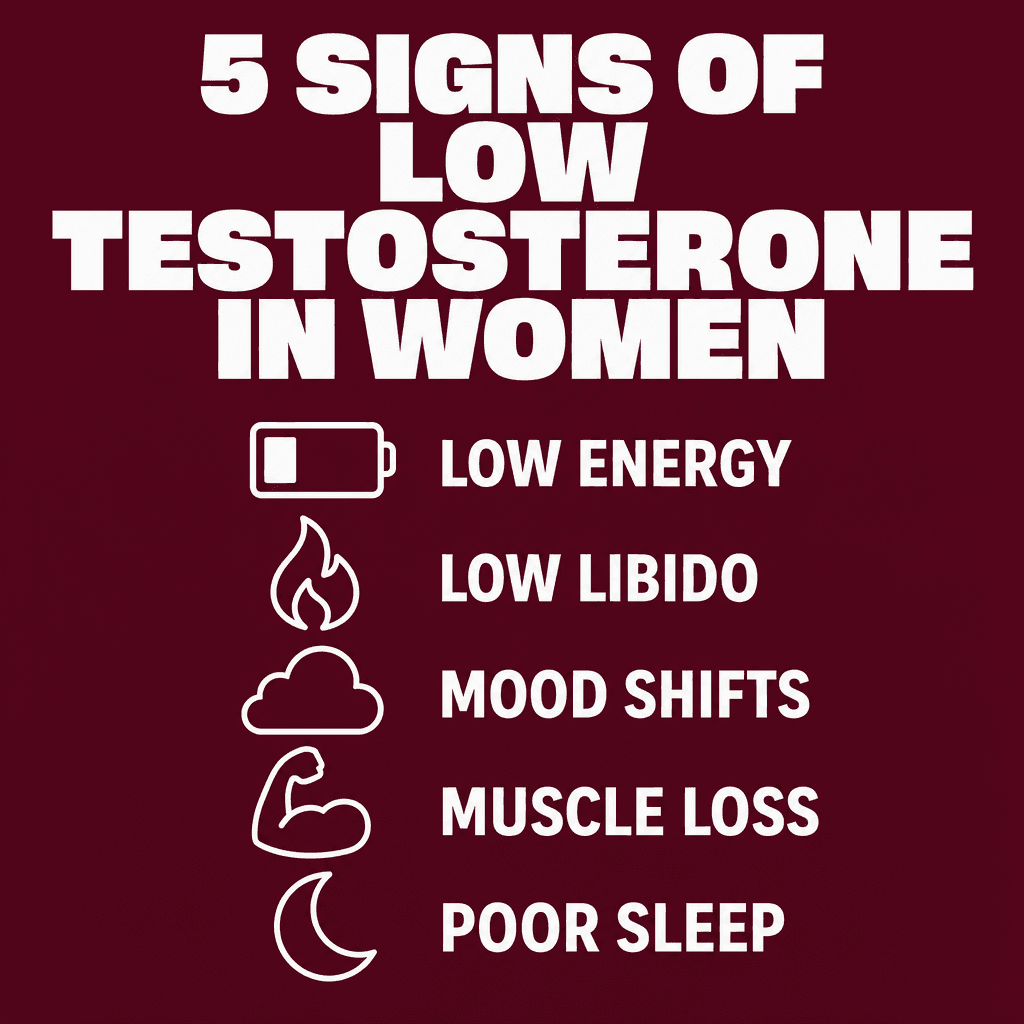
Low testosterone in women does not look the same from person to person. The symptom picture can be subtle at first, then gradually more noticeable. Common complaints include:
Persistent fatigue that does not improve with rest. Low sex drive, specifically a loss of interest that feels different from ordinary stress. Reduced muscle tone and increased difficulty building or maintaining strength. Vaginal dryness. Irregular menstrual cycles. Low mood, mild anxiety, or a flattened emotional range. Thinning hair. Dry or brittle skin. Difficulty sleeping.
The challenge is that none of these symptoms are exclusive to low testosterone. They overlap significantly with thyroid disorders, iron-deficiency anemia, clinical depression, perimenopause, and chronic sleep disruption. This overlap is one reason low testosterone in women is frequently underdiagnosed or misattributed.
A clinician working through this picture will rarely point to testosterone first. More often, they will rule out the more common culprits before considering androgen-related causes.
What Can Drive Testosterone Too Low
The most common cause is time. Natural aging, particularly the transition through perimenopause and menopause, reduces ovarian hormone output across the board, including testosterone.
Surgical removal of the ovaries (oophorectomy) produces a more abrupt drop, since the ovaries are a primary production site. Women who undergo this surgery often notice the effects quickly.
Beyond those two, the causes become more varied. Adrenal insufficiency (Addison's disease), ovarian insufficiency, hyperprolactinemia (elevated prolactin from a pituitary tumor), and Turner syndrome can all reduce androgen output. Chemotherapy and pelvic radiation can damage hormone-producing tissue. Malnutrition and significant energy deficiency, as seen in eating disorders or extreme athletic training, suppress the hormonal axis broadly.
Medications are worth particular attention. Hormonal contraceptives, oral estrogen therapy, corticosteroids, antiandrogens, and opioids have all been linked to reductions in testosterone in women. If a patient recently started any of these and symptoms appeared around the same time, that connection deserves a clinical conversation.
How a Clinician Evaluates This
Diagnosis is not straightforward. The Endocrine Society's clinical practice guideline on androgen therapy in women recommends against diagnosing a formal "androgen deficiency syndrome" in women, because there is no well-defined clinical syndrome and no reliable correlation between testosterone lab values and specific symptoms.
That does not mean testing is useless. It means context matters.
A thorough evaluation begins with history: symptom onset, duration, severity, menstrual history, relevant medications, recent stress or illness, and the degree to which symptoms are causing personal distress. A clinician will also assess for conditions that mimic low testosterone, ordering thyroid panels, a complete blood count for anemia, and relevant metabolic markers.
When testosterone testing is ordered, timing matters. Levels fluctuate throughout the day and across the menstrual cycle, and current assays were largely developed and validated for male reference ranges, making them imprecise at the lower levels typical of women. Clinicians may look at both total testosterone and sex hormone binding globulin (SHBG), because SHBG binds to testosterone in the bloodstream and can affect how much is biologically available. Free testosterone tests exist but carry their own accuracy limitations at female-range concentrations.
The picture that emerges is one of clinical judgment, not a simple "your number is too low" conclusion.
Treatment: When It Is Appropriate and What It Involves
Not every woman with low testosterone needs treatment. The strongest and most consistent evidence supports testosterone therapy for women specifically in postmenopausal women experiencing Hypoactive Sexual Desire Disorder (HSDD), a condition defined by low sexual desire that causes personal distress and is not explained by another cause.
A 2019 Global Consensus Position Statement, cited by the Mayo Clinic, supports this use and has been endorsed by the International Menopause Society. Multiple professional societies agree that carefully monitored testosterone therapy is a reasonable option for this population.
It is worth noting clearly: the FDA has not approved any testosterone product specifically for women in the United States. All prescribing is off-label, which is legally permissible when clinical evidence and professional judgment support it. This regulatory reality makes careful provider selection particularly important.
When therapy is considered, delivery method matters. Transdermal routes such as gels, creams, and patches are generally preferred because they have a more favorable effect on the liver and cholesterol compared to oral forms. Oral testosterone is discouraged due to potential liver effects and negative impact on HDL ("good") cholesterol. Pellets and intramuscular injections are also generally discouraged in women, because they can push levels too high unpredictably, potentially causing acne, excess hair growth, voice changes, or other androgen-excess effects.
Compounded testosterone preparations, while sometimes prescribed, carry additional concerns. Because they are not FDA-regulated, batch-to-batch variation in potency and purity can make consistent dosing difficult.
When testosterone replacement therapy is initiated appropriately, some women notice improvements in sexual symptoms within four weeks, with maximum benefit typically seen around 12 weeks. If no meaningful improvement occurs after six months, most clinicians will recommend discontinuing therapy and reassessing.
Testosterone therapy is contraindicated in women with heart disease, blood vessel disease, liver disease, or a personal history of breast or uterine cancer. These are hard stops, not considerations to negotiate.
Monitoring, Side Effects, and Why Self-Medicating Is Risky
Regular monitoring is not optional when testosterone therapy is part of the picture. Hormone levels should be checked roughly every six months to ensure they remain in a physiologically appropriate range and have not climbed into supraphysiological territory.
The side effects of excess testosterone are real and can include acne, increased facial or body hair, scalp hair thinning in a male pattern, voice deepening, and clitoral enlargement. Some of these changes can be irreversible if levels run high for too long without correction.
This is exactly why self-medicating with over-the-counter DHEA (dehydroepiandrosterone) supplements carries risk. DHEA is a precursor that the body can convert into testosterone, and it is widely available without a prescription. However, it is not regulated by the FDA for safety or efficacy in women, potency varies between products, and the clinical evidence for its effectiveness is limited. Taking it without supervision means no one is tracking whether levels are moving in the right direction or going too far.
The same concern applies to testosterone products purchased outside of a medical setting. Without baseline labs, monitoring, and provider oversight, there is no safety net.
Myths Worth Correcting
One persistent myth is that testosterone therapy is inherently too dangerous for women. The evidence does not support that blanket conclusion. For the right candidate, with the right delivery method, under appropriate monitoring, it carries a manageable risk profile. The key phrase is "appropriate monitoring."
Another myth is that low libido in women is almost always a testosterone problem. It frequently is not. Female sexual dysfunction has many contributing factors: vaginal dryness, medication side effects, relationship dynamics, stress, mood concerns, and prior trauma can all suppress desire independently of hormone levels. Treating testosterone without addressing these other factors often produces disappointing results. A comprehensive evaluation is not a detour — it is the point.
Finally, some women assume that if one hormone specialist dismissed their symptoms, testosterone is off the table entirely. In reality, clinical understanding of female androgens continues to evolve, and a second opinion from a provider experienced in women's hormonal health is always reasonable.
Lifestyle Foundations That Support Hormonal Health
Medical treatment is only one piece of the picture. Several lifestyle factors can meaningfully support the hormonal environment and amplify the benefit of any medical care.
Strength training and resistance exercise support testosterone production and help preserve the muscle and bone density that low testosterone can erode. Adequate sleep, meaning consistent, quality rest, is one of the most powerful regulators of the entire hormonal axis. Chronic sleep deprivation disrupts cortisol, thyroid function, and sex hormones simultaneously.
Nutrition matters too. Severe calorie restriction or protein deficiency signals the body to conserve resources, and hormonal output is often the first casualty. Eating enough — and enough of the right things — is not optional for hormonal health.
Stress management rounds out the picture. Chronically elevated cortisol competes with sex hormone production pathways. Practices that reduce the physiological stress burden, whether that means exercise, adequate downtime, therapy, or connection, create a better internal environment for hormonal balance.
None of these replace medical evaluation, but all of them complement it.
What to Expect From a Telehealth Evaluation
For many women, accessing a hormonal health clinician has historically required significant time and effort. Telehealth has changed that meaningfully.
A telehealth evaluation for possible low testosterone typically begins with a detailed intake covering symptom history, medical and surgical history, current medications, and reproductive history. The provider will often direct you to a local lab for baseline blood work before your appointment or immediately following an initial consultation.
Once labs are reviewed, the clinician discusses findings in the context of your symptoms, not just the numbers in isolation. If therapy is considered appropriate, they will explain delivery options, monitoring expectations, and what to watch for in terms of both benefit and side effects.
Follow-up is built into the process, not an afterthought. Lab rechecks, symptom reassessment, and dosage adjustments happen over time. A provider who offers testosterone therapy without a clear monitoring plan is a provider worth reconsidering.
Taking the Next Step Thoughtfully
Low testosterone in women is a legitimate clinical concern that deserves to be taken seriously — and evaluated carefully. The symptoms are real, the causes are varied, and the treatment options, while limited by current FDA approvals, do include evidence-based approaches for the right candidates.
If you recognize yourself in what you have read here, the most productive next step is a conversation with a qualified clinician who has genuine experience in women's hormonal health. Through platforms like AlphaMD, a telehealth evaluation with an experienced provider is within reach, along with the kind of ongoing monitoring that responsible hormone care requires.
Understanding your own biology is the foundation. Professional guidance is what makes acting on that understanding safe.
Have a question? Ask us.
At AlphaMD, we're here to help. Feel free to ask us any question you would like about TRT, medical weightloss, ED, or other topics related to men's health. Or take a moment to browse through our past questions.
People are asking...
Do you treat women with low t? If so what is a common starting dosage and frequency?...
Yes — licensed providers on the AlphaMD platform treat women with low testosterone. We plan on making an update on our home page soon to better show this because we've had so much interest lately. Pri... See Full Answer
How can I get info on getting my wife some blood work and possibly on hrt? Aside from testosterone, do you also deal with estrogen?...
Generally you would meet with your PCP & talk about her symptoms, then based on those run normal labs to see where she sits & where TRT might help. If you mean with us, then just scheduling a consulta... See Full Answer
Do you treat women? And would admitting I've been taking small amounts [10-20mgs/week IM] of my bf's Test (and getting great results) be a barrier to...
Providers on the AlphaMD platform currently care for female patients on similar low doses to optimize their hormones. They typically need a bit of Estrogen to keep everything in balance as well as the... See Full Answer
Get $30 off your first month’s order
Enter your email address now to receive $30 off your first month’s cost, other discounts, and additional information about TRT.
Legal Disclaimer
This website is a repository of publicly available information and is not intended to form a physician-patient relationship with any individual. The content of this website is for informational purposes only. The information presented on this website is not intended to take the place of your personal physician's advice and is not intended to diagnose, treat, cure, or prevent any disease. Discuss this information with your own physician or healthcare provider to determine what is right for you. All information is intended for your general knowledge only and is not a substitute for medical advice or treatment for specific medical conditions. The information contained herein is presented in summary form only and intended to provide broad consumer understanding and knowledge. The information should not be considered complete and should not be used in place of a visit, phone or telemedicine call, consultation or advice of your physician or other healthcare provider. Only a qualified physician in your state can determine if you qualify for and should undertake treatment.