
How to Dispose of TRT Needles and Syringes Safely
Published on:
Updated on:
People are asking...
The pharmacy recently messed up my script. I was supposed to get a 10ml vile of 200mg cypionate, and it was supposed to be for .50ml (100mg a week). T...
The manufacturing of single use vials and multi-use vials is the same. Each puncture of a vial does increase the risk of contamination, so all vials regardless of size are supposed to be discarded aft... See Full Answer
For someone who is new to this topic, yet interested in TRT if needed, would a pill or topical form be a reliable method of TRT? I have no experienc...
In general oral medications tend to be the least successful with the most amount of side effects. Topical or injectable medications are more direct applications of Testosterone & much better for bene... See Full Answer
What needle do you recommend for subq? I do 140mg of text cyp a week and want to move from once a week to 3 times a week...
In general, a 1ml (100 unit) insulin SQ syringe and needle combination is most popular. Providers typically recommend 27-29g sized needles, but if you have a preference, mention it to the provider ove... See Full Answer
Have a question? Ask us.
At AlphaMD, we're here to help. Feel free to ask us any question you would like about TRT, medical weightloss, ED, or other topics related to men's health. Or take a moment to browse through our past questions.
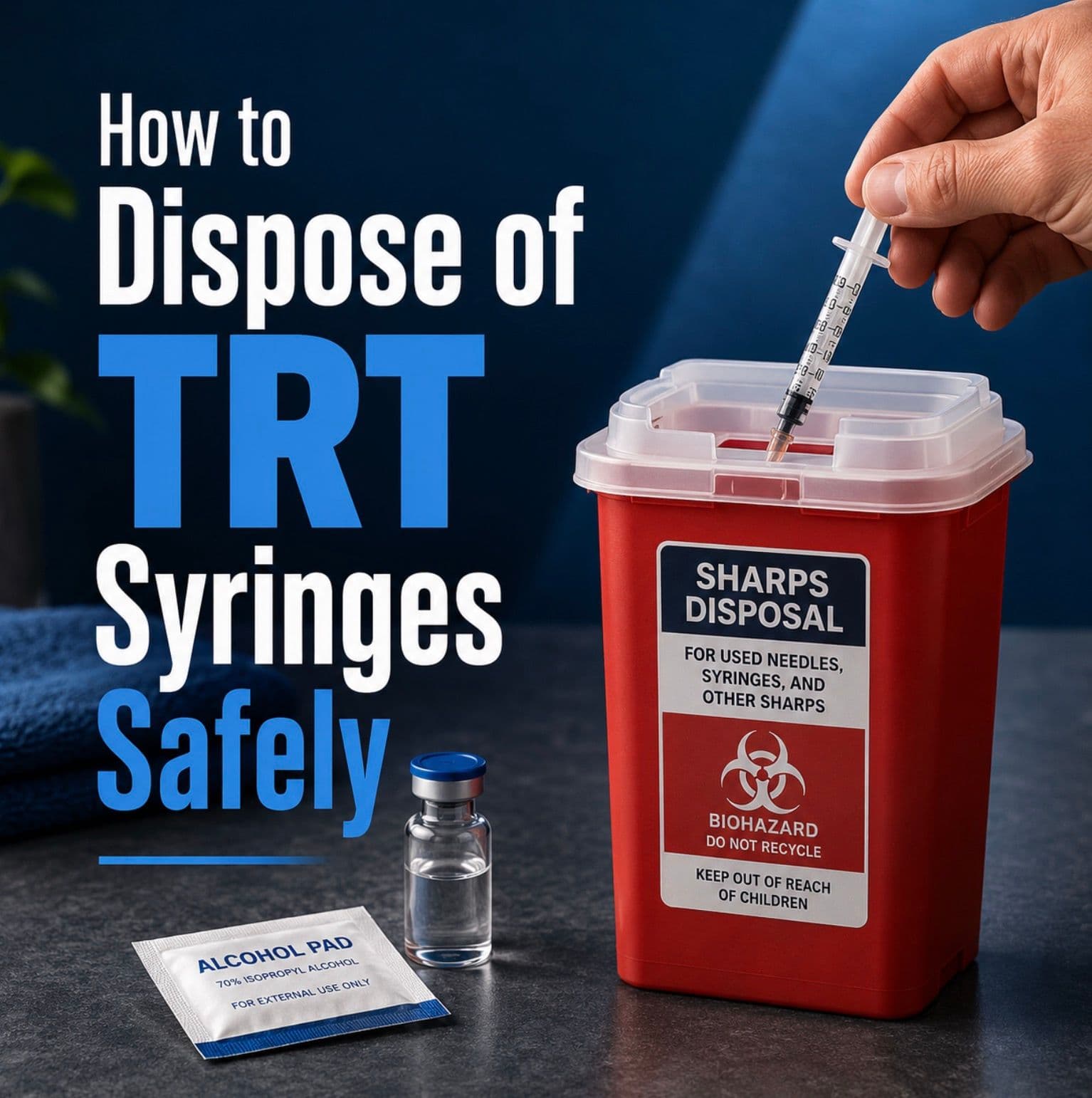
The safest way to dispose of TRT needles and syringes is to place them immediately into an FDA-cleared sharps disposal container. Do not recap, bend, break, remove, recycle, flush, or throw away loose needles. Once the container reaches its fill line, seal it and follow the sharps disposal requirements for your state and local community.
For many men, testosterone replacement therapy involves regularly administering injections at home. Learning how to dispose of the needles, syringes, medication vials, and other supplies properly is an important part of using injectable testosterone safely.
Loose or improperly discarded needles can cause accidental needlestick injuries involving family members, sanitation workers, recycling employees, housekeepers, and pets. Because household sharps disposal requirements vary by state and municipality, the final disposal method depends on where you live.
What Counts as Sharps Waste From TRT?
Sharps are medical items capable of cutting or puncturing the skin. TRT-related sharps may include:
- Injection needles
- Syringes with attached needles
- Drawing needles
- Lancets used for blood testing
- Pen needles, when applicable
- Broken medication vials or ampules
- Full needle-clipping or needle-destruction devices
Even very small or retractable needles should be treated as sharps. They should never be placed loose in household trash, recycling bins, toilets, or plastic bags.
Items such as alcohol pads, adhesive bandages, cotton balls, gauze, wrappers, and needle caps generally do not need to go into a sharps container unless a needle is attached or local rules classify them differently.
How to Dispose of TRT Needles and Syringes
The FDA recommends a two-step process for disposing of needles and other sharps used at home.
Step 1: Place the Needle and Syringe Directly Into a Sharps Container
Immediately after your testosterone injection, place the complete syringe and attached needle into an FDA-cleared sharps disposal container.
Amazon offers many sharps disposal containers in different sizes. Look for a puncture-resistant container specifically designed for medical sharps and described by its manufacturer as FDA-cleared. You can buy one here.
Do not:
- Recap the needle
- Bend or break the needle
- Remove the needle by hand
- Attempt to clean or reuse the syringe
- Leave the needle sitting on a counter
- Place it loose inside a plastic bag
- Put it directly into household trash
Keeping the needle attached to the syringe reduces unnecessary handling and helps lower the risk of an accidental needlestick.
Place your sharps container within easy reach before beginning your injection. Keep it upright, stable, and out of reach of children and pets.
Step 2: Seal and Dispose of the Full Container
Do not overfill your sharps container. FDA-cleared containers generally have a marked fill line showing when they should be closed and replaced. Overfilling increases the risk of needles protruding from the opening or injuring someone handling the container.
When the container reaches its fill line:
- Lock or tightly secure the lid.
- Do not reopen, empty, or reuse the container.
- Follow the disposal rules for your state and community.
- Never put the container into recycling.
Some containers may include temporary and permanent closure settings. Follow the manufacturer’s instructions to make sure the container is permanently sealed before disposal.
Can TRT Syringes Go in Household Trash?
Never place loose needles or syringes directly into household trash.
Some communities allow residents to place a sealed and properly labeled sharps container in household trash. Other communities require sharps to be taken to an approved collection site or managed through a mail-back, hazardous-waste, or special-pickup program.
Do not assume household trash disposal is permitted simply because it is allowed in another state. Household sharps requirements are generally established at the state and local levels.
Before placing a sealed container in household trash, check with:
- Your state health department
- Your state environmental agency
- Your city or county waste department
- Your household trash provider
- A local pharmacy or hospital
- A community sharps disposal program
SafeNeedleDisposal.org provides state-specific instructions, responsible agency information, and community drop-off locations. Individual facilities should be contacted before visiting to confirm their current hours and acceptance requirements.
Where Can You Take a Full Sharps Container?
Available disposal options depend on where you live. Common options include the following.
Pharmacy, Hospital, or Clinic Drop-Off
Some pharmacies, hospitals, health departments, medical offices, police stations, fire stations, and medical-waste facilities accept sealed household sharps containers.
Acceptance is not universal. Call before visiting and ask:
- Whether household sharps are accepted
- Whether a specific container is required
- Whether there is a disposal fee
- When drop-off is available
- Whether proof of residency is required
Do not leave a sharps container outside a facility or place it in an ordinary public trash can.
Household Hazardous-Waste Collection
Some communities accept used needles through household hazardous-waste facilities or scheduled collection events.
Local programs may have specific requirements for the type of container, labeling, closure, and maximum amount accepted.
Sharps Mail-Back Programs
Mail-back programs provide an approved sharps container and shipping materials. Once full, the container is mailed to an authorized disposal facility.
These programs usually charge a fee and may require specific packaging, labeling, and shipping procedures. Only use a mail-back service designed specifically for medical sharps.
Certain FDA-cleared sharps containers may be eligible for mail-back programs, but not every container can be mailed.
Residential Medical-Waste Pickup
Some municipal or private waste companies provide scheduled household medical-waste pickup.
Availability, costs, container requirements, and pickup schedules vary by location.
Community Collection Programs
Some communities offer permanent or temporary sharps collection locations. These may be operated by health departments, public-safety agencies, pharmacies, hospitals, or waste-management authorities.
Search by state or ZIP code before visiting and confirm that the location accepts household-generated sharps.
What Can You Use Without a Sharps Container?
An FDA-cleared sharps disposal container is the preferred option because it is designed to be puncture-resistant, leak-resistant, stable, and securely closable.
When an FDA-cleared container is not immediately available, the FDA says a heavy-duty plastic household container may sometimes be used as an alternative. State and local rules should be checked before choosing or disposing of a substitute container.
A possible alternative could include an empty:
- Laundry detergent bottle
- Bleach bottle
- Windshield-washer fluid bottle
- Heavy-duty plastic cat-litter container
The container should be:
- Made from thick, puncture-resistant plastic
- Leak-resistant on the sides and bottom
- Able to remain upright during use
- Equipped with a tight-fitting, puncture-resistant lid
- Clearly labeled “SHARPS” or “DO NOT RECYCLE”
Do not use:
- Water bottles
- Soda bottles
- Milk jugs
- Glass jars
- Coffee cans with easily removable lids
- Cardboard boxes
- Plastic bags
- Food-storage containers made from thin plastic
Thin containers can be punctured by needles and may not remain securely closed.
Should You Recap a Testosterone Needle?
No. Do not recap a used testosterone needle.
Attempting to guide a small needle back into its cap creates an unnecessary risk of accidentally puncturing your hand or finger. The safer approach is to place the complete needle and syringe directly into the sharps container immediately after the injection.
Prepare for disposal before injecting by placing the sharps container close enough to reach without walking around with an exposed needle.
Should You Remove the Needle From the Syringe?
Generally, no.
Place the connected needle and syringe into the sharps container as one unit. Removing the needle creates additional handling and increases the chance of an accidental needlestick.
Do not bend, break, clip, or manually separate a used needle unless you are using a device designed for that purpose and its use is permitted under your local disposal rules.
Can Used TRT Needles Be Recycled?
No. Used needles, syringes, lancets, and sharps containers should never be placed in a recycling bin.
These items are not accepted as ordinary recyclable plastic. Sharps can puncture recycling bags, become caught in sorting equipment, and injure employees at recycling facilities.
This remains true even when the syringe or sharps container is made from a recyclable type of plastic.
Can You Flush Needles Down the Toilet?
No. Never flush needles, syringes, lancets, or other sharps down a toilet.
Needles can become lodged in plumbing, damage wastewater equipment, enter the environment, or expose sanitation workers to an accidental puncture.
How Should You Dispose of Testosterone Vials?
The proper disposal method depends on whether the vial is empty, contains unused medication, or is broken.
Empty, Unbroken Testosterone Vials
An empty and unbroken medication vial is not normally considered a sharp. However, medication-container disposal rules may vary.
Keep empty vials separate from used needles unless your local program specifically instructs you to place them in the sharps container. Do not recycle medication glass unless your local recycling authority confirms that it is accepted.
Vials Containing Unused Testosterone
Do not pour unused testosterone down a sink or toilet.
Testosterone is a prescription medication and a federally controlled substance. Contact your pharmacy, dispensing service, licensed medical provider, local drug take-back program, or waste authority for disposal instructions.
Not every take-back site accepts injectable medications, liquid medications, or controlled substances in vials. Call the location before visiting.
Broken Testosterone Vials
Broken glass can puncture the skin and should be treated as a sharp.
Do not pick up broken vial pieces with your bare hands. Use tongs, a brush and dustpan, or another tool to collect the glass. Place the pieces in a puncture-resistant container according to local waste requirements.
What About Alcohol Pads, Gauze, and Bandages?
For most people administering TRT at home, lightly used alcohol pads, cotton balls, gauze, adhesive bandages, wrappers, gloves, and needle caps can generally go into household trash unless local rules say otherwise.
Before disposal:
- Confirm that no needle is attached.
- Place materials with visible blood inside a sealed bag.
- Keep discarded materials away from children and pets.
- Follow local rules for items heavily saturated with blood.
Do not fill your sharps container with ordinary wrappers, gauze, alcohol pads, gloves, or other non-sharp waste. The CDC advises reserving sharps containers for items that can cut or puncture the skin.
How to Store a Sharps Container at Home
Place the sharps container near the location where you normally administer your testosterone injections, but keep it inaccessible to children, visitors, and pets.
The container should remain:
- Upright
- Stable
- Dry
- Below eye level when possible
- Away from food-preparation areas
- Away from high-traffic surfaces
- Closed when it is not being used
Do not keep it on the floor or in a location where it could easily be knocked over.
Avoid storing the container underneath other objects that would have to be moved while you are holding an exposed needle.
How to Dispose of TRT Needles While Traveling
Bring a compact, travel-size sharps container when traveling with injectable testosterone. FDA-cleared sharps containers are available in several sizes, including smaller containers designed for travel.
Do not leave used needles in:
- Hotel trash cans
- Airplane seat pockets
- Rental vehicles
- Public-restroom trash cans
- Plastic bags
- Medication cases without a sharps compartment
Before traveling:
- Keep your medication in its original labeled packaging.
- Carry essential injection supplies in your carry-on luggage.
- Bring a travel-size sharps container.
- Check current TSA and airline requirements.
- Research disposal options at your destination.
- Keep used needles sealed in the sharps container until they can be disposed of properly.
Do not attempt to pass through airport security with a loose or exposed used needle.
What Should You Do After an Accidental Needlestick?
Wash the affected area promptly with soap and water. Do not aggressively squeeze, scrub, or cut the puncture wound.
Contact a medical professional for guidance, particularly when:
- The needle belonged to someone else.
- You do not know who used the needle.
- The needle was found in a public place.
- The puncture was deep.
- Blood or another biological material was present.
- Your tetanus vaccination status is uncertain.
Prompt disposal of needles in an appropriate sharps container is one of the most effective ways to reduce preventable needlestick injuries.
TRT Needle Disposal Rules Vary by State
There is no single household sharps disposal rule that applies identically throughout the United States.
Depending on your state and local community, you may be instructed to:
- Use an FDA-cleared sharps container
- Use an approved heavy-duty plastic substitute
- Apply a specific warning label
- Tape or permanently secure the lid
- Bring the container to a designated drop-off site
- Use a mail-back program
- Schedule special-waste pickup
- Place the sealed container in household trash
- Avoid household trash disposal completely
City, county, apartment-building, and private waste-provider requirements may be more specific than statewide guidance. Follow the most specific rule that applies to your home.
The Safe Needle Disposal state directory can help you find guidance and nearby collection options for your location.
TRT Sharps Disposal Checklist
After every testosterone injection:
- Place the used needle and syringe directly into a sharps container.
- Do not recap, remove, bend, or break the needle.
- Keep the container upright and securely stored.
- Stop using it when it reaches the marked fill line.
- Lock or permanently seal the lid.
- Never place loose sharps in household trash.
- Never put sharps or sharps containers in recycling.
- Never flush needles or syringes.
- Check state and local disposal requirements.
- Use an approved drop-off, pickup, mail-back, hazardous-waste, or permitted household-trash option.
Frequently Asked Questions
What is the safest way to dispose of TRT needles?
Immediately place the complete used needle and syringe into an FDA-cleared sharps disposal container. Do not recap or separate the needle. When the container reaches its fill line, permanently seal it and follow the disposal requirements for your state and local community.
Can I put testosterone needles in the garbage?
Never put loose testosterone needles in household garbage. Some communities allow a sealed and properly labeled sharps container to be placed in household trash, while others require drop-off, pickup, hazardous-waste, or mail-back disposal.
Can I use a laundry detergent bottle for TRT needles?
Some state and local authorities allow a heavy-duty plastic detergent bottle as a temporary alternative. It should be puncture-resistant, leak-resistant, stable, tightly closable, and clearly labeled. An FDA-cleared sharps container remains the preferred option.
Can I put a sharps container in recycling?
No. Used sharps and sharps disposal containers should never be placed in a recycling bin, even when the container is made from plastic.
Should I recap my testosterone needle after injecting?
No. Recapping creates an avoidable risk of accidentally puncturing your hand. Place the complete needle and syringe directly into the sharps container.
Should the needle be removed from the syringe?
Generally, no. Dispose of the connected syringe and needle as one unit to reduce handling and the risk of a needlestick injury.
Can I throw away an empty testosterone vial?
An empty and unbroken vial may be accepted in household trash in some locations, but local rules vary. Do not dispose of a vial containing unused testosterone without first checking medication-disposal requirements.
Where can I find a sharps disposal location near me?
Contact local pharmacies, hospitals, health departments, waste providers, and household hazardous-waste programs. You can also search SafeNeedleDisposal.org by state or ZIP code for guidance and community drop-off locations.
The Bottom Line
The safest way to dispose of TRT needles is to place every used needle and syringe directly into an FDA-cleared sharps disposal container without recapping, bending, or separating the needle.
Once the container reaches its fill line, permanently seal it and use a disposal method approved in your community. Depending on your location, that may involve a pharmacy or hospital drop-off, household hazardous-waste facility, community collection program, mail-back service, special pickup, or permitted household-trash disposal.
Never place loose needles in household trash, recycling bins, toilets, hotel wastebaskets, or public garbage containers.
This article is provided for general educational purposes and does not replace state or local waste-disposal requirements. Contact your state health department, environmental agency, local waste authority, pharmacy, or trash provider for instructions applicable to your location.
Have a question? Ask us.
At AlphaMD, we're here to help. Feel free to ask us any question you would like about TRT, medical weightloss, ED, or other topics related to men's health. Or take a moment to browse through our past questions.
People are asking...
The pharmacy recently messed up my script. I was supposed to get a 10ml vile of 200mg cypionate, and it was supposed to be for .50ml (100mg a week). T...
The manufacturing of single use vials and multi-use vials is the same. Each puncture of a vial does increase the risk of contamination, so all vials regardless of size are supposed to be discarded aft... See Full Answer
For someone who is new to this topic, yet interested in TRT if needed, would a pill or topical form be a reliable method of TRT? I have no experienc...
In general oral medications tend to be the least successful with the most amount of side effects. Topical or injectable medications are more direct applications of Testosterone & much better for bene... See Full Answer
What needle do you recommend for subq? I do 140mg of text cyp a week and want to move from once a week to 3 times a week...
In general, a 1ml (100 unit) insulin SQ syringe and needle combination is most popular. Providers typically recommend 27-29g sized needles, but if you have a preference, mention it to the provider ove... See Full Answer
Get $30 off your first month’s order
Enter your email address now to receive $30 off your first month’s cost, other discounts, and additional information about TRT.
Legal Disclaimer
This website is a repository of publicly available information and is not intended to form a physician-patient relationship with any individual. The content of this website is for informational purposes only. The information presented on this website is not intended to take the place of your personal physician's advice and is not intended to diagnose, treat, cure, or prevent any disease. Discuss this information with your own physician or healthcare provider to determine what is right for you. All information is intended for your general knowledge only and is not a substitute for medical advice or treatment for specific medical conditions. The information contained herein is presented in summary form only and intended to provide broad consumer understanding and knowledge. The information should not be considered complete and should not be used in place of a visit, phone or telemedicine call, consultation or advice of your physician or other healthcare provider. Only a qualified physician in your state can determine if you qualify for and should undertake treatment.