
How Chronic Under-Eating Tanks TRT Results Even When Your Labs Look Perfect
Published on:
Updated on:
People are asking...
I’ve been feeling off for a while — low energy, no drive, gaining fat even though I eat clean and work out. I’m in my mid-30s and my doctor said my te...
A lot of guys in your situation feel stuck — the labs say you're "normal," but you don't feel like yourself. That "low-normal" range can be misleading because what’s technically normal doesn’t always ... See Full Answer
What would cause your testosterone and E2 levels to decrease, but the patient has been taking the same dose? (Testosterone cypionate 200mg weekly) No...
This could be a number of things. The first could be simply due to the time of testing relative to the last injection being different from the last test. The second & what is potentially likely here b... See Full Answer
I'm 37. I went to a clinic with my complaints and a hormonal test was done: Fsh 2.69mIU/mL Lh 7.28mIU/mL Prolactin 3.95ng/mL Testosterone 18.0nmol...
Your doctors didn’t lie in saying your labs don’t show anything abnormal. But they won’t always because what is “normal” is based on population averages, not what is normal for you. There is a new di... See Full Answer
Have a question? Ask us.
At AlphaMD, we're here to help. Feel free to ask us any question you would like about TRT, medical weightloss, ED, or other topics related to men's health. Or take a moment to browse through our past questions.
Your testosterone levels look great on paper, but you still feel exhausted, flat, and like TRT isn't doing what it promised. The missing variable might not be your protocol at all - it might be what's on your plate.
When Perfect Numbers Hide an Imperfect Picture
Testosterone replacement therapy works by restoring circulating hormone levels that have dropped below what your body needs to function well. What it doesn't do is manufacture energy out of thin air. If your body is running a significant calorie deficit day after day, TRT is essentially trying to rebuild a house while someone keeps removing the lumber.
Labs capture a snapshot of your hormones at a single point in time. They don't tell your clinician how much you've been eating, how hard you've been training, how disrupted your sleep has become, or how depleted your muscles and liver feel after weeks of underfueling. Two men can have identical testosterone levels on paper and have completely different experiences - one thriving, one barely functional - and chronic under-eating is one of the most overlooked reasons why.
Your Muscles Are Listening to More Than Just Testosterone
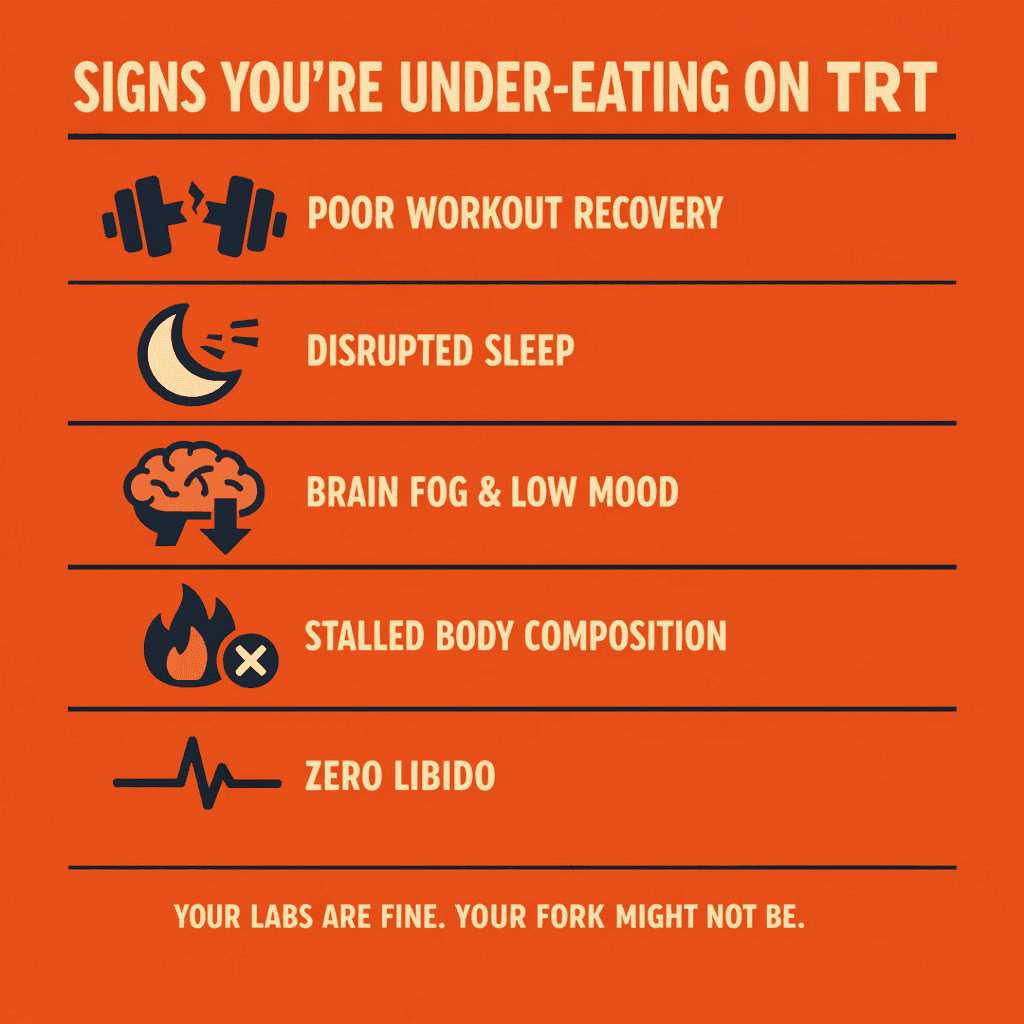
One of the most direct ways that undereating sabotages TRT is through training performance and recovery. Testosterone supports muscle protein synthesis, but protein synthesis requires raw materials and energy. When glycogen stores in your muscles and liver are chronically low because you're not eating enough carbohydrates or total calories, your workouts suffer in ways that compound over time.
Perceived effort goes up. You feel like you're working harder to do less. Recovery slows down. Soreness lingers longer. Motivation to train at all starts to erode. Over weeks and months, this creates a feedback loop where the gym stops feeling productive, so you either push through with diminishing returns or quietly start skipping sessions.
Testosterone is supposed to support the adaptation that follows hard training - it helps signal muscle repair and growth. But if you're not giving your body the energy it needs to actually recover between sessions, that signaling process gets interrupted at a very basic level. More testosterone in circulation doesn't change the math of cellular energy demand.
The Stress System That Won't Quiet Down
Chronic undereating is a physical stressor. Your body doesn't distinguish very well between emotional stress, financial stress, and the stress of not having enough fuel. In all three cases, the hypothalamic-pituitary-adrenal axis, commonly called the HPA axis, gets activated. This is the system that governs your cortisol response.
When you're consistently underfueling, cortisol tends to stay elevated as your body works to mobilize stored energy and maintain basic function. Elevated cortisol over time is deeply counterproductive on TRT. It competes with the downstream effects of testosterone at the cellular level, impairs sleep quality, drives inflammation, and keeps your nervous system in a low-grade alert state.
This is why some men on TRT report persistent fatigue even after labs confirm their testosterone is in a healthy range. The hormone is there. The body simply can't act on it normally because the stress system is chronically activated. You can't out-prescribe a body that doesn't feel safe.
Sleep deserves its own mention here. Appetite restriction, particularly in the evening, can disrupt sleep architecture in ways that further suppress the overnight hormonal processes TRT is meant to support. Poor sleep drives hunger hormones the next day, creating a cycle that becomes self-reinforcing and very hard to recognize from the inside.
The Hormones Behind Your Hormones
Testosterone doesn't operate in isolation. It's part of a broader metabolic and hormonal web, and when calorie intake drops too low for too long, several other systems start to shift in ways that blunt TRT's effectiveness.
Thyroid function is sensitive to energy availability. When the body senses prolonged restriction, it can downregulate thyroid hormone conversion as a conservation strategy. Thyroid hormones influence metabolism, energy, mood, and even how well your cells respond to other hormones. A man with optimal testosterone but sluggish thyroid signaling from chronic dieting may still experience fatigue, cold sensitivity, slow thinking, and weight plateaus.
Leptin, the hormone that signals fullness and communicates energy availability to your brain, drops significantly when body fat and calorie intake fall too low. Low leptin sends distress signals to the hypothalamus - the part of your brain that regulates reproductive hormones - and can effectively tell your system to deprioritize libido, mood, and energy expenditure. This matters even on TRT, because the downstream effects of testosterone depend partly on a hormonal environment that isn't actively fighting your intake.
Ghrelin, the hunger hormone, rises under restriction and can amplify cortisol and stress signaling. Meanwhile, insulin sensitivity - how well your cells respond to insulin and uptake glucose for energy - can paradoxically worsen with extreme restriction in some contexts, particularly when combined with high training loads and poor sleep. All of these systems are interrelated, and they all matter for how you feel on TRT.
When Libido, Mood, and Motivation Go Missing
Men often come to TRT looking for improvements in libido, mood, and mental sharpness alongside energy and body composition. These are reasonable expectations, and TRT genuinely supports all of them - under the right conditions.
Chronic undereating chips away at all four. Low energy availability is directly associated with reduced libido, independent of testosterone levels. The brain and body have a hierarchy of needs, and reproduction and desire get deprioritized when the system perceives scarcity.
Irritability, low motivation, and a kind of emotional flatness are common in men who are underfueling, and they closely mimic the symptoms that bring men to TRT in the first place. This creates genuine confusion. If you started TRT while also under-eating, or if you began cutting calories aggressively after starting TRT, it can be very difficult to sort out what's actually driving your symptoms.
Brain fog is another consistent complaint. The brain is an extremely high-energy organ. When blood sugar availability is inconsistent and glycogen is low, cognitive clarity suffers. Many men describe this as a feeling of being mentally present but somehow disconnected - words come slower, focus is harder, and the mental drive that TRT was supposed to restore just hasn't arrived.
The Scenarios That Are Easy to Miss
Undereating doesn't always look like an intentional diet. Some of the most common scenarios involve men who would genuinely be surprised to hear that food intake might be part of the problem.
Aggressive cutting is the obvious one. Men who are actively trying to lose body fat sometimes reduce intake dramatically, especially when they're impatient with progress. Combining severe restriction with TRT and hard training is a recipe for the symptoms described above, even if labs stay clean.
But busy schedules are just as common. Skipping breakfast, eating a small lunch at a desk, and arriving home too tired to cook a proper meal adds up to a significant deficit without any conscious intention to diet. High-activity jobs - construction, trades, healthcare, first responders - burn far more calories than a sedentary office job, and men in these roles often underestimate how much more they need to eat just to maintain function.
Appetite suppression is also a real factor. Some men on TRT experience reduced appetite, particularly early in the protocol. Others find that stress or habit has simply made them accustomed to eating less. And then there's the well-intentioned version: clean eating that's actually just too little eating. Whole foods, lean proteins, and vegetables are excellent choices - but they're also lower in caloric density, and a man who has eliminated most processed food without adjusting volume may be eating far less than his body needs.
Reading Your Body, Not Just Your Labs
Recognizing undereating isn't always intuitive, especially when appetite regulation has adapted to restriction over time. There are behavioral and physical cues worth paying attention to, none of which require a blood test to notice.
Persistent fatigue that doesn't improve with rest is a signal. So is a plateau or regression in training performance despite consistent effort. Waking up hungry in the night, strong cravings throughout the day, difficulty concentrating in the afternoon, and feeling cold or low-energy in environments where others are comfortable can all point toward insufficient fuel intake.
Emotional cues matter too. Unusual irritability, loss of enthusiasm for things you normally enjoy, and a general sense of flatness that doesn't match your circumstances are worth taking seriously. These aren't personal failures - they're physiological signals.
The practical correction doesn't require counting anything. Eating more consistently throughout the day, prioritizing meals around training, not skipping breakfast if mornings are active, and adding caloric density to meals in the form of healthy fats and whole food carbohydrates are all steps that don't require a detailed plan to implement.
The key distinction is between intentional, moderate fat loss - which is entirely compatible with TRT and generally healthy - and chronic underfueling that goes on long enough to stress the body's hormonal and metabolic systems. The former involves a modest, manageable deficit that doesn't compromise sleep, training, mood, or recovery. The latter is a pattern of prolonged restriction that shows up in how you feel, even when it doesn't show up in labs.
What to Actually Say to Your Clinician
If you're on TRT and not getting the results you expected, the conversation with your clinician shouldn't start and end with asking about adjusting your dose. Labs are one piece of information - an important one - but they don't tell the full story.
Tell your clinician about your energy levels throughout the day, not just first thing in the morning. Describe your sleep quality and whether you're waking during the night. Mention your training frequency and how recovery feels. Talk about your appetite, meal timing, and any periods of deliberate restriction. These details give a clinician a much more complete picture of why your subjective experience might not match your objective results.
Adjusting testosterone isn't always the answer, and in the context of underfueling, it's rarely the right first move. A clinician who understands the interplay between nutrition, lifestyle, and hormone optimization will ask about these factors before recommending protocol changes.
Fueling the Foundation That TRT Is Built On
Testosterone replacement therapy is a powerful clinical tool. It works best when it's placed on top of a foundation that supports it - adequate sleep, manageable stress, training that challenges without depleting, and enough food to fuel all of the above.
When that foundation is missing, perfect labs can coexist with a very imperfect quality of life. The hormone is present. The conditions for it to do its job are not.
If you're navigating TRT and suspect that your nutrition, lifestyle, or symptoms aren't being fully addressed, through AlphaMD you can connect with a licensed provider who looks at the full picture - labs alongside how you're actually living - and builds a plan that treats the person, not just the bloodwork.
Have a question? Ask us.
At AlphaMD, we're here to help. Feel free to ask us any question you would like about TRT, medical weightloss, ED, or other topics related to men's health. Or take a moment to browse through our past questions.
People are asking...
I’ve been feeling off for a while — low energy, no drive, gaining fat even though I eat clean and work out. I’m in my mid-30s and my doctor said my te...
A lot of guys in your situation feel stuck — the labs say you're "normal," but you don't feel like yourself. That "low-normal" range can be misleading because what’s technically normal doesn’t always ... See Full Answer
What would cause your testosterone and E2 levels to decrease, but the patient has been taking the same dose? (Testosterone cypionate 200mg weekly) No...
This could be a number of things. The first could be simply due to the time of testing relative to the last injection being different from the last test. The second & what is potentially likely here b... See Full Answer
I'm 37. I went to a clinic with my complaints and a hormonal test was done: Fsh 2.69mIU/mL Lh 7.28mIU/mL Prolactin 3.95ng/mL Testosterone 18.0nmol...
Your doctors didn’t lie in saying your labs don’t show anything abnormal. But they won’t always because what is “normal” is based on population averages, not what is normal for you. There is a new di... See Full Answer
Get $30 off your first month’s order
Enter your email address now to receive $30 off your first month’s cost, other discounts, and additional information about TRT.
Legal Disclaimer
This website is a repository of publicly available information and is not intended to form a physician-patient relationship with any individual. The content of this website is for informational purposes only. The information presented on this website is not intended to take the place of your personal physician's advice and is not intended to diagnose, treat, cure, or prevent any disease. Discuss this information with your own physician or healthcare provider to determine what is right for you. All information is intended for your general knowledge only and is not a substitute for medical advice or treatment for specific medical conditions. The information contained herein is presented in summary form only and intended to provide broad consumer understanding and knowledge. The information should not be considered complete and should not be used in place of a visit, phone or telemedicine call, consultation or advice of your physician or other healthcare provider. Only a qualified physician in your state can determine if you qualify for and should undertake treatment.