
Why 67% of Men on TRT See Mediocre Results (It's Not the Dosage)
Published on:
Updated on:
People are asking...
Why do TRT clinics just throw 200mg out to start...
They really shouldn't, but because many take the approach of uniform care over individual planning, they pick a dose that will *certainly* give results which is good for marketing, even if it will alm... See Full Answer
So I've been on TRT for 6 months, my clinic doubled my dose when I was at 615 with normal E2 levels then 3 months later. I'm only at like 718 and my E...
You already paid for it, there is no harm in trying it. It’s true, gonadorelin is a poor substitute for hCG, and has little benefit for this purpose, though there may be some while you wait on your ne... See Full Answer
Hey guys, 25 YO. My test is 404, which is pretty low for my age, SHBG being 19.60 nmol/L I’ve previously looked into TRT and was perscribed, with Top...
Yes, that would account for the return in your symptoms slightly, but it is likely another very common occurrence too. During weeks 1-4 most men find increasing benefits week over week. Then during we... See Full Answer
Have a question? Ask us.
At AlphaMD, we're here to help. Feel free to ask us any question you would like about TRT, medical weightloss, ED, or other topics related to men's health. Or take a moment to browse through our past questions.
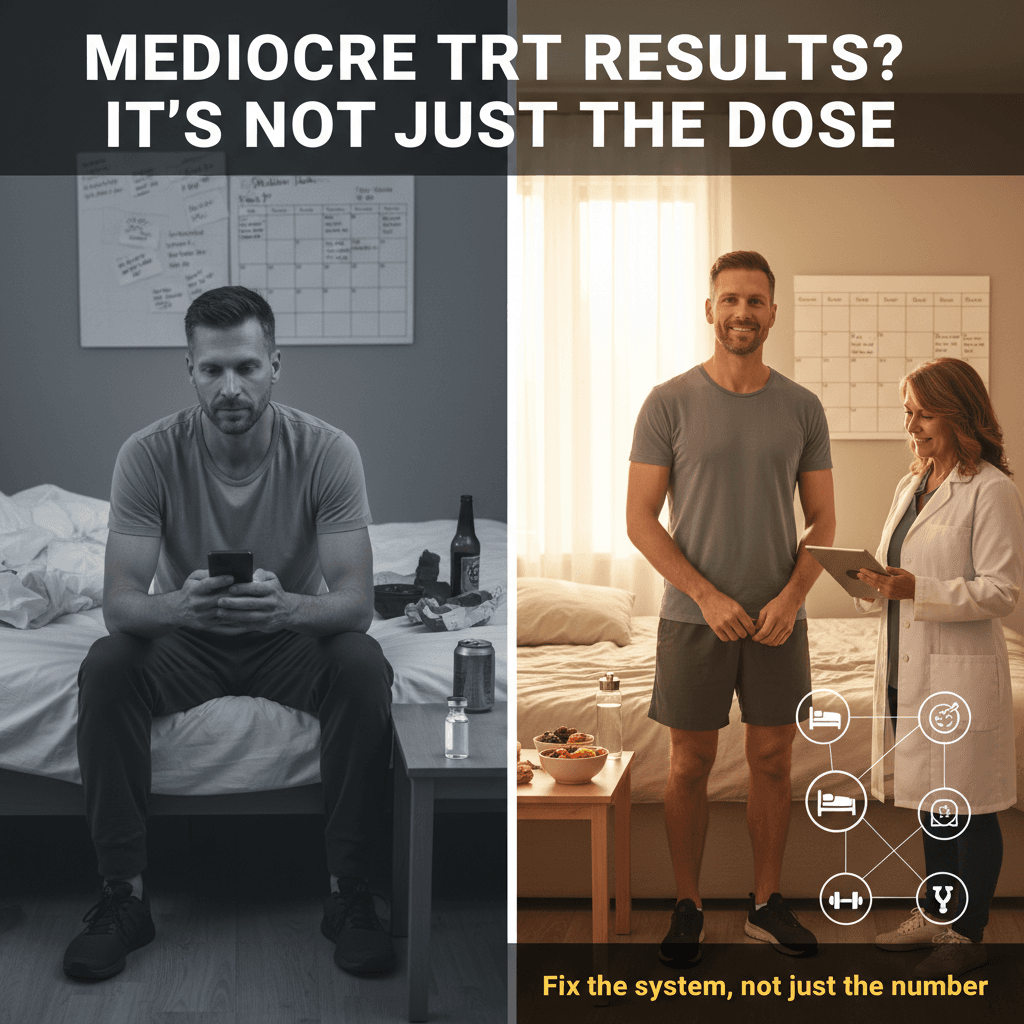
You started testosterone replacement therapy with high hopes, but months later you're still dragging through your days, wondering why the mirror and your energy levels tell a different story than your doctor promised. You're not alone, and the frustrating truth is that your dose probably isn't the problem.
Most men who feel underwhelmed by their TRT results fall into a predictable trap. They assume the solution is simple: adjust the dose up or down until the magic happens. Their providers often reinforce this thinking, tweaking numbers on a prescription pad while ignoring the broader context of why someone feels the way they do. This narrow focus explains why roughly two-thirds of men on TRT report mediocre or disappointing outcomes, even when their testosterone levels look perfectly acceptable on paper.
The real issue isn't about finding the perfect dose. It's about understanding that testosterone doesn't operate in a vacuum, and that hormones are only one piece of a much larger puzzle.
The Dosage Obsession That Keeps Men Stuck
When results disappoint, the knee-jerk reaction is predictable. Men request higher doses, convinced that more testosterone will finally deliver the vitality they're chasing. Some providers comply without much investigation. Others lower the dose, worried about side effects, creating a cycle of adjustments that rarely addresses the underlying problem.
This fixation on quantity misses a fundamental truth: testosterone effectiveness depends heavily on context. A man with poor sleep, metabolic dysfunction, and chronic stress might feel terrible despite having testosterone levels that would make another man feel outstanding. The hormone itself is only as effective as the biological environment it's working within.
Think of testosterone like premium fuel in a car. If the engine is clogged, the timing is off, and the transmission is slipping, switching from regular to premium gas won't transform your driving experience. You might see marginal improvement, but the fundamental problems remain. The same principle applies to your body.
When Other Hormones Sabotage Your Progress
Testosterone doesn't work alone. It functions as part of an interconnected hormonal network, and when other parts of that network are struggling, TRT results suffer accordingly.
Consider thyroid function. Your thyroid hormones regulate metabolism, energy production, and how efficiently your cells use resources. When thyroid function is suboptimal, men often experience fatigue, brain fog, and difficulty building or maintaining muscle, symptoms that overlap considerably with low testosterone. Adding testosterone to a system with compromised thyroid function rarely produces the dramatic improvements men expect. Both systems need attention.
Cortisol, your primary stress hormone, presents another complication. Chronic elevation of cortisol from ongoing stress, poor sleep, or overtraining creates a metabolic environment that works against many of testosterone's benefits. High cortisol promotes fat storage, especially around the midsection, breaks down muscle tissue, and suppresses immune function. Pouring testosterone into a system flooded with cortisol is like trying to build a sandcastle while someone continuously kicks it down.
Insulin sensitivity matters too. Men with insulin resistance or prediabetic metabolic patterns often find that TRT alone doesn't resolve their body composition issues or energy problems. Insulin dysfunction affects how your body handles nutrients, stores fat, and responds to hormonal signals. Addressing metabolic health alongside hormone replacement creates a foundation where testosterone can actually do its job.
The critical insight is that these systems communicate constantly. They influence each other in ways that make isolating one hormone and expecting complete symptom resolution unrealistic. Effective treatment requires looking at the whole system, not just one number on a lab report.
Why Late Night Scrolling And Drive-Through Dinners Undermine Everything
Even with perfect hormone levels across the board, lifestyle factors can completely blunt your results. This is where many men experience the most frustration because they've invested time and money into treatment while inadvertently sabotaging their progress with daily habits.
Sleep deprivation stands out as one of the most powerful saboteurs. Poor sleep disrupts hormone production, impairs recovery, increases inflammation, and undermines insulin sensitivity. Men who consistently get insufficient or poor-quality sleep often find that no amount of testosterone makes them feel energized or helps them build muscle effectively. Their bodies are in a constant state of incomplete recovery, and testosterone can't compensate for that deficit.
Nutrition represents another common friction point. TRT can't overcome a diet that's chronically low in protein, essential fats, and micronutrients. Men who eat irregularly, skip meals, or rely heavily on processed foods often struggle with body composition and energy regardless of their hormone status. Testosterone supports muscle protein synthesis, but that process requires adequate building blocks. Without proper nutrition, the signal is there but the resources aren't.
Alcohol consumption deserves special mention. Regular or heavy drinking interferes with sleep quality, increases estrogen levels, promotes inflammation, and impairs liver function, which affects hormone metabolism. Men who drink frequently while on TRT often wonder why they're not seeing improvements in body composition or mood. The answer usually lies in their weekend habits.
Resistance training, or the lack of it, dramatically influences TRT outcomes. Testosterone creates an environment conducive to building muscle and strength, but it requires the stimulus of progressive resistance training to activate those pathways. Men who start TRT without implementing a consistent training program leave enormous potential on the table. The hormone provides the capacity, but you still need to signal your body to use it.
Chronic stress rounds out the lifestyle factors that commonly derail results. Constant work pressure, relationship difficulties, financial anxiety, or simply trying to do too much creates a physiological state that works against optimization. Stress management isn't optional or secondary; it's fundamental to getting results from any hormone therapy.
The Difference Between Chasing Symptoms And Building Systems
Most men approach TRT with a symptom checklist mentality. They want more energy, better libido, improved mood, easier fat loss, and better workouts. When one symptom improves but others don't, they assume the treatment isn't working and request adjustments. This whack-a-mole approach rarely produces satisfying results.
A more effective framework treats these symptoms as outputs of underlying systems. Instead of asking "how do I fix low energy," the better question becomes "what systems influence energy production, and how are they functioning?" This might involve looking at sleep architecture, thyroid function, iron status, vitamin levels, stress patterns, activity levels, and yes, testosterone. The solution emerges from understanding the whole picture, not from adjusting a single variable.
This systems-based approach requires patience and more comprehensive assessment. It means tracking patterns over time, not just measuring isolated snapshots. It involves paying attention to how different interventions interact, whether lifestyle changes amplify or diminish the effects of hormone therapy, and which factors seem to move the needle most significantly for your particular situation.
Many men find this frustrating initially because it's more complex than "take this dose and feel better." But complexity is the reality of human physiology. The men who embrace this understanding and work with providers who think systemically are the ones who break through from mediocre results to genuinely transformative ones.
When Expectations And Reality Don't Match
Unrealistic expectations silently sabotage many men's experience with TRT. Marketing, forum discussions, and anecdotal stories create visions of rapid, dramatic transformations. Men expect to feel significantly different within days or weeks, anticipate effortless body composition changes, and assume libido issues will resolve immediately.
Reality tends to be more nuanced. Different symptoms improve at different rates. Some men notice mood and energy shifts relatively quickly, while body composition changes require months of consistent effort. Libido improvements depend heavily on relationship factors, stress levels, and overall health, not just hormone levels. Sexual function involves vascular health, psychological factors, and neurological pathways that testosterone influences but doesn't directly control.
Men who judge their results against unrealistic timelines often conclude prematurely that TRT isn't working. They might discontinue treatment, constantly chase dose adjustments, or add other interventions before giving the initial approach adequate time to demonstrate effects. This impatience creates a cycle of starting and stopping that prevents them from ever establishing a stable baseline to assess from.
Understanding that optimization is a process, not an event, helps men stay committed long enough to experience meaningful benefits. It also helps them recognize incremental improvements rather than dismissing anything short of total transformation as failure.
Why Your Provider's Approach Matters More Than You Think
The quality and philosophy of care you receive dramatically influences your outcomes. Men working with providers who operate from rushed, protocol-driven models often get stuck in mediocre results. These approaches typically involve minimal initial assessment, standard dosing based on age or weight, and infrequent follow-up focused almost entirely on lab values.
This model fails because it doesn't account for individual variation in symptoms, lifestyle, concurrent health issues, or treatment response. One man might need frequent monitoring and adjustment in the early months, while another does well with minimal intervention. One man's primary issues might be lifestyle-based, while another has legitimate thyroid or metabolic dysfunction that needs addressing. Cookie-cutter protocols can't accommodate this variability.
Effective care requires listening. It means understanding what symptoms bother you most, how they've progressed, what you've tried, and what your daily life looks like. It involves collaborative problem-solving when results disappoint, exploring potential contributing factors rather than reflexively changing the dose. It requires follow-up that's responsive to your individual situation, not just scheduled at arbitrary intervals.
Men who feel truly heard by their providers, who receive thoughtful explanations for recommendations, and who participate actively in their care planning consistently report better outcomes. This isn't just about satisfaction; it's about catching issues early, maintaining adherence, and addressing the right problems rather than the most obvious ones.
Moving Beyond Mediocre
The path from disappointing TRT results to genuine optimization isn't usually found in dose adjustments. It's found in honest assessment of the bigger picture. That means looking at your sleep patterns, stress levels, nutrition quality, training consistency, and other health markers alongside your hormone status. It means working with providers who think comprehensively rather than prescriptively.
This approach requires more effort and patience than simply requesting a higher dose. It might involve lifestyle changes you've been avoiding, addressing health issues you've minimized, or investing more time in self-monitoring and communication with your provider. The payoff, however, is breaking through the plateau that keeps most men stuck in mediocrity.
Platforms like AlphaMD make this broader perspective easier to access, connecting men with providers who focus on sustainable optimization rather than quick fixes or number chasing. Those providers emphasize the intersection of hormones, lifestyle, and overall health, recognizing that lasting results require attention to all three.
If you're among the majority of men feeling underwhelmed by your TRT results, the solution probably isn't hiding in your dose. It's waiting in the factors you haven't fully addressed yet, the systems you haven't optimized, and the comprehensive approach you haven't tried. Understanding this shifts everything, transforming TRT from a disappointing prescription into one component of a genuinely effective optimization strategy.
Have a question? Ask us.
At AlphaMD, we're here to help. Feel free to ask us any question you would like about TRT, medical weightloss, ED, or other topics related to men's health. Or take a moment to browse through our past questions.
People are asking...
Why do TRT clinics just throw 200mg out to start...
They really shouldn't, but because many take the approach of uniform care over individual planning, they pick a dose that will *certainly* give results which is good for marketing, even if it will alm... See Full Answer
So I've been on TRT for 6 months, my clinic doubled my dose when I was at 615 with normal E2 levels then 3 months later. I'm only at like 718 and my E...
You already paid for it, there is no harm in trying it. It’s true, gonadorelin is a poor substitute for hCG, and has little benefit for this purpose, though there may be some while you wait on your ne... See Full Answer
Hey guys, 25 YO. My test is 404, which is pretty low for my age, SHBG being 19.60 nmol/L I’ve previously looked into TRT and was perscribed, with Top...
Yes, that would account for the return in your symptoms slightly, but it is likely another very common occurrence too. During weeks 1-4 most men find increasing benefits week over week. Then during we... See Full Answer
Get $30 off your first month’s order
Enter your email address now to receive $30 off your first month’s cost, other discounts, and additional information about TRT.
Legal Disclaimer
This website is a repository of publicly available information and is not intended to form a physician-patient relationship with any individual. The content of this website is for informational purposes only. The information presented on this website is not intended to take the place of your personal physician's advice and is not intended to diagnose, treat, cure, or prevent any disease. Discuss this information with your own physician or healthcare provider to determine what is right for you. All information is intended for your general knowledge only and is not a substitute for medical advice or treatment for specific medical conditions. The information contained herein is presented in summary form only and intended to provide broad consumer understanding and knowledge. The information should not be considered complete and should not be used in place of a visit, phone or telemedicine call, consultation or advice of your physician or other healthcare provider. Only a qualified physician in your state can determine if you qualify for and should undertake treatment.