
Fasting and TRT: The Metabolic Case For and Against Intermittent Fasting When Your Hormones Are Optimized
Published on:
Updated on:
People are asking...
Is there one diet that’s best or optimal for TRT? I usually eat following the Mediterranean diet. Frankly I never even thought about this until I just...
Mediterranean diet. That's a good diet to be on. It does depend on your goals. In general as long as you're eating healthy, regularly, and getting food fats in that's the mort important. It's more abo... See Full Answer
What do you recommend for geneticly low SHBG guys like me? I m in great shape and train a lot, also all my blood markers are excellent; lipids, thyroi...
Managing SHBG is difficult, as there body typically tries to make more or less depending on many factors. Those changes you plan on making (fasting, keto, etc) like you are the best way to correct it ... See Full Answer
What you are doing is awesome guys! I would highly appreciate your input on my case. I have been working out in the gym/calisthenics/swimming/jogging...
To answer your questions in order: Varicocele is one of the only truly reversible causes of hypogonadism. It is a fairly minor procedure, so if you can get it taken care of now, there is a possibility... See Full Answer
Have a question? Ask us.
At AlphaMD, we're here to help. Feel free to ask us any question you would like about TRT, medical weightloss, ED, or other topics related to men's health. Or take a moment to browse through our past questions.
Most men on testosterone replacement therapy expect their body to start working better almost immediately, and in many ways it does. What they often don't expect is how much their nutrition strategy still matters once hormones are optimized.
Intermittent fasting has become one of the more popular approaches men bring to that conversation. It's simple, it fits busy schedules, and it carries a reputation for supporting fat loss and metabolic health. But when your hormones are dialed in, the relationship between fasting and your physiology gets more nuanced than most online content suggests.
What Intermittent Fasting Actually Is (And What It Isn't)
At its core, intermittent fasting is a structured pattern of cycling between eating and not eating. Rather than restricting specific foods, it restricts the window of time during which you eat. The most common approach men try compresses daily meals into a shorter window, often somewhere between six and ten hours, leaving the remaining hours as a fasting period. Others alternate entire days of reduced intake with normal eating days, though this tends to be harder to sustain for men with active training schedules.
What fasting is not is a metabolic override. It does not neutralize poor food quality, inadequate protein, chronic sleep debt, or high alcohol intake. That distinction matters a great deal once testosterone is added to the equation, because the temptation to use fasting as a shortcut rather than a tool is real.
What Changes When Testosterone Is Optimized
TRT works. For men who are genuinely hypogonadal, restoring testosterone to a healthy physiological range tends to improve energy, mood, recovery speed, libido, and the ability to build and maintain lean muscle. Insulin sensitivity often improves. Fat distribution, particularly visceral fat, can shift favorably over time. Many men find that their motivation to train increases and that their body responds to that training more effectively.
What does not automatically change is appetite regulation, food choices, sleep quality, or the discipline required to eat in a way that supports their goals. Testosterone optimization changes what your body is capable of. It does not run the program for you.
This is the context in which intermittent fasting enters the picture. Some men find it genuinely useful. Others find it works against the very hormonal environment they have worked to create.
The Metabolic Case For Fasting on TRT
For men who struggle with grazing, mindless snacking, or general decision fatigue around food, a defined eating window can be genuinely clarifying. When you're not making food choices for fourteen or more hours of the day, many of the small, habitual decisions that accumulate into excess calories simply disappear. This is not a trivial benefit. Adherence is the single most underrated variable in any nutrition approach.
There is also a reasonably well-supported connection between time-restricted eating and improvements in insulin sensitivity and glycemic control. For men on TRT who are also managing body composition or carrying excess body fat, this can be meaningful. Testosterone and insulin work in close relationship with each other, and improving the efficiency of one system tends to benefit the other.
Fasting can also align naturally with certain training and lifestyle schedules. A man who trains early in the morning, is not hungry until midday, and wants to finish eating by early evening may find that an eating window fits almost effortlessly into his existing routine. When fasting flows with your life rather than against it, compliance tends to be high and the perceived cost is low.
The Metabolic Case Against Fasting on TRT
The most common problem men run into when combining fasting with TRT is under-eating, specifically under-eating protein. Testosterone supports muscle protein synthesis, but it requires the raw material to do so. If a compressed eating window leads to consistently low total protein intake, lean mass gains stall. Recovery slows. Some men interpret this as a training problem when it is actually a nutrition problem hiding inside a fasting structure.
Training performance is another legitimate concern. Higher-volume sessions, heavy compound lifts, and any training that demands significant glycogen availability tend to suffer when performed in a fully fasted state, particularly for men who are several hours into a fast. This is not universal, and some men adapt over time, but it is worth taking seriously rather than dismissing as mental weakness.
There is also a stress physiology angle that often gets overlooked. Fasting is a mild physiological stressor. That is partly what makes it interesting from a metabolic standpoint. But for men who are already under high psychological or physical stress, who train intensely multiple times per week, or who are sleeping poorly, adding a fasting stress on top of an already burdened system can push cortisol patterns in an unfavorable direction. The body cannot always distinguish between types of stress. More discipline, in this case, can produce worse hormonal outcomes.
Sleep disruption is a related issue some men notice but don't immediately connect to fasting. Eating the last meal too early, or ending the eating window before adequate caloric and carbohydrate intake is achieved, can affect sleep quality. Given that deep sleep is when a significant portion of growth hormone and testosterone release occurs, poor sleep is not a minor inconvenience for men trying to optimize their physiology.
Finally, fasting can function as a mask. Men sometimes use a structured eating window to feel disciplined about their health while continuing to drink regularly, eat low-quality food within their window, sleep inconsistently, and underperform in training. The fasting structure provides a framework that feels like progress, but the actual inputs driving body composition and metabolic health are not improving. This is worth naming honestly.
How TRT Intersects With Fasting Physiology
Testosterone has a meaningful effect on resting metabolic rate, largely through its influence on lean muscle mass. More muscle means higher baseline caloric needs, which means the margin for under-eating shrinks. Men who are actively building or preserving lean mass on TRT may simply need more total food than a compressed eating window consistently delivers.
Cortisol and testosterone exist in a kind of dynamic balance. Chronically elevated cortisol tends to suppress testosterone signaling, among other things. Fasting, training, work stress, and poor sleep all carry a cortisol cost. Men who approach fasting with a "more is better" mindset, layering it aggressively on top of high-volume training and other life stressors, sometimes find themselves feeling worse despite doing what seems like all the right things. The physiology does not reward intensity of effort in the way motivation-based culture suggests it should.
Leptin and ghrelin, the hormones most associated with hunger signaling and energy balance, are also affected by both fasting patterns and testosterone levels. Testosterone has a generally favorable influence on leptin sensitivity, meaning men on TRT may have somewhat better appetite regulation than men who are hypogonadal. But ghrelin, the hunger-triggering hormone, can rise during extended fasts in ways that make the eating window harder to control for some men, leading to overcorrection and the kind of variable intake that undermines consistency.
The distinction between fat loss rate and body composition outcomes is worth spending a moment on. Two men can lose the same amount of weight over three months and have very different outcomes in terms of how much of that loss was fat versus lean tissue. On TRT, the goal for most men is to shift body composition favorably, not simply to see the scale move. Fasting that depletes lean mass, even while creating a caloric deficit, is not serving the hormonal environment that TRT creates.
Who Tends to Do Well, And Who Should Be Cautious
Men who tend to do well with intermittent fasting on TRT often share a few characteristics. They are not hungry in the mornings, they train at a time that aligns with their feeding window, they eat a high-protein, nutrient-dense diet within their window, they sleep well, and their total stress load is manageable. For these men, fasting simplifies eating without fighting their physiology.
Men who should approach fasting with more caution include those who are trying to gain meaningful amounts of lean mass, those who train with high volume or intensity multiple times per week, those who notice significant mood changes, fatigue, or sleep disruption when restricting their eating window, and those with any history of disordered eating. For this last group in particular, structured restriction patterns can reactivate psychological patterns that are difficult to separate from the physiological ones.
Men with diabetes, those taking medications that affect blood sugar, and those with significant gastrointestinal conditions should consult their clinician before experimenting with fasting. This is not a generic disclaimer. It is a genuine and important consideration, because fasting affects glucose regulation, medication timing, and gut motility in ways that require individual clinical assessment.
Practical Decision Points Worth Thinking Through
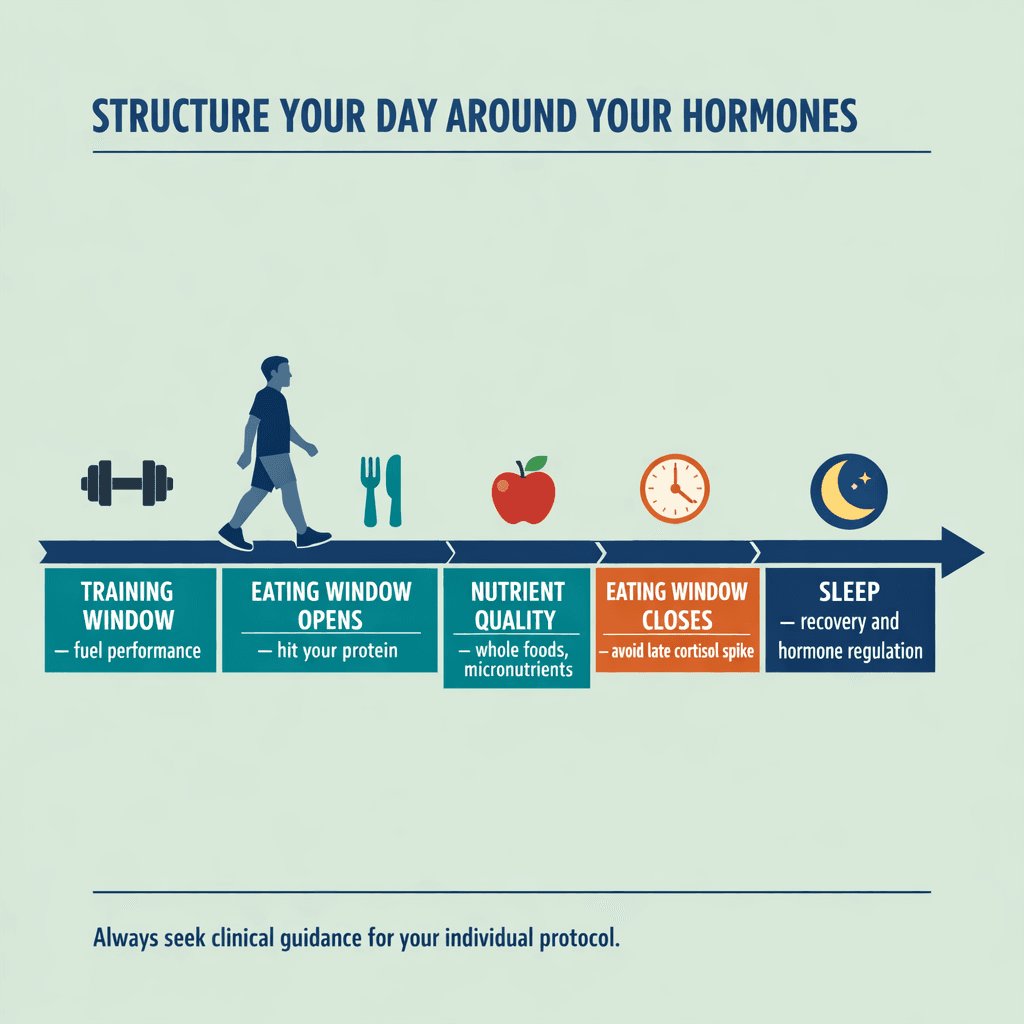
If you're going to experiment with fasting while on TRT, alignment is the most useful concept to carry into it. Align your eating window with your training schedule so that your most demanding sessions are not being fueled by an extended fast. Align your window with your natural sleep schedule so that you're not ending caloric intake so early that sleep quality suffers.
Within whatever window you choose, protein and micronutrient density should be the priority. It is easy to fill an eating window with food volume that looks substantial but delivers inadequate protein and limited micronutrients. Food quality within the window matters as much as the window itself.
Hydration and electrolytes during the fasting period deserve attention, particularly for men who train in the morning before eating. Water, sodium, potassium, and magnesium all play roles in training performance and recovery, and fasting periods without attention to these can produce symptoms that are mistakenly attributed to the fasting itself.
When results plateau, the first things to reassess are not more restriction or a longer fast. They are sleep quality, training consistency, protein intake, overall stress, and whether the fasting structure is still serving adherence or has become an obstacle to it. Adding more constraint is rarely the answer when the fundamentals are not solid.
When the Tool Serves the Goal, and When It Doesn't
Intermittent fasting can be a genuinely useful strategy for men on TRT who are trying to manage body composition, simplify eating, and improve metabolic markers. It is not a cure, it is not universally appropriate, and it should not override the basic requirements of a hormonally optimized physiology: adequate protein, quality sleep, intelligent training, and manageable total stress.
The question worth asking is not whether fasting is good or bad, but whether it is currently serving your metabolism, your training, your sleep, and your ability to stay consistent. When it does all of those things, it's a reasonable tool. When it fights any of them, it's worth reconsidering.
For men navigating these decisions alongside TRT, having clinical support makes a meaningful difference. Through AlphaMD, licensed providers individualize hormone optimization and offer the kind of lifestyle guidance that helps strategies like fasting work with your physiology rather than against it.
Have a question? Ask us.
At AlphaMD, we're here to help. Feel free to ask us any question you would like about TRT, medical weightloss, ED, or other topics related to men's health. Or take a moment to browse through our past questions.
People are asking...
Is there one diet that’s best or optimal for TRT? I usually eat following the Mediterranean diet. Frankly I never even thought about this until I just...
Mediterranean diet. That's a good diet to be on. It does depend on your goals. In general as long as you're eating healthy, regularly, and getting food fats in that's the mort important. It's more abo... See Full Answer
What do you recommend for geneticly low SHBG guys like me? I m in great shape and train a lot, also all my blood markers are excellent; lipids, thyroi...
Managing SHBG is difficult, as there body typically tries to make more or less depending on many factors. Those changes you plan on making (fasting, keto, etc) like you are the best way to correct it ... See Full Answer
What you are doing is awesome guys! I would highly appreciate your input on my case. I have been working out in the gym/calisthenics/swimming/jogging...
To answer your questions in order: Varicocele is one of the only truly reversible causes of hypogonadism. It is a fairly minor procedure, so if you can get it taken care of now, there is a possibility... See Full Answer
Get $30 off your first month’s order
Enter your email address now to receive $30 off your first month’s cost, other discounts, and additional information about TRT.
Legal Disclaimer
This website is a repository of publicly available information and is not intended to form a physician-patient relationship with any individual. The content of this website is for informational purposes only. The information presented on this website is not intended to take the place of your personal physician's advice and is not intended to diagnose, treat, cure, or prevent any disease. Discuss this information with your own physician or healthcare provider to determine what is right for you. All information is intended for your general knowledge only and is not a substitute for medical advice or treatment for specific medical conditions. The information contained herein is presented in summary form only and intended to provide broad consumer understanding and knowledge. The information should not be considered complete and should not be used in place of a visit, phone or telemedicine call, consultation or advice of your physician or other healthcare provider. Only a qualified physician in your state can determine if you qualify for and should undertake treatment.