
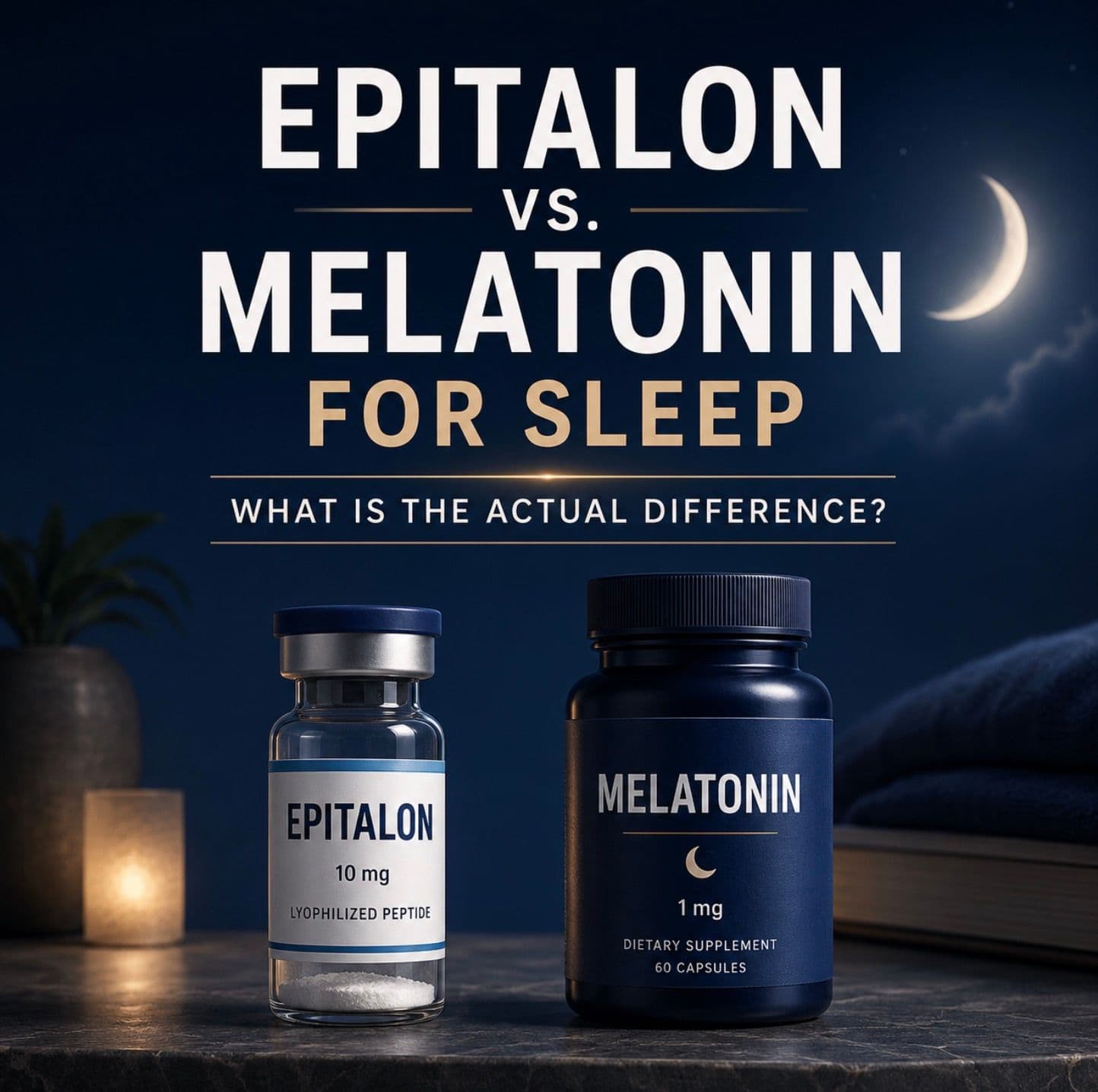
Epitalon vs. Melatonin for Sleep: What Is the Actual Difference?
Published on:
Updated on:
People are asking...
I (45yo, BMI 32 but dropping) recently started enclomiphene 12.5mg/daily, after multiple tests over 6 months had my testosterone steady at ~350. Estra...
It’s hard to say without labs, but high estradiol is a very common cause for insomnia. Enclomiphene raises estradiol to a greater degree than TRT (it blocks the estrogen receptors in the hypothalamus ... See Full Answer
i’ve been on compounded cream for 3 weeks. twice daily to scrotum. i am having difficulty sleeping but also started thyroid. is the thyroid medication...
In general Testosterone helps with sleep rather than hinders it, it's one of the big benefits providers often discuss with patients looking to start TRT. It can take 7-8 weeks to totally stabilize whe... See Full Answer
Can you speak to pinning frequency/time of day and what bearing it has on sleep, if any. Thank you!...
Most men notice increased quality of sleep on TRT. Some however do note having a harder time sleeping, which can sometimes be the case if they're less exhausted. In even more rare cases their dose nee... See Full Answer
Have a question? Ask us.
At AlphaMD, we're here to help. Feel free to ask us any question you would like about TRT, medical weightloss, ED, or other topics related to men's health. Or take a moment to browse through our past questions.
People researching sleep peptides often type some version of "Epitalon vs melatonin" into a search bar, usually assuming Epitalon must be a newer, stronger, or more advanced version of the melatonin they already know. That assumption deserves a closer look, because Epitalon and melatonin are not simply two versions of the same product. One is a hormone your body already makes and that has been studied in humans for decades. The other is an investigational synthetic peptide with a much smaller, more indirect evidence base. This article compares them claim by claim rather than assuming the newer, less-understood option is automatically the better one.
The key point: melatonin is a naturally occurring hormone with decades of human trials, a defined mechanism, and over-the-counter availability, though even its evidence for chronic insomnia specifically is weaker than most people assume. Epitalon is an unapproved synthetic peptide with only two published human studies, neither involving people with diagnosed insomnia, and no adequate human safety data for the injectable form sold online. Epitalon vs melatonin is not a contest between an old option and an upgraded one. It is a comparison between a well-characterized hormone and a much less studied peptide that has not been shown to do the same job.
What Melatonin Actually Is
Melatonin is a hormone produced mainly by the pineal gland in response to darkness. Its rise in the evening and fall in the morning helps set the timing of the body's sleep-wake cycle. When melatonin is taken as an oral supplement, it is the same molecule the body produces, not an analog or a substance that merely influences melatonin from a distance.
In the United States, melatonin is sold over the counter as a dietary supplement, which means it is regulated far less strictly than an approved drug (see the NIH National Center for Complementary and Integrative Health overview). Its evidence base is also more specific than casual use suggests. The American Academy of Sleep Medicine's clinical practice guideline for chronic insomnia in adults recommends against using melatonin for sleep-onset or sleep-maintenance insomnia, citing insufficient evidence, even though the same organization supports melatonin for circadian-timing problems such as jet lag and shift work disorder (see the AASM clinical practice guideline and the AASM's own plain-language summary, "Missing the Mark with Melatonin"). In other words, melatonin is well studied, but "well studied" and "proven effective for chronic insomnia" are not the same claim.
Because melatonin is sold as an unregulated supplement rather than an approved drug, product quality is its own issue. A 2023 analysis published in JAMA found that 22 of 25 melatonin gummy products tested contained a different amount of melatonin than their label claimed, with actual content ranging from 74 percent to 347 percent of the labeled dose (see the JAMA research letter). Melatonin's mechanism and short-term safety profile are well documented, but "over the counter" does not mean every bottle reliably contains what the label says.
What Epitalon Is Proposed to Do
Epitalon (also spelled Epithalon or Epithalone) is a synthetic four-amino-acid peptide, alanine-glutamate-aspartate-glycine, designed in the 1980s to mimic part of Epithalamin, a natural pineal gland extract. It is not melatonin, and it is not marketed as containing melatonin. Instead, it is proposed to influence the pineal gland's own signaling and gene-expression machinery in ways that researchers hypothesize could affect melatonin production, circadian rhythm, and cellular aging.
In July 2026, an FDA advisory committee evaluated Epitalon specifically for insomnia as part of a review of potential compounding substances, and voted to recommend it for possible inclusion on a compounding list despite FDA staff's own conclusion that there were no published clinical studies showing Epitalon treats patients with insomnia (see RAPS' coverage of the vote and the underlying FDA briefing document). A more detailed audit of exactly what has and has not been tested in people is available in AlphaMD's companion article, Epitalon Human Studies: What Has Actually Been Tested in People?.
Direct Hormone Replacement Versus Indirect Pineal Signaling
This is the central mechanistic difference between the two, and it is easy to miss when Epitalon is marketed as a "sleep peptide" next to melatonin. Taking melatonin is direct hormone supplementation: the capsule or gummy contains the identical hormone the pineal gland produces, and it raises circulating melatonin levels in a way that has been measured directly in many trials.
Epitalon is not melatonin and is not a melatonin receptor agonist. The hypothesis behind it is indirect: laboratory studies in pinealocyte cultures have reported that Epitalon affects an enzyme (AANAT) and a transcription factor (pCREB) involved in melatonin synthesis, and the one relevant human study measured a urinary melatonin metabolite and the activity of three circadian genes (Clock, Cry2, and Csnk1e) rather than melatonin itself. That is a hypothesis about influencing the body's own melatonin-making machinery from an upstream signaling point, not a demonstration that Epitalon supplies or reliably raises melatonin the way a melatonin supplement does. Comparing Epitalon vs melatonin on mechanism alone shows they are not aimed at the same, well-confirmed target: one is the hormone, and the other is a proposed regulator of the system that makes it, with far less direct confirmation.
Which Has Stronger Human Evidence?
Melatonin's evidence base is large by comparison. A widely cited meta-analysis pooled 19 randomized, placebo-controlled trials and 1,683 participants and found melatonin modestly reduced the time it took to fall asleep (about 7 minutes faster than placebo) and modestly increased total sleep time (about 8 minutes), with a small improvement in subjective sleep quality (see the meta-analysis in PLOS One). Those effects are real but modest, and, as noted above, they have not been enough to earn a positive recommendation from the American Academy of Sleep Medicine for chronic insomnia specifically.
Epitalon's human evidence base is far smaller. A 2025 peer-reviewed review that compiled 25 years of published Epitalon research identified only two human clinical trials of the compound: a study of 162 patients with retinitis pigmentosa (an eye disease) treated with a localized eye injection, and a study of 75 night-shift workers given a sublingual spray to measure melatonin-metabolite and circadian-gene changes, not diagnosed insomnia (see the review). Neither trial enrolled people with insomnia, and neither used the subcutaneous injection route that is marketed today. Set side by side, melatonin has roughly 20 times more randomized trial participants behind its (admittedly modest) sleep effects than Epitalon has participants in its entire human research record, for any use.
Known Versus Unknown Side Effects
Melatonin's short-term side-effect profile is well characterized: headache, dizziness, nausea, daytime drowsiness, and vivid dreams are the most commonly reported effects, and serious short-term reactions are uncommon in healthy adults (see the StatPearls overview). Its long-term safety, beyond a few weeks of use, has not been as thoroughly studied, and the NIH notes specific caution for people who are pregnant, have epilepsy, or take blood thinners. Because it is an unregulated supplement, quality control is a real concern, as the gummy-dosing data above shows, and pediatric emergency room visits for accidental melatonin ingestion have risen in recent years.
Epitalon's side-effect profile is largely undefined rather than well characterized. The FDA's 2026 review found no adequate human safety studies and no pharmacokinetic data for either Epitalon free base or Epitalon acetate, and it flagged a theoretical, unresolved concern that Epitalon's telomerase-activating effect in laboratory cell cultures could, in principle, carry a long-term cancer risk that has not been ruled out in humans. Peptide sold through online research-chemical channels also carries its own purity and contamination risks, separate from the drug's own biological effects. Known risks that have been studied for decades are a very different situation from unknown risks that have not.
Oral Melatonin Versus Sublingual or Injectable Epitalon
Most melatonin products are taken orally, as tablets, capsules, or gummies, and melatonin's oral absorption and elimination have been characterized in pharmacokinetic studies; doses as small as 0.1 to 0.3 mg can raise blood levels into a normal nighttime range. Epitalon's evidence base uses two entirely different, non-oral routes: a sublingual spray in the circadian-gene study, and a localized eye injection in the retinitis pigmentosa trial. What is actually sold and injected today, a subcutaneous injection, has never been tested in a published human study, at any dose, for any condition. Comparing Epitalon vs melatonin on delivery route is therefore not just oral versus injectable; it is a route with extensive pharmacokinetic data versus a route with none at all.
Why Epitalon Should Not Automatically Be Treated as "Better Melatonin"
No published head-to-head trial has ever compared Epitalon and melatonin directly. Being synthetic, novel, or delivered by injection does not automatically make a substance more effective or safer than an inexpensive hormone that has been studied in thousands of participants across nearly two decades of trials. In this comparison, the evidence points the other way: melatonin, despite its own real limitations for chronic insomnia, has a far larger and more direct human evidence base, a better-characterized safety profile, and decades of use, while Epitalon has two small human studies (neither on insomnia), no established mechanism proven in people, and no adequate human safety data for the form it is sold in.
None of this means melatonin is a complete solution either. Persistent insomnia is best evaluated by a licensed medical provider, and cognitive behavioral therapy for insomnia remains the first-line, most thoroughly supported approach for chronic cases. Anyone considering Epitalon specifically should treat it as an unapproved, investigational substance rather than an upgraded melatonin, and should discuss the actual evidence, and its real gaps, with a licensed provider before use. For a deeper look at what has and has not been tested in people, see AlphaMD's Epitalon Human Studies audit and the broader Epitalon benefits, risks, and side effects overview.
Have a question? Ask us.
At AlphaMD, we're here to help. Feel free to ask us any question you would like about TRT, medical weightloss, ED, or other topics related to men's health. Or take a moment to browse through our past questions.
People are asking...
I (45yo, BMI 32 but dropping) recently started enclomiphene 12.5mg/daily, after multiple tests over 6 months had my testosterone steady at ~350. Estra...
It’s hard to say without labs, but high estradiol is a very common cause for insomnia. Enclomiphene raises estradiol to a greater degree than TRT (it blocks the estrogen receptors in the hypothalamus ... See Full Answer
i’ve been on compounded cream for 3 weeks. twice daily to scrotum. i am having difficulty sleeping but also started thyroid. is the thyroid medication...
In general Testosterone helps with sleep rather than hinders it, it's one of the big benefits providers often discuss with patients looking to start TRT. It can take 7-8 weeks to totally stabilize whe... See Full Answer
Can you speak to pinning frequency/time of day and what bearing it has on sleep, if any. Thank you!...
Most men notice increased quality of sleep on TRT. Some however do note having a harder time sleeping, which can sometimes be the case if they're less exhausted. In even more rare cases their dose nee... See Full Answer
Get $30 off your first month’s order
Enter your email address now to receive $30 off your first month’s cost, other discounts, and additional information about TRT.
Legal Disclaimer
This website is a repository of publicly available information and is not intended to form a physician-patient relationship with any individual. The content of this website is for informational purposes only. The information presented on this website is not intended to take the place of your personal physician's advice and is not intended to diagnose, treat, cure, or prevent any disease. Discuss this information with your own physician or healthcare provider to determine what is right for you. All information is intended for your general knowledge only and is not a substitute for medical advice or treatment for specific medical conditions. The information contained herein is presented in summary form only and intended to provide broad consumer understanding and knowledge. The information should not be considered complete and should not be used in place of a visit, phone or telemedicine call, consultation or advice of your physician or other healthcare provider. Only a qualified physician in your state can determine if you qualify for and should undertake treatment.