
Enclomiphene vs HCG: Understanding Their Roles in Hormone Therapy
Published on:
Updated on:
People are asking...
Would it make sense to be on 25mg of enclomiphene twice a week while on 140mg a week of test cyp to help preserve fertility? I was prescribed this and...
While you can, it's often not the best approach if you're interested in the fitness aspects of TRT (which most men are). Enclomiphene is nice because it doesn't impact fertility the same way that Test... See Full Answer
Do you offer enclomiphene? When should it be considered vs traditional TRT?...
Enclomiphene is available through AlphaMD. Like all SERMs, its effectiveness varies. Due to the way it functions (ramps up pituitary output of FSH and LH), enclomiphene does not work in primary hypogo... See Full Answer
Would you say that TRT with hCG is a much better option for someone that wants to maintain fertility as opposed to Enclomiphene mono therapy? I was co...
Many providers would say that, yes. In general although Enclomiphene appears to have less side effects than Clomid, it has not been around as long as these other therapies and the long term effects ar... See Full Answer
Have a question? Ask us.
At AlphaMD, we're here to help. Feel free to ask us any question you would like about TRT, medical weightloss, ED, or other topics related to men's health. Or take a moment to browse through our past questions.
Updated on July 23rd, 2025
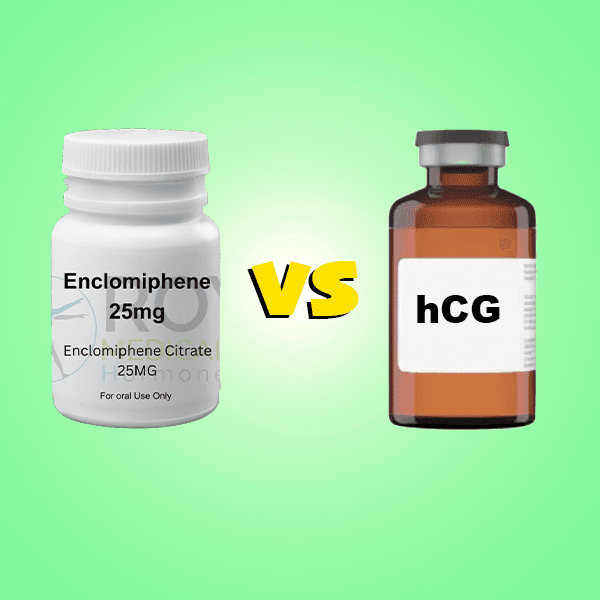
When it comes to hormone optimization and fertility treatments, two commonly discussed medications are enclomiphene and human chorionic gonadotropin (HCG). While both are used to support testosterone production and fertility in men, they work in different ways. Understanding the differences between enclomiphene vs HCG can help patients make informed decisions about their treatment options.
What Is Enclomiphene?
Enclomiphene is a selective estrogen receptor modulator (SERM) that stimulates the body’s natural production of testosterone. It works by blocking estrogen’s negative feedback on the hypothalamus, which in turn increases the release of gonadotropins (LH and FSH) from the pituitary gland. This promotes testicular function, leading to increased testosterone production while also preserving fertility.
Benefits of Enclomiphene
- Increases natural testosterone production
- Helps maintain fertility by stimulating natural sperm production
- Does not suppress the body's ability to produce testosterone like exogenous testosterone therapy
- Generally well-tolerated with minimal side effects compared to traditional testosterone replacement therapy (TRT)
What Is HCG?
Human chorionic gonadotropin (HCG) is a hormone that mimics luteinizing hormone (LH), a key signal for the testes to produce testosterone and sperm. Unlike enclomiphene, HCG directly stimulates the testicles, bypassing the hypothalamic-pituitary axis. This makes it useful for individuals whose natural LH production is suppressed due to testosterone therapy or other medical conditions.
Benefits of HCG
- Supports natural testosterone production when used alongside TRT
- Maintains testicular size and function
- Helps prevent infertility caused by testosterone suppression
- Can be used as part of a post-cycle therapy (PCT) to restore natural hormone levels
Key Differences: Enclomiphene vs HCG
Feature | Enclomiphene | HCG |
Mechanism of Action | Stimulates LH & FSH release | Mimics LH to stimulate testicles directly |
Impact on Fertility | Supports sperm production | Helps maintain sperm production but can desensitize Leydig cells over time |
Use in TRT | Can be used alone to boost testosterone naturally | Often used alongside TRT to prevent testicular shrinkage |
Administration | Oral | Injectable |
Suppression of Natural LH | No | Yes (with prolonged use) |
Which One Is Right for You?
The choice between enclomiphene and HCG depends on individual treatment goals. Enclomiphene is often preferred for men looking to naturally restore their testosterone levels while maintaining fertility. HCG, on the other hand, is commonly used in combination with TRT to preserve testicular function and prevent suppression of sperm production.
For those undergoing TRT, some providers may recommend using both enclomiphene and HCG at different stages of treatment to maximize benefits. Consulting with a healthcare provider is essential to determine the most appropriate approach based on personal hormone levels, fertility goals, and overall health.
Conclusion
Both enclomiphene and HCG offer valuable benefits for individuals looking to optimize testosterone and fertility. Understanding their differences can help patients make informed decisions about their hormone therapy options. AlphaMD makes personalized telehealth consultations easy to access, helping patients navigate their TRT and hormone optimization journeys. A licensed provider can help determine the best treatment plan based on your individual needs. To learn more, visit AlphaMD and explore your options for hormone health today.
Have a question? Ask us.
At AlphaMD, we're here to help. Feel free to ask us any question you would like about TRT, medical weightloss, ED, or other topics related to men's health. Or take a moment to browse through our past questions.
People are asking...
Would it make sense to be on 25mg of enclomiphene twice a week while on 140mg a week of test cyp to help preserve fertility? I was prescribed this and...
While you can, it's often not the best approach if you're interested in the fitness aspects of TRT (which most men are). Enclomiphene is nice because it doesn't impact fertility the same way that Test... See Full Answer
Do you offer enclomiphene? When should it be considered vs traditional TRT?...
Enclomiphene is available through AlphaMD. Like all SERMs, its effectiveness varies. Due to the way it functions (ramps up pituitary output of FSH and LH), enclomiphene does not work in primary hypogo... See Full Answer
Would you say that TRT with hCG is a much better option for someone that wants to maintain fertility as opposed to Enclomiphene mono therapy? I was co...
Many providers would say that, yes. In general although Enclomiphene appears to have less side effects than Clomid, it has not been around as long as these other therapies and the long term effects ar... See Full Answer
Get $30 off your first month’s order
Enter your email address now to receive $30 off your first month’s cost, other discounts, and additional information about TRT.
Legal Disclaimer
This website is a repository of publicly available information and is not intended to form a physician-patient relationship with any individual. The content of this website is for informational purposes only. The information presented on this website is not intended to take the place of your personal physician's advice and is not intended to diagnose, treat, cure, or prevent any disease. Discuss this information with your own physician or healthcare provider to determine what is right for you. All information is intended for your general knowledge only and is not a substitute for medical advice or treatment for specific medical conditions. The information contained herein is presented in summary form only and intended to provide broad consumer understanding and knowledge. The information should not be considered complete and should not be used in place of a visit, phone or telemedicine call, consultation or advice of your physician or other healthcare provider. Only a qualified physician in your state can determine if you qualify for and should undertake treatment.