
ED Is Not a Bedroom Problem - It's a Blood Vessel Problem, and Your Arteries Are 3–5 Years Ahead of Your Heart
Published on:
Updated on:
People are asking...
Do you have any patients where trt has made erection quality worse? I’ve been on trt for 4 months with all bloods in range but feel like my erection q...
So, hormones are only a small part of erection quality, though an important part. As a general rule of thumb, if you get morning wood, but have ED during other times, then the cause of your ED is very... See Full Answer
I had six stents installed in my heart 10 yrs ago, why won't any trt clinics help me? I'm 65m battling low testosterone for 30yrs....
The main reason is liability & the kind of country we are with medicine. A small amount of people produce too many RBC on Testosterone therapy or experience initial upswings in BP or RHR. It's not ver... See Full Answer
did bloods 4 weeks into treatment of 50mg Test E x2 week+ 500iu x3 week SHBG 14/nmol FSH <0.3 iu/l LH < 0.3 iu/l Oestradiol 168 pmol/l Test 41 Nmol/l...
Your lab results look good considering your dose. However, considering the half-life, you usually are better off waiting 7-8 weeks after starting to get labs. At 4 weeks your levels haven’t stabilized... See Full Answer
Have a question? Ask us.
At AlphaMD, we're here to help. Feel free to ask us any question you would like about TRT, medical weightloss, ED, or other topics related to men's health. Or take a moment to browse through our past questions.
Most men who experience erectile dysfunction quietly assume it is about stress, age, or something going wrong in their relationship, but what their body is actually signaling may be far more urgent than that. ED is often one of the earliest, most readable warning signs that your cardiovascular system is in trouble, and it can appear years before a heart attack or stroke ever enters the picture.
Your Smallest Arteries Speak First
The human body has a hierarchy when it comes to blood vessel problems. Atherosclerosis, the gradual buildup of plaque inside arterial walls, does not hit all vessels equally or at the same time. It tends to show up first in the smallest arteries, and the arteries that supply blood flow to the penis are among the smallest in the body.
Coronary arteries, the ones that feed the heart, are significantly larger in diameter than penile arteries. When arterial disease is developing, the smaller vessels are compromised first. This means that by the time the same process starts causing detectable blockages in the coronary arteries, it may have already been quietly limiting blood flow elsewhere for years. Three to five years is the estimate researchers and clinicians commonly reference when describing how far ahead penile artery dysfunction can precede coronary artery disease.
This is not a scare tactic. It is actually an opportunity. If ED is an early signal, then catching and addressing vascular risk factors while ED is the only symptom gives a man a meaningful head start on protecting his heart.
An Erection Is a Vascular Event
Erections are fundamentally about blood flow, not willpower or arousal alone. When sexual stimulation occurs, the body releases nitric oxide, a signaling molecule that tells the smooth muscle lining blood vessel walls to relax. That relaxation allows blood to rush into erectile tissue, creating and maintaining an erection.
When that system breaks down, the culprit is often the endothelium, the thin inner lining of blood vessels. Endothelial dysfunction means the vessel walls are not producing or responding to nitric oxide properly. Blood vessels become less able to dilate on demand. The result is reduced, sluggish, or absent blood flow to erectile tissue.
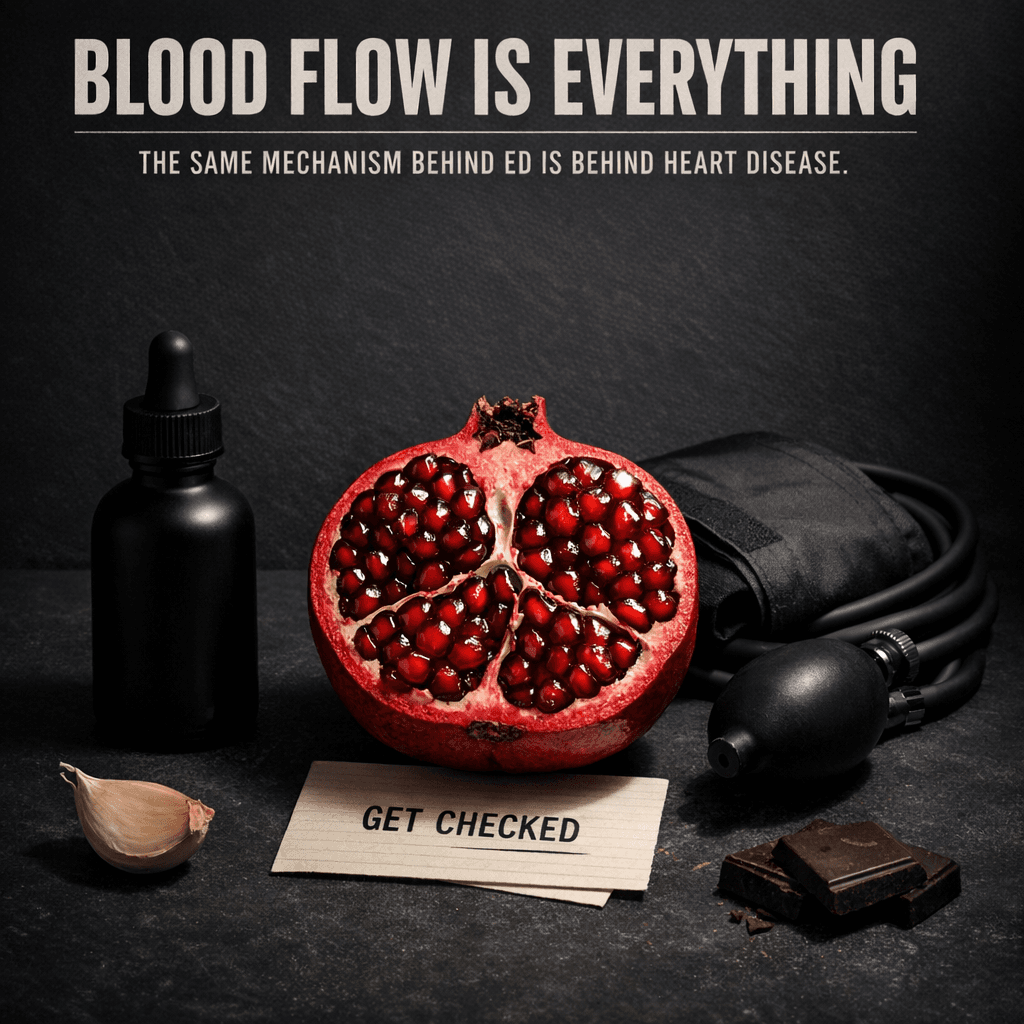
Here is the part that connects everything: endothelial dysfunction is also the foundational mechanism behind atherosclerosis and cardiovascular disease. The same cellular environment that makes arteries stiff and prone to plaque is the same environment that impairs erectile function. ED and cardiovascular disease share a common biological root.
Why the Signal Gets Ignored
Despite the science, most men with ED never connect it to their arteries. They chalk it up to performance anxiety, a rough patch at work, or just getting older. And while psychological factors genuinely do play a role in some cases, the data consistently shows that vascular causes are among the most common drivers of ED, particularly in men over forty.
The silence around ED makes this worse. Many men wait years before mentioning it to a doctor, if they mention it at all. Some turn to over-the-counter supplements or unregulated products without ever getting an evaluation that might reveal a blood pressure problem, prediabetes, or elevated cholesterol that has been quietly doing damage for years.
The stigma costs men time they do not have when it comes to cardiovascular risk.
The Full Picture: ED Is Rarely Just One Thing
Vascular health is the most medically significant contributor to ED, but it is not the only one. A thorough understanding of erectile dysfunction requires looking at the whole man.
Hormonal factors matter. Low testosterone does not always cause ED directly, but it can significantly suppress libido and contribute to a diminished sexual response. Testosterone also plays a supporting role in vascular health, so when levels are low, the picture can become more complicated. Proper evaluation matters here, because treating low testosterone without understanding the broader context is rarely the whole answer.
Metabolic health is deeply intertwined with erectile function. Insulin resistance and type 2 diabetes damage blood vessels and nerves over time, both of which are critical for normal erectile function. Men with poorly controlled blood sugar often experience ED that is driven by a combination of vascular and neurological changes.
Sleep apnea is a surprisingly common and underappreciated contributor. Disrupted sleep and chronic low oxygen levels overnight affect testosterone production, vascular health, and overall energy in ways that directly impact sexual performance.
Medications deserve attention too. A number of commonly prescribed drugs, including certain blood pressure medications, antidepressants, and others, can affect erectile function as a side effect. This does not mean a man should stop his medication, but it does mean a conversation with a clinician is warranted.
Smoking and vaping cause direct vascular damage. Alcohol, especially in larger quantities over time, affects both hormonal balance and nerve function. Chronic stress and depression affect the brain's ability to initiate and sustain the sexual response. Pelvic surgery or injury can disrupt the nerve pathways involved in erection.
The point is not that every man with ED has heart disease. The point is that ED should trigger a real medical evaluation, not a shrug or a quick fix.
When the Body Sends a Signal, Listen
If a man notices consistent or worsening difficulty achieving or maintaining erections, that is the moment to take the signal seriously. Not occasionally, not vaguely, but actually sit down with a clinician and talk about it.
A proper evaluation for ED is not embarrassing or complicated. A good clinician will take a thorough history, ask about when symptoms started and how they have changed, and ask about overall health, stress, sleep, and lifestyle. Blood pressure will be assessed, because hypertension is one of the leading vascular contributors to ED and one of the most treatable. Blood work is typically part of the picture, looking at glucose levels, lipid panels, and often testosterone, along with other markers of metabolic health.
Medication lists get reviewed. Lifestyle factors get discussed. If there are signs pointing toward hormonal issues, a more detailed hormonal workup may follow. If there are red flags suggesting cardiovascular risk, a referral to a cardiologist or primary care physician for further workup may be appropriate.
The goal is not to find one culprit and ignore the rest. The goal is to understand the whole system.
What Getting Better Can Look Like
Treatment for ED is not one-size-fits-all, and it should not be. What works depends entirely on what is driving the problem.
Lifestyle changes are genuinely powerful and are not just a polite recommendation clinicians make before getting to the real treatment. Regular aerobic exercise improves endothelial function and nitric oxide signaling. Reducing body fat, particularly visceral fat, improves testosterone levels and insulin sensitivity. Quitting smoking produces measurable improvements in vascular function. Better sleep restores hormonal rhythms. These changes do not just treat symptoms; they address the underlying biology.
When vascular factors are present, oral medications that enhance nitric oxide-related pathways are often a first step. They work by supporting the same biology that lifestyle improvements also support. They do not create erections on command; they restore the body's ability to respond normally to arousal.
When testosterone is genuinely low and confirmed through proper testing, hormone optimization can make a meaningful difference, particularly for libido and energy, and sometimes for erectile function itself. This is an area where working with a knowledgeable clinician matters because the nuances around hormonal evaluation and treatment are real.
Counseling or sex therapy can be valuable, especially when anxiety, depression, relationship tension, or past trauma are contributing factors. These are not signs of weakness; they are recognized contributors to sexual dysfunction that respond well to the right support.
Other therapies, including devices and procedures, exist for men who do not respond to first-line approaches or who have specific underlying causes. These are conversations to have with a specialist.
Taking the Signal Seriously Changes the Outcome
There is a version of this story where a man notices ED in his mid-forties, assumes it is stress, buys something online, and does not see a doctor. Five years later, the same arterial disease that was quietly signaling through his sexual function has progressed to his coronary arteries.
There is another version where the same man gets evaluated. His blood pressure turns out to be elevated. His fasting glucose is creeping toward prediabetes. His cholesterol profile is not ideal. He makes changes, gets appropriate treatment, and five years later his cardiovascular profile looks completely different.
ED is not a verdict. It is a signal, and signals exist to be acted on.
For men who are ready to take that step, AlphaMD makes it simple to connect with a licensed provider for evaluation and guidance specifically around men's health, including ED and hormone optimization. The approach is built around understanding what is actually driving symptoms, not just masking them. If your body is sending a message through your sexual health, the right response is to find out what it is saying, and to start there.
Have a question? Ask us.
At AlphaMD, we're here to help. Feel free to ask us any question you would like about TRT, medical weightloss, ED, or other topics related to men's health. Or take a moment to browse through our past questions.
People are asking...
Do you have any patients where trt has made erection quality worse? I’ve been on trt for 4 months with all bloods in range but feel like my erection q...
So, hormones are only a small part of erection quality, though an important part. As a general rule of thumb, if you get morning wood, but have ED during other times, then the cause of your ED is very... See Full Answer
I had six stents installed in my heart 10 yrs ago, why won't any trt clinics help me? I'm 65m battling low testosterone for 30yrs....
The main reason is liability & the kind of country we are with medicine. A small amount of people produce too many RBC on Testosterone therapy or experience initial upswings in BP or RHR. It's not ver... See Full Answer
did bloods 4 weeks into treatment of 50mg Test E x2 week+ 500iu x3 week SHBG 14/nmol FSH <0.3 iu/l LH < 0.3 iu/l Oestradiol 168 pmol/l Test 41 Nmol/l...
Your lab results look good considering your dose. However, considering the half-life, you usually are better off waiting 7-8 weeks after starting to get labs. At 4 weeks your levels haven’t stabilized... See Full Answer
Get $30 off your first month’s order
Enter your email address now to receive $30 off your first month’s cost, other discounts, and additional information about TRT.
Legal Disclaimer
This website is a repository of publicly available information and is not intended to form a physician-patient relationship with any individual. The content of this website is for informational purposes only. The information presented on this website is not intended to take the place of your personal physician's advice and is not intended to diagnose, treat, cure, or prevent any disease. Discuss this information with your own physician or healthcare provider to determine what is right for you. All information is intended for your general knowledge only and is not a substitute for medical advice or treatment for specific medical conditions. The information contained herein is presented in summary form only and intended to provide broad consumer understanding and knowledge. The information should not be considered complete and should not be used in place of a visit, phone or telemedicine call, consultation or advice of your physician or other healthcare provider. Only a qualified physician in your state can determine if you qualify for and should undertake treatment.