
Does TRT Make You Infertile? What Men Need to Know Before Starting
Published on:
Updated on:
People are asking...
Other than fertility issues, are there any other concerns that a 26 year old man should have before starting trt? (Before starting I have taken 2 test...
In general, *current* fertility & hair loss are the main concerns providers weigh for otherwise healthy young men. 75% of men can be on a TRT program & still conceive a child with a high dose HCG regi... See Full Answer
At how long on TRT are men normally put in the category of being sterile? And how would being on DHT-derivatives increase the chances?...
TRT is essentially male birth control. All men on TRT will suppress sperm production while on treatment. But just like women on birth control, it is not 100% effective. While it varies by dose, about ... See Full Answer
I was just wondering if TRT ruins sperm quality? Not just like making you infertile, but what effect if any does TRT have on sperm quality and functio...
While on TRT, total sperm count and motility decrease. These changes are reversible once you stop TRT. Adding hCG can mitigate this effect while on TRT.... See Full Answer
Have a question? Ask us.
At AlphaMD, we're here to help. Feel free to ask us any question you would like about TRT, medical weightloss, ED, or other topics related to men's health. Or take a moment to browse through our past questions.
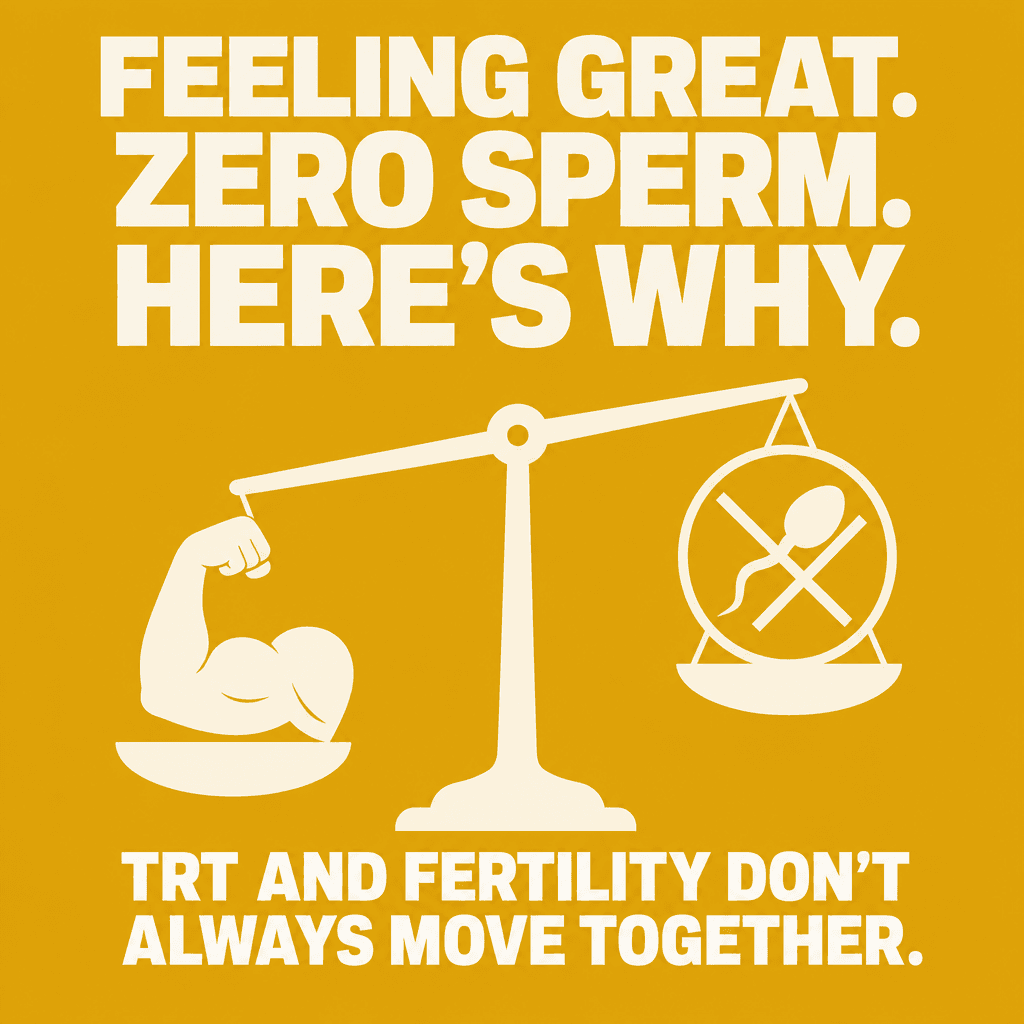
Most men who start testosterone replacement therapy are never warned it can make them infertile. That single gap in counseling has quietly affected the fertility of countless men who simply wanted to feel like themselves again.
The Biology Behind the Problem: What TRT Actually Does to Your Body
To understand why testosterone replacement therapy affects fertility, you need a basic picture of how your body normally produces testosterone and sperm. The process is governed by a communication loop called the hypothalamic-pituitary-testicular (HPT) axis, and it is elegant in its design but vulnerable to outside interference.
Your hypothalamus releases a signaling hormone that prompts the pituitary gland to release two critical gonadotropins: luteinizing hormone (LH) and follicle-stimulating hormone (FSH). LH tells the testes to produce testosterone from within. FSH drives spermatogenesis, the ongoing process of making sperm. The testosterone produced inside the testes, known as intratesticular testosterone, exists at concentrations far higher than what circulates in your bloodstream, and that high local concentration is what sperm production depends on.
When you introduce testosterone from an outside source, your brain detects rising levels and interprets the signal as "enough is already here." The hypothalamus and pituitary dial back their output accordingly. LH and FSH drop. The testes receive no instruction to produce their own testosterone or sperm. Intratesticular testosterone collapses. Spermatogenesis either slows dramatically or stops altogether.
The clinical result is oligospermia (very low sperm count) or azoospermia (zero sperm detected in the ejaculate). According to peer-reviewed research published in PubMed, this makes exogenous testosterone a preventable cause of male infertility, and the word "preventable" carries real weight here.
What the Data Actually Shows
The fertility impact of TRT is not rare or theoretical. It is consistent and well-documented across clinical literature. A 2025 review by Dr. Scott Lundy, MD, PhD, a reproductive urologist at Cleveland Clinic, found that most men who come in with fertility issues while on TRT have never been told the therapy can render them infertile and azoospermic. That is not a minor oversight. For a man trying to conceive, it can be a years-long detour.
Mayo Clinic lists limiting sperm production and testicular shrinkage as documented risks of testosterone therapy, alongside other considerations including increased red blood cell production, sleep apnea exacerbation, prostate stimulation, and gynecomastia. These are not fringe concerns flagged by skeptics. They are standard clinical disclosures that sometimes go unmentioned in rushed consultations.
Can Fertility Return After Stopping TRT?
For many men, yes. But the answer comes with important qualifications that every man considering TRT deserves to hear clearly.
After stopping therapy, the hormonal axis typically begins to recover within a few months. Serum LH and FSH gradually rise again as the external testosterone signal clears. But hormonal recovery and sperm recovery are not the same thing. Sperm production lags behind significantly, and the full recovery timeline, from stopping TRT to achieving a normal sperm count, can take 12 months or longer.
Research published on PubMed (PMID 27855957) found that both age and duration of TRT use are meaningful predictors of how quickly, and whether, spermatogenesis returns. Younger men who have been on therapy for a shorter period tend to recover more completely and more quickly. Older men with longer histories of TRT use face a slower and sometimes incomplete recovery.
There is also the question of pre-existing fertility issues. Some men who remain azoospermic after stopping TRT may have had underlying sperm production problems before they ever started therapy. This makes the baseline evaluation, discussed below, all the more important.
Recovery is possible for most men. It is not guaranteed for any man. That distinction matters enormously when someone is trying to start or grow a family.
A Common Misconception Worth Correcting
"More testosterone means better fertility" is one of the most persistent misunderstandings in men's health, and it has led more than a few men down the wrong path.
The logic seems intuitive: testosterone is associated with masculinity, strength, and reproductive function, so higher levels should support fertility, right? In reality, the opposite is true. High circulating testosterone from an external source suppresses the hormonal signals that the testes need to function. The testes require local hormonal instruction, not simply a high blood level.
A related misconception is that over-the-counter testosterone boosters, things marketed in supplement stores and online, carry the same risk. Most of these products do not contain actual testosterone and work through entirely different, and far less powerful, mechanisms. They do not significantly suppress the HPT axis. This does not mean they are effective for treating hypogonadism, but the fertility risk profile is different from prescription TRT.
Another common confusion: some men assume that because they felt sexually healthy before starting TRT, their fertility will bounce back quickly and completely once they stop. Sexual function and sperm production are related but distinct physiological processes. A man can have normal libido and erections with zero sperm in his ejaculate.
Options for Men Who Want to Treat Low Testosterone Without Sacrificing Fertility
This is where the conversation becomes more hopeful. For men who are dealing with real symptoms of hypogonadism but also want to preserve fertility, there are clinically recognized alternatives and adjuncts worth discussing with a knowledgeable provider.
Human chorionic gonadotropin (HCG) mimics the action of LH. When used appropriately, it can stimulate the testes to produce their own testosterone while keeping the signaling pathway active. Because it works through the body's existing hormonal axis rather than bypassing it, spermatogenesis can be maintained. Research published on PubMed (PMID 23260550) found that concomitant hCG use during testosterone therapy helps preserve intratesticular testosterone and, with it, some degree of sperm production in men who remain on TRT. And for men already on TRT who want to conceive, a newer study (PMID 39442683) found that a combination of HCG and FSH therapy can help optimally restore spermatogenesis.
Clomiphene citrate is another option sometimes used off-label in hypogonadal men. It works at the level of the hypothalamus and pituitary, blocking estrogen receptors there and prompting a natural increase in LH and FSH output. This, in turn, drives both endogenous testosterone production and sperm production. It is not appropriate for everyone, but for men with certain types of hypogonadism who want to preserve fertility, it is a meaningful clinical tool.
Anastrozole, an aromatase inhibitor, reduces the conversion of testosterone to estrogen. It can be useful in specific hormonal profiles and is sometimes used alongside other therapies. None of these options are one-size-fits-all, and none should be initiated without proper clinical evaluation. But they exist, they are being used, and they matter for men who come into a clinic hoping to address their symptoms without closing the door on fatherhood.
What You Should Do Before You Start
If you are considering TRT and have any interest in having biological children now or in the future, there are a few practical steps worth taking before your first dose.
Get a baseline semen analysis. This is not dramatic or complicated. It gives you and your provider a clear picture of where your fertility stands before therapy begins, which is invaluable context whether you end up starting TRT, pursuing alternatives, or deciding to wait.
Consider sperm banking. If you are starting TRT and there is any realistic chance you may want children later, banking sperm beforehand is the most direct form of fertility preservation available. Once TRT-related azoospermia sets in, that window has passed until after recovery, which may take a year or more.
Be honest about your timeline. Are you trying to conceive in the next year? In the next five? Are you certain your family is complete? The answers genuinely shape which approach makes the most sense for you. A man who is done having children may be a very different TRT candidate than a 30-year-old who wants kids someday.
Ask your provider directly: "What happens to my sperm production on this therapy, and what are my options if I want to have children?" A provider who cannot answer that question clearly is not the right fit for this conversation.
It is also worth understanding the regulatory context. The FDA approves testosterone replacement therapy for men who have low testosterone due to a confirmed medical condition, such as a genetic disorder, hypothalamic or pituitary dysfunction, or chemotherapy-related testicular damage. As of 2025, the FDA does not approve TRT for age-related testosterone decline alone. Knowing whether your symptoms reflect a diagnosable medical condition or natural aging affects both your treatment options and what monitoring should look like.
Why This Conversation Is Often Skipped
The fertility risk of TRT is not a secret. It is documented in clinical literature, noted by major institutions, and known to reproductive specialists. Yet men continue to start therapy without being informed.
Part of this reflects a fragmented healthcare system, where the provider prescribing TRT may not be the same one a man would eventually see for fertility concerns. Part of it reflects how consultations are structured: symptoms get addressed, a prescription is written, and downstream consequences like fertility do not always make it into the conversation.
The cost of finding out later is significant. Cleveland Clinic notes that trying to repair fertility after TRT can be expensive and time-consuming, and fertility-sparing medications like HCG can run several hundred dollars per month, often without insurance coverage.
Knowing this before you start, rather than after, is the entire point.
Making an Informed Decision With the Right Support
None of this is meant to suggest that TRT is wrong for every man who is dealing with low testosterone. For men who meet the clinical criteria, who have confirmed hypogonadism and real symptoms affecting their quality of life, and who are not pursuing fertility, TRT can be a meaningful and appropriate treatment. The goal here is simply that the decision be fully informed.
The men who fare best in navigating this are the ones who go into the conversation knowing what questions to ask, what their baseline looks like, and what their family plans actually are. They work with providers who take the time to understand those goals and build a monitoring plan around them.
At AlphaMD, clinicians work with men to evaluate symptoms, review hormone levels, discuss fertility goals, and think through the full picture before recommending a treatment path. Whether that means exploring TRT with appropriate precautions, considering fertility-preserving alternatives, or simply mapping out the right sequence of steps, the goal is care that accounts for the whole person, not just today's lab results.
Have a question? Ask us.
At AlphaMD, we're here to help. Feel free to ask us any question you would like about TRT, medical weightloss, ED, or other topics related to men's health. Or take a moment to browse through our past questions.
People are asking...
Other than fertility issues, are there any other concerns that a 26 year old man should have before starting trt? (Before starting I have taken 2 test...
In general, *current* fertility & hair loss are the main concerns providers weigh for otherwise healthy young men. 75% of men can be on a TRT program & still conceive a child with a high dose HCG regi... See Full Answer
At how long on TRT are men normally put in the category of being sterile? And how would being on DHT-derivatives increase the chances?...
TRT is essentially male birth control. All men on TRT will suppress sperm production while on treatment. But just like women on birth control, it is not 100% effective. While it varies by dose, about ... See Full Answer
I was just wondering if TRT ruins sperm quality? Not just like making you infertile, but what effect if any does TRT have on sperm quality and functio...
While on TRT, total sperm count and motility decrease. These changes are reversible once you stop TRT. Adding hCG can mitigate this effect while on TRT.... See Full Answer
Get $30 off your first month’s order
Enter your email address now to receive $30 off your first month’s cost, other discounts, and additional information about TRT.
Legal Disclaimer
This website is a repository of publicly available information and is not intended to form a physician-patient relationship with any individual. The content of this website is for informational purposes only. The information presented on this website is not intended to take the place of your personal physician's advice and is not intended to diagnose, treat, cure, or prevent any disease. Discuss this information with your own physician or healthcare provider to determine what is right for you. All information is intended for your general knowledge only and is not a substitute for medical advice or treatment for specific medical conditions. The information contained herein is presented in summary form only and intended to provide broad consumer understanding and knowledge. The information should not be considered complete and should not be used in place of a visit, phone or telemedicine call, consultation or advice of your physician or other healthcare provider. Only a qualified physician in your state can determine if you qualify for and should undertake treatment.