
Can Low Testosterone Cause Depression? What Men Need to Know
Published on:
Updated on:
People are asking...
I know a lot of guys get anxiety symptoms when on TRT. What do you find causes that? And what do you do about it?...
Low testosterone is a known cause for anxiety. For many men, TRT improves their anxiety significantly, or resolves it completely. In fact, the science backs this up: https://pubmed.ncbi.nlm.nih.gov/22... See Full Answer
With T fluctuations being so drastic from any given hour, day, week, how can you really know if someone has a hormonal imbalance?...
That is why symptoms are king, and numbers should be used as a guide post for what treatment is appropriate and how responsive someone is. Your 500 and my 500 will feel completely different to each of... See Full Answer
Can you discuss the phenomena of veterans experiencing low T from PTSD? Is this a legitimate thing?...
So, PTSD in and of itself does not cause low testosterone. However, veterans are at risk of hypogonadism for many reasons that often coincide with PTSD. So, first is that many environmental exposures ... See Full Answer
Have a question? Ask us.
At AlphaMD, we're here to help. Feel free to ask us any question you would like about TRT, medical weightloss, ED, or other topics related to men's health. Or take a moment to browse through our past questions.
Feeling persistently low, unmotivated, and emotionally flat is not something men should simply accept as part of getting older. For many men, those feelings have a biological driver that goes unexamined for years: low testosterone.
The connection between testosterone and mental health is real, measurable, and increasingly recognized in clinical practice. Yet the overlap between low testosterone symptoms and depression symptoms is significant enough that the two are routinely confused, misdiagnosed, or treated independently when they may share a common thread. Understanding that relationship is the first step toward actually feeling better.
What Depression Actually Is, and Why It Matters to Get This Right
Depression is not ordinary sadness. Everyone feels down after a difficult event, a loss, or a stretch of bad luck. Clinical depression is different. It is a persistent condition, typically lasting two weeks or more, that affects how a person thinks, feels, and functions across virtually every area of life.
Core symptoms include a loss of interest in activities that used to bring pleasure, persistent low mood, fatigue, difficulty concentrating, changes in sleep and appetite, feelings of worthlessness or excessive guilt, and in serious cases, thoughts of death or self-harm. Depression is a medical condition, not a character flaw or a failure of willpower, and it warrants proper clinical evaluation.
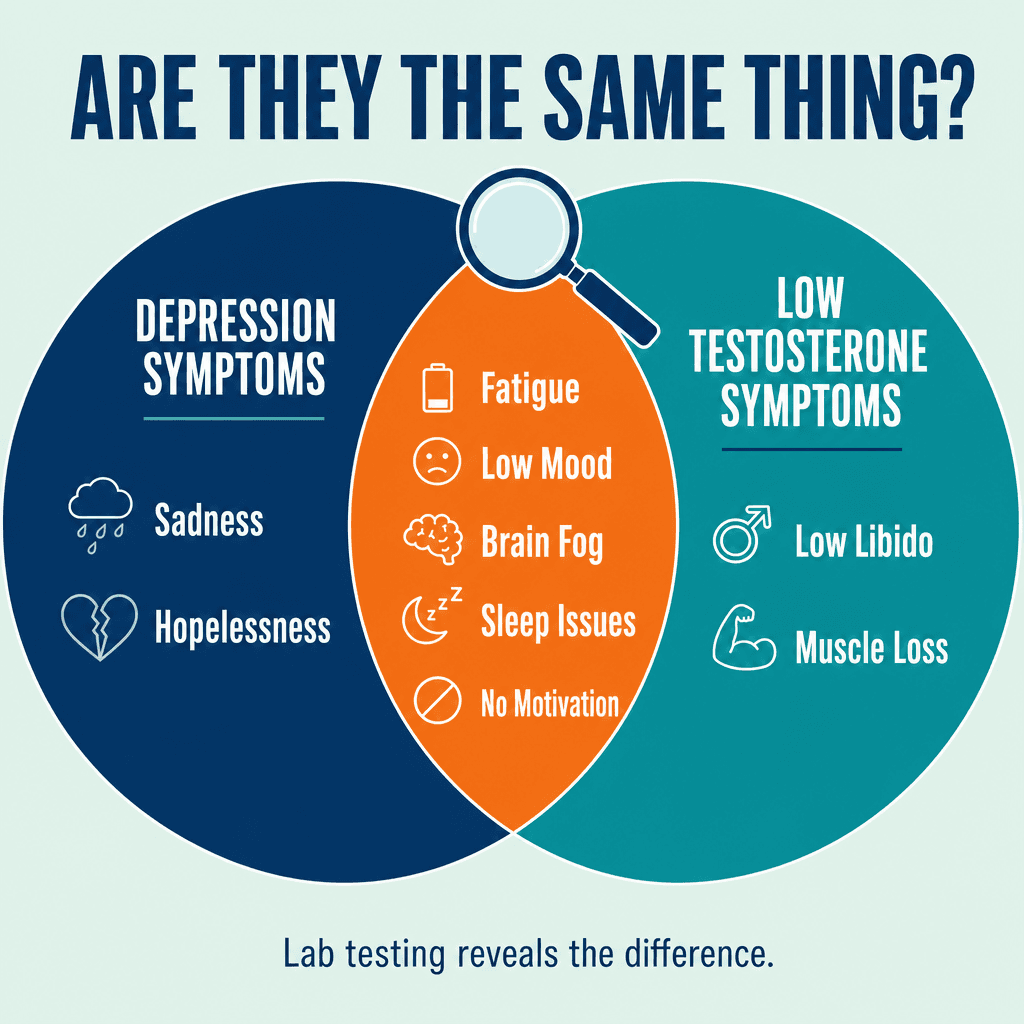
What makes this complicated for men is that many of those same symptoms, such as fatigue, low mood, poor sleep, reduced motivation, and diminished interest in sex, can also be caused by low testosterone. Without lab testing and a thorough evaluation, it is genuinely difficult to tell the difference by symptoms alone.
How Testosterone Influences Mood and Brain Chemistry
Testosterone is not just a hormone that governs muscle mass and libido. It plays a meaningful role in brain function. Testosterone receptors are distributed throughout the brain, including in regions associated with mood regulation, motivation, and stress response.
Research published through the National Institutes of Health has explored how androgens like testosterone interact with neurotransmitter systems, including serotonin and dopamine, both of which are heavily involved in mood, reward, and emotional regulation. When testosterone levels fall, these systems can be affected in ways that produce symptoms that look and feel like depression.
Beyond brain chemistry, low testosterone affects several other biological systems that feed into mental health:
Energy and fatigue. Testosterone supports cellular energy production. Men with low levels frequently describe a bone-deep tiredness that sleep does not seem to resolve. Chronic fatigue is both a symptom of low testosterone and a well-established contributor to depressive states.
Sleep quality. Low testosterone is associated with disrupted sleep architecture, meaning men may spend less time in the deeper, restorative stages of sleep even if they are technically in bed for enough hours. Poor sleep degrades mood, cognitive function, and emotional resilience rapidly.
Motivation and drive. Dopamine pathways are partly modulated by testosterone. When levels are low, many men report a loss of ambition, reduced competitiveness, and a blunted sense of reward, a state that closely mirrors the anhedonia seen in clinical depression.
Stress response. Testosterone interacts with cortisol, the body's primary stress hormone. Low testosterone can tip the balance toward elevated cortisol, creating a hormonal environment that promotes anxiety, irritability, and emotional dysregulation.
Where the Symptoms Overlap and Where They Diverge
The symptom overlap between hypogonadism (clinically low testosterone) and depression is substantial enough that the Mayo Clinic lists mood changes, depression, and difficulty concentrating as recognized symptoms of male hypogonadism. This is not coincidental.
Both conditions can present with fatigue, low mood, poor concentration, sleep disturbances, reduced libido, and social withdrawal. One meaningful distinction is that low testosterone often also produces physical signs: reduced muscle mass, increased body fat particularly around the abdomen, decreased body hair, and sometimes erectile dysfunction. These physical markers can be important clues that something hormonal is contributing to the picture.
However, some men with low testosterone present primarily with emotional and cognitive symptoms, making the hormonal component easy to miss without testing. Conversely, men with clinical depression can experience physical symptoms too. This is exactly why a thorough evaluation matters more than guessing.
Why Self-Diagnosis Is Risky
It is tempting to read a list of symptoms, recognize yourself in them, and draw a conclusion. But treating yourself as if you have low testosterone when the actual problem is depression, or vice versa, can delay effective care and, in the case of depression, can carry serious consequences.
Depression exists on a spectrum. For some men, it is a manageable condition that responds well to lifestyle changes and therapy. For others, it becomes severe and requires urgent psychiatric intervention. If you are experiencing thoughts of suicide or self-harm, that is a psychiatric emergency. Contact the 988 Suicide and Crisis Lifeline by calling or texting 988, or go to your nearest emergency room. Hormonal testing can wait. That cannot.
For everyone else, the safer and smarter path is a proper evaluation that considers both mental health and hormonal health together.
Common Contributors That Complicate the Picture
Before attributing mood problems entirely to low testosterone or depression, it is worth recognizing the long list of factors that can suppress testosterone, worsen mood, or produce symptoms of both:
Sleep apnea is one of the most underdiagnosed contributors. It fragments sleep, suppresses testosterone production, and significantly worsens mood. Many men are shocked to discover that treating sleep apnea produces meaningful improvements in both their energy and their emotional state.
Obesity creates a feedback loop where excess body fat increases the conversion of testosterone to estrogen, further lowering free testosterone. Excess weight is also independently associated with depression.
Chronic stress elevates cortisol, which directly suppresses testosterone production. Men in high-pressure professional or personal situations may have clinically low testosterone that normalizes if the stress is addressed.
Alcohol is a central nervous system depressant and a direct testicular toxin. Regular heavy drinking lowers testosterone and worsens depression simultaneously.
Certain medications, including some antidepressants, opioids, corticosteroids, and antihypertensives, can suppress testosterone or worsen mood as a side effect.
Thyroid dysfunction produces fatigue, mood changes, and cognitive fog that closely mimic both low testosterone and depression. It needs to be ruled out.
Vitamin and nutrient deficiencies, particularly vitamin D, zinc, and magnesium, are associated with lower testosterone and poorer mood outcomes.
Relationship strain and social isolation are powerful independent drivers of depression and chronic stress, which in turn affect hormonal health.
Overtraining without adequate recovery suppresses testosterone acutely and over time, a pattern seen in endurance athletes and men who train excessively without nutrition support.
A thorough evaluation will account for many of these variables rather than jumping straight to a single diagnosis.
When to Consider Lab Testing and What It Involves
If you have been experiencing persistent fatigue, low mood, reduced motivation, poor sleep, or diminished libido for several weeks or longer, lab testing is a reasonable next step. You do not need to be in crisis to warrant an evaluation.
A comprehensive hormonal and metabolic panel typically includes total and free testosterone, sex hormone-binding globulin, luteinizing hormone, follicle-stimulating hormone, estradiol, thyroid function markers, a complete metabolic panel, a complete blood count, vitamin D, and often other markers depending on your symptoms and history. This kind of workup gives a clinician a much clearer picture of what is actually driving your symptoms.
Fertility is worth raising with your provider at this stage if it is relevant to you. Certain treatment options, specifically testosterone replacement therapy, can suppress sperm production while in use. Men who wish to preserve fertility may be candidates for alternatives like human chorionic gonadotropin, which supports the body's own testosterone production rather than replacing it externally. Having that conversation before starting treatment is far easier than navigating it afterward.
Treatment Is Not One-Size-Fits-All
When low testosterone is confirmed and contributing to mood symptoms, treatment options should be considered thoughtfully in the context of the whole person.
Lifestyle interventions are the foundation for everyone. Resistance training consistently raises testosterone and improves mood. Prioritizing sleep, reducing alcohol, managing body weight, and addressing chronic stress are not optional add-ons. They are clinically meaningful and sometimes sufficient on their own.
Mental health care should not be bypassed simply because a hormonal cause is suspected. Cognitive behavioral therapy and other evidence-based approaches are effective for depression regardless of its underlying cause. If a psychiatric evaluation suggests that an antidepressant is appropriate, that is a legitimate clinical path that can sometimes be pursued alongside hormonal treatment.
Hormone optimization, when clinically indicated, can be genuinely life-changing for men whose mood symptoms are rooted in hormonal deficiency. Sermorelin, a growth hormone-releasing peptide, is another option some men explore for supporting overall hormonal balance, recovery, and energy, often alongside primary hormonal treatment.
The goal is not to find a single answer and stop there. It is to build a complete clinical picture and address every contributing factor that can be identified.
Getting the Evaluation You Deserve
Men are often the last to seek help for mental health concerns or hormonal symptoms. Cultural pressure to push through, stay stoic, and avoid appearing vulnerable keeps too many men suffering in silence for years longer than necessary.
The relationship between low testosterone and depression is not fully understood in every detail, but the clinical evidence is clear enough that dismissing it is no longer acceptable. If something feels persistently wrong, whether that is emotional flatness, exhaustion, or a loss of the drive that used to define you, that experience deserves a real investigation.
Through AlphaMD, licensed providers who focus on men's health and hormonal optimization offer comprehensive evaluations that take both your labs and your lived experience seriously. Getting answers does not require a months-long wait or an awkward conversation with a provider who dismisses your concerns. It requires working with a provider who actually understands the complexity of male hormonal health and is equipped to help you address it.
Have a question? Ask us.
At AlphaMD, we're here to help. Feel free to ask us any question you would like about TRT, medical weightloss, ED, or other topics related to men's health. Or take a moment to browse through our past questions.
People are asking...
I know a lot of guys get anxiety symptoms when on TRT. What do you find causes that? And what do you do about it?...
Low testosterone is a known cause for anxiety. For many men, TRT improves their anxiety significantly, or resolves it completely. In fact, the science backs this up: https://pubmed.ncbi.nlm.nih.gov/22... See Full Answer
With T fluctuations being so drastic from any given hour, day, week, how can you really know if someone has a hormonal imbalance?...
That is why symptoms are king, and numbers should be used as a guide post for what treatment is appropriate and how responsive someone is. Your 500 and my 500 will feel completely different to each of... See Full Answer
Can you discuss the phenomena of veterans experiencing low T from PTSD? Is this a legitimate thing?...
So, PTSD in and of itself does not cause low testosterone. However, veterans are at risk of hypogonadism for many reasons that often coincide with PTSD. So, first is that many environmental exposures ... See Full Answer
Get $30 off your first month’s order
Enter your email address now to receive $30 off your first month’s cost, other discounts, and additional information about TRT.
Legal Disclaimer
This website is a repository of publicly available information and is not intended to form a physician-patient relationship with any individual. The content of this website is for informational purposes only. The information presented on this website is not intended to take the place of your personal physician's advice and is not intended to diagnose, treat, cure, or prevent any disease. Discuss this information with your own physician or healthcare provider to determine what is right for you. All information is intended for your general knowledge only and is not a substitute for medical advice or treatment for specific medical conditions. The information contained herein is presented in summary form only and intended to provide broad consumer understanding and knowledge. The information should not be considered complete and should not be used in place of a visit, phone or telemedicine call, consultation or advice of your physician or other healthcare provider. Only a qualified physician in your state can determine if you qualify for and should undertake treatment.