
Can KPV Heal the Gut Lining, or Is the Claim Based Mostly on Mice?
Published on:
Updated on:
People are asking...
Men on TRT getting hair transplants - can they bolster recovery by layering on anything else over TRT? Fin/min is a given....
The peptides GHK-Cu and BPC-157 have shown some benefits in assisting with recovery and regrowth after a hair transplant.... See Full Answer
What your thoughts are on men with Crohn's disease taking testosterone I know my levels are low from years of severe malnutrition and Prednisone use i...
Testosterone is actually an approved treatment for Crohn's Disease Testosterone therapy in men with Crohn's disease improves the clinical course of the disease: data from long-term observational regi... See Full Answer
What you are doing is awesome guys! I would highly appreciate your input on my case. I have been working out in the gym/calisthenics/swimming/jogging...
To answer your questions in order: Varicocele is one of the only truly reversible causes of hypogonadism. It is a fairly minor procedure, so if you can get it taken care of now, there is a possibility... See Full Answer
Have a question? Ask us.
At AlphaMD, we're here to help. Feel free to ask us any question you would like about TRT, medical weightloss, ED, or other topics related to men's health. Or take a moment to browse through our past questions.
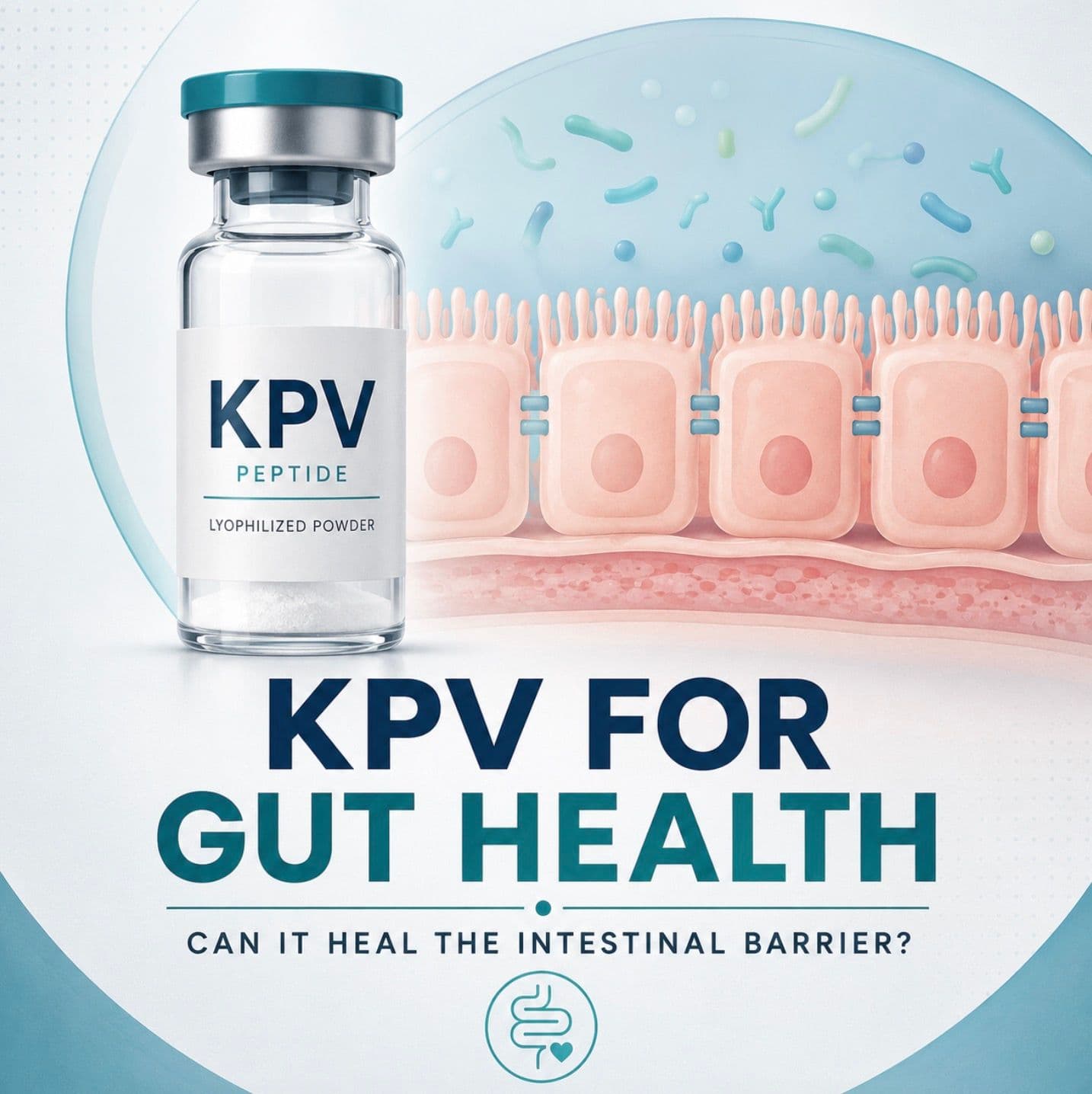
"Heals the gut lining" is one of the most common claims attached to KPV, a tripeptide sold online for leaky gut, inflammatory bowel disease, and general digestive inflammation. The claim draws on real research: KPV does have a documented relationship with intestinal inflammation. What the claim skips over is where that research actually took place, in isolated cells and in mice with chemically induced colitis, and what it actually measured, which in most cases was inflammation, not a repaired barrier. This article separates what the intestinal barrier is, what KPV research has shown about it, and what would still need to be demonstrated before "heals the gut lining" could be called an established fact rather than a hypothesis.
What the Intestinal Barrier Actually Does
The intestinal barrier is not a single wall but a layered system. A mucus layer coats the intestinal surface and physically separates most bacteria from the tissue underneath. Beneath that sits a single layer of epithelial cells, joined to their neighbors by tight junction protein complexes, including claudins, occludin, and ZO-1, that control what can pass between cells rather than through them. Beneath the epithelium sits the lamina propria, dense with immune cells that respond if bacteria or bacterial products do get through. A healthy barrier lets nutrients absorb efficiently while keeping bacteria, toxins, and undigested food particles largely out of the bloodstream. Disruption of any one of these layers, mucus thinning, tight junction opening, or immune overactivation, can increase what researchers call intestinal permeability.
What "Leaky Gut" Means Clinically and Online
Online, "leaky gut" is used as a catch-all explanation for bloating, fatigue, skin problems, food sensitivities, and autoimmune disease. Clinically, the picture is narrower. Increased intestinal permeability is a real, measurable phenomenon, documented in specific diseases such as inflammatory bowel disease and celiac disease, using methods like the lactulose-mannitol urine test or the Ussing chamber, an apparatus that measures ion transport across a biopsied piece of intestinal tissue. But "leaky gut syndrome" as a standalone diagnosis, the idea that permeability itself is a disease that causes unrelated symptoms and can be diagnosed with a blood or stool panel, is not accepted in mainstream gastroenterology. Review the peer-reviewed review of leaky gut syndrome myths and management, which states plainly that no validated test currently exists to make that diagnosis. A separate clinical review of intestinal permeability testing concludes even more directly that the diagnosis of "leaky gut" has no role in the diagnosis or treatment of human disease. That gap between the popular framing and the clinical one matters here, because most KPV marketing for gut health is built on the popular version.
KPV's Proposed Relationship With Inflammatory Signaling
The actual research behind KPV and the gut is more specific than "heals leaky gut." Researchers found that KPV is transported into human intestinal epithelial cells and immune cells by a transporter called PepT1, which is normally expressed in the small intestine and becomes more active in the colon during inflammatory bowel disease. Once inside the cell, KPV was shown to reduce activation of the NF-kB and MAP kinase inflammatory signaling pathways, lowering the secretion of pro-inflammatory cytokines. Review the study identifying KPV's PepT1-mediated anti-inflammatory mechanism. This is a genuine, well-characterized mechanism. It is a mechanism for calming an inflammatory signal inside a cell, not a demonstrated mechanism for rebuilding a damaged barrier structure, and the distinction matters for everything that follows.
Whether It Repairs Tight Junctions
This is the specific claim closest to "heals the gut lining," and it has been directly tested, but only in mice. A 2024 study built a nanodrug combining KPV with the immunosuppressant FK506 and used immunohistochemistry to measure tight junction proteins, claudin-5, occludin, and ZO-1, in the colon tissue of mice with DSS-induced colitis. Review the tight junction protein study in a mouse colitis model. The results were more modest for KPV than headlines suggest: tight junction protein expression, which drops during colitis, was only mildly restored by KPV alone. The combined nanodrug, which paired KPV with a second drug inside an engineered delivery particle, produced substantially stronger tight junction restoration than KPV by itself. Separately, an earlier nanoparticle study found that hyaluronic-acid-targeted KPV nanoparticles accelerated markers of mucosal healing in colitis mice more effectively than untargeted KPV. Both findings point the same direction: some tight-junction-related benefit has been measured with KPV in mice, it is generally modest for KPV alone, and the more meaningful effects required an engineered delivery system rather than the peptide by itself. Neither study involved a human intestine.
Cell Experiments Versus Whole-Body Outcomes
A significant portion of the KPV gut evidence base comes from human intestinal epithelial cell lines such as Caco2-BBE and HT29-Cl.19A, grown in a dish and exposed to inflammatory triggers with and without KPV. These experiments are how researchers identified the PepT1 transporter and the NF-kB pathway in the first place, and they are legitimate mechanistic science. But a monolayer of cultured cells has no mucus layer, no immune system, no blood supply, and no intact barrier architecture to repair. It cannot tell researchers whether an intact intestinal barrier, in a living body, becomes measurably less permeable after KPV exposure. That question requires a whole organism, which is why the field moved to mouse models next, and why a whole-body claim built only on cell-culture data outruns what the cell-culture data can show.
Mouse Colitis Models Versus Human Inflammatory Bowel Disease
The DSS and TNBS colitis models used in KPV research work by chemically damaging the mouse colon lining directly, which triggers an inflammatory response researchers can then measure and try to reduce. Review the original DSS and TNBS colitis studies of oral KPV. Human ulcerative colitis and Crohn's disease are immune-mediated diseases with a different, more complex, and only partially understood cause. A chemical injury model in a mouse is a reasonable, standard way to screen anti-inflammatory candidates, but it is not equivalent to human IBD, and a treatment that reduces damage in a chemical injury model does not automatically reduce disease activity in a person with an immune-driven condition. It is also worth noting how rigorously human IBD healing is actually measured in clinical medicine: validated histological scoring systems such as the Geboes score, the Nancy Index, and the Robarts Histopathology Index define mucosal healing in human ulcerative colitis by the near-total absence of specific inflammatory cells in biopsied tissue, not simply by a reduction in symptoms or blood markers. No KPV study, mouse or human, has yet been evaluated against that human clinical standard.
Whether Ordinary Oral Capsules Reach Inflamed Colon Tissue
Every mouse colitis study discussed above delivered KPV in one of two ways: added directly to drinking water at a research dose, or wrapped in an engineered nanoparticle designed specifically to survive the stomach and release its payload in the colon. Free peptides, in general, have notoriously poor oral bioavailability, typically well under 1 percent, because they are broken down by stomach acid and digestive enzymes before much of the intact molecule can be absorbed. KPV's small size does give it a route through the gut wall via the PepT1 transporter, but whether a tripeptide survives long enough in the digestive tract to reach that transporter intact depends heavily on its exact structure, and hydrolysis by digestive enzymes competes directly with transport for many di- and tripeptides. This is precisely why researchers built nanoparticle and hydrogel delivery systems for KPV in the first place: one study found that KPV encapsulated in a targeted nanoparticle achieved therapeutic effects in mouse colitis at a dose roughly 12,000 times lower than free KPV in solution. Review the nanoparticle-encapsulated KPV colitis study. That gap is a strong signal that free, unprotected KPV, the form found in an ordinary oral capsule sold online, faces a real and substantial delivery problem before it ever reaches inflamed colon tissue in meaningful amounts. No study has measured how much intact KPV from a standard oral capsule actually reaches human colon tissue.
Why Reduced Inflammation Does Not Prove Complete Mucosal Healing
Most positive KPV findings, in cells and in mice, are inflammation measurements: cytokine levels, myeloperoxidase activity, weight loss, or general histological inflammation scores. These are legitimate, standard outcome measures in preclinical research, and reducing inflammation is not a trivial finding. But "reduced inflammation" and "healed intestinal barrier" are not the same claim. A barrier can remain structurally compromised, with disrupted tight junctions and abnormal permeability, even as inflammatory cytokine levels fall, and the reverse can also occur. In human ulcerative colitis, this is exactly why gastroenterology has moved toward histological healing as a stricter, separate endpoint from clinical symptom improvement or endoscopic appearance alone, because patients can look better on the surface while still showing active microscopic inflammation that predicts relapse. No KPV study to date has demonstrated complete, structurally confirmed mucosal healing, by any of the validated human histological standards, in a living patient. The honest summary of the evidence is that KPV reduces inflammatory signals in cells and in mice. It has not been shown to heal a human intestinal barrier.
The Bottom Line
KPV has a real, well-characterized anti-inflammatory mechanism, mediated through the PepT1 transporter and the NF-kB signaling pathway, demonstrated in human cell lines and confirmed across multiple mouse colitis studies. Mouse research has also shown modest tight junction protein restoration with KPV alone, and more substantial restoration when KPV is delivered through an engineered nanoparticle rather than as a free peptide. None of this adds up to evidence that an oral KPV capsule heals the human intestinal barrier. "Leaky gut" as a standalone diagnosis is not recognized in mainstream gastroenterology, the free peptide faces a real oral delivery problem before it reaches inflamed colon tissue, human ulcerative colitis is not the same disease process as chemically induced mouse colitis, and no study has measured structurally confirmed mucosal healing in a human patient taking KPV. The claim that KPV heals the gut lining is a hypothesis with real mechanistic support, built almost entirely on mice, not a demonstrated human outcome.
For a broader look at what KPV research has and has not shown in people, see AlphaMD's KPV human studies audit and KPV benefits, risks, and side effects overview. For a comparison peptide studied specifically for ulcerative colitis, see AlphaMD's BPC-157 for gut health overview.
Medical disclaimer: This article is for informational purposes only and does not constitute medical advice. KPV is not currently an FDA-approved drug. Persistent digestive symptoms should be evaluated by a licensed medical provider. Speak with a doctor before using any medication, peptide, supplement, or injectable product.
Have a question? Ask us.
At AlphaMD, we're here to help. Feel free to ask us any question you would like about TRT, medical weightloss, ED, or other topics related to men's health. Or take a moment to browse through our past questions.
People are asking...
Men on TRT getting hair transplants - can they bolster recovery by layering on anything else over TRT? Fin/min is a given....
The peptides GHK-Cu and BPC-157 have shown some benefits in assisting with recovery and regrowth after a hair transplant.... See Full Answer
What your thoughts are on men with Crohn's disease taking testosterone I know my levels are low from years of severe malnutrition and Prednisone use i...
Testosterone is actually an approved treatment for Crohn's Disease Testosterone therapy in men with Crohn's disease improves the clinical course of the disease: data from long-term observational regi... See Full Answer
What you are doing is awesome guys! I would highly appreciate your input on my case. I have been working out in the gym/calisthenics/swimming/jogging...
To answer your questions in order: Varicocele is one of the only truly reversible causes of hypogonadism. It is a fairly minor procedure, so if you can get it taken care of now, there is a possibility... See Full Answer
Get $30 off your first month’s order
Enter your email address now to receive $30 off your first month’s cost, other discounts, and additional information about TRT.
Legal Disclaimer
This website is a repository of publicly available information and is not intended to form a physician-patient relationship with any individual. The content of this website is for informational purposes only. The information presented on this website is not intended to take the place of your personal physician's advice and is not intended to diagnose, treat, cure, or prevent any disease. Discuss this information with your own physician or healthcare provider to determine what is right for you. All information is intended for your general knowledge only and is not a substitute for medical advice or treatment for specific medical conditions. The information contained herein is presented in summary form only and intended to provide broad consumer understanding and knowledge. The information should not be considered complete and should not be used in place of a visit, phone or telemedicine call, consultation or advice of your physician or other healthcare provider. Only a qualified physician in your state can determine if you qualify for and should undertake treatment.