
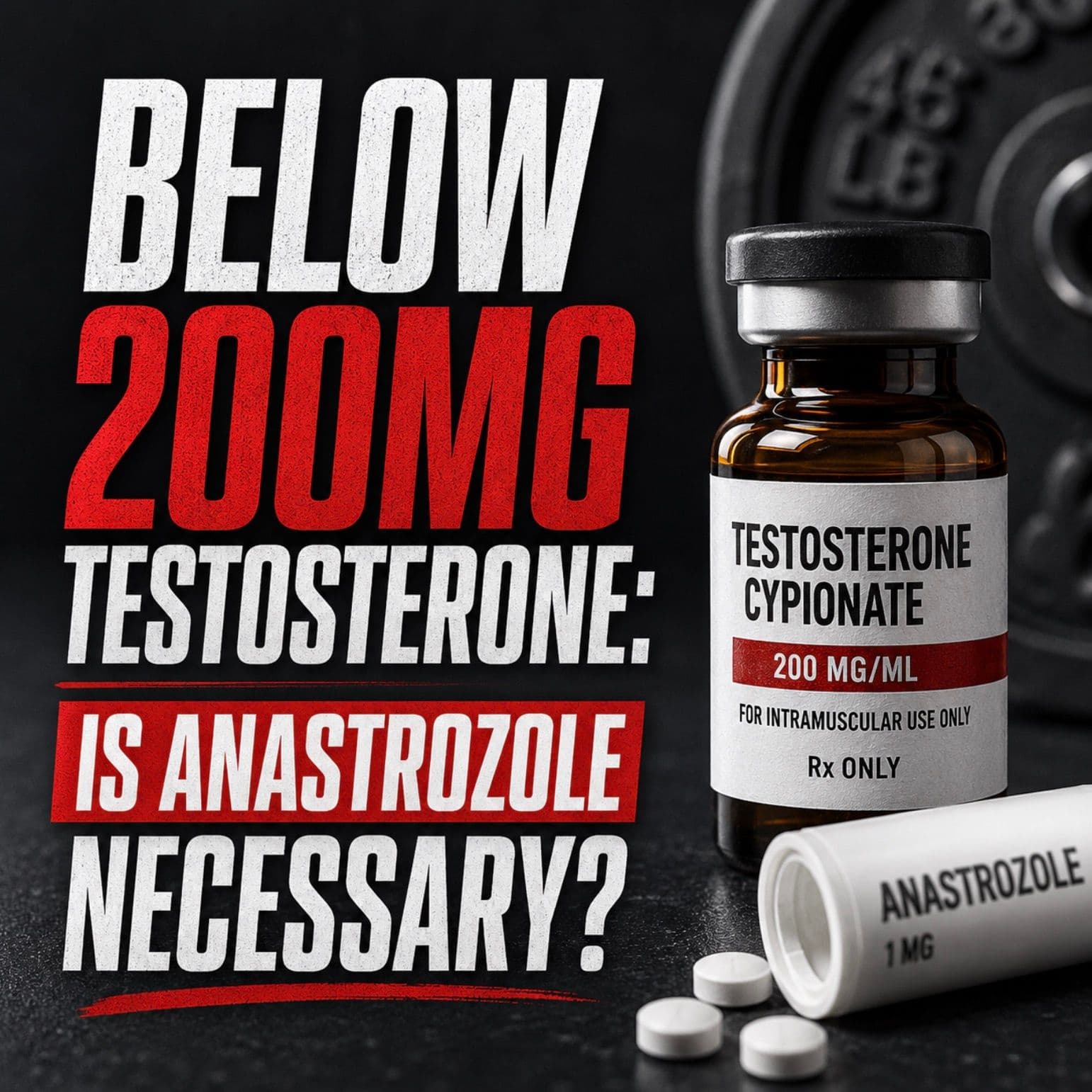
Below 200mg Testosterone: Is Anastrozole (AIs) Necessary?
Published on:
Updated on:
People are asking...
Why do some people here say to only use AI like Anastrozole if symptoms appear but some TRT clinics just put men on it proactively regardless of havin...
To be blunt a lot of online clinics will just put you on a far higher Testosterone level than you need, then assume you'll have side effects like high Estrogen, and put you on an AI knowing that so th... See Full Answer
Any chance there will be AI's in dosages for TRT? All the AI dosages are made for women and men just need a fraction of that. Would be pretty nice if...
Yes. With AlphaMD, providers often lean on trying to avoid AI use via other Estrogen control methods first. If you do need an AI, the provider overseeing your care tends to start pretty conservatively... See Full Answer
I just started TRT and was put on 180 mg test cypionate and anastrozole. Reddit hates AI but my physician put me on it. The huge amount of people sayi...
Never let the people on the internet get between you and a physician you trust. That being said, here are some general thoughts… The primary idea in any field of medicine is that “less is more”. By th... See Full Answer
Have a question? Ask us.
At AlphaMD, we're here to help. Feel free to ask us any question you would like about TRT, medical weightloss, ED, or other topics related to men's health. Or take a moment to browse through our past questions.
Anastrozole is not automatically necessary when taking less than 200 mg of testosterone per week. It is also not automatically necessary at 200 mg or above.
The need for an aromatase inhibitor should be based on your symptoms, testosterone level, estradiol level, treatment response, and overall health. A weekly testosterone dose by itself cannot determine whether anastrozole is appropriate.
In many cases, the first step is not adding another medication. A clinician may instead review the testosterone dose, injection schedule, laboratory timing, and whether the symptoms are actually being caused by estradiol.
Key takeaways
- There is no universal testosterone dose at which anastrozole becomes necessary.
- Men need estradiol for bone health, sexual function, body composition, and other physiological processes.
- Breast tenderness or gynecomastia are among the clearest reasons to evaluate estradiol during TRT.
- Unnecessarily suppressing estradiol can create new symptoms and potential long-term health concerns.
- Anastrozole should be used only when there is a clear clinical reason and appropriate medical monitoring.
What is anastrozole?
Anastrozole is an aromatase inhibitor. Aromatase is an enzyme that converts a portion of testosterone into estradiol, the primary form of estrogen measured in men.
By inhibiting aromatase, anastrozole reduces the amount of estradiol produced from testosterone.
Anastrozole is FDA-approved for certain forms of breast cancer in postmenopausal women. Its use in men, including men receiving testosterone replacement therapy, is considered off-label.
Off-label prescribing is common in medicine, but it means the medication should not be treated as an automatic or standard addition to every TRT protocol.
Does TRT increase estradiol?
It can.
Because some testosterone is naturally converted into estradiol, increasing the amount of testosterone available in the body may also increase estradiol. How much this happens varies considerably between patients.
Two men can use the same testosterone dose and have very different total testosterone, free testosterone, and estradiol results. Differences in metabolism, body composition, medication absorption, injection timing, treatment frequency, and individual aromatase activity can all affect the outcome.
This is why a dose such as 100, 150, or 200 mg per week cannot predict by itself whether a patient will experience an estradiol-related problem.
Is 200 mg of testosterone a special cutoff?
No. There is no evidence-based rule stating that men below 200 mg do not need anastrozole or that men at 200 mg automatically do.
Clinical guidelines focus on the testosterone level achieved in the patient, not simply the number of milligrams prescribed. The American Urological Association recommends adjusting testosterone therapy to achieve a total testosterone level in the middle portion of the laboratory’s normal reference range.
That approach recognizes that the same dose may be inadequate for one patient and excessive for another.
A patient taking 120 mg per week could potentially have high on-treatment testosterone and estradiol levels. Another patient taking a higher dose could remain within an appropriate physiological range. The prescription must therefore be interpreted alongside properly timed laboratory results and clinical response.
Does every man on TRT need an aromatase inhibitor?
No.
There is no guideline-based recommendation that every man receiving TRT should also receive anastrozole. The American Urological Association specifically recommends checking estradiol in patients who develop breast symptoms or gynecomastia during testosterone therapy and monitoring estradiol in patients who are taking aromatase inhibitors.
In one retrospective study of 1,708 men receiving testosterone therapy at a high-volume sexual medicine practice, only 44 men, or approximately 2.6%, were treated with anastrozole under that clinic’s criteria. That single study does not establish a universal treatment protocol, but it demonstrates that aromatase inhibitor use is not inevitable for men on TRT.
The goal of TRT is not to eliminate estrogen. It is to restore an appropriate hormonal environment while improving symptoms and avoiding unnecessary side effects.
Why men need estradiol
Estradiol is often described as a female hormone, but it also performs essential functions in men.
Research involving controlled suppression of testosterone and estradiol has found that estradiol contributes to the regulation of body fat and sexual function. Testosterone and estradiol both appear to influence aspects of male sexual health.
Estradiol is also important for maintaining bone strength. In a randomized trial involving older men, treatment with anastrozole increased testosterone and lowered estradiol but was associated with a reduction in spinal bone mineral density compared with placebo.
Another randomized study comparing testosterone treatment with aromatase inhibition concluded that the conversion of testosterone into estradiol was necessary for maintaining bone mineral density in older men with low testosterone.
Small experimental studies have also raised questions about the metabolic effects of aggressive estrogen suppression. In one randomized crossover trial involving healthy men, anastrozole reduced peripheral insulin sensitivity after six weeks. The study was small and does not establish the long-term effect in TRT patients, but it reinforces that estradiol is metabolically active and should not be suppressed without a reason.
What are possible signs of an estradiol-related problem?
The symptoms most likely to prompt estradiol evaluation during TRT include:
- New or persistent nipple tenderness
- Breast sensitivity
- Development or enlargement of palpable breast tissue
- Gynecomastia that appears or worsens after starting treatment
Some men also associate fluid retention, emotional changes, lower libido, or erectile changes with elevated estradiol. However, these symptoms are nonspecific.
They can also be related to testosterone levels that are too high or too low, medication fluctuations, poor sleep, stress, thyroid problems, elevated prolactin, cardiovascular issues, relationship factors, or unrelated medical conditions.
Symptoms alone cannot confirm high estradiol. Likewise, a laboratory result alone does not always prove that estradiol is causing the symptoms.
What estradiol level is considered too high on TRT?
There is no single estradiol number that automatically requires anastrozole in every man.
Reference ranges vary between laboratories, and estradiol testing can be challenging at the relatively low concentrations found in men. The Endocrine Society has noted that some commonly used estradiol assays may lack sufficient sensitivity and accuracy at male estradiol concentrations.
A result should therefore be interpreted according to:
- The laboratory method and reference range
- The patient’s symptoms
- Total and free testosterone levels
- Timing of the blood draw relative to the testosterone dose
- Previous estradiol results
- Changes in dose, frequency, or formulation
- Whether the patient is already taking an aromatase inhibitor
Consistent testing conditions are important. Comparing a peak result taken shortly after an injection with a trough result taken immediately before the next injection can create a misleading impression that hormone levels have changed dramatically.
What should happen before adding anastrozole?
When a patient develops possible estrogen-related symptoms, a clinician may first review the complete TRT protocol rather than immediately adding an aromatase inhibitor.
Confirm the symptoms and laboratory results
Breast tenderness, gynecomastia, and other symptoms should be evaluated rather than automatically attributed to estrogen. Testosterone and estradiol testing should be interpreted in the context of when the medication was administered.
Review the testosterone level
If testosterone is above the intended treatment range, reducing the testosterone dose may also reduce the amount available for conversion into estradiol.
The AUA guideline indicates that when persistent breast symptoms occur with elevated estradiol and testosterone is in the upper portion of the normal range, adjusting the testosterone dose may be appropriate before relying on an aromatase inhibitor.
Review the treatment schedule
Large fluctuations between testosterone peaks and troughs may affect both symptoms and laboratory results. Depending on the patient and formulation, a clinician may consider changing the dosing frequency or delivery method.
This should be individualized. Dividing injections is not a guaranteed solution for elevated estradiol, but treatment timing is one factor that can be reviewed before another medication is added.
Consider other causes
Breast symptoms can have causes unrelated to TRT. Medications, liver disease, thyroid disorders, elevated prolactin, significant weight changes, and other hormonal conditions may need to be considered.
Persistent breast enlargement, a firm breast mass, nipple discharge, skin changes, or symptoms affecting only one side require medical evaluation.
When might anastrozole be considered?
Anastrozole may be considered when a patient has persistent clinically meaningful symptoms, elevated estradiol confirmed by appropriate testing, and no better explanation for the problem.
It may be particularly relevant when:
- Breast tenderness or gynecomastia persists
- Estradiol remains elevated on repeat testing
- Testosterone is not excessively high
- Adjusting the TRT protocol has not resolved the problem
- A clinician determines that the expected benefit outweighs the risks
When it is prescribed, conservative dosing and follow-up testing are important. The doses used in men on TRT are not necessarily the same as the FDA-approved breast cancer dose.
Patients should not borrow anastrozole, use bodybuilding protocols found online, or change their dose based only on a single estradiol result.
Can anastrozole lower estrogen too much?
Yes.
Because anastrozole inhibits estradiol production, an excessive dose can push estradiol below a healthy range. Possible consequences of excessive estrogen suppression may include sexual dysfunction, hot flashes, changes in body composition, and reduced bone mineral density.
The FDA-approved prescribing information also warns that anastrozole can reduce bone mineral density and may affect cholesterol, although those warnings are primarily based on its studied use in women with breast cancer.
Men who require longer-term aromatase inhibitor therapy may need continued hormone monitoring and, depending on their health history and duration of treatment, consideration of bone and metabolic health.
Can you need anastrozole below 200 mg?
Yes, but the testosterone dose alone is not the reason.
A man taking less than 200 mg per week could potentially develop persistent breast symptoms and have elevated estradiol on appropriate testing. In that situation, anastrozole might be considered after the full treatment protocol has been reviewed.
The reverse is also true. A man taking 200 mg per week does not automatically require an aromatase inhibitor if his testosterone and estradiol are appropriate, he is feeling well, and he has no clinically significant estrogen-related symptoms.
Should you stop taking anastrozole if you feel fine?
Do not discontinue or change a prescribed medication without discussing it with the clinician managing your TRT.
Feeling well may mean the medication is working, but it could also mean that the underlying TRT protocol has changed or that the anastrozole dose is no longer necessary. Follow-up laboratory testing can help determine whether estradiol is appropriately controlled or has become too low.
The bottom line
Being below 200 mg of testosterone per week does not prove that anastrozole is unnecessary. Being at or above 200 mg does not prove that it is needed.
The appropriate decision depends on symptoms, properly timed laboratory testing, the testosterone level achieved, estradiol results, and the patient’s overall response to treatment.
Anastrozole can be useful for selected patients, but it should not be included automatically in every TRT protocol. Estradiol is an important male hormone, and the objective should be balance rather than complete suppression.
Patients experiencing breast tenderness, gynecomastia, or other new symptoms during TRT should speak with their prescribing clinician before adding, stopping, or changing an aromatase inhibitor.
Have a question? Ask us.
At AlphaMD, we're here to help. Feel free to ask us any question you would like about TRT, medical weightloss, ED, or other topics related to men's health. Or take a moment to browse through our past questions.
People are asking...
Why do some people here say to only use AI like Anastrozole if symptoms appear but some TRT clinics just put men on it proactively regardless of havin...
To be blunt a lot of online clinics will just put you on a far higher Testosterone level than you need, then assume you'll have side effects like high Estrogen, and put you on an AI knowing that so th... See Full Answer
Any chance there will be AI's in dosages for TRT? All the AI dosages are made for women and men just need a fraction of that. Would be pretty nice if...
Yes. With AlphaMD, providers often lean on trying to avoid AI use via other Estrogen control methods first. If you do need an AI, the provider overseeing your care tends to start pretty conservatively... See Full Answer
I just started TRT and was put on 180 mg test cypionate and anastrozole. Reddit hates AI but my physician put me on it. The huge amount of people sayi...
Never let the people on the internet get between you and a physician you trust. That being said, here are some general thoughts… The primary idea in any field of medicine is that “less is more”. By th... See Full Answer
Get $30 off your first month’s order
Enter your email address now to receive $30 off your first month’s cost, other discounts, and additional information about TRT.
Legal Disclaimer
This website is a repository of publicly available information and is not intended to form a physician-patient relationship with any individual. The content of this website is for informational purposes only. The information presented on this website is not intended to take the place of your personal physician's advice and is not intended to diagnose, treat, cure, or prevent any disease. Discuss this information with your own physician or healthcare provider to determine what is right for you. All information is intended for your general knowledge only and is not a substitute for medical advice or treatment for specific medical conditions. The information contained herein is presented in summary form only and intended to provide broad consumer understanding and knowledge. The information should not be considered complete and should not be used in place of a visit, phone or telemedicine call, consultation or advice of your physician or other healthcare provider. Only a qualified physician in your state can determine if you qualify for and should undertake treatment.