
Why Your "Normal" Free Testosterone Isn't Normal (And What Your Doctor Isn't Telling You)
Published on:
Updated on:
People are asking...
I'm 37. I went to a clinic with my complaints and a hormonal test was done: Fsh 2.69mIU/mL Lh 7.28mIU/mL Prolactin 3.95ng/mL Testosterone 18.0nmol...
Your doctors didn’t lie in saying your labs don’t show anything abnormal. But they won’t always because what is “normal” is based on population averages, not what is normal for you. There is a new di... See Full Answer
For context, I'm a 35 year old male. I have had two blood test. The first of which stated: Finger prick blood test Total testosterone - 17.100 Free ...
It may be worth rethinking the goal & metrics a bit. For TRT & why you've been denied care, many institutions like insurance companies or very old school providers who are uncomfortable with their hor... See Full Answer
M 19 my total testosterone was 712 free testosterone 11.3(direct) shbg 27nmol. Why is my free test on the low end of normal even though i have normal ...
So there are two things that bind to testosterone, SHBG and albumin. If your SHBG is normal, then the albumin in your blood would be binding to the rest of your total T.... See Full Answer
Have a question? Ask us.
At AlphaMD, we're here to help. Feel free to ask us any question you would like about TRT, medical weightloss, ED, or other topics related to men's health. Or take a moment to browse through our past questions.
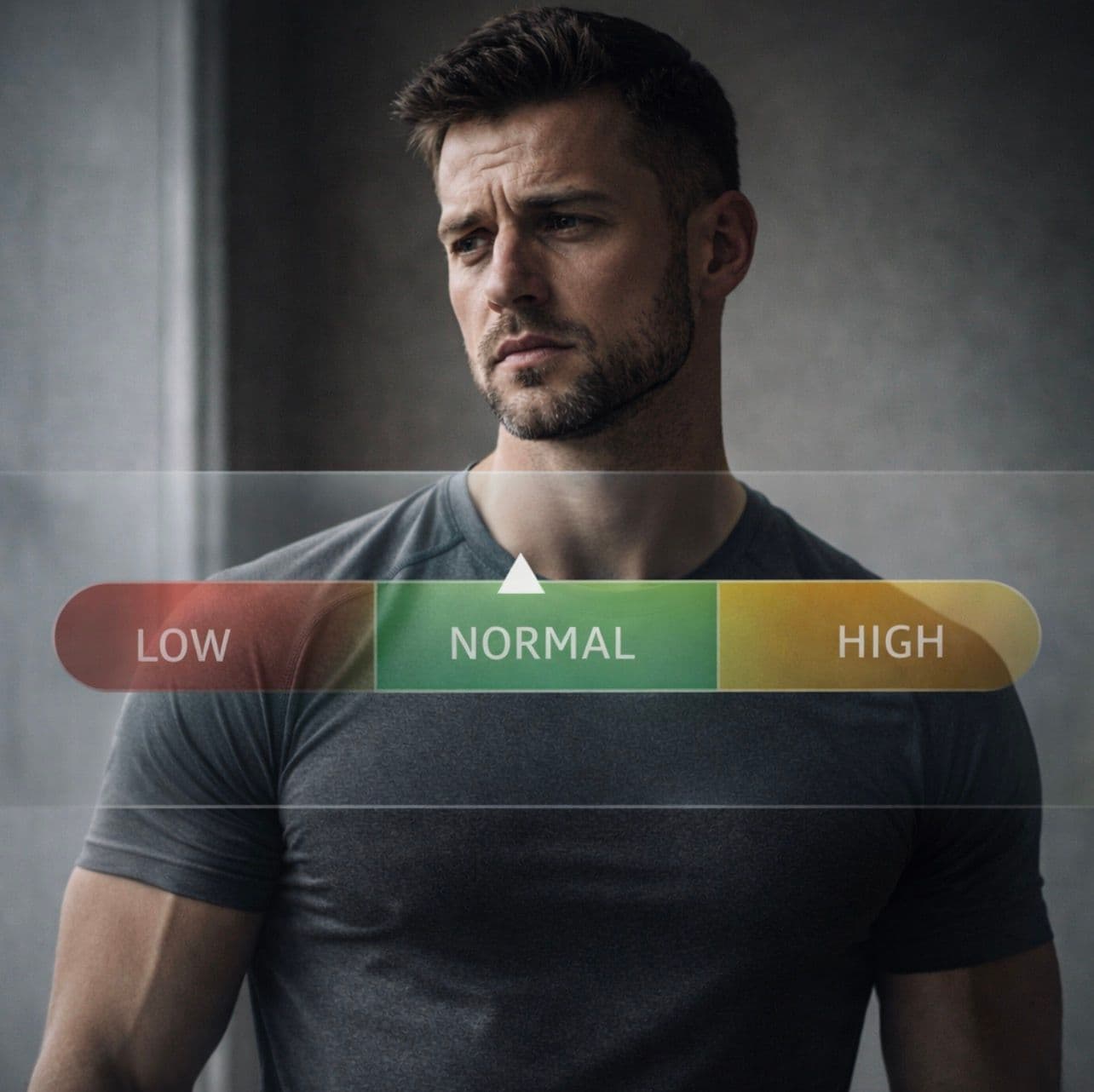
You just got your lab results back. Free testosterone: 312 ng/dL. Your doctor says congratulations, you're normal. So why do you still feel like absolute garbage?
Here's the uncomfortable truth: being "within range" and being optimized are two completely different things. And that reference range your doctor is using? It's not designed to help you feel your best. It's designed to identify disease states. There's a massive difference.
The Reference Range Shell Game
Let's talk about how these ranges actually get created, because most guys have no idea.
Laboratories establish reference ranges by testing a large population of men and then using the middle 95% of results. Sounds scientific, right? Here's the problem: they're mixing 22-year-old athletes with 80-year-old men on blood pressure medication. They're averaging healthy guys with diabetics. They're combining men who lift five days a week with guys who haven't seen their feet in a decade.
The result? A range so broad it's basically meaningless for individual optimization. The typical reference range for total testosterone is something like 264-916 ng/dL. That's not a target. That's just saying "you're somewhere between barely functioning and actually optimized."
Think about it this way: if the reference range for body temperature was 96-102°F because they averaged people with hypothermia and people with fevers, would you be satisfied with 97°F? Would your doctor tell you that's optimal? Of course not. But that's exactly what's happening with testosterone testing.
Your Grandpa Is Tanking Your Numbers
Here's where it gets worse. Most reference ranges pool all adult ages together. That means your results at 35 are being compared to men in their 70s and 80s.
Testosterone naturally declines with age (about 1-2% per year after 30), so when you mix age groups, you drag down the entire range. A 30-year-old man with a total T of 400 ng/dL might technically be "in range," but he's operating at levels more typical of a 60-year-old. His body doesn't care about statistical averages. It knows something's off.
And that's exactly what guys report: brain fog, low energy, decreased muscle mass, reduced libido, stubborn body fat. All the classic symptoms of suboptimal testosterone. But because they're above some arbitrary cutoff, they get sent home with a pat on the head and maybe a prescription for an antidepressant.
The Difference Between "Not Sick" and "Optimized"
Your doctor is trained to identify pathology. That's their job. If your testosterone is above the clinical threshold for hypogonadism (usually around 250-300 ng/dL), you're technically "not sick."
But there's a huge gap between "not clinically hypogonadic" and "optimized for performance, body composition, mental clarity, and quality of life."
Let's use a real scenario. Take two 35-year-old men:
Guy A has total testosterone of 350 ng/dL and free testosterone of 8 pg/mL. He's "normal" according to the reference range. He struggles to build muscle despite training consistently. He needs two cups of coffee to feel human in the morning. His sex drive is there but inconsistent. He's got that stubborn belly fat that won't budge.
Guy B has total testosterone of 750 ng/dL and free testosterone of 18 pg/mL. Also "normal" by the same reference range. He recovers quickly from workouts. He wakes up with energy. Muscle comes easier. Mental clarity is sharp. Libido is strong and consistent.
Same reference range. Wildly different realities.
Why Free Testosterone Matters Even More
Here's something else your doctor might not emphasize: total testosterone is only part of the story. Free testosterone (the amount not bound to proteins and actually available for your tissues to use) is what actually matters for how you feel and function.
You can have decent total testosterone but low free testosterone because of high SHBG (sex hormone binding globulin), which binds up your testosterone and makes it unavailable. This happens more as you age, with certain health conditions, and with lifestyle factors.
So when your doctor glances at your total T and says "looks fine," they might be missing the bigger picture entirely. You could be "normal" on total testosterone but functionally deficient where it counts.
What Actually Matters: Symptoms Plus Numbers
The right approach isn't to worship the reference range or ignore it completely. It's to look at the full picture: how you actually feel, what your symptoms are, and where your numbers fall within that range.
If you're in the bottom third of the reference range and you've got symptoms (low energy, decreased libido, poor recovery, brain fog, difficulty building muscle), that's data worth acting on. You're not optimized, even if you're technically "normal."
Some guys feel great at 500 ng/dL. Others need 700+ to feel like themselves. Individual variation is real, which is why the reference range approach is so flawed for optimization. It's trying to fit everyone into the same statistical bucket.
What You Can Actually Do About This
First, know your numbers. Get comprehensive testing that includes total testosterone, free testosterone, SHBG, estradiol, and thyroid markers. Don't just accept "everything's normal." Get the actual values.
Second, track how you feel relative to those numbers. Keep a log of energy, recovery, libido, mental clarity. This gives you baseline data that's way more useful than a lab's statistical range.
Third, have an honest conversation with a provider who understands optimization, not just disease management. That's where AlphaMD comes in. The provider you meet with looks at where you are, where you want to be, and builds a protocol around actual optimization rather than just checking boxes on outdated reference ranges.
The goal isn't to get you barely above the clinical threshold for hypogonadism. It's to get you functioning at a level where you're building muscle efficiently, recovering well, thinking clearly, and maintaining the energy and drive you had in your twenties.
You deserve better than "you're normal, stop complaining." Your body's running on real hormones with real effects, not statistical averages from a mixed population of healthy athletes and metabolically broken men three times your age.
If you're dealing with symptoms despite being told your testosterone is "fine," it's worth getting a second opinion from providers who understand the difference between reference ranges and actual optimization. Because feeling like yourself again isn't asking too much. It's just asking for the right target.
Have a question? Ask us.
At AlphaMD, we're here to help. Feel free to ask us any question you would like about TRT, medical weightloss, ED, or other topics related to men's health. Or take a moment to browse through our past questions.
People are asking...
I'm 37. I went to a clinic with my complaints and a hormonal test was done: Fsh 2.69mIU/mL Lh 7.28mIU/mL Prolactin 3.95ng/mL Testosterone 18.0nmol...
Your doctors didn’t lie in saying your labs don’t show anything abnormal. But they won’t always because what is “normal” is based on population averages, not what is normal for you. There is a new di... See Full Answer
For context, I'm a 35 year old male. I have had two blood test. The first of which stated: Finger prick blood test Total testosterone - 17.100 Free ...
It may be worth rethinking the goal & metrics a bit. For TRT & why you've been denied care, many institutions like insurance companies or very old school providers who are uncomfortable with their hor... See Full Answer
M 19 my total testosterone was 712 free testosterone 11.3(direct) shbg 27nmol. Why is my free test on the low end of normal even though i have normal ...
So there are two things that bind to testosterone, SHBG and albumin. If your SHBG is normal, then the albumin in your blood would be binding to the rest of your total T.... See Full Answer
Get $30 off your first month’s order
Enter your email address now to receive $30 off your first month’s cost, other discounts, and additional information about TRT.
Legal Disclaimer
This website is a repository of publicly available information and is not intended to form a physician-patient relationship with any individual. The content of this website is for informational purposes only. The information presented on this website is not intended to take the place of your personal physician's advice and is not intended to diagnose, treat, cure, or prevent any disease. Discuss this information with your own physician or healthcare provider to determine what is right for you. All information is intended for your general knowledge only and is not a substitute for medical advice or treatment for specific medical conditions. The information contained herein is presented in summary form only and intended to provide broad consumer understanding and knowledge. The information should not be considered complete and should not be used in place of a visit, phone or telemedicine call, consultation or advice of your physician or other healthcare provider. Only a qualified physician in your state can determine if you qualify for and should undertake treatment.