
Your 'Normal' Testosterone at 350 Is Crushing Your Free T—Here's the Hidden Number
Published on:
Updated on:
People are asking...
Would you say most clinicians are wrong for aiming for a total test level rather than regular high free testosterone levels? I had a clinic keep tryi...
They're not 100% wrong but they're not right. The main reason some places harp on the numbers is because it's good for marketing. Men love numbers & being able to point at things to see "it's working"... See Full Answer
Two questions. First, I find my testosterone significantly tanks when I've been extra busy, especially physically. When I first tanked (270 total or ...
For your first question, this can impact your Testosterone levels if you're not resting properly. I'll barrow from one of our earlier replies: "The majority of your Testosterone is produced and releas... See Full Answer
Let’s say a 45yo guy has all the symptoms of low testosterone but 2 tests 2 months apart show total t at 930ng/dl and free t at 16ng/dl naturally. SHB...
Yes, you could absolutely have symptoms just from the drop in testosterone, despite being within the upper range of normal. If what is normal for you is 1300, and you are now at 930, that drop alone c... See Full Answer
Have a question? Ask us.
At AlphaMD, we're here to help. Feel free to ask us any question you would like about TRT, medical weightloss, ED, or other topics related to men's health. Or take a moment to browse through our past questions.
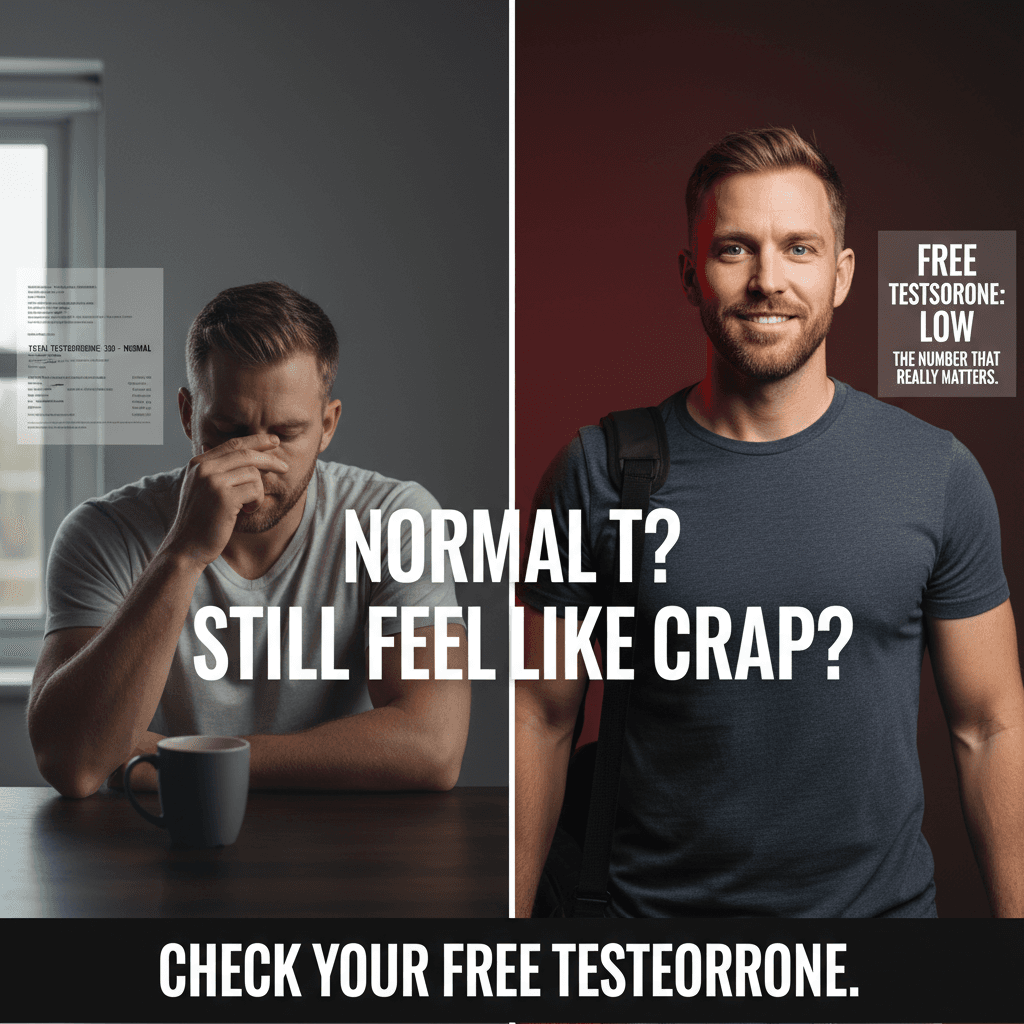
You've been to the doctor. You described the fatigue, the brain fog, the libido that's barely a memory. Your doctor ordered labs, and when the results came back, you were told your testosterone is 350 and that's "within normal range." Yet you still feel like a shadow of yourself.
If this sounds familiar, you're not imagining things. The problem isn't that you're being dramatic or that you need to just push through. The problem is that the number your doctor is looking at, total testosterone, is only part of the story. There's another number hiding behind it, one that actually determines how much testosterone your body can use. And that hidden number might be nowhere near normal.
The Number That's Only Half the Picture
When most doctors order a testosterone test, they're checking total testosterone. This measures all the testosterone floating around in your bloodstream. But not all of that testosterone is available for your body to actually use.
Think of it this way: imagine your testosterone is money in your bank account. Your total testosterone is the full balance, but most of that money is tied up in long-term investments you can't touch. Only a small portion is in your checking account, ready to spend. That available portion is your free testosterone.
In reality, the majority of testosterone in your blood is bound to proteins, primarily one called sex hormone binding globulin, or SHBG. A smaller amount is bound to albumin, another protein. When testosterone is bound to SHBG, it's locked up tight and can't enter your cells to do its job. The testosterone bound to albumin is loosely attached and can become available, but it's the truly free testosterone, the unbound portion, that's immediately ready for action.
This free testosterone typically makes up only about 2-3% of your total testosterone. It's a small fraction, but it's the fraction that matters most.
Why Your 350 Might Be Failing You
Laboratories define "normal ranges" based on population averages. For total testosterone, that range is often something like 300 to 1,000 ng/dL, though it varies slightly between labs. So when your result comes back at 350, you're technically above the minimum threshold. Your doctor checks the box that says "normal" and moves on.
But there are serious problems with relying on this approach.
First, that reference range includes men of all ages, from young adults to elderly men. As men age, testosterone naturally declines. By including 70-year-old men in the same reference range as 25-year-old men, the "normal" range gets dragged downward. If you're 35 and your testosterone matches the average for a 65-year-old, is that really optimal for you?
Second, and more importantly for this discussion, total testosterone tells you nothing about how much testosterone is actually available to your tissues. You could have a total testosterone of 350, but if your SHBG is high, your free testosterone might be in the basement. You're carrying around testosterone you can't use, like having a wallet full of gift cards to stores that closed years ago.
When Your Body Is Running on Empty
Low free testosterone doesn't whisper. It shouts, even when total testosterone looks acceptable on paper.
Men with low free testosterone often describe a persistent fatigue that sleep doesn't fix. You might get eight hours and still wake up feeling like you've been awake for days. The energy to tackle your workouts, your work projects, even simple household tasks just isn't there.
Libido and sexual function frequently take a hit. This isn't just about wanting sex less often. It's a deeper lack of drive, sometimes accompanied by difficulty with erections or reduced sensitivity.
Cognitive changes are common and often deeply frustrating. Brain fog, difficulty concentrating, problems with memory, and a general sense that your thinking has slowed down can all stem from inadequate free testosterone. You might find yourself reading the same paragraph three times or forgetting why you walked into a room.
In the gym, you might notice your strength plateauing or declining despite consistent effort. Recovery takes longer. The pump that used to come easily doesn't show up anymore. Muscle mass becomes harder to build or maintain, while body fat seems to accumulate more easily, especially around the midsection.
Emotionally, low free testosterone can manifest as irritability, reduced motivation, or a flattening of mood. You might not be clinically depressed, but the enthusiasm and drive that used to characterize your personality feel muted.
These symptoms are real, physiological responses to insufficient bioavailable testosterone. They're not character flaws or signs that you need to "man up."
What Drives Free Testosterone Down (While Total Stays Normal)
Several factors can create a disconnect between your total testosterone and your free testosterone, mostly by affecting SHBG levels.
Age is a significant factor. As men get older, SHBG levels tend to rise. This means that even if total testosterone doesn't drop dramatically, more of it gets bound up, leaving less free testosterone available.
Body composition plays a crucial role. Excess body fat, particularly visceral fat around the organs, can increase SHBG production and also convert testosterone to estrogen through an enzyme called aromatase. On the flip side, being extremely lean or over-trained can also disrupt hormone balance.
Chronic stress elevates cortisol, which can interfere with testosterone production and utilization. When your body is in constant fight-or-flight mode, sex hormone production takes a back seat to survival.
Sleep deprivation is another major player. Testosterone production happens primarily during sleep, and chronic poor sleep can suppress production while also affecting the proteins that bind testosterone.
Certain health conditions affect SHBG levels significantly. Thyroid disorders, insulin resistance, metabolic syndrome, and liver conditions can all change how much SHBG your body produces. Some medications can also influence SHBG, though the specific effects vary.
The key point is that you can have all these factors chipping away at your free testosterone while your total testosterone remains in that supposedly "normal" range.
The Test Your Doctor Probably Didn't Order
If you've only had total testosterone measured, you're missing critical information. A comprehensive hormone evaluation should include free testosterone, measured either directly or calculated from total testosterone, SHBG, and albumin levels.
Direct measurement of free testosterone using a method called equilibrium dialysis is considered the gold standard, though it's expensive and not always available. More commonly, labs use a calculated free testosterone, which uses your total testosterone and SHBG levels to estimate how much testosterone is actually available. While not perfect, calculated free testosterone gives a much clearer picture than total testosterone alone.
Beyond free testosterone, comprehensive testing might include SHBG itself, estradiol (the primary estrogen in men, which needs to be balanced with testosterone), luteinizing hormone and follicle-stimulating hormone (which tell you whether your brain is signaling properly for testosterone production), and other markers depending on your symptoms and history.
This broader view helps identify not just that there's a problem, but why there's a problem. Are your testicles not producing enough testosterone? Is your brain not sending the right signals? Is your body producing testosterone but binding it all up? Each scenario might call for a different approach.
What Actually Helps: Beyond the Lab Slip
Discovering that your free testosterone is low despite a "normal" total testosterone isn't just about numbers. It's about having an explanation for what you've been experiencing and opening the door to solutions.
A thoughtful medical approach starts with a thorough conversation about your symptoms, medical history, lifestyle, and goals. Not every man with the same lab values feels the same or needs the same intervention.
Lifestyle factors deserve serious attention because they can genuinely move the needle. Optimizing sleep quality and duration, managing stress through whatever methods work for you, adjusting training volume and intensity to avoid overtraining, improving nutrition to support hormone production, and addressing excess body weight can all improve free testosterone naturally. These aren't just feel-good suggestions, they're interventions with real physiological effects.
For some men, lifestyle optimization is enough to shift free testosterone into a better range and resolve symptoms. For others, particularly those with persistently low levels despite lifestyle changes, or those with clear evidence of hypogonadism, medical treatment might be appropriate.
Testosterone replacement therapy, when supervised by a qualified clinician, can be highly effective for men with genuinely low testosterone. It's not a decision to make lightly or pursue without proper medical guidance, but for the right candidate, it can be life-changing. The goal isn't to achieve superhuman levels, it's to restore testosterone to a healthy, functional range where symptoms resolve and quality of life improves.
Any medical approach should include regular monitoring, not just of testosterone levels but of other health markers, symptoms, and potential side effects. Hormone replacement isn't a set-it-and-forget-it intervention.
You're Not Overreacting, You're Under-Served
If you've been told your testosterone is "normal" while feeling distinctly not normal, trust your experience. Symptoms matter. Quality of life matters. You're not being dramatic when you say something feels off.
The medical system often relies on broad reference ranges and quick assessments because time and resources are limited. But hormone health is nuanced. It requires looking beyond a single number to understand the full picture of what's happening in your body.
You don't have to accept fatigue, low libido, brain fog, and declining physical performance as inevitable parts of aging or modern life. You don't have to tough it out or convince yourself you're fine when you're not.
What you do need is a comprehensive evaluation from someone who understands that total testosterone is just the starting point, not the destination. You need testing that includes free testosterone and the other markers that explain how your hormone system is actually functioning. You need someone who listens to your symptoms and takes them seriously.
Seeking help from a clinic that specializes in men's hormone health can make a significant difference. Modern telehealth services have made this more accessible than ever. Through platforms like AlphaMD, for example, you can connect with licensed providers who focus specifically on men's hormone health and take a comprehensive approach — looking at symptoms, lifestyle factors, and appropriate labs including free testosterone, not just checking a box on total testosterone and moving on. This specialized approach often catches issues that general practitioners miss simply because hormone optimization isn't their primary focus.
Your total testosterone might be 350 and "technically normal," but if your free testosterone is low, you're running your body on a fraction of the fuel it needs. That hidden number, the one your doctor might not have checked, could be the explanation you've been searching for. Getting it tested and understood isn't optional if you want to feel like yourself again. It's essential.
Have a question? Ask us.
At AlphaMD, we're here to help. Feel free to ask us any question you would like about TRT, medical weightloss, ED, or other topics related to men's health. Or take a moment to browse through our past questions.
People are asking...
Would you say most clinicians are wrong for aiming for a total test level rather than regular high free testosterone levels? I had a clinic keep tryi...
They're not 100% wrong but they're not right. The main reason some places harp on the numbers is because it's good for marketing. Men love numbers & being able to point at things to see "it's working"... See Full Answer
Two questions. First, I find my testosterone significantly tanks when I've been extra busy, especially physically. When I first tanked (270 total or ...
For your first question, this can impact your Testosterone levels if you're not resting properly. I'll barrow from one of our earlier replies: "The majority of your Testosterone is produced and releas... See Full Answer
Let’s say a 45yo guy has all the symptoms of low testosterone but 2 tests 2 months apart show total t at 930ng/dl and free t at 16ng/dl naturally. SHB...
Yes, you could absolutely have symptoms just from the drop in testosterone, despite being within the upper range of normal. If what is normal for you is 1300, and you are now at 930, that drop alone c... See Full Answer
Get $30 off your first month’s order
Enter your email address now to receive $30 off your first month’s cost, other discounts, and additional information about TRT.
Legal Disclaimer
This website is a repository of publicly available information and is not intended to form a physician-patient relationship with any individual. The content of this website is for informational purposes only. The information presented on this website is not intended to take the place of your personal physician's advice and is not intended to diagnose, treat, cure, or prevent any disease. Discuss this information with your own physician or healthcare provider to determine what is right for you. All information is intended for your general knowledge only and is not a substitute for medical advice or treatment for specific medical conditions. The information contained herein is presented in summary form only and intended to provide broad consumer understanding and knowledge. The information should not be considered complete and should not be used in place of a visit, phone or telemedicine call, consultation or advice of your physician or other healthcare provider. Only a qualified physician in your state can determine if you qualify for and should undertake treatment.