Unexpected Effects of Andarine GTx-007 (SARM)
Published on:
Updated on:
People are asking...
SARMS with TRT: They indeed have sides and I have seen them crash natural production. There is no free ride but if it cannot crash it because you don'...
The side effects of suppressing natural Testosterone when on any Steroid (including T itself) is usually overshadowed by the amount or effect gained of taking it. In the case of combing SARMs and Test... See Full Answer
I have wondered the effects of SARMS with TRT. Is it worth it? I have seen people use them with incredible results but these people were not taking an...
I do need to be perfectly clear that SARMs are not FDA regulated & providers cannot advise anyone to use them one way or another, so I can't speak to it being worth it or not. That said, many of us he... See Full Answer
I was mistakenly taking Sawpalmetto for a year between 2008 and 2009. Had my T to the floor and recuperated from that over years to the lower end of t...
One of the providers may jump in & add to this regarding that interaction, but I'll share some general observations. Providers on the platform have seen men in similar situations or cases where someon... See Full Answer
Have a question? Ask us.
At AlphaMD, we're here to help. Feel free to ask us any question you would like about TRT, medical weightloss, ED, or other topics related to men's health. Or take a moment to browse through our past questions.
Andarine (S-4 or GTx-007): Effects, Vision Changes, Risks, and What the Evidence Shows
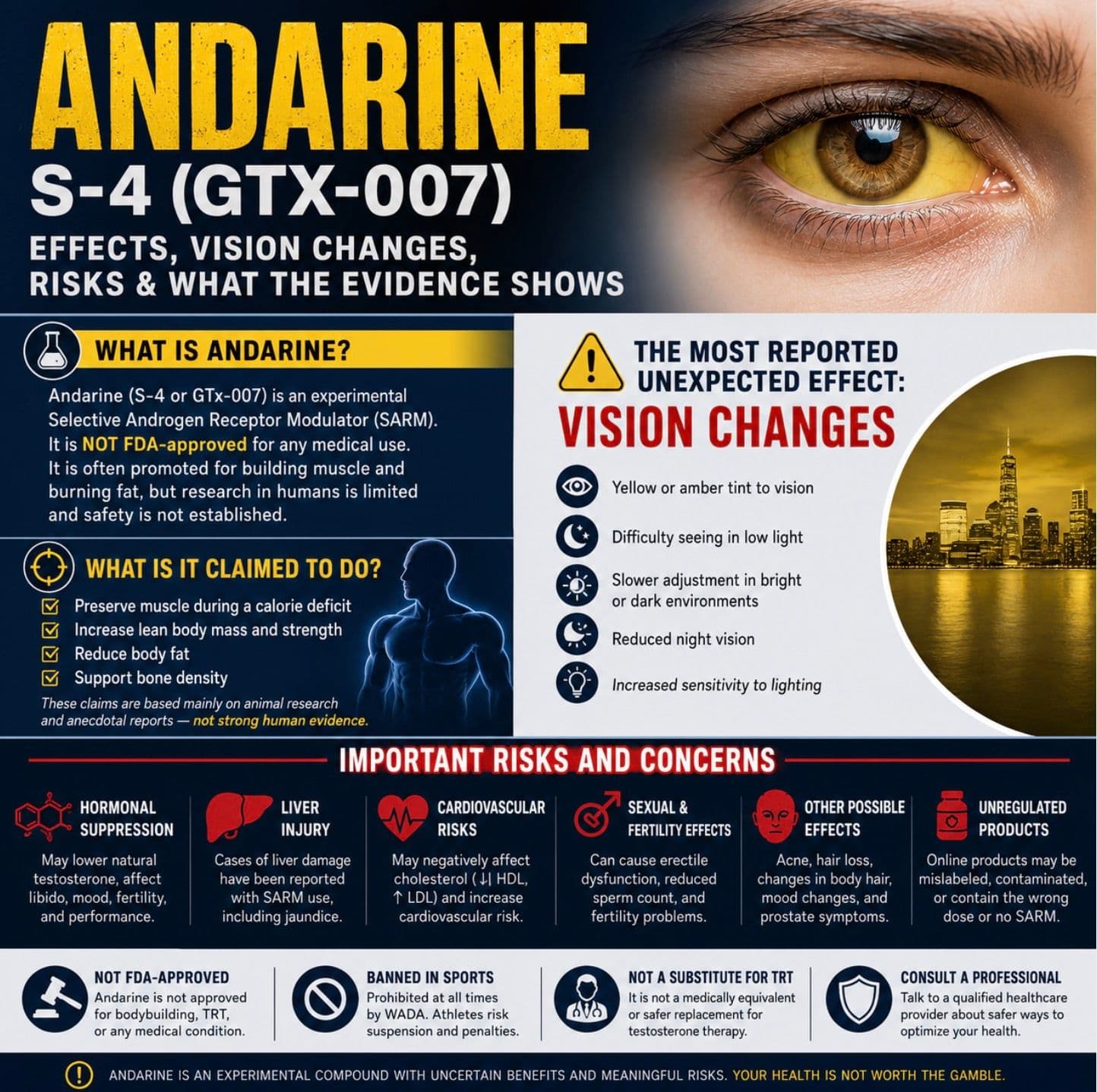
Andarine, also known as S-4 or GTx-007, is an experimental selective androgen receptor modulator, or SARM. It is often promoted online as a compound that can build lean muscle, preserve strength during weight loss, and produce a “harder” physique with fewer side effects than anabolic steroids.
Those claims leave out an important fact: andarine is not approved by the FDA for any medical use. It has not been established as safe or effective for bodybuilding, athletic performance, low testosterone, or testosterone replacement therapy.
The most recognizable adverse effect associated with andarine is altered vision, particularly a yellow tint and difficulty adjusting to darkness. However, vision changes are not the only concern. Like other SARMs, andarine may also suppress natural testosterone production, negatively affect cholesterol, contribute to liver injury, and expose users to unpredictable ingredients from unregulated products.
Key Takeaways
- Andarine is an experimental SARM, not an approved medication or dietary supplement.
- Claims about muscle gain and fat loss are based largely on animal research and anecdotal use, not strong human clinical evidence.
- Yellow-tinted vision and impaired night vision are especially associated with andarine.
- Andarine may suppress natural testosterone production despite being marketed as “selective.”
- Broader SARM-related risks include liver injury, unfavorable cholesterol changes, cardiovascular concerns, fertility problems, and sexual side effects.
- Products sold online may be mislabeled, contaminated, or contain a different dose than advertised.
- Andarine is prohibited at all times for athletes governed by World Anti-Doping Agency rules.
- It is not a medically equivalent or safer replacement for clinician-managed testosterone therapy.
What Is Andarine?
Andarine is a synthetic compound designed to activate androgen receptors. These receptors respond to hormones such as testosterone and influence muscle, bone, reproductive function, skin, hair, and several other tissues.
Researchers originally investigated SARMs in hopes of producing some of testosterone’s anabolic effects in muscle and bone while limiting androgenic effects in other parts of the body.
Andarine was studied in preclinical models for conditions involving muscle loss, bone loss, and prostate disease. Development did not lead to an approved medication, and much of the evidence commonly cited by sellers comes from laboratory or animal research rather than large, controlled human trials.
The names andarine, S-4, and GTx-007 generally refer to the same experimental compound.
What Is Andarine Supposed to Do?
Online sellers and bodybuilding communities commonly claim that andarine can:
- Preserve muscle during a calorie deficit
- Increase lean body mass
- Improve strength
- Reduce body fat
- Create a leaner or more defined appearance
- Support bone density
Early animal studies suggested that S-4 could stimulate certain androgen-responsive tissues and improve measures related to muscle and bone. That finding explains why the compound attracted research interest.
It does not prove that andarine safely produces meaningful bodybuilding benefits in humans.
There is no well-established, FDA-approved andarine dose, no standardized treatment protocol, and no high-quality evidence demonstrating that recreational use provides more benefit than harm.
The Unexpected Effect Most Associated With Andarine: Vision Changes
The unusual side effect most frequently associated with andarine is a change in vision.
Users have reported effects such as:
- A yellow or amber tint to vision
- Difficulty seeing in low light
- Slower adjustment when moving between bright and dark environments
- Reduced night vision
- Increased sensitivity to changes in lighting
These symptoms are especially concerning for anyone who drives at night, operates machinery, works in dim environments, or participates in activities requiring accurate depth perception and rapid visual adjustment.
The precise frequency and long-term implications of these effects are uncertain because andarine has not undergone the type of large human safety program required for an approved medication.
Anecdotal reports sometimes suggest that visual symptoms improve after the compound is discontinued. However, that does not establish that repeated exposure is harmless or that every user will recover on the same timeline.
New or worsening vision changes warrant prompt medical evaluation. A person experiencing impaired vision should avoid driving or performing other activities in which reduced visual function could cause injury.
Can Andarine Lower Natural Testosterone?
Yes. Andarine may suppress the hypothalamic-pituitary-gonadal axis, the hormonal system that regulates natural testosterone and sperm production.
Although SARMs are described as “selective,” selectivity does not mean that the body ignores them. When an androgen receptor is activated by an external compound, the brain may interpret that activity as a signal that less natural hormone production is needed.
Possible consequences may include:
- Lower testosterone
- Reduced luteinizing hormone and follicle-stimulating hormone
- Fatigue
- Reduced libido
- Erectile difficulties
- Mood changes
- Loss of strength or muscle after discontinuation
- Reduced sperm production
- Fertility problems
The severity and duration of suppression can vary. Product purity, actual dose, duration of exposure, use of additional compounds, and the individual’s baseline health may all affect the outcome.
Because underground SARM products are not reliably standardized, users may not know how much andarine they are actually taking—or whether the product contains andarine at all.
Is Andarine Safer Than Anabolic Steroids?
There is not enough reliable evidence to conclude that andarine is a safe alternative to anabolic steroids.
SARMs were developed in pursuit of more tissue-selective androgen effects, but compounds sold as SARMs can still affect multiple systems throughout the body. Reported or suspected risks across the SARM category include:
- Hormonal suppression
- Liver injury
- Reduced HDL cholesterol
- Increased LDL cholesterol
- Cardiovascular complications
- Sexual dysfunction
- Fertility impairment
- Mood or behavioral changes
- Tendon or musculoskeletal injury
The FDA warns that products containing SARMs have been associated with serious risks, including liver damage and an increased risk of heart attack or stroke. No SARM is FDA-approved for recreational bodybuilding or athletic enhancement.
A compound should not be assumed safe simply because it is nonsteroidal, orally administered, marketed as “research-grade,” or described as selective.
Does Andarine Cause Liver Damage?
Andarine-specific human safety data are limited, but liver injury is a recognized concern with the broader SARM category.
Published case reports and reviews have described drug-induced liver injury in people using products marketed as SARMs. Reported patterns include jaundice and cholestatic or hepatocellular liver injury.
Symptoms that may indicate liver injury include:
- Yellowing of the skin or eyes
- Dark urine
- Pale stool
- Persistent nausea
- Abdominal pain
- Severe itching
- Loss of appetite
- Unusual fatigue
Anyone experiencing these symptoms after using a SARM should stop using the product and seek medical care promptly.
Normal liver tests before use do not guarantee that liver injury will not occur later. Periodic laboratory monitoring also cannot transform an unapproved and poorly characterized compound into a safe treatment.
How Can Andarine Affect Cholesterol and Cardiovascular Risk?
Androgen-receptor-active compounds can affect lipid metabolism. SARMs have been associated with reductions in high-density lipoprotein cholesterol, commonly called HDL or “good” cholesterol, and unfavorable changes in other cardiovascular risk markers.
Potential concerns include:
- Lower HDL cholesterol
- Higher LDL cholesterol
- Increased blood pressure
- Changes in cardiovascular risk
- Unknown interactions with other performance-enhancing drugs
The true cardiovascular risk of andarine cannot be accurately quantified because controlled human safety data are inadequate.
This uncertainty matters because many people considering SARMs may already have risk factors such as high blood pressure, abnormal cholesterol, obesity, sleep apnea, smoking, diabetes, or a family history of cardiovascular disease.
Can Andarine Cause Hair Loss or Acne?
Possibly.
Andarine activates androgen receptors, and androgenic activity can influence oil production, acne, and genetically susceptible hair follicles. The likelihood of these effects may depend on genetics, total androgen exposure, and whether other hormones or performance-enhancing compounds are being used simultaneously.
Potential androgen-related effects may include:
- Acne
- Oily skin
- Accelerated male-pattern hair loss
- Changes in body hair
- Prostate or urinary symptoms
Describing a SARM as tissue-selective does not mean it has no androgenic activity in the skin, scalp, prostate, or reproductive system.
Is Andarine a Substitute for TRT?
No. Andarine is not a medically equivalent substitute for testosterone replacement therapy.
Clinician-managed TRT uses an approved hormone to treat appropriately diagnosed testosterone deficiency. A legitimate TRT evaluation typically includes symptoms, repeated laboratory testing, medical history, risk assessment, follow-up testing, and ongoing dose adjustment.
Andarine differs in several important ways:
- It is not FDA-approved.
- It is not endogenous testosterone.
- It does not reliably reproduce testosterone’s full physiologic functions.
- It may suppress natural testosterone production.
- Product purity and dosing are often uncertain.
- Its long-term safety has not been established.
- There is no accepted medical protocol for using it to treat hypogonadism.
Testosterone contributes to more than muscle growth. It also affects sexual function, mood, red blood cell production, bone health, reproductive signaling, and metabolic function. Selectively activating some androgen receptors does not make a SARM a complete hormonal replacement.
Men experiencing symptoms of low testosterone should pursue a proper clinical evaluation rather than self-treating with an experimental compound.
Are Products Sold as Andarine Reliable?
Product quality is one of the largest practical risks associated with SARMs.
Products marketed online may contain:
- Less active ingredient than stated
- More active ingredient than stated
- A different SARM
- Multiple undeclared drugs
- Contaminants
- No active SARM at all
The labels “research chemical” and “not for human consumption” do not guarantee manufacturing quality. In some cases, those labels are used while the same product is simultaneously promoted for muscle growth or fat loss.
The FDA has issued warning letters to sellers marketing S-4 andarine and other SARMs as bodybuilding products. The agency has also announced recalls after products marketed as supplements were found to contain undeclared andarine and other unapproved substances.
This makes personal risk difficult to predict. Even published reports about a particular amount of andarine may not apply to a mislabeled product purchased online.
Is Andarine Banned in Sports?
Yes. SARMs, including andarine, are prohibited under World Anti-Doping Agency rules.
They are banned both in and out of competition. Competitive athletes can test positive even when a product does not clearly list a SARM on its label.
“Supplement contamination” does not necessarily protect an athlete from sanctions. Athletes governed by anti-doping rules are generally responsible for substances found in their bodies.
What Should Someone Do After Using Andarine?
A person who has used andarine should be honest with a healthcare professional about the compound, estimated amount, duration of use, source, and any other drugs or supplements taken at the same time.
Depending on symptoms and medical history, a clinician may consider evaluating:
- Total and free testosterone
- Luteinizing hormone
- Follicle-stimulating hormone
- Estradiol
- Complete blood count
- Liver enzymes and bilirubin
- Kidney function
- Lipid profile
- Blood pressure
- Fertility markers when relevant
Laboratory testing should be selected and interpreted by a qualified clinician. Results can be influenced by when the compound was stopped, other medications, acute illness, sleep, calorie restriction, and preexisting hormonal conditions.
Seek urgent medical attention for symptoms such as chest pain, shortness of breath, fainting, severe abdominal pain, jaundice, major mood or behavioral changes, or sudden vision loss.
Andarine vs. Medically Supervised Testosterone Therapy
The central difference is not simply that one compound is a SARM and the other is testosterone. The difference is the quality of evidence, manufacturing oversight, diagnostic process, and clinical monitoring.
Medically supervised testosterone therapy generally involves:
- Confirming symptoms consistent with testosterone deficiency
- Obtaining appropriate morning testosterone measurements
- Reviewing possible causes of low testosterone
- Screening for contraindications and risk factors
- Using regulated medication from a licensed pharmacy
- Monitoring symptoms and laboratory values
- Adjusting treatment based on clinical response
Online andarine use generally lacks these safeguards.
TRT is not appropriate for every man and still requires careful medical oversight. But an approved therapy prescribed after an appropriate evaluation should not be equated with an unapproved research compound purchased from an unregulated seller.
Frequently Asked Questions
What is the difference between andarine, S-4, and GTx-007?
They are alternative names for the same experimental selective androgen receptor modulator.
Is andarine FDA-approved?
No. Andarine is not FDA-approved for bodybuilding, low testosterone, osteoporosis, muscle wasting, or any other medical condition.
Does andarine build muscle?
Preclinical studies suggest that it can produce anabolic effects in animals. There is not enough high-quality human evidence to determine a safe, reliable muscle-building benefit.
Why does andarine affect vision?
The exact mechanism and long-term significance have not been fully established in human clinical research. Reports commonly describe yellow-tinted vision, reduced night vision, and difficulty adapting between light and darkness.
Are andarine vision changes permanent?
Some users report improvement after stopping, but controlled evidence is inadequate. Persistent, severe, or sudden visual symptoms require medical evaluation.
Does andarine shut down testosterone?
It may suppress natural testosterone production. The degree of suppression varies and cannot be reliably predicted from the product label.
Does andarine require post-cycle therapy?
There is no medically approved andarine cycle or standardized post-cycle therapy protocol. Self-prescribing additional hormonal drugs may introduce further risks and obscure the cause of symptoms. Anyone with post-use symptoms should seek clinical assessment and laboratory testing.
Is andarine legal to purchase?
Andarine is not approved as a medication or dietary supplement in the United States. Products marketed for human consumption may violate federal law even when they are labeled as research chemicals.
Can drug-tested athletes use andarine?
No. Andarine is prohibited at all times under World Anti-Doping Agency rules.
The Bottom Line
Andarine is an experimental SARM with uncertain benefits and meaningful risks. Its reputation for producing a leaner physique with fewer side effects than steroids is not supported by sufficient human clinical evidence.
The compound is especially associated with yellow-tinted vision and impaired night vision, but potential harm extends beyond the eyes. Hormonal suppression, fertility problems, liver injury, adverse cholesterol changes, cardiovascular concerns, and unreliable product contents are also important considerations.
Andarine should not be treated as a safe supplement, a proven bodybuilding medication, or a substitute for testosterone replacement therapy.
Men concerned about low testosterone, body composition, strength, libido, or energy should begin with a legitimate medical evaluation. Identifying the underlying problem offers a safer and more effective path than relying on an unapproved compound with unknown purity and limited human safety data.
References
- U.S. Food and Drug Administration. FDA Warns of Use of Selective Androgen Receptor Modulators Among Teens, Young Adults.
- U.S. Food and Drug Administration. Certain Bodybuilding Products Put Consumers at Risk for Heart Attack, Stroke, Serious Liver Damage and More.
- U.S. Food and Drug Administration. Warning letters involving products marketed as S-4 andarine and other SARMs.
- National Institute of Diabetes and Digestive and Kidney Diseases. LiverTox: Selective Androgen Receptor Modulators.
- Gao W, et al. Selective Androgen Receptor Modulator Treatment Improves Muscle Strength and Body Composition and Prevents Bone Loss in Orchidectomized Rats. Endocrinology. 2005.
- World Anti-Doping Agency. 2026 Prohibited List.
- U.S. Anti-Doping Agency. Selective Androgen Receptor Modulators: What Athletes Need to Know.
- Leciejewska N, et al. Selective Androgen Receptor Modulator Use and Related Adverse Events. European Journal of Clinical Pharmacology. 2024.
This article is for educational purposes and does not provide medical advice, diagnosis, or a protocol for using andarine or other performance-enhancing drugs.
Have a question? Ask us.
At AlphaMD, we're here to help. Feel free to ask us any question you would like about TRT, medical weightloss, ED, or other topics related to men's health. Or take a moment to browse through our past questions.
People are asking...
SARMS with TRT: They indeed have sides and I have seen them crash natural production. There is no free ride but if it cannot crash it because you don'...
The side effects of suppressing natural Testosterone when on any Steroid (including T itself) is usually overshadowed by the amount or effect gained of taking it. In the case of combing SARMs and Test... See Full Answer
I have wondered the effects of SARMS with TRT. Is it worth it? I have seen people use them with incredible results but these people were not taking an...
I do need to be perfectly clear that SARMs are not FDA regulated & providers cannot advise anyone to use them one way or another, so I can't speak to it being worth it or not. That said, many of us he... See Full Answer
I was mistakenly taking Sawpalmetto for a year between 2008 and 2009. Had my T to the floor and recuperated from that over years to the lower end of t...
One of the providers may jump in & add to this regarding that interaction, but I'll share some general observations. Providers on the platform have seen men in similar situations or cases where someon... See Full Answer
Get $30 off your first month’s order
Enter your email address now to receive $30 off your first month’s cost, other discounts, and additional information about TRT.
Legal Disclaimer
This website is a repository of publicly available information and is not intended to form a physician-patient relationship with any individual. The content of this website is for informational purposes only. The information presented on this website is not intended to take the place of your personal physician's advice and is not intended to diagnose, treat, cure, or prevent any disease. Discuss this information with your own physician or healthcare provider to determine what is right for you. All information is intended for your general knowledge only and is not a substitute for medical advice or treatment for specific medical conditions. The information contained herein is presented in summary form only and intended to provide broad consumer understanding and knowledge. The information should not be considered complete and should not be used in place of a visit, phone or telemedicine call, consultation or advice of your physician or other healthcare provider. Only a qualified physician in your state can determine if you qualify for and should undertake treatment.