
The Omega-3 Dose That Actually Moves Cardiovascular Markers on TRT Is Probably 3x What You're Taking
Published on:
Updated on:
People are asking...
did bloods 4 weeks into treatment of 50mg Test E x2 week+ 500iu x3 week SHBG 14/nmol FSH <0.3 iu/l LH < 0.3 iu/l Oestradiol 168 pmol/l Test 41 Nmol/l...
Your lab results look good considering your dose. However, considering the half-life, you usually are better off waiting 7-8 weeks after starting to get labs. At 4 weeks your levels haven’t stabilized... See Full Answer
I’m on 100mg TRT and am trying to get more dialed in on my proper dose amount and frequency and am suddenly getting ads for enclomiphene and was conce...
Many providers would say you'd get a bit more out of going up a few more mgs for T, but like you mentioned the E is a concern. You could potentially try switching to subq and if that lowers your E mor... See Full Answer
34, been consistent in the gym for 14 years with a good diet. Had very low energy, low libido and poor recovery after my workouts. Currently on 180 M...
It's very likely that 180mg from that starting T level may be more than you need, especially if you're feeling so good. Dropping down to 160mg (or 170mg first for 3-4 weeks) and seeing how you feel w... See Full Answer
Have a question? Ask us.
At AlphaMD, we're here to help. Feel free to ask us any question you would like about TRT, medical weightloss, ED, or other topics related to men's health. Or take a moment to browse through our past questions.
Most men on TRT who take fish oil are taking it in amounts that research would consider a rounding error. If your cardiovascular markers haven't budged despite months of supplementing, the dose, the quality, and what's actually inside the capsule are almost certainly the problem.
Why Cardiovascular Health Becomes a Front-Burner Issue on TRT
Testosterone replacement therapy changes your physiology in meaningful ways. Hematocrit rises in many men, which affects blood viscosity, the thickness and flow characteristics of blood moving through your vessels. Lipid profiles can shift, sometimes favorably, sometimes not. Inflammation markers, blood pressure, and vascular function all sit in the background as variables your clinician monitors over time. None of this is a reason to fear TRT, but it is a reason to take cardiovascular support seriously as an active part of your protocol, not an afterthought.
Omega-3 fatty acids have one of the stronger bodies of evidence behind them when it comes to influencing several of these markers. The word "influencing" is doing real work in that sentence. Omega-3s are not a replacement for clinical monitoring, pharmaceutical management when warranted, or lifestyle fundamentals. But for men who are already managing their TRT thoughtfully, omega-3 intake is one of the few nutritional levers with genuinely meaningful mechanistic support.
The problem is that a lot of men think they're pulling that lever when they're barely touching it.
Fish Oil and Omega-3s Are Not the Same Number on the Label
This is where most people get lost, and it's worth spending time here because the confusion is widespread and genuinely consequential.
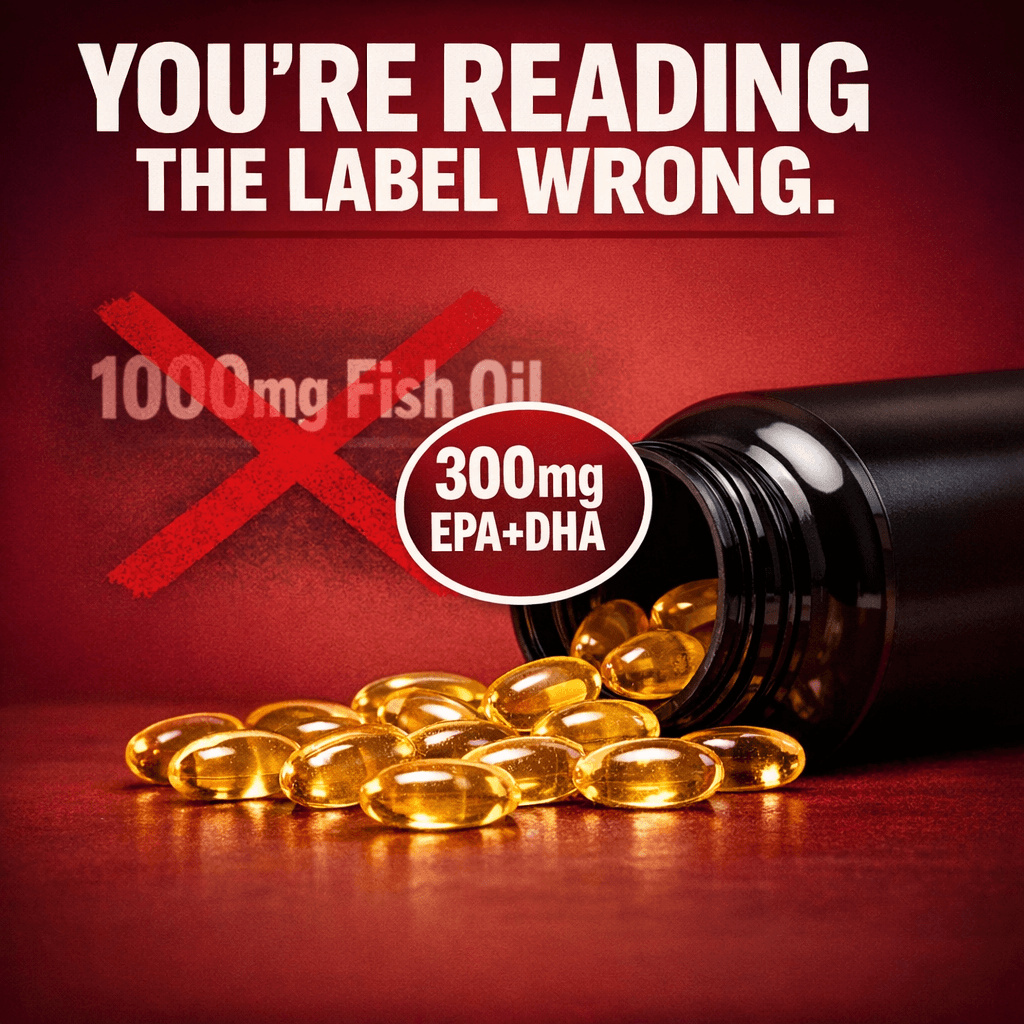
When you pick up a bottle of fish oil and it says a certain amount per capsule, that number is referring to the total fish oil content. The actual omega-3 fatty acids, specifically EPA (eicosapentaenoic acid) and DHA (docosahexaenoic acid), are a fraction of that total. And EPA and DHA are the biologically active components that research has tied to changes in triglycerides, inflammation, endothelial function, and other markers you actually care about.
A standard capsule might have a headline number on the front label that sounds substantial, but flip it over and look at the EPA and DHA content listed on the supplement facts panel. What you'll often find is that the combined EPA plus DHA is considerably less than half the total fish oil listed. Sometimes much less.
So if you're comparing your intake to what studies have used to produce meaningful cardiovascular outcomes, you need to be comparing the right numbers. Many people are effectively taking a fraction of what they think they're taking, and a fraction of what research typically uses, because they're reading the wrong line on the label.
Higher-potency formulations exist specifically to address this. A concentrated omega-3 product delivers more EPA and DHA per capsule, meaning you can reach a more meaningful intake without swallowing a handful of standard capsules daily.
Why the Research Doses and Your Current Intake Probably Don't Match
Studies that have successfully moved cardiovascular markers using omega-3s, particularly triglycerides, have generally used higher intake levels than what most people casually supplement with. The gap between "what most people take" and "what appears in the research that produces results" is significant.
This isn't a secret buried in obscure journals. It's fairly well established in the cardiometabolic literature. Prescription-strength omega-3 formulations exist in clinical medicine specifically because standard over-the-counter supplementing often doesn't produce the magnitude of effect needed for therapeutic purposes.
For men on TRT with elevated triglycerides, modest HDL, or general inflammation concerns, getting into the intake range that research has found effective matters. Not as a substitute for a physician-guided lipid management plan, but as a component of one.
The practical implication is this: if you've been taking fish oil for months and retested your lipids without seeing movement, consider whether your EPA and DHA intake is actually in the range where studies have observed effects, rather than assuming omega-3s simply don't work for you.
What Omega-3s Are Actually Doing in the Body
Understanding the mechanisms helps clarify why consistency and adequate intake both matter, and why you can't expect short-term supplementing to produce long-term results.
Triglycerides are the most well-established target. EPA and DHA reduce hepatic triglyceride synthesis and increase clearance. The effect is dose-dependent, meaning higher intakes generally produce larger reductions, and it requires sustained supplementation to appear and be maintained.
HDL particle characteristics can improve with omega-3 intake, though the effect on HDL cholesterol measured in standard labs is often modest. The more interesting story is at the particle level, where omega-3s may shift LDL from small, dense particles toward larger, less atherogenic ones. This isn't captured on a basic lipid panel, which is worth knowing if you're only looking at standard lab outputs.
Inflammation is a critical piece for men on TRT, particularly those who train hard. EPA is a precursor to specialized pro-resolving mediators, molecules that actively help resolve inflammatory responses rather than simply suppressing them. Chronic low-grade inflammation is an independent cardiovascular risk factor, and training hard while in a caloric surplus or with suboptimal recovery can sustain it. Adequate EPA intake supports the body's ability to cycle out of inflammatory states more efficiently.
Endothelial function, the capacity of the inner lining of blood vessels to dilate and respond appropriately, is supported by omega-3s through nitric oxide pathway modulation and reduction of oxidative stress. This is directly relevant to blood pressure regulation and overall vascular health, both of which matter in the TRT context.
There is also evidence around cardiac rhythm. Some data supports a role for omega-3s in arrhythmia risk, though the research here is more nuanced and context-dependent. This is part of why the clinical conversation around omega-3s at higher intakes is one worth having with a physician, not just reading about in a supplement article.
Why Your Capsules Might Be Doing Nothing (And It's Not All About Dose)
Potency gaps are one reason omega-3 supplementing fails to move markers. But there are others worth naming.
Oxidation is a real and underappreciated problem. Fish oil is highly susceptible to rancidity, and oxidized omega-3s don't just lose potency, they may actually generate oxidative byproducts that work against cardiovascular health. The telltale sign is a strong fishy smell or aftertaste beyond mild. Quality products are manufactured, stored, and packaged to minimize oxidative exposure. Third-party testing for oxidation markers (peroxide value, anisidine value) is something serious brands do and advertise. If your fish oil smells like a neglected bait bucket, it's probably not doing what you want it to do.
Adherence is another quiet saboteur. Taking omega-3s a few times a week instead of daily, or cycling on and off, produces inconsistent tissue incorporation. Omega-3s need to be built up in cell membranes over weeks to months to exert their full effects. Erratic supplementing is closer to no supplementing than people realize.
Timeline expectations also matter. People who retest lipids after a few weeks of omega-3 supplementing and see no change often conclude the supplement doesn't work. The research that shows triglyceride reductions uses consistent intake over a longer period. Weeks is not the right measuring stick.
Sourcing and form matter too. Triglyceride-form omega-3s are generally better absorbed than ethyl ester forms. Not all products disclose this. Checking with a brand or looking for third-party quality seals helps filter out lower-quality options.
How to Actually Choose a Product Worth Taking
Read the supplement facts panel, not the front label. Look for combined EPA plus DHA content per serving, and assess how many servings would be needed to reach a meaningful intake level in the context of what research has studied.
Look for third-party testing certifications. Organizations like IFOS (International Fish Oil Standards), NSF, or USP independently verify potency and purity. This matters for both quality assurance and contaminant screening, since fish-derived products carry potential exposure to heavy metals and environmental pollutants if sourcing and purification aren't rigorous.
For cardiovascular markers specifically, EPA-heavy formulations have more direct mechanistic support around triglycerides and inflammation. DHA plays a stronger role in neurological and cognitive health. A combined EPA-DHA product covers both, but if the primary goal is cardiovascular marker management, an EPA-forward formula is worth considering.
Food-first options are worth mentioning honestly. Fatty fish like salmon, sardines, mackerel, and herring contain meaningful amounts of EPA and DHA. Eating fatty fish multiple times per week can contribute substantially to omega-3 intake. The barrier for most men is consistency, palatability, and the practicality of eating sufficient quantities regularly enough to match what concentrated supplementation can deliver. Both strategies can coexist.
Safety Considerations You Should Not Ignore
Omega-3s at higher intakes are generally well tolerated, but there are real interactions and risks that require a clinician's input.
Anticoagulant and antiplatelet medications are the primary concern. Omega-3s have mild blood-thinning effects, and combining higher intakes with warfarin, heparin, aspirin, clopidogrel, or newer anticoagulants can increase bleeding risk. If you're on any of these medications, discuss your omega-3 intake explicitly with your prescribing physician before increasing it.
Upcoming surgery is another pause point. Most clinical guidelines recommend stopping omega-3 supplementation at least a week or two before any surgical procedure because of the mild antiplatelet effect.
Atrial fibrillation is an area with evolving research. Some large trials at high prescription-grade intakes have shown a signal for increased AFib risk in certain populations. If you have existing AFib or significant cardiac history, this is specifically a conversation to have with a cardiologist, not something to self-navigate.
Gastrointestinal side effects, including fishy burps, nausea, and loose stools, are common, especially at higher intakes. Taking omega-3s with meals and choosing enteric-coated capsules can help. Fish allergies are an obvious contraindication. Algae-based omega-3 products exist for those with fish allergies or who avoid animal products.
Omega-3s Within the Larger TRT Cardiovascular Framework
Omega-3s are one piece. The framework they belong in is broader, and no supplement strategy compensates for foundational gaps in the rest of it.
Sleep is the most underrated cardiovascular intervention men on TRT overlook. Chronic sleep deprivation independently elevates inflammatory markers, increases blood pressure, and impairs glucose metabolism. Seven to nine hours is not optional background noise.
Resistance training and aerobic conditioning work through different but complementary cardiovascular mechanisms. Resistance training improves body composition, insulin sensitivity, and metabolic rate. Aerobic conditioning, even moderate amounts, has direct effects on cardiac efficiency, blood pressure, and lipid profiles. Both belong in the protocol.
Alcohol and smoking are the inputs that most directly undermine cardiovascular progress for men on TRT, yet they're often treated as peripheral rather than central concerns. Elevated hematocrit combined with smoking and alcohol represents compounding risk that no supplement mitigates.
Lab monitoring through a clinician is non-negotiable. Hematocrit, lipids, blood pressure, and relevant inflammatory markers need to be tracked at appropriate intervals. What's happening inside your body on TRT isn't fully visible without looking.
Through AlphaMD, men on TRT can think through exactly this kind of integrated approach with the provider overseeing their care, connecting the dots between hormone optimization, cardiovascular monitoring, and supplement decisions in one plan. The goal isn't just optimized testosterone, it's making sure the rest of the picture is managed with the same seriousness.
The Gap Between Good Intentions and Actual Effect
Most men who take fish oil are acting in good faith. They know omega-3s are good for cardiovascular health. They bought a bottle. They take a capsule most days. They expect it to be enough.
The gap between good intentions and actual cardiovascular effect sits at the intersection of three things: getting enough EPA and DHA to reach intake levels that research has found meaningful, using a product with verified quality and potency, and maintaining consistency long enough for tissue incorporation and marker changes to occur.
All three have to be present. High potency with poor adherence fails. Consistent adherence with a rancid or low-EPA product fails. And even good quality, consistent supplementing at amounts well below what studies have used tends to produce results that look like nothing happened.
If you're serious about using omega-3s as part of your cardiovascular support strategy on TRT, start by reading the back of your current bottle. Count the EPA and DHA, not the fish oil total. Then honestly evaluate whether what you're taking is in the range that the research that actually moved markers was using. For most men, the answer to that question changes how they approach this supplement entirely.
Have a question? Ask us.
At AlphaMD, we're here to help. Feel free to ask us any question you would like about TRT, medical weightloss, ED, or other topics related to men's health. Or take a moment to browse through our past questions.
People are asking...
did bloods 4 weeks into treatment of 50mg Test E x2 week+ 500iu x3 week SHBG 14/nmol FSH <0.3 iu/l LH < 0.3 iu/l Oestradiol 168 pmol/l Test 41 Nmol/l...
Your lab results look good considering your dose. However, considering the half-life, you usually are better off waiting 7-8 weeks after starting to get labs. At 4 weeks your levels haven’t stabilized... See Full Answer
I’m on 100mg TRT and am trying to get more dialed in on my proper dose amount and frequency and am suddenly getting ads for enclomiphene and was conce...
Many providers would say you'd get a bit more out of going up a few more mgs for T, but like you mentioned the E is a concern. You could potentially try switching to subq and if that lowers your E mor... See Full Answer
34, been consistent in the gym for 14 years with a good diet. Had very low energy, low libido and poor recovery after my workouts. Currently on 180 M...
It's very likely that 180mg from that starting T level may be more than you need, especially if you're feeling so good. Dropping down to 160mg (or 170mg first for 3-4 weeks) and seeing how you feel w... See Full Answer
Get $30 off your first month’s order
Enter your email address now to receive $30 off your first month’s cost, other discounts, and additional information about TRT.
Legal Disclaimer
This website is a repository of publicly available information and is not intended to form a physician-patient relationship with any individual. The content of this website is for informational purposes only. The information presented on this website is not intended to take the place of your personal physician's advice and is not intended to diagnose, treat, cure, or prevent any disease. Discuss this information with your own physician or healthcare provider to determine what is right for you. All information is intended for your general knowledge only and is not a substitute for medical advice or treatment for specific medical conditions. The information contained herein is presented in summary form only and intended to provide broad consumer understanding and knowledge. The information should not be considered complete and should not be used in place of a visit, phone or telemedicine call, consultation or advice of your physician or other healthcare provider. Only a qualified physician in your state can determine if you qualify for and should undertake treatment.