
The Estrogen Paradox: Why Crushing Your E2 Is Destroying Your TRT Results
Published on:
Updated on:
People are asking...
Just started 200 mg split in 2 doses a week. Felt great first few week with high sex drive, full erections, morning wood, and strength in the gym. Wee...
There is a very common phenomenon around the 6 week mark of TRT, where some of the benefits seem to diminish. No one knows why that is, though we believe it is because that is the usual time window wh... See Full Answer
What would cause your testosterone and E2 levels to decrease, but the patient has been taking the same dose? (Testosterone cypionate 200mg weekly) No...
This could be a number of things. The first could be simply due to the time of testing relative to the last injection being different from the last test. The second & what is potentially likely here b... See Full Answer
I just had 6 week bloods done. e2 was 48. SHBG must be crashed because my free T was 255. Obviously an e2 of 48 is unlikely to cause any puff or itchi...
Well, to break things down, when starting TRT you should generally not be adjusting your routine or adding medications until the 7-8 week mark when your body's hormones balance out for exactly this re... See Full Answer
Have a question? Ask us.
At AlphaMD, we're here to help. Feel free to ask us any question you would like about TRT, medical weightloss, ED, or other topics related to men's health. Or take a moment to browse through our past questions.
You started testosterone replacement therapy to feel like yourself again, but now your joints ache, your libido is gone, and your mood is worse than before you ever touched a needle. Welcome to the most common mistake men make on TRT: crushing their estrogen in a misguided attempt to optimize their results.
The internet is full of horror stories about "high estrogen" on testosterone therapy. Guys in forums talk about gynecomastia, water retention, and emotional instability as if estradiol is some kind of hormonal poison that needs to be eliminated at all costs. The solution always seems to be the same: pop an aromatase inhibitor, drive that E2 into the ground, and watch your physique transform.
Except that's not what happens.
What actually happens is that men who aggressively suppress their estradiol end up feeling progressively worse, wondering why TRT isn't delivering on its promises. They blame their testosterone protocol, their clinic, their genetics, or just about anything other than the real culprit: the fact that they've starved their body of a hormone that's absolutely critical for male health and performance.
The Estrogen Your Body Actually Needs
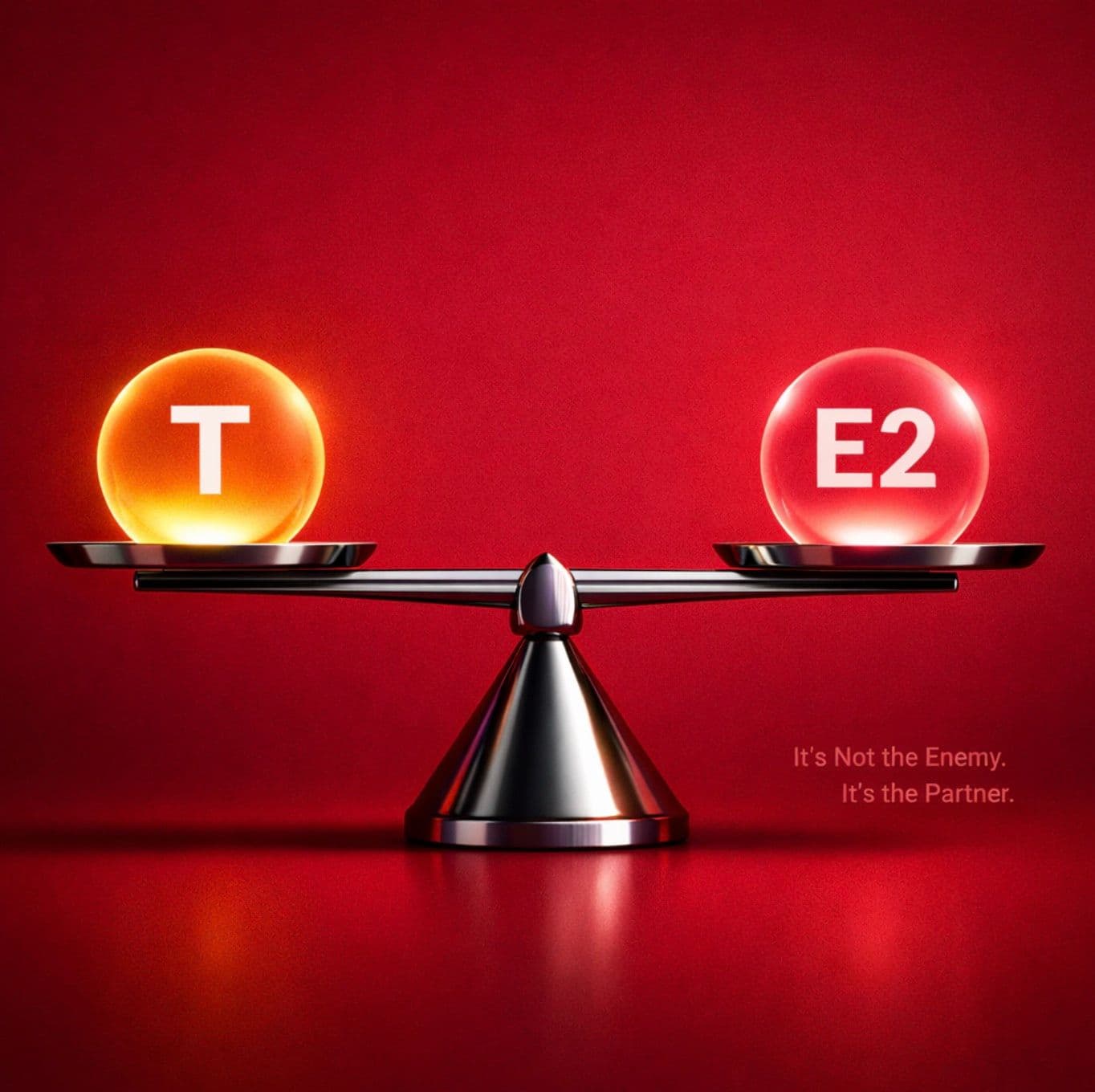
Let's clear something up right away. Estradiol is not a female hormone that men need to avoid. It's a male hormone that happens to also be important for women. Your body converts testosterone into estradiol through an enzyme called aromatase, and this conversion isn't some unfortunate side effect of TRT. It's a feature, not a bug.
Estradiol plays direct roles in sexual function, cognitive performance, cardiovascular health, bone density, joint comfort, mood regulation, and metabolic health. When you're on testosterone therapy and your body is converting some of that testosterone into estradiol, it's doing exactly what it's supposed to do. That estradiol contributes to many of the positive effects you're chasing with TRT in the first place.
Think about what men actually want from testosterone replacement therapy. Better libido and sexual performance. More energy and mental clarity. Improved body composition. Stronger bones and healthier joints. Better mood and motivation. Guess what? Adequate estradiol levels support every single one of those outcomes.
The paradox is that men suppress the very hormone that helps deliver the results they want.
When Killing Estrogen Kills Your Progress
The symptoms of low estradiol in men are remarkably consistent, and they look eerily similar to the symptoms of low testosterone. That's because the two hormones work together, not against each other.
When estradiol drops too low, one of the first things men notice is a nosedive in libido. The interest in sex just evaporates, sometimes seemingly overnight. Erection quality suffers, too. You might still be able to perform mechanically, but the firmness, sustainability, and overall quality of erections decline noticeably.
Mood takes a hit as well. Low estradiol is associated with increased anxiety, irritability, and a general sense of emotional flatness. Some men describe it as feeling "hollowed out" or emotionally numb. Others report increased tearfulness or emotional instability. The stereotype that estrogen makes men emotional is backwards. Crashing your estrogen makes you emotionally unstable.
Joint pain and stiffness are telltale signs. Estradiol has protective effects on connective tissue and joint health. When it gets too low, men often develop achy knees, sore elbows, stiff shoulders, or general discomfort in their joints that wasn't there before. If you're suddenly feeling like you aged ten years in the gym, low estradiol might be why.
Energy and cognitive function also suffer. Brain fog, difficulty concentrating, memory problems, and a general lack of mental sharpness are all associated with inadequate estradiol levels. Sleep quality can deteriorate as well, with more frequent waking during the night and less restorative rest overall.
The cruel irony is that many of these symptoms mirror what men feel when their testosterone is low, which is why they sought TRT in the first place. They start therapy, add an aromatase inhibitor because someone told them to "control estrogen," and then end up feeling just as bad, or worse, than they did before treatment.
Why Your Joints, Mood, and Libido All Tank Together
Estradiol doesn't work in isolation. It interacts with testosterone and other signaling pathways throughout the body to create the overall hormonal environment that determines how you feel and function.
Libido, for example, isn't just about testosterone levels. It's about the ratio and interaction between testosterone, estradiol, and other factors like dopamine signaling and overall metabolic health. You need both hormones in adequate amounts for optimal sexual function. Too much or too little of either can cause problems, but the "too little estradiol" scenario is far more common in men on TRT than most people realize.
The joint and connective tissue effects are related to estradiol's role in collagen synthesis and tissue maintenance. Estrogen receptors are present in cartilage, tendons, and ligaments. When estradiol levels are appropriate, these tissues stay healthier and more resilient. When estradiol is suppressed, the structural integrity and comfort of these tissues decline.
Mood and cognitive effects tie back to estradiol's influence on neurotransmitter systems in the brain. Estrogen receptors are abundant in areas of the brain that regulate emotion, memory, and executive function. Adequate estradiol supports healthy serotonin signaling, protects against neuroinflammation, and contributes to overall brain health.
These systems are interconnected. When you crash your estradiol, you don't just affect one thing. You create a cascade of problems across multiple systems that all contribute to how you feel day to day.
The Myth That High E2 Is Always the Problem
Much of the fear around estrogen on TRT comes from outdated bodybuilding forums and anecdotal reports that blame every unwanted symptom on "high estrogen." Water retention? High estrogen. Mood swings? High estrogen. Sensitive nipples? Definitely high estrogen.
The reality is more nuanced. Yes, some men do experience symptoms related to estradiol levels that are disproportionately high relative to their testosterone. But those cases are often context-dependent and individual. A lab number that causes problems for one person might be perfectly comfortable for another.
Water retention, for instance, can be influenced by sodium intake, carbohydrate consumption, training volume, sleep quality, stress levels, and other factors that have nothing to do with estradiol. Blaming every instance of bloating on estrogen is lazy thinking.
The bigger issue is that men are making decisions based on arbitrary lab ranges rather than on how they actually feel. A number on a piece of paper doesn't tell you whether your hormones are optimized. Your subjective experience, physical performance, and overall wellbeing tell you that.
Some men feel fantastic with estradiol levels that would be considered "high" according to standard reference ranges. Others might feel best in the middle or lower end of those ranges. There's no universal target that applies to everyone, and chasing a specific number without regard for symptoms is a recipe for frustration.
How Testosterone Becomes Estradiol and Why That's Not Bad
When you inject or apply testosterone, some of it gets converted into estradiol by the aromatase enzyme, which is present in various tissues throughout the body, including fat tissue, muscle, liver, and brain.
This conversion is a normal, healthy process. It's how your body maintains hormonal balance. The idea that this conversion needs to be blocked or minimized unless there's a specific, symptom-based reason to do so is a mistake that stems from misunderstanding how male hormones work.
Aromatase inhibitors are powerful drugs that block this conversion. They were originally developed to treat estrogen-receptor-positive breast cancer in women, where the goal is to starve cancer cells of estrogen. Using them in men on TRT should be a targeted intervention based on clear symptoms and thoughtful clinical judgment, not a default part of every protocol.
The problem is that many men start aromatase inhibitors preventively, or because they see a lab value that's "out of range," without ever experiencing any negative symptoms. They're solving a problem that doesn't exist, and in the process, they create real problems.
Smarter Estrogen Management on TRT
The first principle of managing estradiol on testosterone therapy is simple: treat the patient, not the lab result. If you feel great, your libido is strong, your mood is stable, your joints feel good, and you're making progress in the gym, then your estrogen is probably fine, regardless of what the number says.
If you're experiencing symptoms that could be related to estradiol being too high or too low, that's when you have a conversation with a knowledgeable clinician about whether an intervention makes sense. Even then, the goal is usually to make small adjustments and monitor how you respond, not to aggressively suppress estrogen into oblivion.
Lifestyle factors also matter. Body fat percentage has a significant impact on aromatase activity. Men with higher body fat tend to convert more testosterone into estradiol. Losing fat can naturally bring estradiol levels down without needing medication. Sleep quality, stress management, alcohol consumption, and training intensity all influence hormonal balance as well.
The point is that hormone optimization is complex and individual. It requires attention to the whole picture, not just one lab marker. Working with a provider who understands male hormone physiology and who prioritizes how you feel over rigid adherence to reference ranges is essential.
Rethinking the Enemy
The estrogen paradox comes down to this: men fear a hormone that's actually working in their favor, and in trying to eliminate it, they sabotage the very outcomes they're trying to achieve.
Testosterone replacement therapy can be life-changing when it's done thoughtfully, with attention to all the hormones involved, not just testosterone in isolation. Estradiol isn't an unfortunate byproduct to be minimized. It's a critical part of what makes you feel good, perform well, and stay healthy over the long term.
If you're on TRT and you're not getting the results you expected, or if you felt great at first but then started feeling worse after adding other medications to your protocol, it's worth asking whether your estradiol has been driven too low. That single factor could explain why your joints hurt, your libido disappeared, and your motivation tanked.
This is where working with a provider who understands the nuance of hormone optimization makes all the difference. Through AlphaMD, you can connect with providers who take an individualized approach for men, paying close attention to how estradiol fits into the bigger picture of testosterone therapy rather than reflexively suppressing it. The goal is to help you feel your best, not to chase arbitrary numbers or follow cookie-cutter protocols that ignore your unique physiology.
Crushing your estrogen might sound like a shortcut to the lean, high-performing version of yourself you're aiming for. In reality, it's one of the fastest ways to undermine your progress and feel worse than when you started. Understanding the role estradiol plays in male health, respecting its importance, and managing it intelligently is what separates mediocre TRT outcomes from truly transformative ones.
Have a question? Ask us.
At AlphaMD, we're here to help. Feel free to ask us any question you would like about TRT, medical weightloss, ED, or other topics related to men's health. Or take a moment to browse through our past questions.
People are asking...
Just started 200 mg split in 2 doses a week. Felt great first few week with high sex drive, full erections, morning wood, and strength in the gym. Wee...
There is a very common phenomenon around the 6 week mark of TRT, where some of the benefits seem to diminish. No one knows why that is, though we believe it is because that is the usual time window wh... See Full Answer
What would cause your testosterone and E2 levels to decrease, but the patient has been taking the same dose? (Testosterone cypionate 200mg weekly) No...
This could be a number of things. The first could be simply due to the time of testing relative to the last injection being different from the last test. The second & what is potentially likely here b... See Full Answer
I just had 6 week bloods done. e2 was 48. SHBG must be crashed because my free T was 255. Obviously an e2 of 48 is unlikely to cause any puff or itchi...
Well, to break things down, when starting TRT you should generally not be adjusting your routine or adding medications until the 7-8 week mark when your body's hormones balance out for exactly this re... See Full Answer
Get $30 off your first month’s order
Enter your email address now to receive $30 off your first month’s cost, other discounts, and additional information about TRT.
Legal Disclaimer
This website is a repository of publicly available information and is not intended to form a physician-patient relationship with any individual. The content of this website is for informational purposes only. The information presented on this website is not intended to take the place of your personal physician's advice and is not intended to diagnose, treat, cure, or prevent any disease. Discuss this information with your own physician or healthcare provider to determine what is right for you. All information is intended for your general knowledge only and is not a substitute for medical advice or treatment for specific medical conditions. The information contained herein is presented in summary form only and intended to provide broad consumer understanding and knowledge. The information should not be considered complete and should not be used in place of a visit, phone or telemedicine call, consultation or advice of your physician or other healthcare provider. Only a qualified physician in your state can determine if you qualify for and should undertake treatment.