
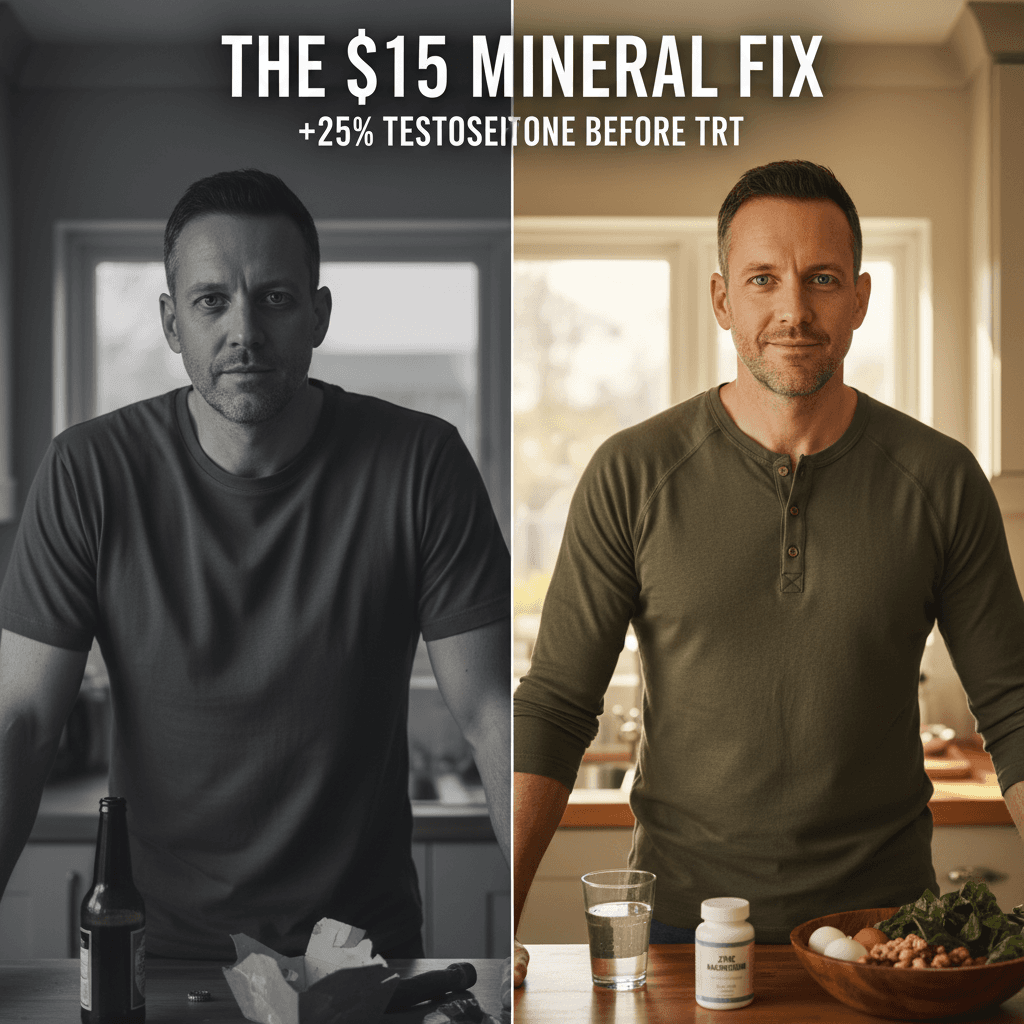
The $15 Mineral Fix That Raised His Testosterone 25% Before He Ever Touched TRT
Published on:
Updated on:
People are asking...
Just started 200 mg split in 2 doses a week. Felt great first few week with high sex drive, full erections, morning wood, and strength in the gym. Wee...
There is a very common phenomenon around the 6 week mark of TRT, where some of the benefits seem to diminish. No one knows why that is, though we believe it is because that is the usual time window wh... See Full Answer
Is it possible for enclomiphene to “kickstart”Testosterone production? Example, 46yo male, 5’10 167lbs works out, eats good, sleep is pretty good, low...
Experienced providers will tell you they have never seen anything “kickstart” testosterone production. The analogy I have used in this case is to think of your testicles as a car engine which is not ... See Full Answer
I am: 42 yo male, 5'11" 280 lbs with a BMI of 40 and 42% body fat. Pre trt blood work: TESTOSTERONE, TOTAL, MS 242 L TESTOSTERONE, FREE 35.7 I star...
In most cases a provider would want a patient to wait at least past the 6-7 week mark before adjusting dosages because that's around the point that your body truly accepts the extra Testosterone as it... See Full Answer
Have a question? Ask us.
At AlphaMD, we're here to help. Feel free to ask us any question you would like about TRT, medical weightloss, ED, or other topics related to men's health. Or take a moment to browse through our past questions.
Mark was 38 when his doctor dismissed his fatigue and low libido with a shrug, telling him it was just stress and age catching up. Six months later, after correcting a mineral deficiency his original doctor never tested for, his total testosterone had climbed 25% and he felt like himself again.
His story isn't typical, and it's definitely not guaranteed. But it highlights something important that too many men overlook: before you ever consider testosterone replacement therapy, there are foundational pieces that need to be in place. Sometimes, the problem isn't that your body has stopped making testosterone. Sometimes, it's simply missing the raw materials it needs to do the job.
The Guy Who Checked Every Box Except One
Mark did most things right. He lifted weights three times a week, ate a reasonable diet, kept his weight in check, and limited alcohol to weekends. But he'd been dragging for over a year. His energy tanked by mid-afternoon, his motivation to train evaporated, and his interest in sex had become sporadic at best.
He suspected low testosterone. The symptoms lined up. When he finally convinced his primary care doctor to run labs, his total testosterone came back in the low-normal range. Not bad enough to raise alarm bells, but not great either. His doctor offered no treatment and suggested he just needed to sleep more.
Frustrated, Mark sought a second opinion from a men's health clinic that took a broader approach. They ran a more complete panel, including micronutrient levels. That's when the real picture emerged: his zinc and magnesium levels were both significantly below optimal.
Within weeks of correcting those deficiencies, Mark noticed changes. Better sleep. More energy. Strength gains in the gym that had stalled for months. When he retested his testosterone three months later, it had risen substantially. Not into superhuman territory, but solidly into a healthier range. The difference in how he felt was even more dramatic than the numbers suggested.
What Testosterone Actually Does (And Why It Matters)
Testosterone isn't just about muscle and libido, though those are the headlines. It plays a role in energy levels, mood stability, motivation, cognitive sharpness, bone density, and how your body handles fat and builds muscle. When levels decline, the effects can be subtle at first. You might not wake up one day unable to function. Instead, you slowly become a dimmer version of yourself.
Many men experience a gradual drop in testosterone as they age, typically starting in their 30s. For some, this decline is steep enough to cause noticeable symptoms. For others, it's barely perceptible. But age isn't the only factor. Chronic stress, poor sleep, excess body fat, certain medications, and yes, nutritional deficiencies can all suppress testosterone production.
The key point: your body makes testosterone from a complex cascade of signals and biochemical processes. If any link in that chain is weak, the whole system suffers.
The Minerals Your Hormones Can't Ignore
Two minerals stand out when it comes to male hormone health: zinc and magnesium. Both are involved in hundreds of enzymatic reactions in your body, including those that regulate testosterone production, sleep quality, recovery from exercise, and immune function.
Zinc is directly involved in the synthesis of testosterone. It also helps regulate the enzyme that converts testosterone into estrogen, keeping that balance in check. Men lose zinc through sweat, and intense training or physical labor can deplete levels faster than a typical diet replaces them. Zinc is also crucial for sperm production and overall reproductive health.
Magnesium plays a supporting role in testosterone production, but its impact on sleep and recovery might be even more important. Deep, restorative sleep is when your body does most of its testosterone production. If magnesium deficiency is wrecking your sleep quality, your testosterone production takes a hit. Magnesium also helps manage cortisol, the stress hormone that can suppress testosterone when chronically elevated.
The problem? Modern diets often fall short. Processed foods are low in both minerals. Soil depletion means even whole foods contain less than they used to. Stress, alcohol, and certain medications increase how much magnesium and zinc your body excretes. Even if you're eating reasonably well, you might be running on empty.
How Deficiencies Happen Without You Noticing
You don't need to be malnourished to be deficient. Subclinical deficiencies, where levels are low enough to affect function but not low enough to cause overt disease, are surprisingly common.
Heavy training is one culprit. Athletes and men who train intensely lose more zinc and magnesium through sweat and urine. If you're pushing hard in the gym without paying attention to micronutrient intake, you might be digging yourself into a hole.
Alcohol is another factor. Regular drinking increases magnesium excretion and interferes with zinc absorption. Even moderate consumption over time can quietly drain your stores.
Digestive issues matter too. Conditions like irritable bowel syndrome, inflammatory bowel disease, or even chronic antacid use can impair mineral absorption. You might be eating the right foods, but your gut isn't extracting what you need.
Stress is a hidden drain. Chronic stress burns through magnesium at an accelerated rate. If you're grinding through high-pressure work, poor sleep, and constant demands, your body is spending minerals faster than you're replacing them.
The result? You feel off. Your labs might show borderline or low-normal testosterone. But the root cause isn't necessarily that your testes have stopped working. It might be that they're starved for the building blocks they need.
What Happens When You Fix the Foundation
When a man with a genuine deficiency corrects it, the changes can be noticeable. Not overnight, and not in everyone, but often enough that it's worth investigating.
Sleep quality typically improves first, especially with magnesium. Deeper sleep means better recovery and more robust overnight testosterone production. Energy levels follow. The mid-afternoon crash that felt inevitable starts to lift. Motivation to train returns, and workouts feel more productive.
Libido and mood can improve as testosterone levels rise and the body's overall stress response normalizes. Some men see measurable increases in testosterone on follow-up labs. Others feel significantly better even if the lab changes are modest, because the body is functioning more efficiently across the board.
Mark's 25% increase was real, but it's important to understand the context. He started from a deficient baseline. Correcting that deficiency allowed his body to perform normally again. This isn't about taking a mineral and unlocking secret superhuman potential. It's about removing a bottleneck that was holding him back.
Not every man with low testosterone has a mineral deficiency. Not every deficiency will result in dramatic lab changes. Individual biology, the severity of deficiency, overall health, age, and other factors all play a role. But for men who are deficient, addressing it is foundational.
Why Testing and Guidance Matter
You can't fix what you don't measure. Guessing about mineral status or testosterone levels based on symptoms alone is a recipe for frustration. Symptoms overlap with dozens of other conditions. Fatigue could be thyroid dysfunction, sleep apnea, depression, or anemia. Low libido could be relationship stress, medication side effects, or psychological factors.
Proper lab testing gives you a clear picture. A comprehensive panel should include total and free testosterone, estradiol, thyroid hormones, metabolic markers, and yes, key micronutrients. Many standard panels don't include zinc or magnesium levels, so you have to ask for them specifically.
Once you have data, you can make informed decisions. If your testosterone is genuinely low and you have no correctible deficiencies or lifestyle factors dragging it down, TRT might be appropriate. But if you're deficient in key minerals, sleeping poorly, carrying excess body fat, or dealing with chronic stress, those are the first targets.
Supplements aren't risk-free, either. Taking high amounts of zinc without need can interfere with copper absorption and cause imbalances. Excessive magnesium can cause digestive upset. Working with a knowledgeable clinician helps you dose appropriately and avoid problems.
The Lifestyle Factors That Make or Break Your Hormones
Minerals matter, but they're just one piece. Testosterone production thrives on a foundation of good habits.
Sleep is non-negotiable. Most testosterone production happens during deep sleep. Chronic sleep deprivation crushes levels, sometimes dramatically. Prioritizing seven to eight hours of quality sleep does more for your hormones than most supplements ever will.
Resistance training is a powerful signal. Lifting heavy weights tells your body it needs to build and maintain muscle, which encourages testosterone production. Conversely, excessive endurance training without adequate recovery can suppress it.
Body composition plays a role. Excess body fat, especially around the midsection, increases aromatase activity, converting testosterone into estrogen. Losing fat often improves testosterone levels naturally.
Stress management helps keep cortisol in check. Chronic high cortisol suppresses testosterone production. Finding ways to manage stress, whether through exercise, meditation, time in nature, or simply setting boundaries, protects your hormonal health.
Alcohol moderation matters. Heavy drinking suppresses testosterone and depletes the very minerals that support its production. Cutting back can have a surprisingly large impact.
These aren't sexy interventions. They don't promise overnight transformations. But they work, and they form the foundation that everything else builds on.
When Simple Fixes Aren't Enough
Sometimes, despite doing everything right, testosterone levels remain low. Primary hypogonadism, secondary hypogonadism, pituitary issues, or simply the reality of aging can mean that lifestyle and micronutrient optimization aren't sufficient.
That's when testosterone replacement therapy becomes a legitimate consideration. TRT, when appropriately prescribed and monitored, can be life-changing for men with genuinely low levels and symptomatic hypogonadism.
The key is approaching it intelligently. Jumping straight to TRT without investigating root causes means you might miss simple fixes. But waiting indefinitely while trying supplement after supplement when you genuinely need TRT means suffering unnecessarily.
This is where working with a men's health service like AlphaMD makes sense. Through AlphaMD, a licensed provider takes a comprehensive approach, looking at labs, lifestyle, nutrition, and potential deficiencies before recommending a path forward. If a mineral deficiency or correctable lifestyle factor is dragging your testosterone down, your provider will identify it. If TRT is truly the right move, the provider overseeing your care will guide you through it with ongoing monitoring. The goal isn't to sell you on one solution or another. It's to figure out what your body actually needs.
Building From the Ground Up
Mark's story is a reminder that the flashy solution isn't always the right one. Before he ever considered TRT, a basic nutritional deficiency was quietly sabotaging his hormones, energy, and quality of life. Fixing it didn't require a prescription or a complex protocol. It required identifying the problem and addressing it intelligently.
Not every man will have the same experience. Some will need TRT. Others will benefit most from sleep, training, or weight loss. But the principle holds: start with the fundamentals. Test, don't guess. Address deficiencies, optimize lifestyle, and then evaluate what's left.
Your body is surprisingly capable when you give it what it needs. Sometimes, that's as simple as a mineral your cells have been craving. Other times, it's more complex. The difference between spinning your wheels and making real progress often comes down to having the right information and the right guidance.
Whether you're dealing with low energy, declining motivation, or labs that confirm low testosterone, the path forward starts with understanding what's actually going on. Simple fixes like correcting a mineral deficiency might be enough. Or they might be the foundation that makes everything else work better. Either way, they're worth investigating before you assume the problem requires a more aggressive intervention.
Have a question? Ask us.
At AlphaMD, we're here to help. Feel free to ask us any question you would like about TRT, medical weightloss, ED, or other topics related to men's health. Or take a moment to browse through our past questions.
People are asking...
Just started 200 mg split in 2 doses a week. Felt great first few week with high sex drive, full erections, morning wood, and strength in the gym. Wee...
There is a very common phenomenon around the 6 week mark of TRT, where some of the benefits seem to diminish. No one knows why that is, though we believe it is because that is the usual time window wh... See Full Answer
Is it possible for enclomiphene to “kickstart”Testosterone production? Example, 46yo male, 5’10 167lbs works out, eats good, sleep is pretty good, low...
Experienced providers will tell you they have never seen anything “kickstart” testosterone production. The analogy I have used in this case is to think of your testicles as a car engine which is not ... See Full Answer
I am: 42 yo male, 5'11" 280 lbs with a BMI of 40 and 42% body fat. Pre trt blood work: TESTOSTERONE, TOTAL, MS 242 L TESTOSTERONE, FREE 35.7 I star...
In most cases a provider would want a patient to wait at least past the 6-7 week mark before adjusting dosages because that's around the point that your body truly accepts the extra Testosterone as it... See Full Answer
Get $30 off your first month’s order
Enter your email address now to receive $30 off your first month’s cost, other discounts, and additional information about TRT.
Legal Disclaimer
This website is a repository of publicly available information and is not intended to form a physician-patient relationship with any individual. The content of this website is for informational purposes only. The information presented on this website is not intended to take the place of your personal physician's advice and is not intended to diagnose, treat, cure, or prevent any disease. Discuss this information with your own physician or healthcare provider to determine what is right for you. All information is intended for your general knowledge only and is not a substitute for medical advice or treatment for specific medical conditions. The information contained herein is presented in summary form only and intended to provide broad consumer understanding and knowledge. The information should not be considered complete and should not be used in place of a visit, phone or telemedicine call, consultation or advice of your physician or other healthcare provider. Only a qualified physician in your state can determine if you qualify for and should undertake treatment.