
The 10,000 Steps Rule on TRT: Why Walking Matters More Than You Think
Published on:
Updated on:
People are asking...
It makes no rational sense to me that total testosterone “far more important”…. even for starting dose. When subjects can have the same total testoste...
Maybe think of it a different way. Your FT level varies a lot based on your SHBG and your albumin levels. And since no one knows to what degree your body will respond to TRT, initial dosing, for the T... See Full Answer
Why do TRT clinics just throw 200mg out to start...
They really shouldn't, but because many take the approach of uniform care over individual planning, they pick a dose that will *certainly* give results which is good for marketing, even if it will alm... See Full Answer
Fitness question: Many men think about starting TRT with their natural T levels in the 200-400 range. How much improvement in the gym would such patie...
In general, men who have levels in those ranges & who are experiencing low Testosterone symptoms will already have difficulty putting on muscle mass, maintaining it, and keeping fat off due to those f... See Full Answer
Have a question? Ask us.
At AlphaMD, we're here to help. Feel free to ask us any question you would like about TRT, medical weightloss, ED, or other topics related to men's health. Or take a moment to browse through our past questions.
You've optimized your testosterone, dialed in your protocol, and expected the world to change overnight. But if you're still sitting for ten hours a day, you're leaving one of the most powerful tools for men's health completely on the table: walking.
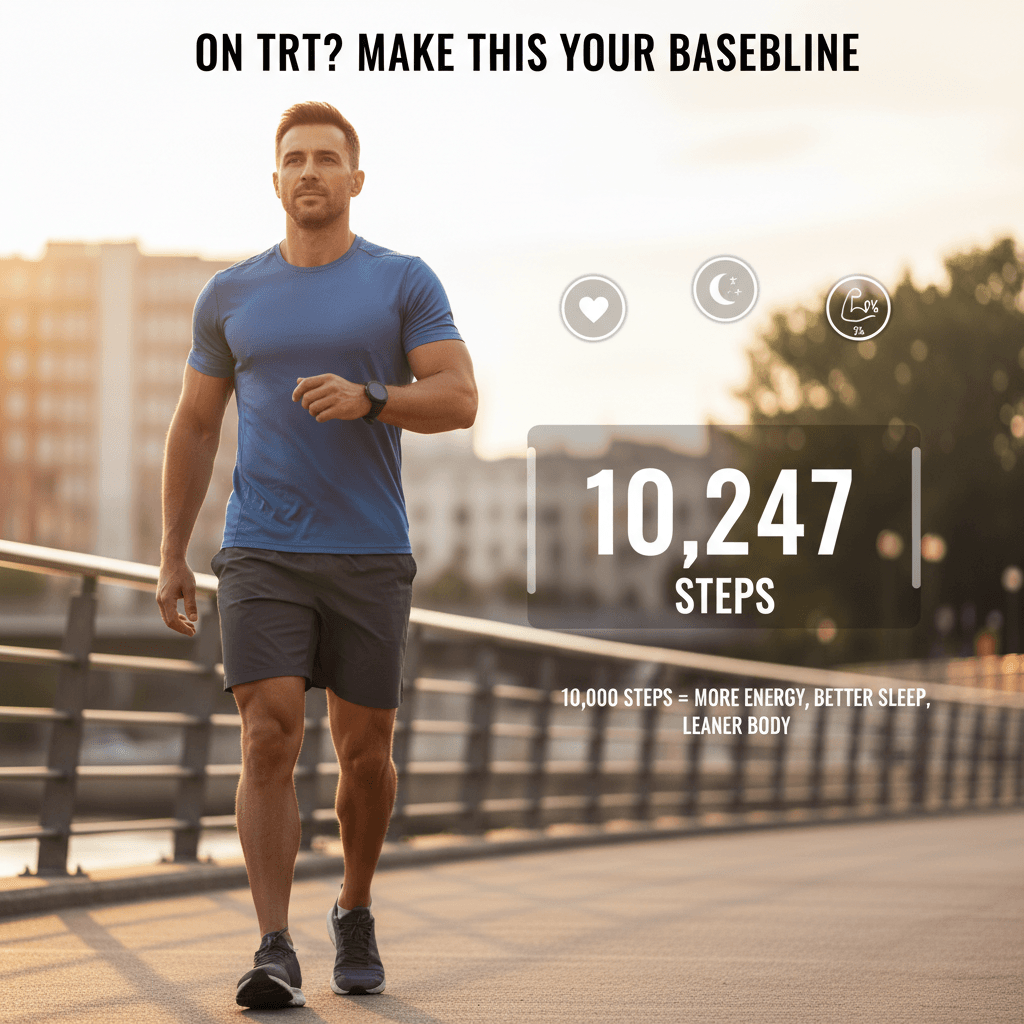
Most guys on testosterone replacement therapy focus exclusively on their protocol, their labs, and their workouts. They track their levels, adjust their dosing schedule, and wait for the magic to happen. What often gets ignored is the simplest, most accessible form of daily movement that can dramatically amplify everything TRT is trying to do for your body. Walking 10,000 steps a day isn't just a fitness trend for soccer moms with step trackers. For men on TRT, it's a metabolic game-changer that addresses some of the exact health markers you're trying to improve.
Why Your Steps Matter More Once You Start TRT
Testosterone replacement therapy can be transformative for men dealing with low testosterone symptoms. Energy returns, motivation improves, muscle mass becomes easier to build and maintain, and body composition starts shifting in the right direction. But TRT doesn't work in isolation, and it's definitely not a replacement for the fundamentals of metabolic health.
When you start TRT, your body becomes primed to respond better to physical activity. Your muscles are more receptive to stimulus, your recovery improves, and your energy levels give you the capacity to actually move more throughout the day. But this also means the absence of movement becomes a bigger missed opportunity. You're essentially upgrading your body's engine while leaving it parked in the driveway.
TRT can influence several cardiovascular and metabolic markers, and not always in favorable directions if lifestyle factors aren't managed. Some men experience changes in cholesterol levels, blood pressure, or hematocrit. Others notice improvements in insulin sensitivity and fat distribution, but only when paired with consistent activity. Walking becomes a critical partner in managing these variables. It's low-impact enough to do daily without overtaxing your recovery, yet powerful enough to meaningfully influence insulin sensitivity, blood pressure, inflammation, and cardiovascular fitness.
What 10,000 Steps Is Really Doing Inside Your Body
The 10,000-step target has become a cultural benchmark, and while the number itself is somewhat arbitrary, it represents a meaningful volume of daily low-intensity movement. For most people, 10,000 steps translates to roughly four to five miles of walking, depending on stride length. That amount of movement triggers a cascade of metabolic and cardiovascular benefits that complement TRT in powerful ways.
First, walking improves insulin sensitivity. This matters immensely for men on TRT, especially those carrying extra body fat or dealing with metabolic syndrome. Insulin resistance makes it harder to lose fat, easier to gain it, and increases your risk for type 2 diabetes and cardiovascular disease. Regular walking helps shuttle glucose into your muscles without requiring intense exercise. Your body becomes more efficient at managing blood sugar, which supports fat loss, energy stability, and long-term metabolic health.
Second, walking has a direct, measurable impact on cardiovascular health. It lowers resting heart rate over time, improves circulation, reduces blood pressure, and strengthens the heart without the stress of high-intensity training. For men on TRT, cardiovascular health isn't just a nice bonus. It's a central part of using hormone therapy safely and effectively over the long term. Walking consistently is one of the simplest ways to improve your cardiovascular risk profile while your body adapts to optimized testosterone levels.
Third, walking reduces systemic inflammation. Chronic low-grade inflammation is linked to obesity, insulin resistance, heart disease, and a host of other conditions that many men struggle with before starting TRT. Daily movement helps calm that inflammatory response. It's not as flashy as crushing a heavy workout, but the cumulative anti-inflammatory effect of walking thousands of steps every day can have profound effects on how you feel and how your body functions.
Walking, Body Composition, and Fat Loss on TRT
One of the most common reasons men pursue TRT is difficulty losing fat, particularly around the midsection. Low testosterone is strongly associated with increased body fat and reduced lean muscle mass. TRT helps shift that equation, but it doesn't automatically strip away fat without effort.
Walking creates a daily caloric deficit without the appetite spike or recovery demands of intense cardio. It's sustainable, repeatable, and doesn't interfere with strength training or muscle recovery. When combined with optimized testosterone levels, this steady energy expenditure supports fat loss while preserving lean tissue. Your body is better positioned to burn fat for fuel, and walking gives it the consistent stimulus to do so.
Many men find that walking also reduces stress-related eating and evening snacking. A 20-minute walk after dinner, for example, can blunt cravings, improve digestion, and create a mental break that prevents the couch-to-kitchen autopilot that derails fat loss efforts. The psychological component of walking is just as valuable as the physical one.
The Mental Health and Sleep Connection
TRT often improves mood, motivation, and mental clarity, but it doesn't cure anxiety, stress, or poor sleep on its own. Walking fills that gap in ways that are backed by decades of research. Regular walking reduces symptoms of depression and anxiety, improves stress resilience, and promotes better sleep quality.
Sleep is particularly important for men on TRT. Poor sleep blunts testosterone production, impairs recovery, increases cortisol, and makes fat loss significantly harder. Walking, especially outdoors and earlier in the day, helps regulate circadian rhythms and promotes deeper, more restorative sleep. Evening walks can also help with winding down and transitioning out of work mode, which many men struggle with.
The mental clarity that comes from a daily walk shouldn't be underestimated either. Walking meetings, walking phone calls, or simply walking to think through a problem can be more productive than another hour at your desk. For men juggling demanding careers and family responsibilities, walking offers a rare combination of physical activity, mental processing time, and stress relief all in one.
From Office Chair to Evening Walk: Making It Fit Your Life
The biggest obstacle to hitting 10,000 steps isn't motivation. It's logistics. Most men spend the majority of their day sitting, whether at a desk, in a car, or on the couch. Fitting in several miles of walking requires intentionality, but it doesn't require overhauling your entire schedule.
Start by measuring your baseline. Wear a step tracker or use your phone for a week and see where you actually are. Many guys are surprised to find they're only hitting 3,000 to 5,000 steps on a typical workday. From there, look for small opportunities to add movement without adding time. Park farther away. Take the stairs. Walk while on phone calls. Take a lap around the building between meetings. These micro-additions accumulate quickly.
Walking meetings are one of the most underutilized tools in the modern workplace. Instead of sitting in a conference room or on a Zoom call, suggest a walking meeting. You'll often find the conversation is more productive, creative, and efficient when both parties are moving. If your job allows for it, consider a treadmill desk or standing desk with a walking pad. Even walking at one to two miles per hour while working can add thousands of steps without taking extra time.
Evening walks with your partner, your kids, or your dog are another high-return habit. It's time you're already spending, but you're adding movement, fresh air, and connection. A 30-minute family walk after dinner can easily add 3,000 to 4,000 steps and becomes a ritual that benefits everyone.
The 10,000-Step Target: A Guide, Not a Rule
It's important to recognize that 10,000 steps is a helpful general target, not a rigid prescription. The idea originated from a Japanese marketing campaign in the 1960s, and while research has since validated that this volume of movement has real health benefits, it's not a magic number. Some days you'll hit 12,000. Other days you'll hit 6,000. What matters most is consistency over time and meaningful improvement from your current baseline.
If you're currently sedentary and averaging 3,000 steps a day, jumping straight to 10,000 might feel overwhelming and lead to burnout or injury. Instead, aim to increase by 1,000 to 2,000 steps per week until you reach a sustainable level. Even getting to 7,000 or 8,000 steps daily will provide significant metabolic and cardiovascular benefits. Progress beats perfection every time.
For men on TRT who are also strength training, walking serves as active recovery. It promotes blood flow, reduces muscle soreness, and supports joint health without interfering with your ability to lift heavy or build muscle. You don't need to choose between walking and the gym. They complement each other.
Long-Term Cardiovascular Risk and TRT
One of the ongoing discussions in men's health and TRT is the potential impact on cardiovascular risk. While the research is mixed and evolving, what's clear is that lifestyle factors play a massive role in determining outcomes. Men who use TRT while remaining sedentary, overweight, and metabolically unhealthy face different risks than men who pair hormone therapy with daily movement, strength training, and attention to diet.
Walking is one of the most evidence-supported interventions for reducing cardiovascular risk. It lowers LDL cholesterol, raises HDL cholesterol, reduces triglycerides, improves endothelial function, and decreases arterial stiffness. These are the exact markers that matter for long-term heart and vascular health. For men on TRT, prioritizing cardiovascular fitness isn't optional. It's essential.
Think of walking as foundational maintenance for your cardiovascular system. TRT optimizes your hormone levels, but walking keeps your heart, blood vessels, and metabolic systems functioning smoothly. Together, they create a much more favorable long-term health profile than either one in isolation.
Building the Habit That Compounds
The beauty of walking is that it compounds over time. One walk doesn't transform your health, but 300 walks over the course of a year absolutely will. The cumulative effect on your cardiovascular system, your body composition, your mental health, and your metabolic markers is significant. This is especially true for men on TRT who are looking to maximize the benefits of therapy while minimizing potential risks.
Start simple. Pick one or two times during the day when a walk makes sense and commit to those. Maybe it's a 10-minute walk first thing in the morning and a 20-minute walk after dinner. Maybe it's walking during your lunch break three days a week. Build the habit first, then increase the volume as it becomes automatic.
Use a step tracker if it helps with accountability, but don't let the numbers become a source of stress. The goal is to make walking a natural, enjoyable part of your daily routine, not another thing to optimize and stress over. Some men find that listening to podcasts, audiobooks, or music makes walking more engaging. Others prefer the silence and mental space. Experiment and find what works for you.
Movement as Medicine
TRT can provide the hormonal foundation for better energy, body composition, and quality of life, but it works best when supported by the fundamentals. Walking 10,000 steps a day, or working toward that target, is one of the most accessible and effective ways to enhance every benefit TRT offers while protecting your long-term health.
It improves insulin sensitivity, supports fat loss, strengthens your cardiovascular system, reduces inflammation, enhances mood, and promotes better sleep. It's low-impact, sustainable, and fits into nearly any schedule with a little creativity. Most importantly, it gives you an active role in your health outcomes rather than passively waiting for a protocol to fix everything.
Whether you're just starting to explore TRT or you've been on therapy for years, daily movement matters. Your heart, your metabolism, and your long-term health will thank you for it. Services like AlphaMD understand that modern men's health isn't just about hormone optimization in isolation. It's about building sustainable habits, pairing therapy with real lifestyle changes, and supporting men in making movement, sleep, nutrition, and stress management core parts of their health strategy. Walking might seem simple, but simple is often exactly what works.
Have a question? Ask us.
At AlphaMD, we're here to help. Feel free to ask us any question you would like about TRT, medical weightloss, ED, or other topics related to men's health. Or take a moment to browse through our past questions.
People are asking...
It makes no rational sense to me that total testosterone “far more important”…. even for starting dose. When subjects can have the same total testoste...
Maybe think of it a different way. Your FT level varies a lot based on your SHBG and your albumin levels. And since no one knows to what degree your body will respond to TRT, initial dosing, for the T... See Full Answer
Why do TRT clinics just throw 200mg out to start...
They really shouldn't, but because many take the approach of uniform care over individual planning, they pick a dose that will *certainly* give results which is good for marketing, even if it will alm... See Full Answer
Fitness question: Many men think about starting TRT with their natural T levels in the 200-400 range. How much improvement in the gym would such patie...
In general, men who have levels in those ranges & who are experiencing low Testosterone symptoms will already have difficulty putting on muscle mass, maintaining it, and keeping fat off due to those f... See Full Answer
Get $30 off your first month’s order
Enter your email address now to receive $30 off your first month’s cost, other discounts, and additional information about TRT.
Legal Disclaimer
This website is a repository of publicly available information and is not intended to form a physician-patient relationship with any individual. The content of this website is for informational purposes only. The information presented on this website is not intended to take the place of your personal physician's advice and is not intended to diagnose, treat, cure, or prevent any disease. Discuss this information with your own physician or healthcare provider to determine what is right for you. All information is intended for your general knowledge only and is not a substitute for medical advice or treatment for specific medical conditions. The information contained herein is presented in summary form only and intended to provide broad consumer understanding and knowledge. The information should not be considered complete and should not be used in place of a visit, phone or telemedicine call, consultation or advice of your physician or other healthcare provider. Only a qualified physician in your state can determine if you qualify for and should undertake treatment.