
Testosterone Is a Nootropic - The Neuroscience Case for TRT as a Cognitive Performance Tool
Published on:
Updated on:
People are asking...
What are the general health benefits of TRT with someone with RRMS, besides the obvious benefits from extra muscle mass ?...
Interestingly, low testosterone appears to actually be a risk factor for developing MS. In fact, men with hypogonadism have a risk ratio of 4.62 of developing MS at a future date. So men with low te... See Full Answer
Why did I get brain fog from TRT (Androgel)? Could not think anymore. Any ideas why that could be?...
The thought regarding this is that use of exogenous TRT shuts down all upstream steps in the hormone cascade . Some of these hormones have effects on the brain, in particular pregnenolone. As you can... See Full Answer
Have been zeroing on some health issues and I recently got a Testosterone test of 301 ng/dl. As a very healthy male ( train 6x a week, track every cal...
Based on your symptoms, a licensed provider would likely consider you a candidate for TRT. A provider would want to talk with you to dive a bit deeper into them, but at a glance, yes.Men who are very ... See Full Answer
Have a question? Ask us.
At AlphaMD, we're here to help. Feel free to ask us any question you would like about TRT, medical weightloss, ED, or other topics related to men's health. Or take a moment to browse through our past questions.
Most people think of nootropics as pills you order online to sharpen your focus before a big presentation. What they rarely consider is that one of the most powerful cognitive modulators in the human body has been circulating in your bloodstream since puberty.
Testosterone is a nootropic - the neuroscience case for TRT as a cognitive performance tool is built on decades of research into how this hormone shapes the very architecture of thought. This is not about bodybuilding mythology. It is about brain chemistry, synaptic signaling, and what happens to cognition when a foundational hormonal signal quietly fades.
What Makes Something a Nootropic
The term "nootropic" was coined in the 1970s to describe compounds that enhance cognitive function - particularly memory, attention, and executive performance - without significant toxicity. Over time, the definition has expanded loosely to include anything that meaningfully supports brain function, from caffeine to racetams to adaptogenic herbs.
For a hormone to fit that label honestly, it needs to do more than correlate with feeling good. It needs a biologically plausible mechanism, some clinical evidence across meaningful cognitive domains, and a reasonable safety profile when used appropriately. Testosterone, as it turns out, checks several of those boxes - though not without important nuance.
How Testosterone Actually Talks to Your Brain
The brain is not a bystander to hormonal shifts. It is an active target. Androgen receptors are distributed throughout key cognitive regions including the prefrontal cortex, hippocampus, amygdala, and cerebellum. When testosterone or its metabolites bind to these receptors, they influence gene expression, neurochemistry, and even the physical structure of neurons.
One major pathway involves the conversion of testosterone to estradiol via aromatase, which is expressed in the brain itself. Estradiol then acts on estrogen receptors that modulate synaptic plasticity - the strengthening and pruning of connections that underlies learning and memory. So the story is never purely about testosterone alone; it is about a hormonal ecosystem.
Testosterone also interacts with the dopaminergic system. Dopamine is the neurotransmitter most associated with motivation, reward anticipation, and goal-directed behavior. Research suggests testosterone can upregulate dopamine receptor sensitivity and influence dopamine synthesis, which may partly explain why low testosterone is so often accompanied by flat motivation and anhedonia.
The GABAergic and glutamatergic systems are also in the picture. Testosterone and its neurosteroid metabolites - particularly 3-alpha-androstanediol - can modulate GABA-A receptors, influencing anxiety levels and neural excitability. Glutamate, the brain's primary excitatory neurotransmitter, interacts with androgen signaling in ways that affect synaptic strength and neuroplasticity.
Beyond neurotransmitters, testosterone plays a role in myelination - the process by which nerve fibers are insulated with myelin sheaths, which speeds signal transmission. It also has anti-inflammatory properties relevant to the brain, since chronic low-grade neuroinflammation is increasingly implicated in cognitive decline. Neurovascular effects - including influence over cerebral blood flow regulation - round out a mechanism profile that is genuinely broad.
Cognition by Domain: Where the Evidence Is Stronger and Where It Gets Complicated
Not all cognitive domains respond equally to testosterone, and it would be misleading to suggest otherwise.
Spatial ability and attention show some of the more consistent associations with testosterone levels in research literature. Studies in both younger and older men have found correlations between circulating testosterone and performance on tasks requiring visuospatial processing and sustained attention. Reaction time is another area where androgen effects appear relatively reliable.
Working memory and executive function show a more mixed picture. Some intervention studies report improvements following testosterone optimization in hypogonadal men, while others find modest or null effects. The variability likely reflects differences in baseline hormone status, age, study design, and the sensitivity of the cognitive tests used.
Motivation and drive may be where testosterone's cognitive impact is most clinically felt. This is less about raw intellectual horsepower and more about the will to engage - to initiate tasks, sustain effort, and push through mental fatigue. These are qualities that are genuinely hard to measure in a lab but profoundly important in daily life.
Verbal fluency is a domain where testosterone's effects appear to be more modest, and in some studies, estradiol is a stronger predictor than testosterone itself. Mental fatigue - the subjective experience of cognitive exhaustion - may improve with testosterone optimization, though this is partly mediated by improvements in sleep quality and mood rather than direct neurochemical action.
A useful review published in Frontiers in Neuroendocrinology synthesizes much of this research and underscores that testosterone's cognitive effects are real but context-dependent - strongest in men with confirmed hormonal deficiency and least dramatic in men with normal baseline levels.
Low T Symptoms vs. True Hypogonadism: An Important Distinction
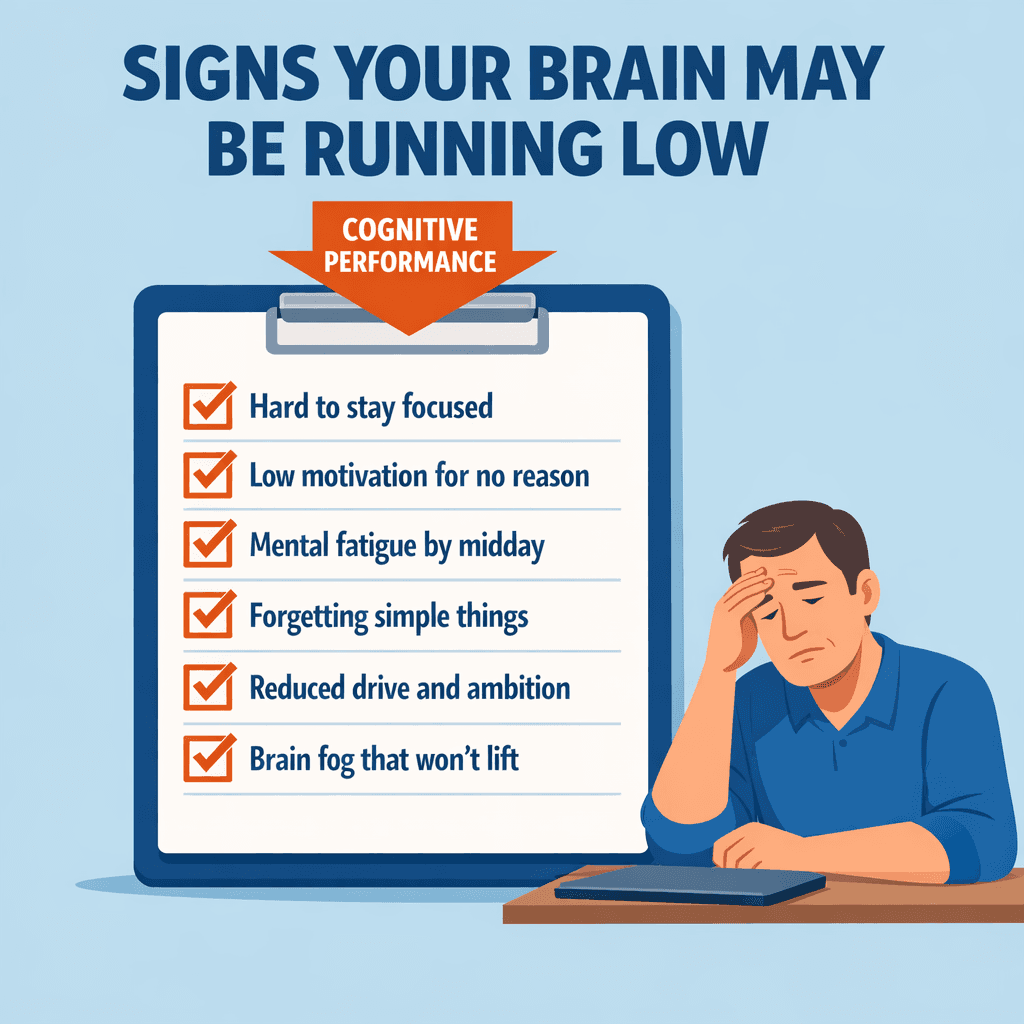
Many men who feel mentally foggy, unmotivated, and emotionally flat assume low testosterone is the cause. Sometimes they are right. Often the picture is more complicated.
Clinically meaningful hypogonadism involves consistently low testosterone production confirmed through laboratory testing, paired with symptoms that align with androgen deficiency. But the same symptom cluster - cognitive slowing, poor focus, low drive, irritability, and sleep disruption - can arise from sleep apnea, depression, chronic stress, obesity, insulin resistance, thyroid dysfunction, or the side effects of certain medications.
This overlap matters because treating testosterone when the root cause is something else may provide limited benefit, and in some cases, can obscure a diagnosis that needs different management. A thorough clinical evaluation is not a bureaucratic hurdle. It is genuinely necessary to make sense of what is actually happening.
What TRT Is and Who May Benefit
Testosterone replacement therapy is a medical treatment designed to restore testosterone to a physiologically appropriate range in men who have confirmed deficiency. It is available in several forms - injectable, transdermal gel, topical cream, and others - each with its own absorption profile, convenience tradeoffs, and monitoring requirements.
Men who may benefit most are those with clinically confirmed hypogonadism who are experiencing symptoms that meaningfully affect quality of life. The Endocrine Society's clinical practice guidelines provide a framework for who should be considered for treatment, and they emphasize that initiation should follow a proper diagnostic workup rather than symptom-based assumptions alone.
Cognitive benefits, when they occur, tend to emerge gradually - often over months rather than weeks. For many men, the more noticeable early changes involve energy, motivation, and mood. Better sleep follows. From there, the subjective sense of mental clarity often improves as a downstream effect rather than a direct pharmacological result.
Realistic Expectations for Cognitive Performance
It is worth being honest here. Testosterone optimization is not a cognitive upgrade in the way that phrase is used in tech culture. Most men on appropriate TRT do not report suddenly solving problems faster or becoming dramatically sharper in conversation.
What many do report is a reduction in the mental friction that made everything feel harder than it should. The motivation to begin tasks returns. Mental fatigue becomes less oppressive. Concentration improves in a way that feels less like enhancement and more like restoration - getting back to a baseline that had quietly eroded.
For men whose cognition was noticeably impaired by untreated hypogonadism, the improvements can be meaningful. For men with testosterone levels already in an adequate range, additional supplementation is unlikely to produce significant cognitive gains and carries its own risks.
Side Effects and Risks: A Grounded View
No medical treatment comes without tradeoffs, and responsible discussion of testosterone as a cognitive performance tool requires acknowledging them plainly.
Erythrocytosis - an increase in red blood cell mass - is one of the more common and clinically relevant side effects, requiring monitoring through regular blood work. Fertility considerations are significant: exogenous testosterone suppresses the hormonal signals that drive sperm production, which is a meaningful concern for men who may want biological children.
Other commonly reported effects include acne and increased skin oiliness, which are usually manageable. Mood changes can occur in either direction. Sleep apnea may worsen in susceptible individuals, so screening and awareness matter. Prostate health is often raised as a concern, and while the relationship between TRT and prostate cancer risk has been substantially revised in recent years, ongoing monitoring remains appropriate and expected as part of standard care.
All of this points to the same conclusion: clinician oversight is not optional. It is the mechanism by which benefits are preserved and risks are caught early.
Adjunct Therapies Worth Knowing About
For some men on testosterone therapy, human chorionic gonadotropin is used alongside TRT to preserve testicular function and maintain some degree of natural testosterone production. HCG mimics luteinizing hormone, which keeps the signaling pathway to the testes at least partially active.
Sermorelin is a growth hormone-releasing hormone analogue that is sometimes used in the context of broader hormone optimization. It works by stimulating the pituitary to produce growth hormone more naturally, and it is often discussed in relation to sleep quality, body composition, and recovery - factors that indirectly support cognitive performance.
It is also worth noting that Female TRT is a genuinely distinct clinical area. Women have androgen receptors too, and low testosterone can affect energy, mood, and cognition in women as well - but the physiology, dosing considerations, monitoring parameters, and risk-benefit analysis differ significantly from male TRT. Women seeking evaluation should work with clinicians who specialize in female hormone health.
Bringing It Together
The neuroscience case for testosterone as a cognitive performance tool is real, but it is also conditional. It applies most clearly to men with confirmed deficiency, measured carefully, treated appropriately, and monitored consistently. It is not a shortcut to a sharper mind for men who are already hormonally healthy.
At AlphaMD, the approach to hormone optimization starts with evaluation - understanding what is actually driving symptoms before reaching for any treatment. If testosterone or related therapies are appropriate, they are used thoughtfully, with the goal of restoring function rather than chasing numbers. Cognitive performance is part of that picture, alongside energy, mood, and long-term health. That is what a real nootropic strategy looks like.
Have a question? Ask us.
At AlphaMD, we're here to help. Feel free to ask us any question you would like about TRT, medical weightloss, ED, or other topics related to men's health. Or take a moment to browse through our past questions.
People are asking...
What are the general health benefits of TRT with someone with RRMS, besides the obvious benefits from extra muscle mass ?...
Interestingly, low testosterone appears to actually be a risk factor for developing MS. In fact, men with hypogonadism have a risk ratio of 4.62 of developing MS at a future date. So men with low te... See Full Answer
Why did I get brain fog from TRT (Androgel)? Could not think anymore. Any ideas why that could be?...
The thought regarding this is that use of exogenous TRT shuts down all upstream steps in the hormone cascade . Some of these hormones have effects on the brain, in particular pregnenolone. As you can... See Full Answer
Have been zeroing on some health issues and I recently got a Testosterone test of 301 ng/dl. As a very healthy male ( train 6x a week, track every cal...
Based on your symptoms, a licensed provider would likely consider you a candidate for TRT. A provider would want to talk with you to dive a bit deeper into them, but at a glance, yes.Men who are very ... See Full Answer
Get $30 off your first month’s order
Enter your email address now to receive $30 off your first month’s cost, other discounts, and additional information about TRT.
Legal Disclaimer
This website is a repository of publicly available information and is not intended to form a physician-patient relationship with any individual. The content of this website is for informational purposes only. The information presented on this website is not intended to take the place of your personal physician's advice and is not intended to diagnose, treat, cure, or prevent any disease. Discuss this information with your own physician or healthcare provider to determine what is right for you. All information is intended for your general knowledge only and is not a substitute for medical advice or treatment for specific medical conditions. The information contained herein is presented in summary form only and intended to provide broad consumer understanding and knowledge. The information should not be considered complete and should not be used in place of a visit, phone or telemedicine call, consultation or advice of your physician or other healthcare provider. Only a qualified physician in your state can determine if you qualify for and should undertake treatment.